
A funny journey back to the origin and history of the piano. Who invented the piano?
We supossed you’re here because you want to deepen in the history and origin of this instrument that today has a great importance.
The inventor of the original piano mechanism is attributed to the Italian Bartolomeo Cristofori. Although curiously despite being its Italian inventor this country turned its back on this instrument for quite some time. Its main development is in Germany, so it is in that country where the Piano or Pianoforte is developed.
In Italian piano is slow or loose and forte is strong. That’s why the piano has the ability to sound louder or looser based on the force with which you press the key is also called PianoForte.
I’m sure you’ll be interested in…
- Ranking with the best digital pianos in quality-price ratio
- The cheapest musical keyboards for beginners
- Learn piano by yourself and for free
Before the piano, there were some keys instruments very popular like the Harpsichord, but they didn’t have the main characteristic of the piano. Which was to be able to regulate the volume of the note depending on how strong or weak the key was pressed. In this way the piano changed the way it even played the music.
Well, we’re lying to you, the Harpsichord did allow you to regulate the volume and add expressiveness to what you were playing, but it had very little power and volume. So it didn’t work for the new kind of music that was being created. Much more expressive and sentimental.
And what year was the piano invented?
Bartolomeo Cristofori began to make his invention back in 1698, almost three hundred years ago. Although it wasn’t the piano as we know it now, it had about 4 octaves and no pedals to maintain the note. And since then, the hammer action system has been improved.
You want to know what the harpsichord sounded like? It was the most popular instrument when the piano was created, and it still took a long time for the piano to surpass it in popularity.
The Harpsichord
And how was the piano becoming so popular?
How we really named the piano before began to develop in Germany, and at first it was ignored in Italy. It was a somewhat eccentric character called Gottfried Silbermann who built the piano in Germany.
Silberman was a renowned harpsichord maker, but he was also a very joking and risk-taker. On one occasion he had to leave Freiburg at full speed because he had tried to kidnap a nun in a very shabby way and had to go into hiding in Strasbourg. He was a very skillful person for business but his taste for the opposite sex got him into a lot of trouble, in a few words, musicians…..
Silberman heard about Cristofori’s system and built one of the first pianos that existed. Some of them belonged to Frederick the Great himself. The same Johann Sebastian Bach came to try the invention but curiously he did not like it much at first but then gave his approval years later.
Even so, the piano took a long time to prevail over other keyboard instruments, but it was because baroque music was still dominated by polyphony and counterpoint.
Silberman’s piano was later developed in England by other manufacturers who reduced the size of the instrument and simplified the mechanism so that it became affordable for the middle classes. This greatly influenced its development and extended its use and popularity.
The great piano players
As the piano gained popularity at the end of the Baroque and the beginning of Romanticism, the great composers began to compose for this powerful and expressive instrument. In history, J.S. Bach and Dussek stand out as pioneers, but Mozart is the first of the greats. There is also talk of Clementi as one of the creators of the new way of playing and the piano.
Mozart discovered in the piano how to express feelings with volume changes. Creating a world of incomparable beauty, but it was Beethoven who transgressed everything. Beethoven played in a way never before seen, wild. You could say it was Jimmy Hendrix’s version of his time, a real rockstar. It was very normal that he would destroy the keyboards with his energetic way of playing.
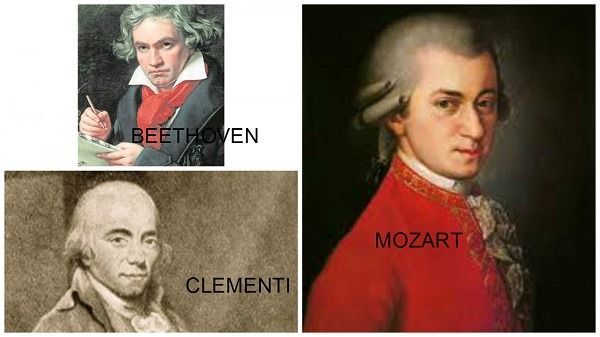
Of course, very important figures would arrive later and each one of them contributed their stamp on the music composed for piano. Artists such as Joseph Haydn, Schubert. Basically they were closing the Baroque and opened the door to a new music with a much more singable melody. And there were also singers in their evenings…
AND SUDDENLY THE PIANO BECOMES THE MOST POPULAR INSTRUMENT DURING THE 19TH CENTURY.
Throughout the nineteenth century the piano became popular to incredible levels. The middle classes are beginning to acquire them and all over the world there is no house that does not have a piano in its living room. Of course, all this is helped by the fact that much cheaper and less space-consuming models such as upright pianos emerge. Which has the whole mechanism mounted in the vertical plane. To make them sound louder, the top cover is opened.
We have to keep in mind that these times there was no television, no consoles, no radio. The piano became the center of meetings. It kept people entertained and was wonderful because it prevented arguments about politics from ending up with a tray on someone’s head. This highlights the importance of the piano as a social element.
It is said that in the mid-19th century alone in Paris there were more than 15,000 piano teachers. Brands like Steinway export their pianos halfway around the world and in this way we can see scenes of camels transporting them.
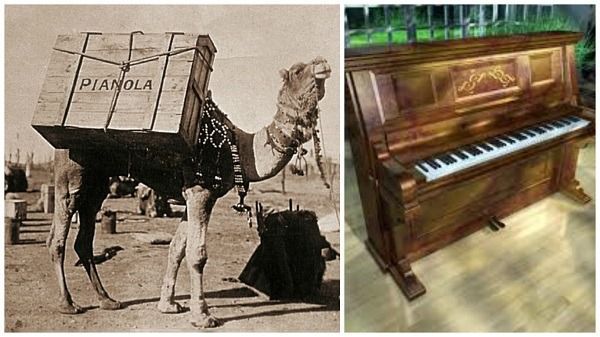
We can say that the 19th century is the golden age of the piano. In all styles it was the most played instrument. El Vals, popular music of all kinds… not to mention his role in military music. Very popular this style during the nineteenth century, whose function was to give glory to the military campaigns and increase the morale of the population. In some cases the notes could imitate elements of the war, such as cannon fire.
Schubert for example composed military music, here a sample.
Schubert Military music nº 1 Op 51
And in the wild west it also becomes very popular, there was always a piano in the typical cowboy bar. Which will then be the soundtrack of this genre. This was already at the end of the 19th century.
20th Century: Jazz and Swing
Like the 20th century, the piano is still at its peak. Especially at the beginning of the 20th century, there’s no bar or house without a piano. However, new styles of music are beginning that are still very much alive today. These are Swing and Jazz.
We can say that Swing is a type of Jazz, but it is also related to the style of dance that became so popular in the United States during the first half of the 20th century.
The piano begins in this time to share starring with the guitar as the main harmonic instrument, but it still shines by itself. In addition, the piano is usually the reference instrument for composition and learning harmony because it is much more visual in that sense.
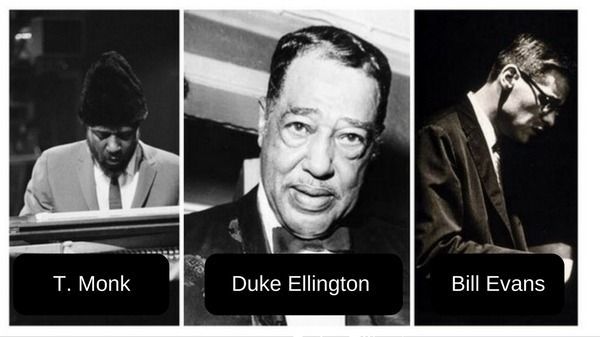
It is true that all kinds of piano music are still being composed during the 20th century but we cannot avoid highlighting Jazz and the introduction of modern harmony. This change is so great that today there are conservatories of “Classic” and others of “Modern”Music. This is due to the introduction of modern harmony, which is developed and created as the geniuses of Jazz of the 20th century emerge. The rules of classical harmony are broken, creating new rules and playing with dissonances.
Some names that change the rules of music are Bill Evans, Duke Ellington, Thelonious Monk
The 70’s and the arrival of the digital piano and synthesizers
In the ’70s comes something that will revolutionize music. This is synthesizers and piano keyboards. By means of digital technology it is possible to produce sounds from scratch and to modify their waves. This opens up an incredible number of possibilities for musicians. It’s the beginning of electronic music and those keyboard players surrounded by synth keyboards everywhere. An example of this new world is Herbie Hancock.
Herbie Hancock is one of the best examples of innovative pianist. Great Jazz musician does not hesitate to experiment with new technologies and becomes a great fan of synthesizers and disco music. Next we leave you a video where you can see the jump of planet that some keyboardists give.
Well, this post is coming to an end, obviously we have left many things but we hope to have entertained you and have given you an overview of the history and evolution of this wonderful instrument. If you liked this article and you think someone might like it, don’t hesitate to share it.
Vote if you liked this article 🙂
