
- Home
- Author's Archive:

Review Synthesizers Akai MPK miniplay. Where to buy it?
I’ll tell you how this post is built. First I list the features of the Akai MPK miniplay synthesizer. Then you have a video or two, purchase links and useful comments from other users and then you have one of the most useful parts; comparison tables with similar keyboards so you can compare.
- Very compact keyboard controller for in the go
- 25 Touch-sensitive synth-action mini-keys
- 8 Backlit pads with Note Repeat and Full amount function (x2 banks)
- 4 settings for modifying interior Sounds (Different sounds of piano and other instruments) or parameters (x2 banks)
- 128 Built-in noises and 10 drum kits
- Built-in speaker
- OLED show
- Pitch / modulation joystick
- Arpeggiator
- 3.5 mm Headphone output
- 6.3 mm Sustain pedal (The most important pedal of a piano or keyboard is the sustain pedal and is used to keep the note playing even if you stop pressing the key.) input
- USB port
- Power supply: 3x AA batteries or USB coach power
- Dimensions: 312 x 172 x 46 mm
- Weight: 450 g
- ProTools First, Akai Pro MPC Essentials, AIR Music Tech Hybrid 3 and SONiVOX Wobble (down load)

This keyboard usually has a price around 99.00 €
Now that we’ve seen the features of this synthesizer Akai MPK miniplay watch these related videos to learn more.
https://www.youtube.com/watch?v=hndCmo3V98A
Post you may be interested in
- Ranking with the best synthesizers
- My selection of cheap synthesizers.
- Synthesizers Basic Guide.
- AKAI Synthesizers
Some comments from people who come to the forum about this model:
Comment:
I bought this in order to experiment with at house. It is fun and it’s really great so it may be used standalone. I’ve run it through my guitar to my loop pedal and you may make some great backing songs along with it. Having the ability to run it on batteries is another function that is great the built in presenter is a little lacking but that does not bother me as I’m either deploying it with headphones or through an amp. I would definitely suggest it.
Comment:
Very good!!! Fast delivery, 2 stickers, good feedback!!
I ordered from tomman more than once rather than stayed unhappy!!!
I ordered from tomman more than once rather than stayed unhappy!!!
because of Thomann group!!!!
Akai MPK miniplay vs Korg Monotron Delay
The synthesizer Akai MPK miniplay is usually 50 € more expensive than Korg Monotron Delay.
|
Akai MPK miniplay |
Korg Monotron Delay |
|---|---|
|
|
And then a video of the synthesizerKorg Monotron Delay
If you want to know more about this option, click on the following link to see the Korg Monotron Delay review
Akai MPK miniplay vs Korg Volca FM
The synthesizer Akai MPK miniplayis usually 29 € cheaper than Korg Volca FM, but the difference is so small that this can vary..
|
Akai MPK miniplay |
Korg Volca FM |
|---|---|
|
|
And then a video of the synthesizerKorg Volca FM
If you want to know more about this option, click on the following link to see the Korg Volca FM review
Akai MPK miniplay vs Korg Volca Bass
The synthesizer Akai MPK miniplayis usually 36 € cheaper than Korg Volca Bass, but the difference is so small that this can vary..
|
Akai MPK miniplay |
Korg Volca Bass |
|---|---|
|
|
And then a video of the synthesizerKorg Volca Bass
If you want to know more about this option, click on the following link to see the Korg Volca Bass review
Akai MPK miniplay vs Korg Volca Keys
The synthesizer Akai MPK miniplayis usually 30 € cheaper than Korg Volca Keys, but the difference is so small that this can vary..
|
Akai MPK miniplay |
Korg Volca Keys |
|---|---|
|
|
And then a video of the synthesizerKorg Volca Keys
If you want to know more about this option, click on the following link to see the Korg Volca Keys review
Where to buy the synthesizer Akai MPK miniplay
Amazon
- Free Shipping and possibility of shipping in one day with Amazon Premium.
- Full Guarantee but they are no experts in music equipment.
- Sometimes better price.
- He’s got worse stock than Thomann.
Thomann
- Free Shipping.
- Full warranty. If you have any problems, they take care of everything.
- 100% reliable payment.
- Leader in trouble-free shipping.
- Usually Best price.
- Best Reputation: They are the leading online store in Europe and have the best catalogue and information.
Also look at these models with a similar price and features:
- SOMA Ether V2
- Behringer MS-1-BK
- Behringer MS-1-BL
- Behringer MS-1-RD
- Arturia MicroFreak
- Akai MPK miniplay
- Korg Volca Keys
- Korg Volca FM
- Korg Volca Modular
- Teenage Engineering PO-12 rhythm
- Korg Monologue Silver
- Korg Volca Bass
- Korg Monologue BK
- Korg Volca Nubass
- Moog Theremini
- IK Multimedia UNO Synth
- Teenage Engineering PO-16 factory
- Teenage Engineering PO-20 arcade
- Yamaha Reface DX
- Teenage Engineering PO-28 robot
- Korg Monologue Blue
- Korg Volca Kick
- Arturia MicroBrute
- Teenage Engineering PO-14 sub
- Widara Distant Voices Theremin
- Teenage Engineering Ultimate Cocktail PO Superset
- Teenage Engineering Ultimate Punch PO Superset
- Arturia MicroBrute Creation Edition
- Korg Monotron Duo
- Teenage Engineering PO-24 office
- Korg Monotron Delay
- Korg NTS-1

Review Synthesizers Korg Minilogue XD. Where to buy it?
I’ll tell you how this post is built. First I list the features of the Korg Minilogue XD synthesizer. Then you have a video or two, purchase links and useful comments from other users and then you have one of the most useful parts; comparison tables with similar keyboards so you can compare.
- 4 Voice polyphony (Number of notes that can sound at once. This includes songs that sound at once. So if you play over an accompaniment sound, more notes will accumulate.)
- 37 Velocity-sensitive keys Slim
- Two analogue VCOs and digital multi-engine oscillator (Noise, FM, User-Wavetables) per voice
- 2-pole filter with drive circuit
- 1 x VCA, 1 x LFO, 2 envelopes
- Oscillator sync and band modulation
- 500 Sounds (Different sounds of piano and other instruments) storable (200 presets + 300 users)
- Digital effects section with modulation impacts, delay and reverb (Reverberation effect which is a reflection effect of the sound)
- 4 Voice Modes (Poly, Unison, Chord, Arp / Latch)
- Joystick for pitchbend and modulation
- Micro tuning with 23 preset and 6 indiviDual (Dual mode allows you to combine two sounds to create a more complete sound. Typical combination of piano + sound of string instruments) scales
- Polyphonic 16 Step Sequencer with Motion Sequencer
- Display associated with generated waveform by oscilloscope function into the OLED display
- 44 Controls for immediate access to any or all parameters
- control interface made from robust aluminium
- back panel made from real wood
- Stereo line output (2x 6.3 mm jack)
- Headphone production (6.3 mm jack stereo)
- Sustain pedal (The most important pedal of a piano or keyboard is the sustain pedal and is used to keep the note playing even if you stop pressing the key.) connector (6.3 mm jack)
- Sync In / Out (3.5 mm jack mono)
- 2 x CV In (3.5 mm jack)
- midi (MIDI allows you to do such wonderful things as connect the keyboard to the computer, record a soundtrack and with certain programs pass with a click what you have played to musical notes in a score. MIDI tracks store information from musical notes) In / Out
- USB B
- Dimensions (W x D x H): 500 x 300 x 85 mm
- body weight: 2.8 kg
- Includes power DC 9V (KA350)

This keyboard usually has a price around 525.00 €
Now that we’ve seen the features of this synthesizer Korg Minilogue XD watch these related videos to learn more.
Post you may be interested in
- Ranking with the best synthesizers
- My selection of cheap synthesizers.
- Synthesizers Basic Guide.
- KORG Synthesizers
Some comments from people who come to the forum about this model:
Comment:
I expected this synth become awesome. And it IS awesome.
The very first preset after switching the device on is terrific, immediately show the power of the engine under the bonnet.
Feature-wise it is good, but because the others into the *logue series could have usage some more modulation options.
Conclusion: do not overthink it, simply go and get it.
The very first preset after switching the device on is terrific, immediately show the power of the engine under the bonnet.
Feature-wise it is good, but because the others into the *logue series could have usage some more modulation options.
Conclusion: do not overthink it, simply go and get it.
Comment:
Nice variety of machines, no variety of filters, which means that plenty of sounds which… all have an extremely comparable characteristic. So again, ‘you need to like its sound’ 😉
Korg Minilogue XD vs Korg MS-20 mini
The synthesizer Korg Minilogue XDis usually 24 € cheaper than Korg MS-20 mini, but the difference is so small that this can vary..
|
Korg Minilogue XD |
Korg MS-20 mini |
|---|---|
|
|
And then a video of the synthesizerKorg MS-20 mini
If you want to know more about this option, click on the following link to see the Korg MS-20 mini review
Korg Minilogue XD vs Korg Minilogue
The synthesizer Korg Minilogue XD is usually 26 € more expensive than Korg Minilogue, but the difference is so small that this can vary..
|
Korg Minilogue XD |
Korg Minilogue |
|---|---|
|
|
And then a video of the synthesizerKorg Minilogue
If you want to know more about this option, click on the following link to see the Korg Minilogue review
Korg Minilogue XD vs Behringer DeepMind 6
The synthesizer Korg Minilogue XD is usually 26 € more expensive than Behringer DeepMind 6, but the difference is so small that this can vary..
|
Korg Minilogue XD |
Behringer DeepMind 6 |
|---|---|
|
|
And then a video of the synthesizerBehringer DeepMind 6
If you want to know more about this option, click on the following link to see the Behringer DeepMind 6 review
Korg Minilogue XD vs Teenage Engineering OP-Z
The synthesizer Korg Minilogue XDis usually 4 € cheaper than Teenage Engineering OP-Z, but the difference is so small that this can vary..
|
Korg Minilogue XD |
Teenage Engineering OP-Z |
|---|---|
|
|
And then a video of the synthesizerTeenage Engineering OP-Z
If you want to know more about this option, click on the following link to see the Teenage Engineering OP-Z review
Where to buy the synthesizer Korg Minilogue XD
Amazon
- Free Shipping and possibility of shipping in one day with Amazon Premium.
- Full Guarantee but they are no experts in music equipment.
- Sometimes better price.
- He’s got worse stock than Thomann.
Thomann
- Free Shipping.
- Full warranty. If you have any problems, they take care of everything.
- 100% reliable payment.
- Leader in trouble-free shipping.
- Usually Best price.
- Best Reputation: They are the leading online store in Europe and have the best catalogue and information.
Also look at these models with a similar price and features:
- Behringer Odyssey
- Critter & Guitari Organelle M Grey
- Behringer Vocoder VC340
- Critter & Guitari Organelle M Blue
- Behringer Poly D
- Korg Minilogue XD
- Novation MiniNova
- Roland AX-Edge Black
- Moog Grandmother
- SOMA Lyra-8 Black Beast
- SOMA Lyra-8 White Angel
- Teenage Engineering OP-Z
- Roland Juno-DS 88
- Korg Kross 2-88MB
- Behringer DeepMind 12
- Moog Etherwave Theremin Ash
- Arturia MiniBrute 2
- Korg microKORG
- Korg Kross 2-88
- Modal Argon8
- Novation Bass Station II
- Korg Kross 2-61
- Behringer DeepMind 6
- Korg Minilogue
- Roland Juno-DS 61
- Roland JD-Xi
- Korg MS-20 mini
- Moog Etherwave Theremin Plus
- Yamaha Reface CS
- Yamaha Reface YC
- Roland Juno-DS 61B Black Edition
- Yamaha Reface CP
- Korg Triton taktile 49
- Roland System-1
- Yamaha MX49 V2 Black
- Roland AX-Edge White
- Yamaha MOXF 6
- Moog Sub Phatty
- Teenage Engineering PO-30 Superset
- Waldorf Blofeld Keyboard Black
- Yamaha MX88
- Roland Juno-DS 76
- Korg Minilogue PG
- Waldorf STVC
- Korg King Korg Black
- Moog Etherwave Theremin Kit Plus
- Roland SH-01 Gaia
- Studiologic Sledge 2 Black Edition
- Korg microKorg XL +
- Korg microKORG S
- Waldorf Blofeld Keyboard
- Yamaha MX61 V2 Black
- Yamaha MX61 V2 Blue
- Yamaha MX49 V2 Blue
- Korg Minilogue XD Pearl White
- ARP Odyssey
- Sonicware ELZ 1
- Roland FA-06
- Korg Krome EX 61

Review Synthesizers Arturia MicroFreak. Where to buy it?
I’ll tell you how this post is built. First I list the features of the Arturia MicroFreak synthesizer. Then you have a video or two, purchase links and useful comments from other users and then you have one of the most useful parts; comparison tables with similar keyboards so you can compare.
- Touch keyboard with 25 secrets
- Velocity dynamic with polyphonic aftertouch
- Digital oscillator with synthesis techniques like Karplus Strong, Harmonic OSC, Superwave and Texturer
- Analog state adjustable filter (-12 dB/oct.) with selectable lowpass, bandpass and highpass faculties
- LFO with 6 vibration modes
- 2 Envelope generators
- Modulation matrix with 5 sources and 7 goals
- Arpeggiator
- Step sequencer with 4 automation songs and random parameters
- Paraphonic mode
- OLED display
- Line output: 6.3 mm Jack
- CV / Gate / Pressure Outputs: 3.5 mm Jack
- Clock In / Out: 3.5 mm Handle
- midi (MIDI allows you to do such wonderful things as connect the keyboard to the computer, record a soundtrack and with certain programs pass with a click what you have played to musical notes in a score. MIDI tracks store information from musical notes) In / Out: 3.5 mm TRS jack
- USB port
- Dimensions: 311 x 233 x 55 mm
- Weight 1.02 kg
- Includes 12V DC power supply unit
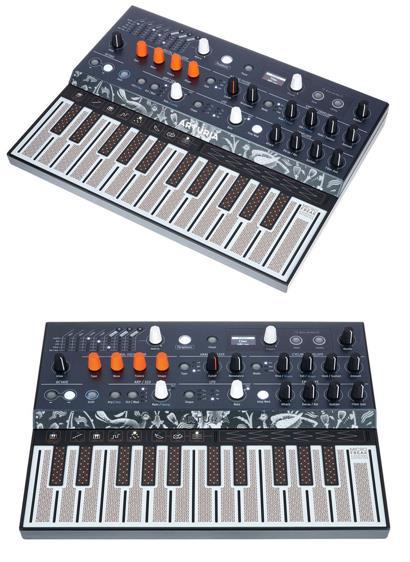
This keyboard usually has a price around 277.00 €
Now that we’ve seen the features of this synthesizer Arturia MicroFreak watch these related videos to learn more.
Post you may be interested in
- Ranking with the best synthesizers
- My selection of cheap synthesizers.
- Synthesizers Basic Guide.
- ARTURIA Synthesizers
Some comments from people who come to the forum about this model:
Comment:
I’m a guitarist but I love synths, I had a genuine plastic ‘Wasp’ straight back in the day along side a couple of Roland electric guitar synths.. Now I just fuss with software synths in a DAW. I saw online videos associated with Microfreak and chose to get one and I have always been super impressed, this thing is a super flexible and beast that is effective. The keyboard isn’t an issue over MIDI if you prefer for me at all but is most likely not to everybody’s taste – though of course it is possible to play it. The noise sources are great and diverse while the filter and modulation matrix are kinda the icing in the cake.
There isn’t much point in me trying to explain the sounds and features here, you can find lots of informative videos on youtube but I will say that I believe it is great fun and simple to use and is effective at making some good sounds. It has CV and gate outs too so now I’m vulnerable to benefiting from modular stuff, ha ha!
Out of this package the synth worked great but I did notice a couple of weird problems, often filter settings would leap around and also the key hold would activate arbitrarily. At first I thought it had been simply my fingers that are fat seemed perhaps not. The firmware was checked by me personally variation and sure enough it had been out of date. I downloaded the Arturia MIDI control software and used that to upgrade the firmware and to update the presets to your 1.1 version and all sorts of the nagging problems just disappeared, really, happy. Bear in mind that this is certainly a 4 sound paraphonic synth not merely a monosynth, actually I do not observe you can fare better for the cost.
Comment:
I’m utilized just bunch of good VST before, i’m completely content with them. But once i wished to have a not virtual, a "real" instrument to own another workflow style, and, consequently, different paths considering creativity. Portability ended up being a criterion that is big.
After long researching of some variations, microfreak had becomes my choice. I had lot of fears and skepticism about any of it, but cost of the synth is a flavorsome.
Also it’s difficult to estimate all possibilities with only dry noise. I was thinking, good results that are additional result in the noise really awesome, but was not too sure. Sound demos, what i found in internet just about all ended up being with dry sound or slightly slurred in my experience.
whenever i received and try it on my own- all good objectives had been confirmed.
This little thing can several things, but at first it isn’t so obvious. It is cool to play i understood how to use it rapidly along with it. In a few means It’s not so easy, as utilizing virtual instruments, but it is much more pleasant.
Microfreak features its own noise design, and this rocks !, because individuality is benefit. Some aspects, with contrast with some my VSTi’s i never have therefore effective, but microfreak has its own powers and possibilities, what i’m have not before.
Microfreak won’t have its very own impacts. Some patches getting good without one. However if use alternative party effects, sonic opportunities and power increasing plenty.
I’d advise to get good impacts using the synth, gear or plug-ins, at least one good reverb, this worthy of it.
Sound of the synth is electronic, and incredibly quality. It is sound much better than a few of my vsti’s, sometimes also without additional results.
Microfreak filled with good sides of digital sound.
The synth have capability to create analog- style appears, but i question, whatever they therefore cool, as real analog. Anyhow the synth sounds a really cool in digital sonic design.
But filter let me reveal analog. Some oscillator modes have actually features, exactly what making filter not important to utilize using them, but the filter is real cool, it is work smooth and sometimes making sound "warmer".
Modulation matrix rocks !. It’s really easy, if get accustomed to it, and provide a whole lot of opportunities. You can also modulate level of other modulations!
I love the keyboard. In some means not too good as "traditional" keyboard, but i’m, as pianist, do not feel conservative negativity about that sensor decision, it’s just different option to play.
For me it is comfortably and enjoyable to utilize. And it is actually expressive. I’m certain, this flat keys better, then inexpensive secrets with bad velocity control or without it.
I never very like a sequencer and arpeggiator, because i accustomed to DAW’s using their medical control of every thing, but anyway seem’s useful. But i really like a chance of modulating something from sequencer/arpeggiator.
If you need affordable, small, fun and interesting digital synth- the Microfreak is a great decision, i think.
However, if you need just only features, and also you not obsessed about control of genuine tool, or just around unwonted workflow; or perhaps you can’t stand electronic sound- maybe it’s can disappoint you.
Arturia MicroFreak vs Novation Bass Station II
The synthesizer Arturia MicroFreakis usually 98 € cheaper than Novation Bass Station II.
|
Arturia MicroFreak |
Novation Bass Station II |
|---|---|
|
|
And then a video of the synthesizerNovation Bass Station II
If you want to know more about this option, click on the following link to see the Novation Bass Station II review
Arturia MicroFreak vs Arturia MicroBrute
The synthesizer Arturia MicroFreakis usually 2 € cheaper than Arturia MicroBrute, but the difference is so small that this can vary..
|
Arturia MicroFreak |
Arturia MicroBrute |
|---|---|
|
|
And then a video of the synthesizerArturia MicroBrute
If you want to know more about this option, click on the following link to see the Arturia MicroBrute review
Arturia MicroFreak vs Korg microKORG
The synthesizer Arturia MicroFreakis usually 52 € cheaper than Korg microKORG.
|
Arturia MicroFreak |
Korg microKORG |
|---|---|
|
|
And then a video of the synthesizerKorg microKORG
If you want to know more about this option, click on the following link to see the Korg microKORG review
Arturia MicroFreak vs Novation MiniNova
The synthesizer Arturia MicroFreakis usually 45 € cheaper than Novation MiniNova, but the difference is so small that this can vary..
|
Arturia MicroFreak |
Novation MiniNova |
|---|---|
|
|
And then a video of the synthesizerNovation MiniNova
If you want to know more about this option, click on the following link to see the Novation MiniNova review
Where to buy the synthesizer Arturia MicroFreak
Amazon
- Free Shipping and possibility of shipping in one day with Amazon Premium.
- Full Guarantee but they are no experts in music equipment.
- Sometimes better price.
- He’s got worse stock than Thomann.
Thomann
- Free Shipping.
- Full warranty. If you have any problems, they take care of everything.
- 100% reliable payment.
- Leader in trouble-free shipping.
- Usually Best price.
- Best Reputation: They are the leading online store in Europe and have the best catalogue and information.
Also look at these models with a similar price and features:
- SOMA Ether V2
- Behringer MS-1-BK
- Behringer MS-1-BL
- Behringer MS-1-RD
- Arturia MicroFreak
- Akai MPK miniplay
- Korg Volca Keys
- Korg Volca FM
- Korg Volca Modular
- Teenage Engineering PO-12 rhythm
- Korg Monologue Silver
- Korg Volca Bass
- Korg Monologue BK
- Korg Volca Nubass
- Moog Theremini
- IK Multimedia UNO Synth
- Teenage Engineering PO-16 factory
- Teenage Engineering PO-20 arcade
- Yamaha Reface DX
- Teenage Engineering PO-28 robot
- Korg Monologue Blue
- Korg Volca Kick
- Arturia MicroBrute
- Teenage Engineering PO-14 sub
- Widara Distant Voices Theremin
- Teenage Engineering Ultimate Cocktail PO Superset
- Teenage Engineering Ultimate Punch PO Superset
- Arturia MicroBrute Creation Edition
- Korg Monotron Duo
- Teenage Engineering PO-24 office
- Korg Monotron Delay
- Korg NTS-1