
- Home
- Author's Archive:
Review of the Elektron Analog Rytm MKII: Review and Where to Buy
Elektron has been leading the drum machine market for a few years now, presenting powerful equipment, loved by many and widely praised by critics.
But with the Analog Rytm MKII, Elektron takes a step forward, a powerful drum machine that combines the color and warmth of analog equipment with the practicality and diversity of sampling.
This hybrid rig is a direct upgrade to Elektron’s highly successful Analog Rytm, and among the improvements are more controls for instant access to features, sampling capabilities and changes to the pads to run them better.
The sound of the Elektron Analog Rytm MKII
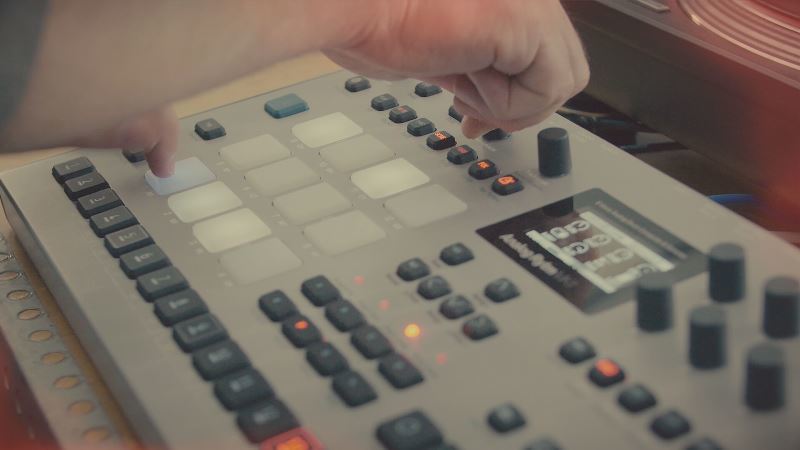
This powerful drum machine has 8 drum voices, in each voice you can select an engine from the 8 available analog percussion sound, in addition to this in each voice can also be assigned audio samples, with 1 Gb of space available for samples.
Important that these 8 voices end up becoming 12 since there are 4 percussion elements that share an analog engine, hence its sequencer is 12 drum tracks.
Each voice has an additional multimode analog filter, an analog overdrive, envelopes for the Filter and for the Amplifier section and an assignable LFO.
Finally it counts Delay and Reverb in buses for sending and an analog compressor in the amplification section.
General specifications of the Elektron Analog Rytm MKII
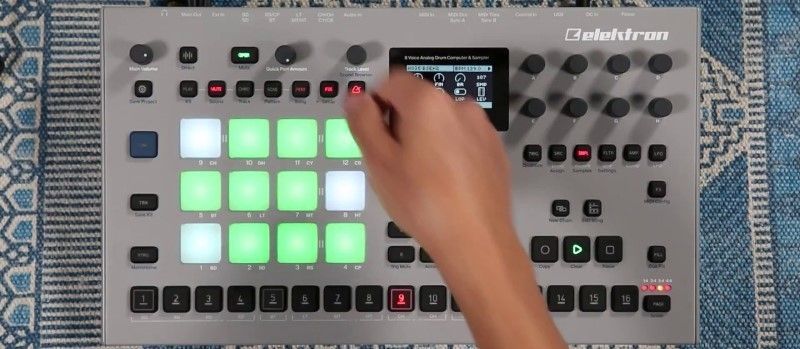
- Sampling engine.
- OLED display with very good definition for good viewing in low light environments.
- Larger backlit pads for more comfort and with an approximate pulse duration of 50 million.
- Precise and high resolution encoders.
- More dedicated controls to access the functions of this equipment instantly.
- Expression input and CV input to externally control parameters of this drum machine with other equipment.
- Balanced inputs for sample recording.
- Sequencer up to 64 steps.
- 5-pin MIDI In, Out and Thru.
Overbridge and Elektron Transfer software to control the Analog Rytm MKII
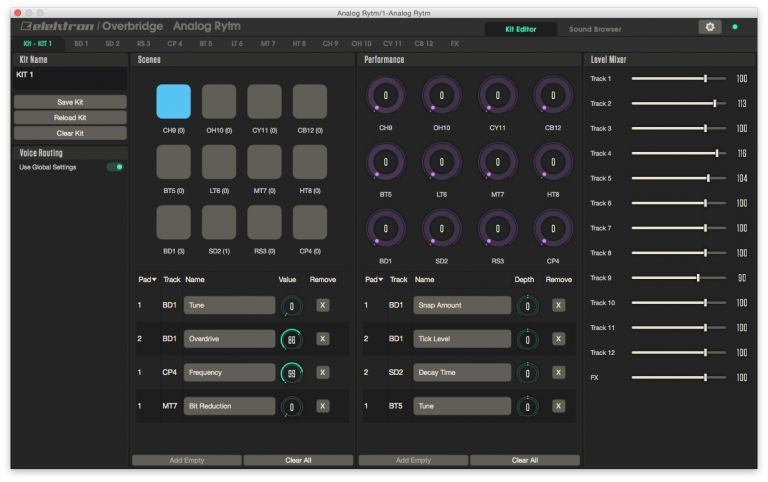
Thanks to the Elektron Transfer software, samples can easily be dragged from the computer to the Analog Rytm MKII and vice versa.
Now, the Overbridge software, which comes with the Analog Rytm MKII, is much more complete and allows this unit to integrate very well with computers and has the following features:
- Complete integration of Analog Rytm MKII with DAW software.
- It is possible to control Analog Rytm from virtually any DAW with the included VST/AU plugins (It is also possible to use the stand-alone application)
- It allows the user to use the Analog Rytm MKII as a 2 output, 2 input audio interface.
- It allows you to transmit directly to any DAW the 8 outputs of your analog voices, the external inputs and the main bus without the need for additional cable connections in 24 bit/48 kHz quality.
- Allows audio to be sent directly from the DAW without cable connections to the analog compressor.
Elektron Analog Rytm MKII vs Elektron Analog Rytm
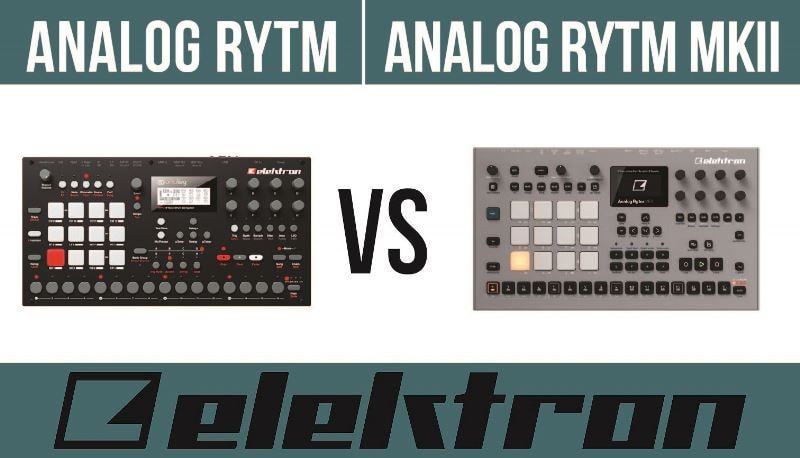
The MKII version is the direct successor to the highly successful Analog Rytm launched in 2014 by Elektron, including improvements such as
- Better quality in the audio samples.
- Better quality on the OLED screen.
- Larger pad size for ease of execution.
- The number of controls were increased for greater enforceability.
- Balanced inputs for sample recording.
- Improvements in the bandwidth for communication with the Overbridge software.
Elektron Analog Rytm MKII vs Dave Smith Instruments Tempest

The Tempest by Dave Smith Instruments is a far superior rhythm machine, among the tabs that make the Tempest a superior rhythm box:
Two analog voice oscillators that can generate sawtooth, triangle, sawtooth/triangle and variable pulse width waves and this is in addition to its 2 digital voice oscillators with over 450 electronic percussion samples and waveforms.
Another interesting detail is that each of the voices has a suboscillator, an octave lower.
Also each voice has a low pass analog filter type Curtis and a high pass analog filter.
Each voice has 5 envelope sections, while the Analog Rytm MKII has only 2 envelope sections.
It has 2 assignable LFOs per voice, versus the Analog Rytm MKII with only one LFO per voice.
Also with an 8×8 modulation matrix and analogue compressor.
Elektron Analog Rytm MKII vs Elektron Octatrack MKII
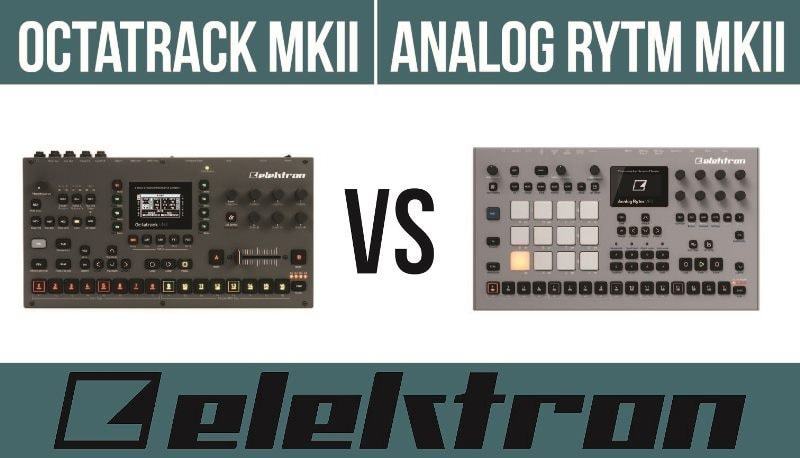
Here we have two very different drum machines in principle, while the Analog Rytm MKII is a hybrid machine that has the best of both worlds, analog or digital, the Octatrack MKII is a powerful digital sampler, which allows you to modify the sound in much more advanced ways than in the Analog Rytm.
Among the main differences in the Octatrack MKII, the following stand out:
- The Analog Rytm has a capacity of 1 Gb for the audio samples, while in the Octatrack, the samples are loaded into a flash memory, which extends the size possibilities enormously.
- It has dedicated controls to manipulate the samples for greater agility at the time of sound creation.
- It has 3 assignable LFOs per track versus only 1 LFO in the Analog Rytm MKII.
- It has 2 main outputs and 2 additional cue outputs, versus the 8 outputs, one for each voice of the Analog Rytm MKII.
It should be noted that although the Elektron Octatrack MKII may be more interesting for some because of its greater number of features, the Analog Rytm MKII is an analog equipment and therefore for many, it is worth sacrificing these features for the heat offered by the analog circuitry.
Elektron Analog Rytm MKII vs Roland TR-8
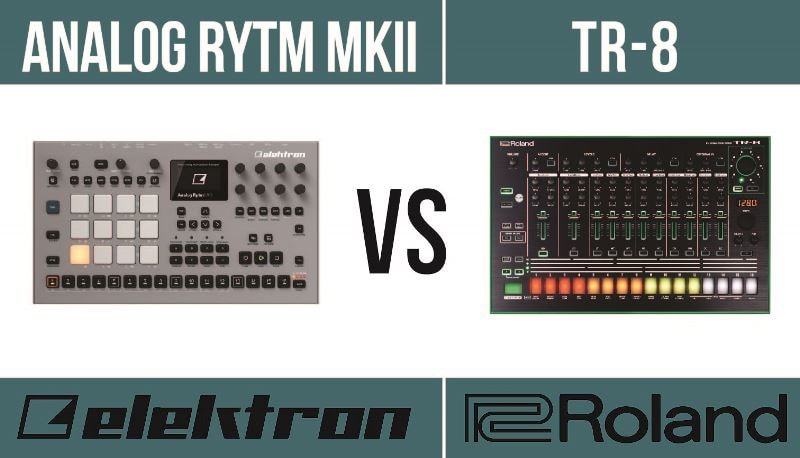
Here we have 2 somewhat similar rhythm boxes, with one main difference, the Analog Rytm is an analog equipment while the TR-8 is a digital equipment.
Roland’s TR-8 has 11 voices versus the 8 analog voices of the Analog Rytm that end up being 12 voices for the 4 that share the analog engine.
Another important detail is that the TR-8 does not have a sampling engine, so its sound cannot be expanded, versus the Analog Rytm MKII that has 1 Gb for samples.
The TR-8 has neither a filter nor an LFO, while the Analog Rytm MKII has a multi-mode analog filter for each voice and an assignable LFO for each voice.
The Analog Rytm MKII has analog distortion for each voice and analog compression for the amplification section while the TR-8 does not have this.
While the Analog Rytm MKII has 8 individual outputs for your vocals plus the main stereo output, the TR-8 has only the main stereo output.
Finally, for the more nostalgic users, the TR-8 has among its banks with drum sounds that come directly from the legendary TR-808 and TR-909, two Roland rhythm machines that made history in the 80’s.
Elektron Analog Rytm MKII vs Roland TR-09
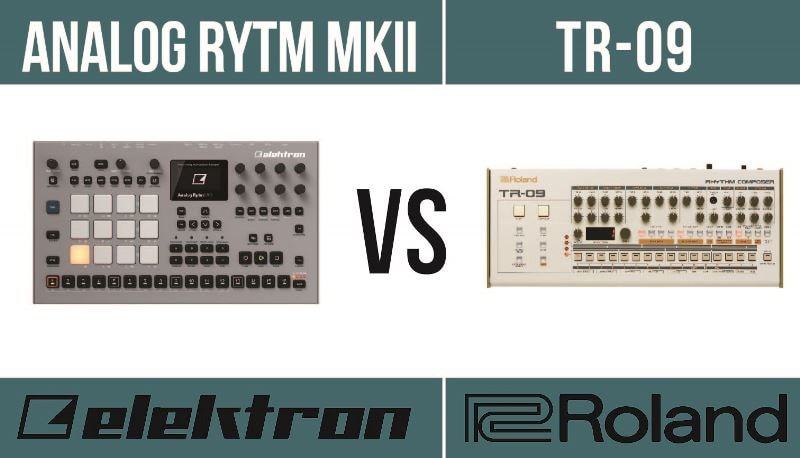
The Roland TR-09 comes with much less performance than the Analog Rytm MKII, also notable in its price that is far below.
This equipment perfectly recreates the legendary Roland TR-909 presented to the world by Roland in 1984, a drum machine that defined the sound of the nascent Techno and House of the time.
The TR-09 has 9 fixed voices with some possibilities of modification, while the Analog Rytm, thanks to its more powerful analog engines and its sampling engine, has many possibilities of sound exploration.
The TR-09 sequencer is much simpler, with only 16 steps versus the 64 steps of the Analog Rytm MKII sequencer.
The TR-09 has no effects, while the Analog Rytm has analog distortion and filtering in each voice, possibility of sending to Reverb and Delay in addition to the analog compression in the master.
Finally, as it is a recreation of a vintage equipment, the TR-09 has neither individual outputs for your voices nor the wide possibilities offered by the Overbridge software.
Elektron Analog Rytm MKII vs Jomox Alpha Base
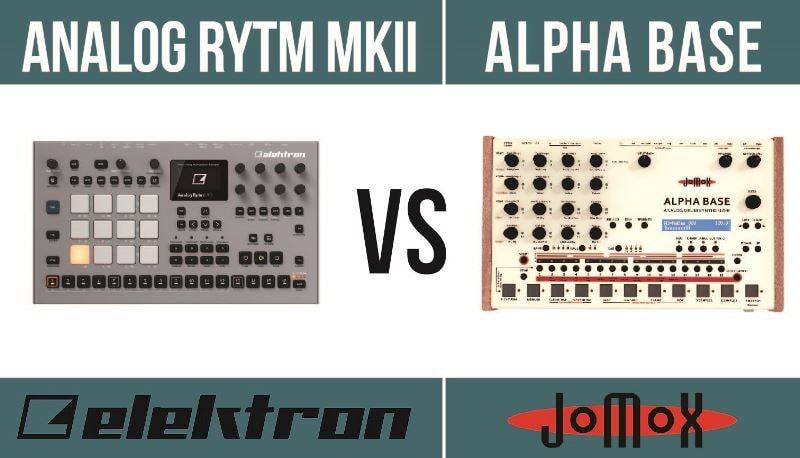
Here we have 2 very good quality analog drum machines, both with different advantages that make them a great choice.
Both are hybrid devices that combine the best of both worlds, analog and digital.
The Alpha Base has 11 instruments while the Analog Rytm has 8 analog voices that end up creating 12 sounds.
The sound generator of the Alpha Base is somewhat different, each of its 16 voices has different particularities, some are 100% analog, others combine sampling with analog sound, others are 100% digital and focused on sampling, and it has a mini FM synthesizer of up to 6 voices that can be used to generate percussive noises typical of FM synthesis or to play with an external MIDI controller.
While the Analog Rytm’s sound generator has 8 analog engines and samples can be added in parallel to each of their voices.
Although both machines have Delay and Reverb, the Alpha Base has neither Distortion nor Compression, while the Analog Rytm has Analog Distortion for each voice and an analog compressor for the master.
Finally, the Alpha Base, does not have pads to easily play your instruments in real time, while the Analog Rytm has 12 backlit pads.
Where to buy Elektron Analog Rytm MKII?
You can find this article in the following stores at the best price. The links lead directly to the product:
Thomann
- Free Shipping.
- Full warranty. If you have any problems, they take care of everything.
- 100% reliable payment.
- Leader in trouble-free shipping.
- Usually Best price.
- Best Reputation: They are the leading online store in Europe and have the best catalogue and information.
Amazon
- Free Shipping and possibility of shipping in one day with Amazon Premium.
- Full Guarantee but they are no experts in music equipment.
- Sometimes better price.
- He’s got worse stock than Thomann.
Conclusions
The Analog Rytm is definitely an incredible piece of equipment, combining the best of the analog world with the versatility offered by digital samples, a combination that is becoming increasingly common in high-end equipment.
If you’re looking for a state-of-the-art drum machine with great features and you’re on a budget, the Analog Rytm MKII is definitely the choice.
Analysis and opinion Minimoog Model D: Where to buy
At the end of 1970, the great inventor Robert Moog, together with his partner Bill Hemsath, presented the world with a portable and powerful synthesizer that would change the history of music at that time.
Great musicians such as Rick Wakeman (Yes), Richard Wright (Pink Floyd), Wendy Carlos, Keith Emerson (Emerson, Lake and Palmer), Gary Numan, Charly Garcia, Krafwerk, among many others, have immortalized the sound of this synthesizer in their records making it go down in history as one of the favorite synthesizers of many of the great keyboardists of the 70’s and 80’s.
Other posts you may be interesting in
- Ranking with the best synthesizers
- My selection of cheap synthesizers.
- Synthesizers Basic Guide.
- Synthesizers by Brand.
The Minimoog is a subtractive monophonic analog synthesizer, with a very characteristic sound with a lot of character and a very warm timbre, used very commonly for recording electronic basses and lead singers, but thanks to its great versatility it can be used to create different types of sounds.
Paying tribute to this iconic synthesizer, the brand has launched a first reissue of this model with some updated features to the new era, called the Minimoog Voyager and later in 2016, presented the reissue of the Minimoog Model D, with all its circuitry intact, adding some features accommodated to the time.
Basic operation of the Minimoog Model D
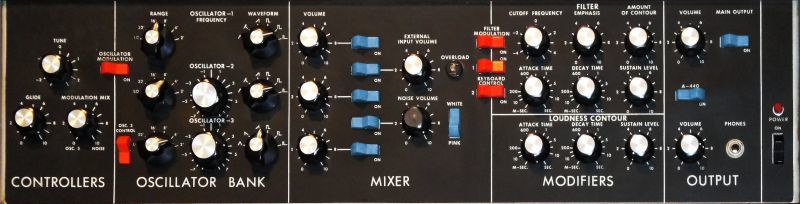
This classic synthesizer does not have the ability to save presets, so each sound must be created from scratch, with no possibility of saving it to the synthesizer’s memory.
Another important aspect of this synthesizer is that all its features have a control on the front panel, so this synthesizer has all its functions ready to use in real time and instantly.
The type of synthesis used by this equipment is subtractive synthesis, which is one of the most popular in history and many synthesizers use it nowadays, some of them inspired by the legendary Minimoog.
New features of the Minimoog Model D
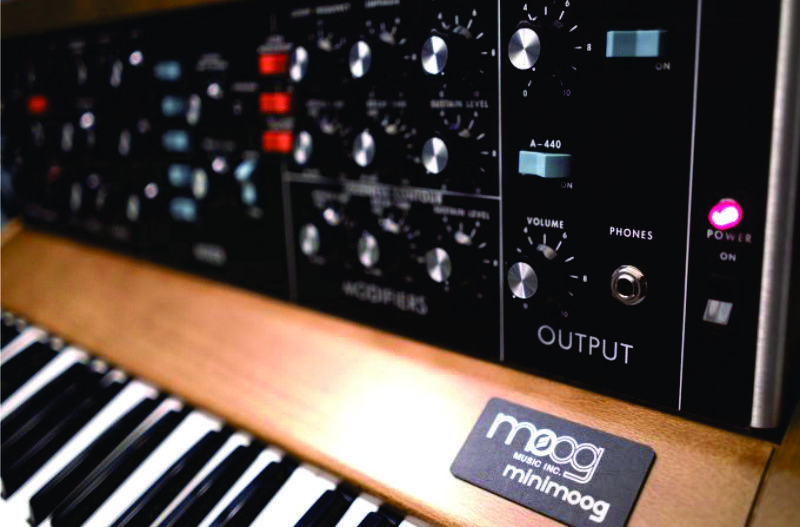
In the new reissue of the Minimoog the brand has added some modifications that expand the capabilities of this synthesizer, but keeping the sound and audio path of its predecessor.
Being a 1970’s synthesizer, the original model did not include MIDI ports, since this protocol had not been invented yet, in this new model, 5-pin MIDI ports for input, output and thru are included (MIDI Thru is an output connection to chain several synthesizers) .
This new model includes a 3.5 octave Fatar keyboard, with sensitivity to velocity and after-pressure.
It also includes voltage-controlled outputs for tone, gate, speed and after-pressure to communicate with modular systems or semi-modular synthesizers.
Finally it has a modification in the mixer overload to create more full-bodied and distorted sounds.
The sound of the Minimoog Model D
The Minimoog Model D has three oscillators, each with 6 available waveforms (Triangle, Sawtooth, Square, Wide Pulse, Short Pulse and a triangle sawtooth wave that is in oscillators 1 and 2 and an inverted sawtooth wave included in oscillator 3).
Each oscillator has a frequency control that determines the height at which the note is being played on that oscillator, somewhat similar to the octave rise or fall controls on modern synthesizers.
Oscillators 2 and 3 also have tuning stability controls to create sounds with slight detuning between each oscillator that give it more body and character.
In the Controls section, you have a control for the overall synth tuning and a control for the Glide, which determines how long it takes to progressively move from one note to another after the second note is pressed, this control is also known as Portamento on other synthesizers.
It also has a basic LFO with the possibility of being configured in triangular or square wave type.
This synthesizer has a noise generator that can be selected in Pink Noise or White Noise, quite useful for creating larger filter sweeps or electronic percussions.
This synthesizer also has a mixer for its 3 oscillators, the noise generator and an external input, with on/off controls for each of these sound sources and volume controls, with an additional Overload option, which allows you to add more body and distortion to the sound.
Finally, an envelope for the amplification section with attack, decay and hold controls.
The Minimoog Model D filter
One of the most characteristic elements of this synthesizer is its resonant filter, this is a 24dB 4-pole lowpass filter with quite a lot of character, which has the basic parameters of cutoff and resonance, but also has a dedicated envelope, with attack, decay and sustain to give more movement to this filter and keyboard tracking controls.
Listed by many as one of the best filters on synthesizers.
Moog Minimoog Voyager
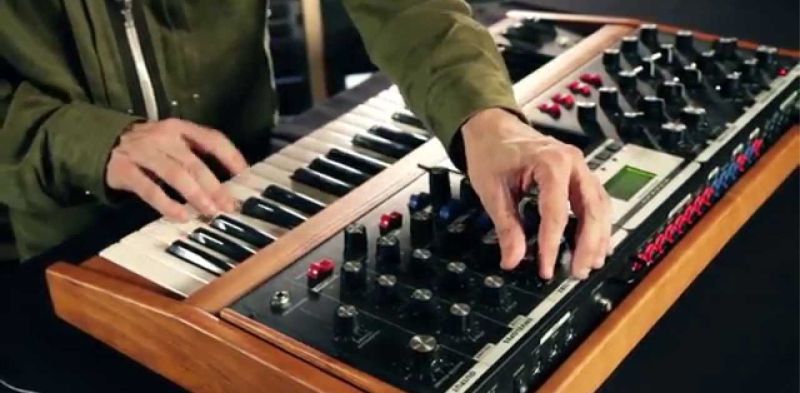
The Minimoog Voyager is the update of the original Minimoog Model D, made by Bob Moog himself in 2002, with new features and a renewed sound.
This synthesizer, although it is 100% analog, has digitally controlled oscillators so they are more stable in their tuning, although for many this sacrifices a little the character of their sound.
Its oscillators are very similar to the original Minimoog as are its mixer and filter, but its LFO section is much more complete by adding several controls which allows you to expand your sound exploration thanks to new routing possibilities, in its two envelope sections, the “Relaxation” parameter is added which was not present in the original Minimoog.
New features include MIDI connectivity, the ability to save more than 800 presets and an assignable X/Y pad for modifying the sound according to parameters you set.
This synthesizer was released in several colors and in editions with more functionalities and semi-modulars.
This synthesizer has been used by great musicians like Herbie Hancock, Rick Wakeman, Chick Corea, Brian Eno, Trent Reznor and Stevie Wonder among many other outstanding musicians.
Moog Minimoog Model D vs Moog Minimoog Voyager

Although these two synthesizers are in principle somewhat similar, they differ in that the current Minimoog Model D is a replica of the original 1970 Minimoog, with the features of that time, adding only the MIDI implementation and some additional functionality; while the Minimoog Voyager is a synth inspired by the iconic synthesizer of the 70’s but with notable changes such as digitally controlled oscillators for more stable tuning, its fully modified LFO with many more controls than the original Minimoog, its X/Y pad, the implementation of MIDI and the ability to save presets, making it a very live focused synth.
Minimoog VST

This synthesizer is so iconic and outstanding that different brands have tried to emulate its sound in software, including the Moog brand itself which recently introduced the Minimoog Model D in a mobile app.
Among the most prominent software copies available at VSTi are
- Arturia – Model V.
- Native Instruments – Monark.
- GForce Software – Minimonsta.
- IK Multimedia – Minimood
Some of these copies add certain additional functionalities, such as effects, polyphony, arpeggiators and greater signal routing possibilities, as well as excellent preset banks.
Moog Minimoog Model D vs Moog Sub 37
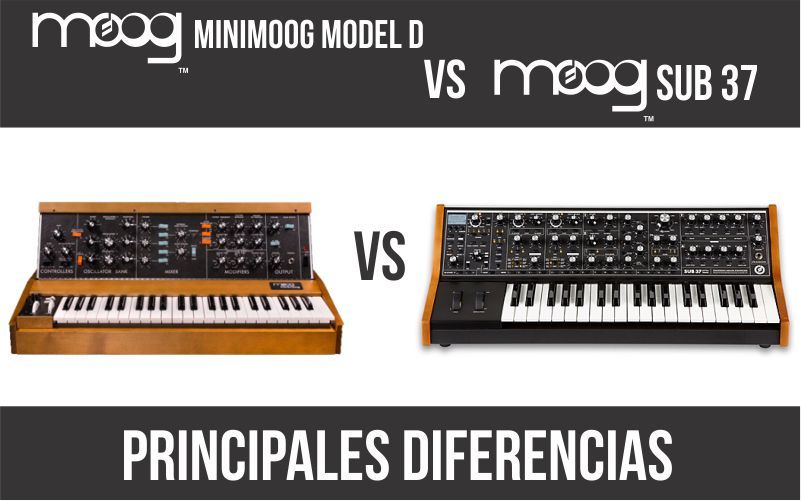
The Moog Sub 37 is a state-of-the-art paraphonic analog synthesizer created in honor of the great Bob Moog, a synthesizer with modern features such as the ability to save presets, arpeggiator and sequencer that can be synchronized, with two LFOs to modify the sound, and a filter and an envelope section in principle very similar to the Minimoog Model D.
As for the oscillators, the Sub 37 has 2 oscillators while the Minimoog has 3 oscillators, but the Sub 37 has an additional sub oscillator an octave lower to achieve deeper basses.
Another important detail is that the Minimoog is a monophonic synthesizer while the Sub 37 is a 2 voice paraphonic synthesizer, so it can be used as monophonic, but it can also be used with a 2 voice polyphony, each voice using one of the synthesizers.
Finally, the Sub 37 is a much cheaper synthesizer than the Minimoog Model D so it is a quite interesting option for many users.
Moog Minimoog Model D vs Behringer Model D
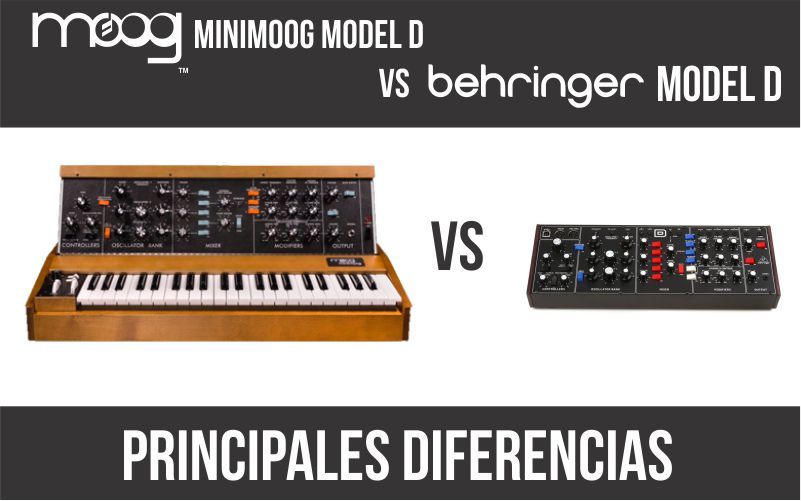
Recently, the Behringer brand has launched amidst controversy the Model D, a true copy of the legendary Minimoog Model D for an eleventh of its price.
Its sound and routing are exactly the same, with a couple of differences: the Behringer Model D has no keyboard, and a difference that may be of interest to many, the Behringer Model D has several voltage-controlled inputs and outputs on each of its parts, for connection to modular systems and semi-modular synthesizers.
For many audio lovers the Minimoog Model D is a collector’s item, but it is undeniable that the sound of Behringer’s Model D is quite similar, if not almost identical.
Other posts you may be interesting in
Analysis and Opinion Behringer Model D: Where to Buy
Behringer has given a great surprise with this launch, the Model D, a true imitation of the Minimoog Model D with the same controls, without keys, in a semi-modular format to connect to modular systems and what has caused more impact, for less than a tenth of the price of the Minimoog.
The big discussion about this machine is whether it sounds the same as the Minimoog Model D, and that is that Behringer has created a very faithful imitation of this legendary synthesizer with hundreds of people making comparisons around the world, with one common denominator in the comments: “They sound the same”.
Where to buy Behringer Model D?
In few words: The Behringer Model D is a semi-modular monophonic analog synthesizer that mimics the sound and controls of the legendary Minimoog Model D by Moog, one of the most important synthesizers in history, adding its possibility of connection with other modular and semi-modular systems thanks to its 14 voltage-connected inputs/outputs that allow you to expand your sound exploration and at a price well below that of the Moog synthesizer.
Although the Moog brand tried to sue Behringer, they sought to protect themselves from the time expiration of their patents and were able to launch their product on the market without any problems. Furthermore, Behringer has announced that it is working on 20 other new devices, including new synthesizers, such as the recently launched Neutron, and copies of legendary synthesizers that made history and classic drum machines.

Like the Minimoog, this synthesizer has 3 oscillators, each with 6 waveforms available, each of these oscillators with a range control, which refers to the octave of that oscillator, a waveform selector and on oscillators 2 and 3, a control to determine the stability of the tuning of these to achieve fuller-bodied detuned sounds.
The Controller section features global pitch control, Glide control, which determines how long it takes for the sound to progressively move from one note to another after the first note is released, and an assignable LFO with the ability to be set to square and triangle wave type.
In mixer section, it has controls for the level of each of the 3 oscillators, as well as control for the level of its noise generator and the option to select the type of noise, white or pink, and a control for the external input.
In the amplification section there is an envelope section with Attack, Decay and Hold controls; with an additional control not found in the Minimoog, the “Loud Decay” which acts on the release of this envelope, thanks to the patch points of this synthesizer, this envelope can be sent to other external modular or semi-modular equipment.
The filter of the Behringer Model D
The Minimoog’s resonant filter is quite praised by fans of these devices, so Behringer has made a great effort to replicate as closely as possible this 24 dB 4-pole filter, adding some things like the possibility of setting this filter to low pass or high pass (The Minimoog’s filter only works as a low pass).
This filter has a dedicated envelope with controls for attack, hold and decay and a contour control that determines how much the envelope affects this filter.
A control for the Keyboard Control, which changes the color of this filter according to the height of the notes being played, when activated.
Thanks to the patch points, the Cutoff can be controlled externally in this filter, and the envelope of this filter can be sent to control other external equipment.
Behringer Model D vs Minimoog Model D
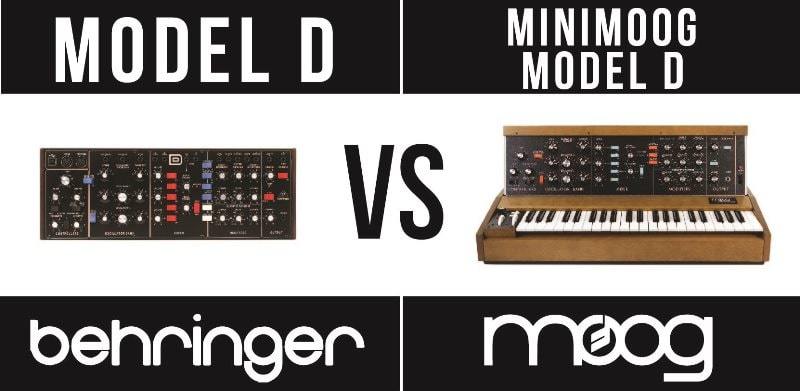
The Behringer Model D is a copy of the Minimoog Model D in both controls and sound.
The first and most notable difference is that the Behringer Model D has no keys, while the Minimoog Model D has a 3 octave keyboard.
The size of your panel is also different with the Behringer Model D being much smaller.
The Behringer Model D has some additional features such as the ability to use the filter as a high pass or low pass, control to activate a Filter Envelope Decay that would affect the relaxation of the filter and control to activate an Amplifier Envelope Decay that would affect the relaxation of this section, it is also possible to enable or disable the main output, but in terms of performance, the most notable feature of the Behringer Model D is its 3 patch points to communicate with modular systems, a feature that makes this synthesizer a semi-modular synthesizer, while the Minimoog Model D does not have this functionality.
Finally, and the most decisive argument for many is that for less than a tenth of the price of the Minimoog Model D, you can buy this clone made by Behringer.
Here is our review of the Minimoog Model D for more information.
Behringer Model D vs Roland SE-02
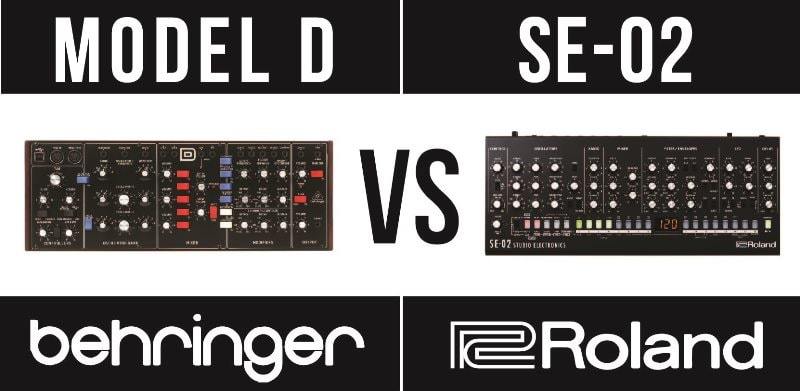
Both monophonic analog devices are inspired by the legendary Minimoog, with Behringer’s Model D being a more faithful copy, while the Roland SE-02 is a synthesizer with some of its shared features, being a device inspired by the Minimoog but not an imitation.
The Roland SE-02 has some additional features such as
- Step sequencer.
- Delay Digital
- XMOD section, with the possibility of making some additional connections not available in the Minimoog.
- An LFO with 9 types of waves available.
- The ability to save presets, up to 128 User Presets and 384 Factory Presets.
- Its chain mode allows several of these units to be grouped together, expanding polyphony, one polyphony voice for each chained unit.
Finally, it is important to note that Behringer’s Model D is a semi-modular synthesizer so its sound exploration can be greater thanks to connections with external equipment and modular or semi-modular systems.
Behringer Model D vs Behringer Neutron
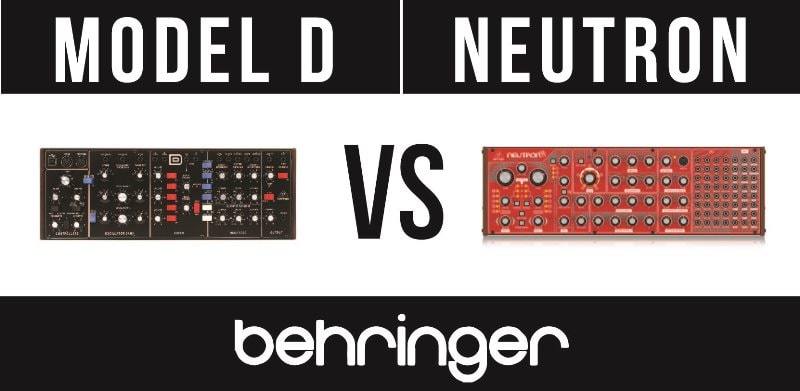
Both semi-modular analog synthesizers were created by Behringer, but while the Model D is an imitation of the Moog brand’s Minimoog Model D, the Neutron is a creation from scratch by the brand, being its third synthesizer launched with a good response from the public.
Here are the main differences:
- The Model D has 3 oscillators while the Neutron has 2 oscillators.
- While the Behringer Model D is monophonic, the Neutron has two modes, monophonic and paraphonic (the latter means that it can split its oscillators to give polyphony, so in the case of this synthesizer, in paraphonic mode it can have 2 voices of polyphony, each sounding from one of its oscillators)
- While the Model D has 13 patch points, the Neutron has 32 inputs and 24 outputs in its patch section.
- The Neutron also has 2 effects: Delay and Overdrive, to further modify the sound.
Behringer Model D vs Moog Mother 32

Both equipments are analogical monophonic semi-modular, with quite significant differences in their functionalities, among them:
- The Moog Mother 32 has a sequencer with up to 32 steps, while the Behringer Model D does not have that functionality.
- The Behringer Model D has 3 oscillators while the Mother 32 only has 1.
- While the Model D has 13 patch points, the Mother 32 has 32.
- The Behringer Model D has two envelope sections, one dedicated to the filter and one to the amp section, while the Mother 32 has only one envelope section.
Where to buy Behringer Model D?
We propose you our favourite shops to buy this kind of articles:
Conclusions
The Minimoog Model D is a device that has definitely stayed in the history of synthesizer lovers and definitely for many, knowing that they can have a device with the same sound and features, for less than a tenth of the price of the original equipment, is great news.