
Analysis and Opinion Behringer Model D: Where to Buy
Behringer has given a great surprise with this launch, the Model D, a true imitation of the Minimoog Model D with the same controls, without keys, in a semi-modular format to connect to modular systems and what has caused more impact, for less than a tenth of the price of the Minimoog.
The big discussion about this machine is whether it sounds the same as the Minimoog Model D, and that is that Behringer has created a very faithful imitation of this legendary synthesizer with hundreds of people making comparisons around the world, with one common denominator in the comments: “They sound the same”.
Where to buy Behringer Model D?
In few words: The Behringer Model D is a semi-modular monophonic analog synthesizer that mimics the sound and controls of the legendary Minimoog Model D by Moog, one of the most important synthesizers in history, adding its possibility of connection with other modular and semi-modular systems thanks to its 14 voltage-connected inputs/outputs that allow you to expand your sound exploration and at a price well below that of the Moog synthesizer.
Although the Moog brand tried to sue Behringer, they sought to protect themselves from the time expiration of their patents and were able to launch their product on the market without any problems. Furthermore, Behringer has announced that it is working on 20 other new devices, including new synthesizers, such as the recently launched Neutron, and copies of legendary synthesizers that made history and classic drum machines.

Like the Minimoog, this synthesizer has 3 oscillators, each with 6 waveforms available, each of these oscillators with a range control, which refers to the octave of that oscillator, a waveform selector and on oscillators 2 and 3, a control to determine the stability of the tuning of these to achieve fuller-bodied detuned sounds.
The Controller section features global pitch control, Glide control, which determines how long it takes for the sound to progressively move from one note to another after the first note is released, and an assignable LFO with the ability to be set to square and triangle wave type.
In mixer section, it has controls for the level of each of the 3 oscillators, as well as control for the level of its noise generator and the option to select the type of noise, white or pink, and a control for the external input.
In the amplification section there is an envelope section with Attack, Decay and Hold controls; with an additional control not found in the Minimoog, the “Loud Decay” which acts on the release of this envelope, thanks to the patch points of this synthesizer, this envelope can be sent to other external modular or semi-modular equipment.
The filter of the Behringer Model D
The Minimoog’s resonant filter is quite praised by fans of these devices, so Behringer has made a great effort to replicate as closely as possible this 24 dB 4-pole filter, adding some things like the possibility of setting this filter to low pass or high pass (The Minimoog’s filter only works as a low pass).
This filter has a dedicated envelope with controls for attack, hold and decay and a contour control that determines how much the envelope affects this filter.
A control for the Keyboard Control, which changes the color of this filter according to the height of the notes being played, when activated.
Thanks to the patch points, the Cutoff can be controlled externally in this filter, and the envelope of this filter can be sent to control other external equipment.
Behringer Model D vs Minimoog Model D
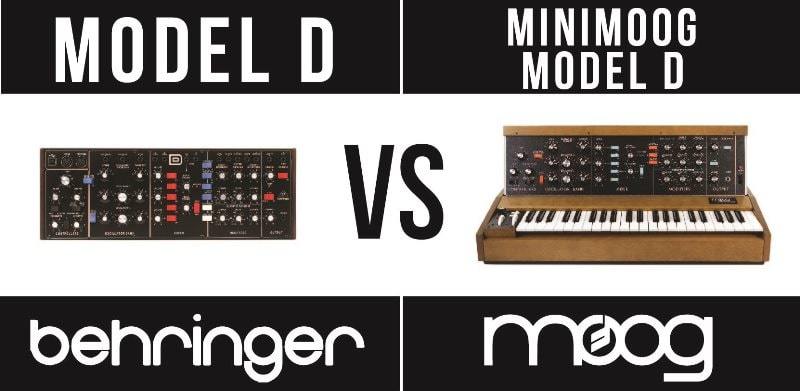
The Behringer Model D is a copy of the Minimoog Model D in both controls and sound.
The first and most notable difference is that the Behringer Model D has no keys, while the Minimoog Model D has a 3 octave keyboard.
The size of your panel is also different with the Behringer Model D being much smaller.
The Behringer Model D has some additional features such as the ability to use the filter as a high pass or low pass, control to activate a Filter Envelope Decay that would affect the relaxation of the filter and control to activate an Amplifier Envelope Decay that would affect the relaxation of this section, it is also possible to enable or disable the main output, but in terms of performance, the most notable feature of the Behringer Model D is its 3 patch points to communicate with modular systems, a feature that makes this synthesizer a semi-modular synthesizer, while the Minimoog Model D does not have this functionality.
Finally, and the most decisive argument for many is that for less than a tenth of the price of the Minimoog Model D, you can buy this clone made by Behringer.
Here is our review of the Minimoog Model D for more information.
Behringer Model D vs Roland SE-02
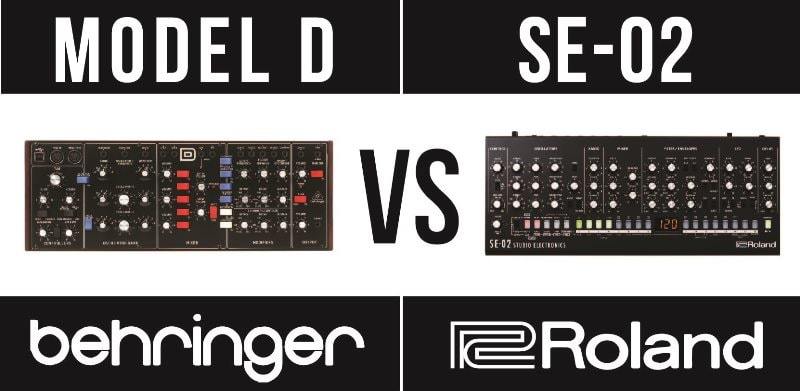
Both monophonic analog devices are inspired by the legendary Minimoog, with Behringer’s Model D being a more faithful copy, while the Roland SE-02 is a synthesizer with some of its shared features, being a device inspired by the Minimoog but not an imitation.
The Roland SE-02 has some additional features such as
- Step sequencer.
- Delay Digital
- XMOD section, with the possibility of making some additional connections not available in the Minimoog.
- An LFO with 9 types of waves available.
- The ability to save presets, up to 128 User Presets and 384 Factory Presets.
- Its chain mode allows several of these units to be grouped together, expanding polyphony, one polyphony voice for each chained unit.
Finally, it is important to note that Behringer’s Model D is a semi-modular synthesizer so its sound exploration can be greater thanks to connections with external equipment and modular or semi-modular systems.
Behringer Model D vs Behringer Neutron
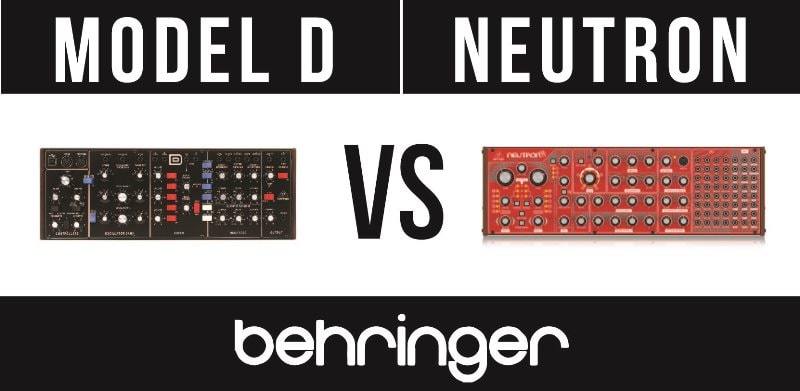
Both semi-modular analog synthesizers were created by Behringer, but while the Model D is an imitation of the Moog brand’s Minimoog Model D, the Neutron is a creation from scratch by the brand, being its third synthesizer launched with a good response from the public.
Here are the main differences:
- The Model D has 3 oscillators while the Neutron has 2 oscillators.
- While the Behringer Model D is monophonic, the Neutron has two modes, monophonic and paraphonic (the latter means that it can split its oscillators to give polyphony, so in the case of this synthesizer, in paraphonic mode it can have 2 voices of polyphony, each sounding from one of its oscillators)
- While the Model D has 13 patch points, the Neutron has 32 inputs and 24 outputs in its patch section.
- The Neutron also has 2 effects: Delay and Overdrive, to further modify the sound.
Behringer Model D vs Moog Mother 32

Both equipments are analogical monophonic semi-modular, with quite significant differences in their functionalities, among them:
- The Moog Mother 32 has a sequencer with up to 32 steps, while the Behringer Model D does not have that functionality.
- The Behringer Model D has 3 oscillators while the Mother 32 only has 1.
- While the Model D has 13 patch points, the Mother 32 has 32.
- The Behringer Model D has two envelope sections, one dedicated to the filter and one to the amp section, while the Mother 32 has only one envelope section.
Where to buy Behringer Model D?
We propose you our favourite shops to buy this kind of articles:
Conclusions
The Minimoog Model D is a device that has definitely stayed in the history of synthesizer lovers and definitely for many, knowing that they can have a device with the same sound and features, for less than a tenth of the price of the original equipment, is great news.

