
The best pianists in history
This is not the first post nor the last you’ll see with this title but if you want to be a little different from the others to classify the best pianists we are not going to use a single parameter such as virtuosity. We are going to evaluate other aspects such as their musicality and their social impact with the music they created in their time.
All this leads us to wonder what a good musician is. Who does play faster? Who does composes better or have a better rhythm?
Before entering our classification we leave you with an answer to these questions. Here’s a genius like Jon Chapin giving his point of view on what a good musician he is.
I’m sure you’ll be interested in…
Some of the best musicians cannot play their instrument virtuously, but they play music extremely well…
There is not only classical music
Many times it seems that the past was always better. And it’s true that there’s almost always talk about the classics. They are the ones who were creating a musical world around the piano since its invention more than two centuries ago. But even if it seems to be a lie, we also have geniuses in the 20th century that can be compared to the geniuses of the classical world.
Having said all this, it must be said that we are going to respect a little the chronological order of the classification, especially to have a chronology. So here we go with our selection.
Wolfang Amadeus Mozart (1756-1791)
Evidently he has to be on the list and not just because he was a prodigy and learned from other musicians, applying everything he learned about himself like a sponge. But also because he was one of the first to seriously bet on the piano.
Mozart played many instruments and was a harpsichord and harpsichord virtuoso. Which were more popular than the piano in the 18th century.
At Mozart’s time romanticism was coming and a different instrument was needed to express emotions and moods. The piano made it possible to regulate its dynamics by pressing the key with one force or another and this gave it a devastating capacity to express itself.
But Mozart was able to imagine a world of instruments at once. All of them sounding in their head perfectly differentiated. It was like a Cubase human multitrack software cyborg and photographic memory.
Here’s a piece for piano that marked a milestone in his career:
W.A.Mozart: Concerto for piano and orchestra Nº9
Ludwig van Beethoven (1770-1827)
A real impressive pianist in its history. Beethoven changed the music with his way of playing and his compositions, with an expressiveness and musical richness never seen before.
We could define Beethoven as the Jimmy Hendrix in that time, piano version. They said that the piano keys had to be changed every few months as they were being charged. So he was the luthiers’ best friend.
What he had of genius was lacking in social skills. He had a difficult childhood due to an alcoholic father who forced him to practice instead of playing with other children and this affected him in his social relationships. Not to mention his cruel fate in the form of deafness. A musician’s worst nightmare (well, along with no cable jack to plug your instrument into a jam session, but it doesn’t come to mind)
Among other curious stories of this great musician we can talk about his piano duels. Yeah yeah, like rappers’ cockfighting. In particular, a duel that took place in 1800 in the Lobkowitz palace against Daniel Steibelt. To make fun of his rival Beethoven took scores of a song from his rival and began to play it and modify it at the same time he played. He humiliated his opponent so much that he moved to another city.

Beethoven with a serious face
Okay, now let’s take some temporary leaps. We know that we skip some geniuses like Johann Sebastian Bach or Joseph Haydn but the length of a post on a blog can not be 35 pages. By jumping these pianists much want to kill us but well, is what one risks doing this type of post.
Franz Liszt and extreme virtuosity (1811-1886)
Probably the pianist with the best technique that has ever existed in the history of the piano. And few people dare to refute this reality today. Although he is a pianist now forgotten by many.
It is curious that what inspired this pianist and many others to reach this level of technical perfection and virtuosity was not another pianist, but the great violinist Paganini.
Paganini studied 14 hours a day, they said he was not human and Liszt wanted to take this same level to the piano and we can say he did it.
It must be said that what this man did is a life choice and of course he is considered by many to be the best technically speaking pianist that has ever existed. Although we must not forget that pianists like Schumann in his eagerness to reach virtuosity was built an artifact to elongate the fingers of the hand and have more range for his fingers … The composition had to be changed after the hand had been damaged for life.
Liszt’s works are often characterised by their technical complexity
Duke Ellington, a good team player (1899-1974)
We had doubts between putting Duke Ellington or Bill Evans, but in the end we decided on Duke (we felt weakness of his album with Coltrane).
Duke Ellington is one of the key pieces in 20th century jazz. With a prolific musical production he reached the highest levels of success and today many of his compositions for Big Band are the object of study in modern music schools.
Of course this man was an authentic factory of standard Jazz, but in addition to his orchestra have passed the greatest jazz musicians ever seen as the saxophonist Johnny Hodges.
The award for teamwork comes from his habit of focusing his compositions to get the best out of other musicians and make them shine. A tremendous character, this Duke Ellington.
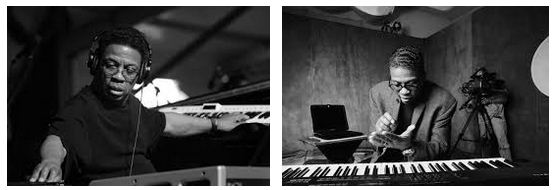
Herbie Hancock (1940 – still alive)
Herbie certainly takes the innovation award. This pianist has been a key piece in the evolution of jazz piano towards electronic music and synthesizers.
There are conflicting opinions about Hancock, as certain changes in his musical career have not pleased the most purists. He has played all styles of Jazz and composed some of the best known songs of that style such as Watermelon Man.
With engineering education Herbie Hancock marked the first step in the use of electronic music. He spent 5 years with Miles Davis but then left him to follow his own trajectory. Then I travel to Funk and innovate with the use of electric pianos and synthesizers. Winning several Grammy awards and reaching a total worldwide repercussion.
He is a restless musician and a reference in the world of synthesizers and electronic keyboards. It’s definitely our favorite.
There are many more amazing musicians and we know that we have left apart but it is impossible to get them all out. But we’re sure it’s a good selection.

