
- Home
- Author's Archive:
Selection of MIDI Controllers with 88 Hammer Action Keys
To practice with the piano at least at the beginning it is clear that it is valid with 61 keys. But if you really want to invest thinking about not having to change anything in the future and always being able to play 2 hands calmly, it’s not a bad idea to buy a MIDI controller that already has 88 keys and an acceptable Hammer Action.
The 88-key MIDI controllers may or may not have internal speakers. On the one hand we are going to show you a MIDI controller designed to work from home and that has many built-in controls for music editing. And then we’re going to show you a Hammer Action piano keyboard that has MIDI output and is also a digital piano, so it has speakers and lots of professional sounds built in.
M-Audio Oxygen 88 Keys
Brand with enough prestige as far as MIDI controllers are concerned. It’s a pretty light keyboard for the size it is.
Very suitable to work fast with programs of musical creation and composition. The potentiometers are made of plastic and at first it gives the impression of delicacy but then it is verified that the material is stable and durable.
The idea of this keyboard is that you have a full 88-key keyboard but more focused on having controls that help you in music editing. It has many buttons and remotes that speed up your productivity when mixing and recording with programs like Cubase or Ableton. The following video explains some of the features that come with this MIDI controller.
Hammer Action’s feel allows you to match real piano feel with the productivity of a MIDI controller specific to music editing. Includes Ableton Live Lite and Ignite Music Creation.
It’s a perfect choice if you want it for music editing and you’re not going to move it from home. If you also want to use it as a portable digital piano we advise you to take a look at the second keyboard in the list. If you want to buy this MIDI controller here a link to the best price:
Yamaha P 115B and Yahama P125 (Black) – Digital Piano with USB MIDI
High quality piano keyboard with MIDI interface. If you play the piano and want a keyboard that can be used to study and as a MIDI controller, this is the option that exists in the market with the best value for money.
Yamaha P125 is the new brand.
Yamaha is a very reliable brand and Yamaha’s special Hammer Action is tremendously faithful to its acoustic pianos.
The Yamaha P115 has another intentionality than the previously shown Oxygen model. It is a portable digital piano that can serve as a MIDI controller as it has USB MIDI to Host output.
It comes with a sustain pedal (keep the note sustained over time) and although there are better ones it will help you get started. You can always buy a better pedal in the future. Here’s of to connect the Yamaha to a computer.
As you might have noticed, both can be MIDI controllers, but depending on what you want, they can have more features for music editing or not.
Yamaha PB-115B vs M-Audio Oxygen 88
Oxygen’s MAdudio controller has many controls that will make you fly when it comes to music production even though its Hammer Action is a bit worse than the Yamaha P115.
The Yamaha P115 doesn’t have all the controls and shortcuts that the Oxygen has but it works as a stage piano and as it has 7W speakers you can take it with you to play and rehearse elsewhere. The Oxygen is more to have in your home studio.
If you can only buy one of the two you have to assess whether you want to just study piano and play at home or in the future want to take your digital piano to play with other people. In the second case go for the Yamaha P115 and if you will always work from home and like to produce music choose the M-Audio Oxygen.
If your budget is not too big you can find other options in our selection of musical keyboards with the best value for money. In that article you have very interesting options of 61 keys with MIDI at very affordable prices.We hope you found this article useful. If so, don’t hesitate to share it on your social networks. Thanks for reading!
Vote if you liked this article 🙂

Top 10 Jazz Pianist in History
Jazz pianists don’t always get the “commercial” recognition they should. But they do not cease to enjoy great prestige. Many of them have found world fame and Jazz is becoming more and more respected and demanded in the world of music. Above all it is necessary to note the strong boom of the Swing dance in all the cities of the world.
Many of the pianists we are going to cite and their work have been real milestones for music. They have broken the rules of modern harmony and changed the paradigms of music in their time. Today many of its themes are considered standard, authentic reference themes played by all modern music students on the planet.
I’m sure you’ll be interested in…
Here’s our selection:
Thelonious Monk (1917-1982)
American pianist and founder of the Bebop movement. He is one of the most respected and referenced jazz composers in history.
During his musical career he came into contact with legendary musicians such as Charlie Parker and John Coltrane. He had episodes of drugs but they didn’t affect him to have a prolific career. At the end of his career he lived in retirement because of his mental problems.
Some of their themes are key standards in the history of Jazz. One of them is “Round About Midnight.” Next we leave you a recording where you can see him in person with his Thelonious Monk Quartet.
Bill Evans (1929-1980)
Bill Evans stands out as one of the key figures in Cool Jazz. Which was a style with more expressive phrases and less complex phrases and scales than with Bebop scales.
Bill Evans is sometimes accused of moving away from the black roots of Jazz and being too strict with his elitist composing rules. Bill Evans drinks directly from the expressionism of Debussy and Ravel.
He specialized in the formation of bass trios, piano and drums. Composing a special dialogue between them, fortunately there is a recording of him and George Russell playing the famed Concerto for Billy the Kid
Marian McPartland (1918-2013)
There are very good pianists throughout history, but unfortunately historical recognition has fallen rather on men in the world of Jazz. Although Maria McPartland did achieve notoriety and world fame in the world. In 2004 he received a Grammy in recognition of his career and his contribution to Jazz.
I travel all over the world, although I normally lived in the United States. When she was young she was accepted in London at the Guildhall School of Music and it is curious what they said about her in 1935 at the time of accepting her.
“Incredible enthusiasm, gift of God and a wonderful imagination.”
They also said at the time that her technique was not good…but she improved and improved until she became a master.
She had a passionate life in even being in World War II as a volunteer and where she had to learn accordion because there were no available. There she met her husband, a volunteer Chicago cornetist on a Jam, and then invited her to form a sextet with other musicians to entertain the troops.
Marian not only stood out for a time in her life, but for her continuous work for Jazz. In the 60’s she formed her own record label to promote undervalued Jazz musicians and from the 70’s onwards she toured half the world. Although he didn’t have a great musical reading, he played with symphony orchestras learning the subject by ear.
Here she is playing “In a Mist”.
Dave Brubeck (1920-2012)
Great musician and one of the top representatives of Cool Jazz (West Coast Jazz current) along with Bill Evans. Elegant and with touches of improvisation genius is one of the pianists who broke the boundaries of Jazz and reached a very wide audience.
With his faithful saxophonist Paul Desmond composed the ultra-famous Jazz standard “Take Five”.
Bud Powell (1924-1966)
New Yorker by birth is one of the greatest exponents of Bebop. He was born into a family of musicians although he had a difficult childhood. Even his grandfather was a flamenco guitarist who trained in Cuba.
In 1944 he joins Cootie Williams’ orchestra, but the terrible schizophrenia hovers over him. Although in 1946 he returned to play and came into contact with Jazz Bebop, where he stood out as a fundamental figure playing with figures such as Dizzy Gillespie and Charles Mingus in a legendary concert held in Toronto, Canada.
Although he tried to reverse schizophrenia with electroshock sessions, he eventually fell into decline with the passage of time.
Video of Bud Powell in Paris in 1962:
Duke Ellington (1899-1974)
Another genius born in Jazz City, New York. He is one of the Jazz musicians with the most prolific activity (he wrote more than 1000 compositions). Some of the greatest figures of Jazz have passed through their orchestras like the saxophonist Johnny Hodges.
Especially popular were his performances at the mythical Cotton Club in Harlem, where he reached national dimension as a musician throughout the United States.
His contribution to the orchestra and his charisma raised Jazz to equal its popularity to that of other musical genres. It was considered a true “Rock Star” in the United States.
Here’s one of his most popular songs from the album he did with John Coltrane “In a Sentimental Mood”.
Art Tatum (1909-1956)
Art Tatum was a musician born in Cleveland and ahead of his time. In the 1930s he set the tone for Bebop’s musicians to explore years later.
Almost blind since he was a child, Art Tatum with 6 years old was able to play songs by ear that were for duets without knowing that they had to be played by two interpreters. We are talking about some of the most technically gifted musicians of the 20th century.
He used to make his recordings without other musicians because it was difficult for them to follow his fast tempo and his harmonic changes. His piano solos have truly legendary improvisations.
Chick Corea (Born in 1941)
American by birth is one of the greatest exponents of the birth of Jazz Fussion in the 1970s. He played with Miles Davis and it was with him that he began to lay the foundations of this genre. His career has followed a very parallel course to Herbie Hancock’s and they have even collaborated together.
Composer of several standards that today can be found in the reference book Real Book. The star quintet that he formed in 1996 with musicians like Kenny Garret in which they versioned Bud Powell and Thelonious Monk is especially noteworthy.
Herbie Hancock (Born in 1940)
Like Chick Corea, Herbie Hancock collaborated with Miles Davis on Funk albums and is one of the most transgressive Jazz musicians who have experimented with all styles and genres. And that has provoked conflicting opinions about his person.
Hancock stands out as a virtuoso and creative in any style of Jazz but it is his experimentation with electronics that makes him a unique figure. Throughout his career he has experimented with synthesizers of all kinds and is a reference figure in Electric Jazz. World famous has written and performed the music of the film Round Midnight about Dexter Gordon.
Brad Mehldau (Born in 1970)
One of the young promises with the most projection today. We strongly recommend that you do not lose sight of this musician because he has given and will give much to talk about throughout history.
Virtuous and balanced, he is sometimes compared to Bill Evans but he does not like this comparison. He has developed an independence of hands and an extraterrestrial level rhythm.
We noticed him for this list because of his role on the tour with Joshua Redman. One of the best saxophonists there is today. Attention this boy!
We hope you liked our selection, if so, don’t hesitate to share it to promote good music and culture. Thank you for reading us!
Vote if you liked this article 🙂

The best pianists in history
This is not the first post nor the last you’ll see with this title but if you want to be a little different from the others to classify the best pianists we are not going to use a single parameter such as virtuosity. We are going to evaluate other aspects such as their musicality and their social impact with the music they created in their time.
All this leads us to wonder what a good musician is. Who does play faster? Who does composes better or have a better rhythm?
Before entering our classification we leave you with an answer to these questions. Here’s a genius like Jon Chapin giving his point of view on what a good musician he is.
I’m sure you’ll be interested in…
Some of the best musicians cannot play their instrument virtuously, but they play music extremely well…
There is not only classical music
Many times it seems that the past was always better. And it’s true that there’s almost always talk about the classics. They are the ones who were creating a musical world around the piano since its invention more than two centuries ago. But even if it seems to be a lie, we also have geniuses in the 20th century that can be compared to the geniuses of the classical world.
Having said all this, it must be said that we are going to respect a little the chronological order of the classification, especially to have a chronology. So here we go with our selection.
Wolfang Amadeus Mozart (1756-1791)
Evidently he has to be on the list and not just because he was a prodigy and learned from other musicians, applying everything he learned about himself like a sponge. But also because he was one of the first to seriously bet on the piano.
Mozart played many instruments and was a harpsichord and harpsichord virtuoso. Which were more popular than the piano in the 18th century.
At Mozart’s time romanticism was coming and a different instrument was needed to express emotions and moods. The piano made it possible to regulate its dynamics by pressing the key with one force or another and this gave it a devastating capacity to express itself.
But Mozart was able to imagine a world of instruments at once. All of them sounding in their head perfectly differentiated. It was like a Cubase human multitrack software cyborg and photographic memory.
Here’s a piece for piano that marked a milestone in his career:
W.A.Mozart: Concerto for piano and orchestra Nº9
Ludwig van Beethoven (1770-1827)
A real impressive pianist in its history. Beethoven changed the music with his way of playing and his compositions, with an expressiveness and musical richness never seen before.
We could define Beethoven as the Jimmy Hendrix in that time, piano version. They said that the piano keys had to be changed every few months as they were being charged. So he was the luthiers’ best friend.
What he had of genius was lacking in social skills. He had a difficult childhood due to an alcoholic father who forced him to practice instead of playing with other children and this affected him in his social relationships. Not to mention his cruel fate in the form of deafness. A musician’s worst nightmare (well, along with no cable jack to plug your instrument into a jam session, but it doesn’t come to mind)
Among other curious stories of this great musician we can talk about his piano duels. Yeah yeah, like rappers’ cockfighting. In particular, a duel that took place in 1800 in the Lobkowitz palace against Daniel Steibelt. To make fun of his rival Beethoven took scores of a song from his rival and began to play it and modify it at the same time he played. He humiliated his opponent so much that he moved to another city.

Beethoven with a serious face
Okay, now let’s take some temporary leaps. We know that we skip some geniuses like Johann Sebastian Bach or Joseph Haydn but the length of a post on a blog can not be 35 pages. By jumping these pianists much want to kill us but well, is what one risks doing this type of post.
Franz Liszt and extreme virtuosity (1811-1886)
Probably the pianist with the best technique that has ever existed in the history of the piano. And few people dare to refute this reality today. Although he is a pianist now forgotten by many.
It is curious that what inspired this pianist and many others to reach this level of technical perfection and virtuosity was not another pianist, but the great violinist Paganini.
Paganini studied 14 hours a day, they said he was not human and Liszt wanted to take this same level to the piano and we can say he did it.
It must be said that what this man did is a life choice and of course he is considered by many to be the best technically speaking pianist that has ever existed. Although we must not forget that pianists like Schumann in his eagerness to reach virtuosity was built an artifact to elongate the fingers of the hand and have more range for his fingers … The composition had to be changed after the hand had been damaged for life.
Liszt’s works are often characterised by their technical complexity
Duke Ellington, a good team player (1899-1974)
We had doubts between putting Duke Ellington or Bill Evans, but in the end we decided on Duke (we felt weakness of his album with Coltrane).
Duke Ellington is one of the key pieces in 20th century jazz. With a prolific musical production he reached the highest levels of success and today many of his compositions for Big Band are the object of study in modern music schools.
Of course this man was an authentic factory of standard Jazz, but in addition to his orchestra have passed the greatest jazz musicians ever seen as the saxophonist Johnny Hodges.
The award for teamwork comes from his habit of focusing his compositions to get the best out of other musicians and make them shine. A tremendous character, this Duke Ellington.
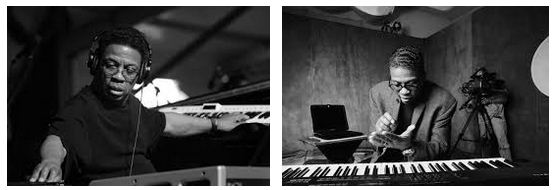
Herbie Hancock (1940 – still alive)
Herbie certainly takes the innovation award. This pianist has been a key piece in the evolution of jazz piano towards electronic music and synthesizers.
There are conflicting opinions about Hancock, as certain changes in his musical career have not pleased the most purists. He has played all styles of Jazz and composed some of the best known songs of that style such as Watermelon Man.
With engineering education Herbie Hancock marked the first step in the use of electronic music. He spent 5 years with Miles Davis but then left him to follow his own trajectory. Then I travel to Funk and innovate with the use of electric pianos and synthesizers. Winning several Grammy awards and reaching a total worldwide repercussion.
He is a restless musician and a reference in the world of synthesizers and electronic keyboards. It’s definitely our favorite.
There are many more amazing musicians and we know that we have left apart but it is impossible to get them all out. But we’re sure it’s a good selection.