
- Home
- Author's Archive:
Children’s Musical Keyboard Selection
If you are a parent looking for a keyboard for your child to start exploring and maybe in the future start with the piano you are in the right place.
By children we mean infants under 10 years of age. When we think of a keyboard for them we have to keep in mind that even a child likes to play. So here’s one of the first to consider. Make the keyboard fun and for that it has to have a lot of sounds.
I’m sure you’ll be interested in…
It is not highly recommended to buy a keyboard from a child without any kind of guide. It is dangerous cause without the right piano you child can quit.
You are probably thinking that children’s keyboards should be simpler and cheaper. Of course they are cheaper and so we thought to recommend three models. But don’t worry if it’s got a lot of buttons, either. Children are real sponges and will quickly get the functionalities.
If your child is under the age of 5, we don’t recommend that you put him to music yet. Only if you’re thinking about the Suzuki method that’s more natural for them. In that case, the models we have selected will work for you.
There are keyboards with colored piano keys but don’t buy them, they really don’t inspire the musical feeling in the child and they sound so bad that they will lead you to acoustic agony. They have to have a few minimums.
Let’s go with our selection:
Yamaha PSR F51
The Yamaha PSR F51 is a keyboard with 120 sounds plus a number of accompaniments for your child to play on. And all for less than 100 €.
It has 61 keys, so you can play any song you like. He’s got 114 rhythms from all over the world that’s sure to amuse him. Simple and intuitive interface.Very lightweight, can run on batteries and comes with the included power supply. It has 2 W speakers and headphones output for your child to touch in silence.
Ideal to start in a relaxed and fun atmosphere. If you are going to start the conservatory is already a more serious thing and you should look at our guide with the best piano keyboards. Although it may be worth the bottom of the list if you’re on a tight budget.
We leave you a video to see the amount of sounds it has and a link that takes you to the best price for this keyboard.
Casio CTK 1300
The Casio CTK 1300 is the direct competitor of the Yamaha PSR F51. Also with a price under 100 euros is a keyboard that follows the same paradigm.
It has 100 different sounds including different sounds and has another 100 accompaniments to play on.
The Yamaha PSR F51 has some more polyphony, which is the amount of notes that can sound at once. Including the accompaniment you’re playing.
Also supports batteries and works with charger but is not included.
It has 61 keys and although it is very popular but for now wins the Yamaha PSR F51. Although there are real fans of the Casio brand. You have to keep in mind that none of these keyboards have sensitive or Hammer Action keyboards. It’s for first contact and fun. But the next one we’re going to talk to you about already raises the level for a little more money.
Below video
Click the button if you want to see the best price for the Casio CTK 1300
Casio CTK 3200 and CTK 3500
The Casio CTK 3200 electronic keyboard (we link on that review the new model Casio CTK 3500) is a great option for a child to consider and for a really low price.
It’s a keyboard that has all the basics to start with the piano, have fun and if you’re a little serious for the first year of conservatory. And then it is very useful for various functions or can be sold easily second hand because it is in high demand. And all this for a price difference over the first of about 50 euros.
The Casio CTK 3200 is very good because it carries:
- 61 sensitive keys.
- MIDI connection to the computer to then compose with computer programs. Ideal for children.
- More polyphony, sounds and accompaniments than the other keyboards on the list. And more quality.
- Bring the power supply and it also has sustain pedal input. Which will be very useful for learning piano.
- It also has many controls to play with sounds like the Pitch Bend and is very portable also admitting batteries.
We hope we helped you choose a children’s piano. I’m sure your child will have fun choosing which one you choose. Feel free to continue reading useful content on our blog below. You may also be interested in our guide with everything you need to know about pianos.
Vote if you like this article 🙂
How to choose the best Piano Bench
The piano bench is a very important element in the study of the piano. We are going to spend many hours studying with our instrument, so it is important to worry about ergonomics.
In this post we are going to explain the factors to take into account when buying a piano stool and we are also going to give you some postural advice to avoid back pain and injuries typical of pianists who study a lot. On the other hand we will also select some stool that we consider suitable.
I’m sure you’ll be interested in…
- Ranking with the best digital pianos in quality-price ratio
- The cheapest musical keyboards for beginners
- Learn piano by yourself and for free
It is very important that the stool is adjustable. Everyone is different and we have different heights or our legs can be longer or shorter. All this means that if we sit on any chair our limbs and backs can be in incorrect positions.
Incorrect positioning creates stress and this can lead to injury in the long run. Besides, playing with tension makes us play worse.
The right position to play the piano
We are going to give you some basic guidelines that will tell you if you are in the right position or not.On the one hand the arms, it is important that having our back straight the elbows are at the same height as the keyboard. In a similar way to the image:

We have to bear in mind that when we study piano we are going to be sitting for many hours. So it is important that the piano stool is well padded so that our buttocks do not suffer.
The back should be straight and shoulders relaxed. When playing piano you will not always be straight, but you will lean to the right or to the left when you want to play very low or very high notes. That’s why we only have to support the buttocks on the sidewalk and not the legs. Sit as far to the edge as possible, supporting your buttocks. More or less as shown in the following image:
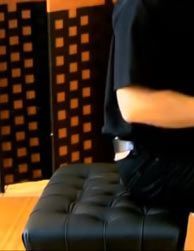
Of course we must avoid doing it in the following way:
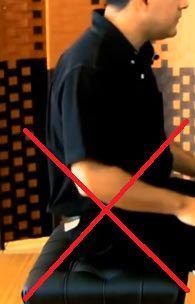
We leave a video that explains perfectly the proper way to sit and you’ll see why it is so important that your bank is adjustable. After the video read on that the post follows.
The best adjustable piano bench
There are plenty of benches but without doubt the most popular is the Classic Cantabile. It is adjustable and very comfortable and has a very balanced price. Less than 100 euros.
This model of adjustable stool is one of the most sold nowadays and it is bought in conservatories, music schools, etc. It is valid for many hours of study. Here we leave it on the web that have it at the best price:
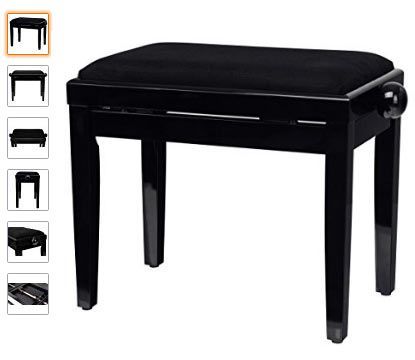
As well have a look to see the model below of Thomann Music Store:
There are better ones but in relation quality price these models is more than enough. Here are some tips to keep in mind.
Avoiding injuries when playing the piano
It is very important that in addition to having an adjustable piano stool you stretch at least every hour. If you are going to study a lot your body will suffer a lot if you do not stretch and rest.
We recommend that you visit our post with stretching for musicians. It is very important that you learn to stretch and avoid injuries because, for example, a badly healed tendinitis can leave you months without touching.
On the other hand, the adjustable stool is just as necessary. For digital or electronic pianos. If you are thinking of buying a piano we leave you our selection of the best portable digital pianos. And if you are learning piano do not hesitate to visit our section with resources to learn piano . And if you go down a bit you will also find very popular posts like our choice of the best pianists crazy stories. Thank you for reading us!
Vote if you liked this article 🙂
Where to Buy Yamaha PSR Keyboards – Analysis and Opinion
The Yamaha PSR portable keyboards are a series of keyboards with a great variety of sounds. There is an “E” series designed for beginners and an “S” being designed for professionals.
Yamaha PSR keyboards are some of the most popular keyboards out there. It is possible that because of its large number of models for beginner.
The objective of these keyboards is to give the interpreter the possibility of having a great set of sounds in the same instrument. Its main objective is not the practice and study of the piano.
Yamaha PSR keyboards are perfect as rehearsal keyboards as they weigh very little and as MIDI controllers and composers. Although they are not intended for long-term and medium-term study. They’re good for playing the keyboard for the first few months and find out if you like it.
Portability is one of its strengths as they usually weigh between 4 and 6 kg.
They usually bring sensitivity to the keyboard so you can regulate a little the dynamics of the note you’re playing and also support sharp pedal to keep the note in time. But the E series doen´t have keyboard sensitivity.
First we’re going to talk about three PSR keyboards from the beginner’s series E
Yamaha PSR E Series
I’m sure you’ll be interested in…
- Ranking with the best digital pianos in quality-price ratio
- The cheapest musical keyboards for beginners
- Other Yamaha Digital Piano Reviews
- Learn piano by yourself and for free
Let’s talk about Yamaha PSR E353 and Yamaha PSR E253 whose price is between 100 and 150 € and then the Yamaha PSR E453 that goes up little price.
The Yamaha PSR E353 features 61 keys, keyboard sensitivity and sustain pedal input and can also be connected via MIDI to the computer. All this makes it more worthwhile than the Yamaha PSR E253, as the price difference is ridiculous.
The Yamaha PSR E253 is a little cheaper, it has sustain pedal input but it doesn’t have a sensitive keyboard or MIDI.
If your budget is between 100 and 150 no doubt go for the Yamaha PSR E363. Here’s an in-depth review of the Yamaha PSR E363.
The Yamaha PSR E453 is a bit more expensive than the Yamaha PSR E353 but provides many more sounds and options that make it more usable. And his polyphony is 48 notes. What are the notes that may sound at the same time.
The Yamaha PSR E453 gives a more professional look and is closer to the more professional SRS. He’s a little heavier at 6 kg and his variety of sounds and effects is brutal. We encourage you to take a look at our review of the Yamaha PSR E463.
All Yamaha PSRs come this year with a free subscription to Flowkey, a powerful interactive piano learning app. And they also bring Yamaha’s Education Suite.
Yamaha PSR F Series
These ultra cheap keyboards or very lightweight 61-key portable keyboards with prices below 100 Euros. But they’re very basic keyboards designed to have fun or to hear how a chord sounds and to help the composition.
They don’t have a sensitive keyboard or pedal input but their low price makes them suitable if you just want a keyboard that sounds and has 61 keys to do harmony-related things.
One of its best-selling models is the Yamaha PSR F51.
Yamaha PSR Professional Series S > PSR S750, PSR S650 and PSR S950
The Yamaha PSR S755 and PSR 955 go up quite a bit in price, but they have their reasons for it. These portable keyboards bring an enormous amount of professional sounds.
Over 1000 euros but if you are a professional looking for a portable keyboard with better polyphony, multitrack recording these are your keyboards. Evidently there is no doubt that they are for a different audience than the Yamaha series E.
They’re very live-oriented keyboards. And with a lot of support for creating DJ music. They have many real-time controls to modify the music and many sounds and styles for electronic music.
I really love the Yamaha PSR S670. It is the perfect middle point between the E serie and the S series with a price around 500 €. Good sounds and quality.
If you want to know more about musical keyboards, don’t hesitate to visit our yamaha keyboard guide.
We hope that you have contributed a lot to this article. If you think it could be useful to someone, don’t hesitate to share it. Thank you for reading it!
Vote if you liked this article 🙂