
- Home
- Author's Archive:
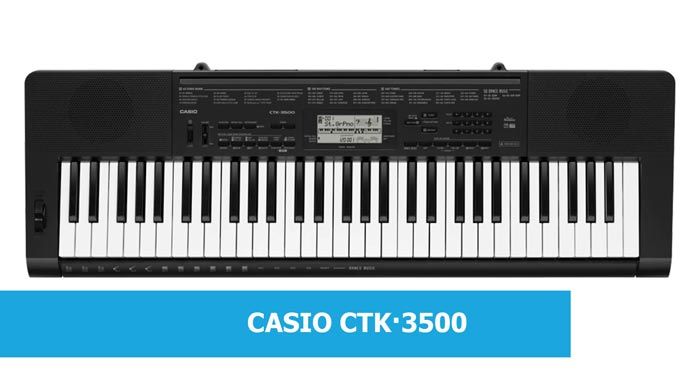
Digital Piano Casio CTK 3500 Full Review. Is it worth it?
Digital Piano Casio CTK 3500 Full Review. Is it worth it?
Today we are going to talk about the Casio CTK 3500. The new version of the Casio CTK 3200 and one of Casio’s best-selling models in the entry-level range or for people looking for a secondary keyboard.
The Casio CTK 3500 is a direct competitor of the Yamaha PSR E363 (formerly YAMAHA PSR E353) and has started almost at once. This has its logic because both companies compete for the same business niche.
I’m sure you’ll be interested in…
- See this section for possible discounts and offers
- Ranking with the best digital pianos in quality-price ratio
- The cheapest musical keyboards for beginners
- Learn piano by yourself and for free
The Casio CTK 3500 and similar are cheap keyboards, but they comply with premises that make them very useful. They have a sensitive keyboard, USB MIDI connection and input for sustain pedal. The fact about having this pedal is it makes worth learning the first two years if you have a very low budget. And then there are many utilities like keyboard layout and rehearsal thanks to its USB-MIDI interface.
Where to Buy Casio CTK 3500?
Amazon
- Free Shipping and possibility of shipping in one day with Amazon Premium.
- Full Guarantee but they are no experts in music equipment
- Leader in fast shipments.
- Price that change a lot daily.
- The best option in USA and ASIA
Thomann
- Free Shipping with special offer bundle.
- Full warranty. If you have any problems, they take care of everything.
- 100% reliable payment.
- Leader in trouble-free shipping.
- Usually best price.
- Best Reputation: They are the leading online store in Europe and have the best catalogue and information.
The USB MIDI interface is something very powerful. You can do such wonderful things as connect your keyboard to your computer, record a MIDI track in programs like CUBASE and then with a single click export that track to score. Nowadays, the MIDI connection is basic because if you do not have it in a short time, you will surely miss it.
They are keyboards with a very advantageous price, although you have to bear in mind that they have a low price. They are usually around 150 € and of course, the keys have a plastic touch. The truth is, I like the feel of Casio better than that of its competitor Yamaha. But well, it is not a very good touch either. But for the price to pay…
You have a keyboard with two sensibilities. This means that you can press the louder or looser key and the note will sound more or less based on this intensity. It is not much, but it is worth it in the first place.
It’s not a Hammer Action keyboard. In other words, the keys have no weight and this is a limitation in learning the piano. As we say it’s a piano that you can use for the first and second year. Very good to know if you like to play the piano as they are easy to sell or have other utilities.
Let’s examine other technical aspects:
Sound
The Casio sound engine is quite accomplished and the piano and electric piano sounds are quite nice. They don’t sound as professional as on top-of-the-range keyboards, but they have several sounds that sound very acceptable. The electronic music on this range of keyboards can always sound a little… unprofessional…
It has 48-voice polyphony, which is not bad at all for the price it has got. The polyphony of a keyboard is the number of musical notes that can sound at a time. This includes the ones you are playing and the accompaniments that may be playing at the same time. It is ok for an initial level.
It brings 400 different tones or sounds, including classical and electric piano sounds, several different instruments, electronic music sounds. You have a bit of everything but the important thing is the sounds of piano and electric piano. Those sounds are good for the price range in which this keyboard is.
It has reverb effects, Hall piano and many others to change the tone with which you are playing and give more brightness, resonance, and so on.
It has 100 integrated rhythms and 60 songs and accompaniments that adapt to what you play.
Watch this video that makes a tour of the most relevant sounds of this keyboard.
Here is another video that shows you some of the styles that come with the keyboard.
Connectivity and extras
As we mentioned before, you have two things that are vital. USB MIDI connector to work with the computer and connector for a sustain pedal. This pedal is used to keep the note playing even if the key is released and is a basic interpretative resource when playing piano.
The interface is very intuitive and has configurable controls to save shortcuts to the most functionalities. You have up to 100 possible settings and you can set up rhythms and songs to keep them handy while playing live.
You can transport up to an octave. Which can be quite comfortable on certain occasions.
It is very portable and can be played with batteries. Although it comes with its included feeder. Weighing 3.5 Kg, it is perfect to take with you to rehearsals at a friend’s house or to work anywhere. It is perfect as a composition keyboard on either side of the house.
As a live piano with its 2 W speakers is not worth much, you need to connect its headphone output to an amplifier. Although for a live of a certain size you probably need to give more power to the signal with an injection box to make it sound good. It is not intended for a live show, but with the output of headphones to an amplifier, it can serve you in a restaurant, for example.
About the learning suites that come with the keyboard… well, it is good to entertain, but in my opinion you can not learn the keyboard this way. In any case, there are much more powerful applications such as Flowkey. We talked to them in our article with the best software to learn piano in a self-taught way.
Now, let’s compare it with other keyboard models to clarify between so much code and number.
Casio CTK 3500 vs Casio CTK 3200
There are no significant differences, basically they are the same keyboard but Casio had to give it a facelift as Yamaha released the Yamaha PSR E363. But they are the same, two keyboards that can hardly include more features for the money they cost.
It is true that the CASIO CTK 3500 brings more functionality to dance music. But in this range are a little functions to entertain. Both in Yamaha and Casio if you want serious DJ performance you need to go to higher models. For example the Yamaha PSR of the S series.
They have the same number of sounds, the same polyphony, the same keyboard, USB MIDI, etc.
We leave you the official video of the CASIO CTK 3200 but do not hesitate to see our article on the Casio CTK 3200 if you find it second-hand under 80€.
Casio CTK 3500 vs Yamaha PSR E363 vs PSR 353
The truth is that they are direct competitors with very similar features and the Casio CTK used to be a little cheaper. But now the Yamaha PSR E363 has upgraded its polyphony to 48 notes. Which already equals the Casio CTK 3500. The former Yamaha PSR E353 had a polyphony of 32 voices.
What the Yamaha do have is a duo function to divide the keyboard in two and be able to play pupil and teacher at the same time or do a duo with another pianist.
I personally like the feel of the CASIO keyboard better, but over some Yamaha sounds I prefer to CASIO sounds. Buying the cheapest one at any given time may be the best choice.
If you want to know more do not hesitate to visit our review on the Yamaha PSR E363. These keyboards are in our guide to cheap keyboards where you’ll also find a quick reference table to quickly guide you to what’s best for you. On the other hand if you have a little more budget and want a Hammer Action keyboard to last you more years do not hesitate to look at our selection with the best portable pianos of the moment.
Where to Buy the CASIO CTK 3500?
As you have seen above we mainly recommend you to buy it at Amazon if you are in America or ASIA but if you are at Europe Thomann is the best::
For a similar price you have the following pianos and keyboards:
- YAMAHA PSR-EW300
- YAMAHA PSR-E263
- YAMAHA PSR-A350
- YAMAHA PSR F51
- YAMAHA PSR F50
- YAMAHA PSR EW400
- YAMAHA PSR E363
- YAMAHA PSR E353
- YAMAHA PSR E253
- YAMAHA NP-32 PIAGGERO
- YAMAHA EZ 220
- YAMAHA PSR EW410
- STARTONE MKR 61
- STARTONE MK-300
- STARTONE MK-200
- KORG TINY PIANO
- CASIO SA78
- CASIO SA 77
- CASIO SA 76
- CASIO SA 47
- CASIO SA 46
- CASIO LK-280
- CASIO LK-265
- CASIO LK-135
- CASIO CTK-2500
- CASIO CTK-240
- CASIO CTK 7200
- CASIO CTK 4400
- CASIO CTK 2200
- CASIO CTK 1500
- YAMAHA NP12
- ROLAND GO PIANO
- CASIO CTK1300
- CASIO CTK 6200
- CASIO CTK 3200
Did you like this article?
>>>>>>>>

Digital Piano Korg SP 280 Full Review. is it worth it?
Review and Where to Buy the Korg SP 280
The Korg SP 280 is the Korg’s bet to compete with the Yamaha P115 (now Yamaha P125) and the Roland FP 30. Its idea is to create a portable digital piano to study but with a clear to use it for a lot of years.
It is a piano keyboard for less than 700 € that differs a little from its rivals in some features that call our attention. It costs around €584/$700/£539.
Sound
With a polyphony of 120 notes the Korg SP 280 offers us enough margin in this aspect. Polyphony is the number of notes that sound at once. Including the accompaniments that sound as you play.
Where to Buy the Korg SP 280?
Amazon
- Free Shipping and possibility of shipping in one day with Amazon Premium.
- Full Guarantee but they are no experts in music equipment
- Leader in fast shipments.
- Price that change a lot daily.
- The best option in USA and ASIA
Thomann
- Free Shipping
- Full warranty. If you have any problems, they take care of everything.
- 100% reliable payment.
- Leader in trouble-free shipping.
- Usually best price.
- Best Reputation: They are the leading online store in Europe and have the best catalogue and information.
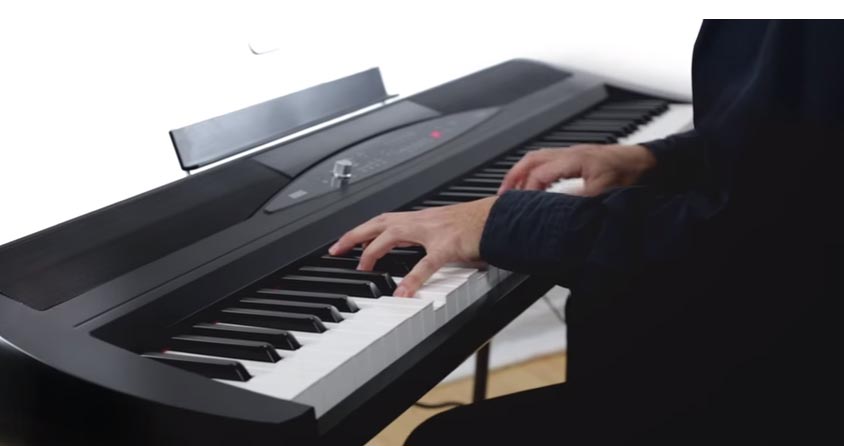
It has 30 sounds of real piano, electric pianos, baroque instruments, strings and even guitar. In this he outperforms his rivals except for Roland FP 30. It has reverb, chorus and brightness effects of enough quality for its price. With three levels each.
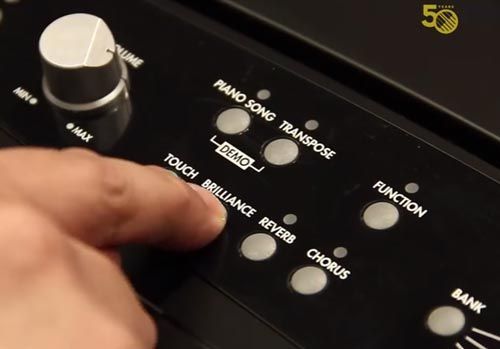
It has a very successful and usable interface. You can layering and mixing two sounds at once. For example piano with strings. A basic of these keyboards.
Listen to this video that even though it is in English will teach you how several of those tones sound. Then the review goes on talking about things you need to know, so read on.
Hammer Action and controls
He has a Hammer Action Korg (weighted keys) NH with a touch of ivory and synthetic ebony that we like quite a lot. It absorbs a lot of sweat for a mid-range piano.
Its Hammer Action and adjustable sensitivity is the norm for pianos in its range. And the fact that it can be regulated is not so common.
It has transposition and tuning functions. The metronome is very complete and intuitive.
I’m sure you’ll be interested in…
- See this section for possible discounts and offers
- Ranking with the best digital pianos in quality-price ratio
- The cheapest musical keyboards for beginners
- Learn piano by yourself and for free
Connectivity and Extras
In this case it has MIDI IN/OUT. This is important because you can do such wonderful things as record a MIDI track on your computer while playing with the CUBASE program and then export that track to music sheet with a single click. Or manipulate it and transport it to another shade. It’s very important.
We’re surprised he can’t take a triple pedal. With sustain pedal included. Which is the most used and the one that helps to keep the note in time while stepping. Supports half-pedal option. It’s got another pedal connector.
Like many pianos in this price range you can divide the piano in two so you can study teacher and student or do duets. The good thing is, he’s got two headphones outputs, too.
Apart from a pleasant feel and a very usable interface what stands out most is the power of your speakers. They’re 15 W, so in many places you won’t even need to amplify. It also has stereo line output for you to connect to any PA or amplification system without the need for an injection box.
Comes with stand and power supply included. What saves you the money of buying it later, that must be taken into account in the price. It has a good portability of 19 kg, it is ok to take it in the car. In more complicated public transport.It’s good for studying up to the middle grade without any problems. No triple pedal is allowed.
Korg SP 280 vs Yamaha P115 and Yamaha P125
It must be said that the Yamaha P115 is out of print and its new model is the best Yamaha P115. So let’s compare it with the Yamaha P115 and you can extrapolate the same comparison with the Yamaha P125 because the only difference between the two is that the Yamaha P125 brings 10 more piano sounds.
On the one hand the Yamaha P115 and the Yamaha P125 have more polyphony. Up to 192 notes.
As for the Hammer Action, we like the touch of the Korg SP 280 better. It’s very successful. Otherwise in this aspect both are equal.
The Korg SP 280 gains in that its speakers are much more powerful and its interface much more usable. And it also has 30 sounds compared to the 10 of the Yamaha P115. But now that equals more because the Yamaha P125 has 24 now.
Both have MIDI and Duet mode with two headphones. Both come with lectern but the Korg SP 280 comes with support included. That’s what you have to think about the price difference.
Both have live line output and the Yamaha P125 and the P115 has a turbo called Sound Boost to make it sound more powerful.
Before it was more expensive the Korg but it has lowered enough of price until it equals with the P125. Although the Yamaha P125 has line output to play live.The Yamaha P125 is sold more but if you find the Korg SP 280 very cheap is to consider it. Don’t miss our review of the Yamaha P125 and this video which clearly explains important concepts of digital pianos:
Korg SP 280 vs Roland FP 30
Roland FP 30 is a very tough opponent to beat. Is better in price with the Yamaha P125 but has some very curious extras. His keyboard’s pretty good. Although the sensitivity is not adjustable like the Korg SP 280.
It has a polyphony similar to the Korg of 128 voices and 35 sounds with its super natural engine and its 11 W speaker system is between the Yamaha P125 and the Korg SP 280. Although the Korg continues to gain sound power.
It has a built-in microphone so you can record your songs even with voice and record it directly to the computer to a flash drive. Well, it’s got a USB port.
The Roland FP 30 has two headphone outputs for teacher and student in the Duet mode.The Roland FP 30 is almost perfect.. Don’t miss our review of the Roland FP 30.
Where to Buy the Korg SP 280
If you live at America or Asia check Amazon. If you live at Europe pls check as well Thomann:
If you want to know other options of brands such as Casio we recommend our selection with the best piano keyboards of the moment. In it are the Yamaha P125 and the Roland FP 30. On the other hand we leave you these posts that surely interest you:
For a similar price you have the following pianos and keyboards:
- YAMAHA YDP-S34 ARIUS
- YAMAHA YDP 163
- YAMAHA YDP 143
- YAMAHA PSR S770
- YAMAHA PSR S670
- YAMAHA PSR E453
- YAMAHA PSR E443
- YAMAHA P45
- YAMAHA P255
- YAMAHA P125
- YAMAHA P-121
- YAMAHA P115
- YAMAHA P105
- YAMAHA DGX 660
- YAMAHA ARIUS YDP 142
- YAMAHA PSR S775
- YAMAHA PSR E463
- YAMAHA P35
- THOMANN SP 5600
- THOMANN DP-33
- THOMANN DP-31
- ROLAND GO KEYS
- ROLAND FP-60
- ROLAND FP 80
- PIANO THOMANN SP 320
- KURZWEIL SPS4-8
- KURZWEIL SP6
- KURZWEIL SP4-8
- KURZWEIL FORTE SE
- KURZWEIL FORTE 8
- KURZWEIL ARTIS 7
- KORG PA-700 ORIENTAL
- KORG PA-700
- KORG PA600
- KORG PA-300
- KORG PA-1000
- KORG HAVIAN 30
- KORG GRANDSTAGE 88
- CASIO PX-870 PRIVIA
- CASIO PX-770 PRIVIA
- CASIO PX-5S PRIVIA PRO
- CASIO PX-560 PRIVIA
- CASIO PX-360 PRIVIA
- CASIO PX 160
- CASIO CT-X800
- CASIO CT-X700
- CASIO CT-X5000
- CASIO CT-X3000
- CASIO CDP 130
- THOMANN DP 26
- ROLAND FP 90
- ROLAND FP 30
- ROLAND FA 06
- ROLAND BK 5
- KORG LP 380
- KORG B1
- KAWAI ES8
- KAWAI ES110
- KAWAI ES100
- KAWAI CN27
- KAWAI CN25
- CASIO CDP 230
- CASIO CDP S100
Did you like this post?
Children’s Musical Keyboard Selection
If you are a parent looking for a keyboard for your child to start exploring and maybe in the future start with the piano you are in the right place.
By children we mean infants under 10 years of age. When we think of a keyboard for them we have to keep in mind that even a child likes to play. So here’s one of the first to consider. Make the keyboard fun and for that it has to have a lot of sounds.
I’m sure you’ll be interested in…
It is not highly recommended to buy a keyboard from a child without any kind of guide. It is dangerous cause without the right piano you child can quit.
You are probably thinking that children’s keyboards should be simpler and cheaper. Of course they are cheaper and so we thought to recommend three models. But don’t worry if it’s got a lot of buttons, either. Children are real sponges and will quickly get the functionalities.
If your child is under the age of 5, we don’t recommend that you put him to music yet. Only if you’re thinking about the Suzuki method that’s more natural for them. In that case, the models we have selected will work for you.
There are keyboards with colored piano keys but don’t buy them, they really don’t inspire the musical feeling in the child and they sound so bad that they will lead you to acoustic agony. They have to have a few minimums.
Let’s go with our selection:
Yamaha PSR F51
The Yamaha PSR F51 is a keyboard with 120 sounds plus a number of accompaniments for your child to play on. And all for less than 100 €.
It has 61 keys, so you can play any song you like. He’s got 114 rhythms from all over the world that’s sure to amuse him. Simple and intuitive interface.Very lightweight, can run on batteries and comes with the included power supply. It has 2 W speakers and headphones output for your child to touch in silence.
Ideal to start in a relaxed and fun atmosphere. If you are going to start the conservatory is already a more serious thing and you should look at our guide with the best piano keyboards. Although it may be worth the bottom of the list if you’re on a tight budget.
We leave you a video to see the amount of sounds it has and a link that takes you to the best price for this keyboard.
Casio CTK 1300
The Casio CTK 1300 is the direct competitor of the Yamaha PSR F51. Also with a price under 100 euros is a keyboard that follows the same paradigm.
It has 100 different sounds including different sounds and has another 100 accompaniments to play on.
The Yamaha PSR F51 has some more polyphony, which is the amount of notes that can sound at once. Including the accompaniment you’re playing.
Also supports batteries and works with charger but is not included.
It has 61 keys and although it is very popular but for now wins the Yamaha PSR F51. Although there are real fans of the Casio brand. You have to keep in mind that none of these keyboards have sensitive or Hammer Action keyboards. It’s for first contact and fun. But the next one we’re going to talk to you about already raises the level for a little more money.
Below video
Click the button if you want to see the best price for the Casio CTK 1300
Casio CTK 3200 and CTK 3500
The Casio CTK 3200 electronic keyboard (we link on that review the new model Casio CTK 3500) is a great option for a child to consider and for a really low price.
It’s a keyboard that has all the basics to start with the piano, have fun and if you’re a little serious for the first year of conservatory. And then it is very useful for various functions or can be sold easily second hand because it is in high demand. And all this for a price difference over the first of about 50 euros.
The Casio CTK 3200 is very good because it carries:
- 61 sensitive keys.
- MIDI connection to the computer to then compose with computer programs. Ideal for children.
- More polyphony, sounds and accompaniments than the other keyboards on the list. And more quality.
- Bring the power supply and it also has sustain pedal input. Which will be very useful for learning piano.
- It also has many controls to play with sounds like the Pitch Bend and is very portable also admitting batteries.
We hope we helped you choose a children’s piano. I’m sure your child will have fun choosing which one you choose. Feel free to continue reading useful content on our blog below. You may also be interested in our guide with everything you need to know about pianos.
Vote if you like this article 🙂