
Review M-Audio Hammer 88 MIDI keyboard. Where to buy it?
M-Audio is a business unit of inMusic Brands that designs and markets digital audio and MIDI interfaces, keyboards and MIDI controllers, synthesizers, speakers, studio monitors, digital DJ systems, microphones, and music software. I’ll tell you how this post is built. First I will list the features of this M-Audio Hammer 88 keyboard. Then you have a video or two, shopping links, and useful reviews from other users and then you have one of the most useful parts; comparison charts with similar keyboards so you can compare.
- Keyboard controller with weighted hammer action
- 88 keys
- USB-MIDI connection, Plug & Play compatible on Mac or PC
- MIDI output for connection to external MIDI peripherals
- Pitch-Bend and modulation wheels
- Volume Fader and Up/Down Buttons
- Keyboard zone assignment for split and layer functions and chord function with 1 finger (4 voices)
- Easy parameter editing via the included Hammer 88 editor
- Compatible with iOS with Apple iPad Camera Connection Kit connector (available separately)
- Includes licenses for the following software packages: AIR “Mini Grand” Acoustic Grand Piano, AIR “Velvet” Vintage Electric Piano, AIR “DB-33” Tonewheel Organ Simulator and SONiVOX “Eighty-Eight Ensemble” Authentic Piano Instrument
- Ableton Live Lite
- Includes 3-month license for Skoove for online piano lessons
- Includes score support
- Powered by USB port or external power supply (not included)
- Dimensions: 1420 x 300 x 130 mm
- Weight: 17.5 kg
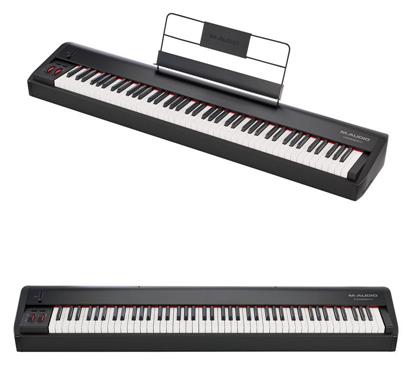
It also offers Pitch-Bend and modulation wheels and volume fader and Up/Down buttons, being a somewhat minimalist MIDI controller in functions, as we can’t find anything about pads, knobs, buttons and other control functions.
It is conceived as a simulation of a real acoustic piano and has assignment zones for Split and Layer functions and 1-finger chord function (4 voices). It also offers easy parameter editing via the included Hammer 88 editor. Also included are the licenses for AIR “Mini Grand” Acoustic Grand Piano, AIR “Velvet” Vintage Electric Piano, AIR “DB-33” Tonewheel Organ Simulator, and SONiVOX “Eighty-Eight Ensemble” Authentic Piano Instrument and Ableton Live Lite.
It has a USB-MIDI connection, sustain, expression and footswitch inputs is Mac and PC compatible, and offers a MIDI output.
Now that we’ve seen the features of this M-Audio Hammer 88 keyboard, check out these related videos to learn more.
Posts you may be interested in
- Ranking with the best midi keyboards
- My selection of cheap midi keyboards.
- Best MIDI Software to work with.
- MIDI Basic Guide.
- Midi Keyboards by Brand.
M-Audio Hammer 88 vs Studiologic SL88 Grand
The M-Audio Hammer 88 MIDI Keyboard is priced at €422/£366/$419 and the Studiologic SL88 Grand is priced at €769/£699/$785. Let’s go face-to-face:
- Both offer 88 keys with hammer mechanics, in the case of the Studiologic SL88 Grand, it is a TP40 Wood with Aftertouch (FATAR Brand) keyboard with wooden core keys and ivory touch.
- The M-Audio Hammer 88 also offers Pitch-Bend and modulation wheels, and volume fader and Up/Down buttons. When the Studiologic SL88 Grand offers a 6-way control joystick, 3 assignable buttons, 4 programmable zones, 4 programmable pedal connections and 3 programmable joystick controllers.
- In connections, the M-Audio Hammer 88 has USB-MIDI connection, MIDI output, sustain pedal input, expression, and footswitch and is powered via USB although it also has an input for an external power supply, which is not included. The Studiologic SL88 Grand offers a USB-MIDI connection and also includes a 9V DC 1A power supply (not USB powered) and a VFP1/10 sustain pedal.
- The M-Audio Hammer 88 includes licenses for the following software packages: AIR “Mini Grand” Acoustic Grand Piano, AIR “Velvet” Vintage Electric Piano, AIR “DB-33” Tonewheel Organ Simulator, and SONiVOX “Eighty-Eight Ensemble” Authentic Piano Instrument and Ableton Live Lite. The Studiologic SL88 Grand includes a collection of virtual instruments (once the hardware is registered).
Let’s put the features of these keyboards in a table so you can compare
|
M-Audio Hammer 88 |
Studiologic SL88 Grand |
|---|---|
|
|
In this interesting comparison, we can notice that both are good MIDI controllers, the M-Audio Hammer 88 which is a somewhat minimalist MIDI controller that its main function is on its 7-octave keyboard. And the Studiologic SL88 Grand that has many and more functions than its competition, apart from the great quality of the keyboard it has, also offers joystick, knobs and assignable zones that will allow greater control of the DAW we are using. The M-Audio is an excellent choice for its price range, but the Studiologic SL88 Grand outperforms it in many features.
Here’s a video of the Studiologic SL88 Grand keyboard
If you want to know more about this option, click on the following link to see the Studiologic SL88 Studio review
M-Audio Hammer 88 vs Kawai VPC1
The M-Audio Hammer 88 MIDI Keyboard is priced at €422/£366/$419 and the Kawai VPC1 is priced at €1,268/£1,168/$1,295. Let’s see the face-to-face:
- Both offer 88 keys with hammer mechanics, in case the Kawai VPC1 has an RM3 Grand II (Kawai’s own) hammer action, with 3 sensors and let-off simulation and ivory key surface. It has a really wonderful keyboard.
- The M-Audio Hammer 88 also offers Pitch-Bend and modulation wheels, and volume fader and Up/Down buttons. When the Kawai VPC1 offers a graphical interface where you can choose certain settings. It also has the following features: An unlimited number of Touch Curves, Touch Learn function, Velocity Off Set for each key, and more.
- When connected, the M-Audio Hammer 88 has a USB-MIDI connection, MIDI output, sustain pedal input, expression and footswitch input, and is powered via USB, but also has an input for an external power supply, which is not included. The Kawai VPC1 offers USB-MIDI connection, USB-Host, free pedal assignment, MIDI input and output, connections for triple footswitches and can be powered via USB or the included power supply.
- The M-Audio Hammer 88 includes licenses for the following software packages: AIR “Mini Grand” Acoustic Grand Piano, AIR “Velvet” Vintage Electric Piano, AIR “DB-33” Tonewheel Organ Simulator and SONiVOX “Eighty-Eight Ensemble” Authentic Piano Instrument and Ableton Live Lite.
Let’s put the features of these keyboards in a table so you can compare
|
M-Audio Hammer 88 |
Kawai VPC1 |
|---|---|
|
|
As we have seen since the introduction of this comparison we see that the controllers have a great difference in price, the M-Audio Hammer 88 that we have already analyzed before at almost a third of the price of the Kawai VPC1 which is a MIDI controller with a great quality keyboard, typical of the Kawai brand, with all the functions already analyzed before, without a doubt this is the best MIDI controller in the comparison.
And here is a video of the Kawai VPC1 keyboard
If you want to know more about this option, click on the following link to see the Kawai VPC1 review.
M-Audio Hammer 88 vs Roland A-88 MKII
The M-Audio Hammer 88 MIDI Keyboard is priced at €422/£366/$419 and the Roland A-88 MKII is priced at €959/£859/$949. Let’s move on to the face-to-face:
- Both offer 88 hammer-action keys, in the case of the Roland A-88 MKII keys they offer PHA-4 Standard technology with an ivory touch.
- The M-Audio Hammer 88 also offers Pitch-Bend and modulation wheels, and volume fader and Up/Down buttons. When the Roland A-88 MKII offers a joystick for Pitch/Modulation function, +/- buttons for octave selection and keyboard sensitivity adjustment, 8 Pads and rotary controllers with RGB lighting for MIDI hardware and software control.
- When connected, the M-Audio Hammer 88 has a USB-MIDI connection, MIDI output, sustain pedal input, expression pedal input, and footswitch input, and is powered via USB, but also has an input for an external power supply, which is not included. The Roland A-88 MKII offers USB-MIDI connection, MIDI input and output, input for a sustain pedal and 2 connections for an expression pedal. It can also be powered via USB-C or an external transformer.
- The M-Audio Hammer 88 includes licenses for the following software packages: AIR “Mini Grand” Acoustic Grand Piano, AIR “Velvet” Vintage Electric Piano, AIR “DB-33” Tonewheel Organ Simulator and SONiVOX “Eighty-Eight Ensemble” Authentic Piano Instrument and Ableton Live Lite.
Let’s put the features of these keyboards in a table so you can compare
|
M-Audio Hammer 88 |
Roland A-88 MKII |
|---|---|
|
|
In this comparison, we have an interesting face to face, with the M-Audio Hammer 88 that we have already analyzed a few times in this post. And the Roland A-88 MKII which is a high-quality MIDI keyboard and also has more functions like a joystick, up and down octave buttons, and 8 pads with RGB backlighting. If you have the budget go for the Roland A-88 MKII, if not the M-Audio Hammer 88 is not a bad choice.
And here’s a video of the Roland A-88 MKII
https://www.youtube.com/watch?v=USFvGCHt5PY
M-Audio Hammer 88 vs Native Instruments Komplete Kontrol S88 MK2
The M-Audio Hammer 88 MIDI Keyboard is priced at €422/£366/$419 and the Native Instruments Komplete Kontrol S88 MK2 is priced at €945/£866/$955. With a difference of 486 euros between them.
- Both offer 88 hammer-action keys, the keyboard of the Native Instruments Komplete Kontrol S88 MK2 is a high-quality Fatar brand.
- The M-Audio Hammer 88 also offers Pitch-Bend and modulation wheels, and volume fader and Up/Down buttons. When the Native Instruments Komplete Kontrol S88 MK2 offers pitch bend and modulation wheels and a touch strip for expression control, a 4D (4-dimensional) pushbutton encoder and pre-mapped control for KOMPLETE instruments and other instruments from major manufacturers. Other functions offered are Preset navigation based on labels, an RGB (RedGreenBlue) light guide above each key that indicates different functions, a ‘Smart Play’ that allows you to consult the scales and modes of the light guide, and others.
- When connected, the M-Audio Hammer 88 has a USB-MIDI connection, MIDI output, sustain pedal input, expression pedal input, and footswitch input, and is powered via USB, but also has an input for an external power supply, which is not included. While the Native Instruments Komplete Kontrol S88 MK2 offers USB-MIDI connection, MIDI input and output, and input for two assignable pedals. It also has a power supply input that is included.
- The M-Audio Hammer 88 includes licenses for the following software packages: AIR “Mini Grand” Acoustic Grand Piano, AIR “Velvet” Vintage Electric Piano, AIR “DB-33” Tonewheel Organ Simulator, and SONiVOX “Eighty-Eight Ensemble” Authentic Piano Instrument and Ableton Live Lite. The Native Instruments Komplete Kontrol S88 MK2 includes the KOMPLETE SELECT sample library package.
Let’s put the features of these keyboards in a table so you can compare
|
M-Audio Hammer 88 |
Native Instruments Komplete Kontrol S88 K12 |
|---|---|
|
|
In the current comparison, if we find a big difference, the M-Audio Hammer 88 looks like a very minimalist MIDI controller keyboard compared to the Native Instruments Komplete Kontrol S88 MK2 that after its 88-key Fatar brand keyboard, which is already a great quality, also offers many features and compatibility with the most popular DAWs, really in a very complete MIDI controller, if you have the budget this is the choice.
And here is a video of the Native Instruments Komplete Kontrol S88 K12 keyboard
M-Audio Hammer 88 vs Akai MPK 261
The M-Audio Hammer 88 MIDI Keyboard is priced at €422/£366/$419 and the Akai MPK 261 is priced at €385/£339/$393, but the difference is so small that this may vary depending on the shop where we ask. We have two MIDI controllers with very different functions, let’s go face to face:
- The M-Audio Hammer 88 offers 88 hammer-action keys, while the Akai MPK 261 offers 61 semi-weighted keys.
- The M-Audio Hammer 88 also offers Pitch-Bend and Modulation wheels, and volume fader and Up/Down buttons. The Akai MPK 261 offers 16 MPC (Midi Production Center) pads with RGB (RedGreenBlue) backlighting, 4 x 4 pad banks, 8 control knobs, 8 assignable faders, and 8 backlit switches. Also included are integrated transport (rec, play, pause, stop, etc.) and parameter controls, and Pitch bend, modulation and octave controls for dynamic performances.
- When connected, the M-Audio Hammer 88 has a USB-MIDI connection, MIDI output, sustain pedal input, expression and footswitch input, and is powered via USB, but also has an input for an external power supply, which is not included. While the Akai MPK 261 offers USB-MIDI connection, and input for two pedals: expression and sustain. It is powered via USB.
- The M-Audio Hammer 88 includes licenses for the following software packages: AIR “Mini Grand” Acoustic Grand Piano, AIR “Velvet” Vintage Electric Piano, AIR “DB-33” Tonewheel Organ Simulator and SONiVOX “Eighty-Eight Ensemble” Authentic Piano Instrument and Ableton Live Lite. The Akai MPK 261 includes the licenses for Ableton Live Lite, Hybrid 3 by AIR Music Tech, SONiVOX Twist 2.0 and Akai Pro MPC Essentials.
Let’s put the features of these keyboards in a table so you can compare
|
M-Audio Hammer 88 |
Akai MPK 261 |
|---|---|
|
|
In our last comparison, we have two MIDI controllers with different functions and features, on the one hand, the M-Audio Hammer 88 has a more minimalist model where it includes a MIDI keyboard with counterbalanced hammer mechanics, pitch bend and modulation wheels and a volume fader. On the other hand, the Akai MPK 261 offers many more features of a MIDI controller such as pads, knobs, faders and switches and a 61-key keyboard. So depending on your needs you will choose the best one.
And here is a video of the Akai MPK 261
If you want to know more about this option, click on the following link to see the Akai MPK 261 review.
Where to buy the M-Audio Hammer 88 keyboard
Amazon
- Free Shipping and the possibility of shipping in one day with Amazon Premium.
- Full Guarantee but they are no experts in music equipment.
- Sometimes a better price.
- He’s got worse stock than Thomann.
Thomann
- Free Shipping.
- Full warranty. If you have any problems, they take care of everything.
- 100% reliable payment.
- A leader in trouble-free shipping.
- Usually the Best price.
- Best Reputation: They are the leading online store in Europe and have the best catalog and information.
Also, look at these models with a similar price and features:
- Roli Seaboard Rise 25
- Roli Seaboard Block Studio Edition
- Roli Songmaker Kit Studio Edition
- Haken Audio ContinuuMini
- Roli Seaboard Rise 49
- Native Instruments Komplete Kontrol S49 MK2
- Arturia KeyLab MkII 49 Black
- Akai MPK 249
- Arturia KeyLab MkII 49 White
- Novation 49SL MKIII
- Korg Triton taktile 49
- Keith McMillen K-Board Pro 4
- Native Instruments Komplete Kontrol S61 MK2
- Novation 61SL MKIII
- Novation Impulse 61
- Arturia KeyLab MkII 61 White
- Arturia KeyLab MkII 61 Black
- Nektar Panorama P6
- Akai MPK 261
- Nektar Panorama T6
- Studiologic SL73 Studio
- Native Instruments Komplete Kontrol S88 MK2
- Studiologic SL88 Studio
- Arturia KeyLab 88 MkII
- M-Audio Hammer 88
- Studiologic SL88 Grand
- Studiologic Numa Stage
- Doepfer PK88 GH
- Doepfer PK88 GH without Case

