
Yamaha PSR EW410 Review: Opinion and Where to Buy It
The Yamaha PSR EW410 is an excellent choice as an entry-level keyboard, with ample possibilities for playing multiple musical genres, 76 keys (6 octaves), 758 sounds covering quite a few types of musical instruments with a very good quality acoustic piano sound, and 235 types of rhythms from different musical genres.
It has powerful built-in speakers (12 W + 12 W) as well as live and live functions that meet the needs of beginner concert keyboardists.
Where to buy it?This keyboard also features a wide range of Latin American rhythms such as cumbia, bachata, son cubano, joropo, parranda and many more, with Latin users in mind.An excellent choice for keyboardists looking for a keyboard that is suitable for both studio and live use and has a wider 5 octave range.
The sound of the Yamaha PSR EW410

I’m sure you’ll be interested in…
- Ranking with the best digital pianos in quality-price ratio
- The cheapest musical keyboards for beginners
- Other Yamaha Digital Piano Reviews
- Learn piano by yourself and for free
Among its 758 sounds is a wide range of instruments ranging from pianos, organs, synths, winds, strings, drums and more, but the Yamaha PSR EW410 stands out over the PSR-E line for having a higher quality acoustic piano from the Live library! From Yamaha, some of these 758 sounds also come from Yamaha bookstores like Sweet!, Cool! and also have 3 dynamic voices.
The voices on this keyboard could be divided into 237 panel voices, with a more professional sound, 24 drum kits, 40 arpeggios and 457 voices from the XGlite library.The panel sounds are divided like this:
- 10 acoustic pianos.
- 8 electric pianos.
- 15 organs.
- 6 accordions.
- 13 guitars.
- 17 lows.
- 19 string sounds.
- 5 chorus sounds.
- 15 saxophones.
- 10 trumpets.
- 15 metal sounds.
- 9 flutes.
- 28 solo synthesizers.
- 18 pad synthesizers.
- 12 percussions.
- 37 ethnic sounds.
Also thanks to the Quick Sampling system, it is possible to record audio samples to create new sounds according to the needs of the keyboardist.
Its amplification system has a power of 12W and 12W with 12 cm Bass Reflex loudspeakers.
It also has an effects section with 10 effects varied in the DSP, 12 Reverb types, 5 Chorus types, 6 equalization types and 26 harmony types so that different modifications to your voices can be made to your liking.
Also as a very useful functionality for live, can record up to 80 minutes of audio in WAV format and also has external audio input to launch tracks, sequences and so on from an external player.
The Rhythms of the Yamaha PSR EW410
This keyboard comes with 235 rhythms from the factory and also has the ability to play more additional rhythms from a USB memory stick.
Each rhythm has intro, final, fills, self-synchronization, and accompaniment with various instruments according to the chords being played; each rhythm has 4 variations and a “Climax” that make the execution more varied.
Its “Groove creator” feature allows the user to create DJ-style music, with pre-recorded loops and patterns that can be combined to create fun rhythms.
In this video is shown in the demonstration of the PSR E463, but in these two teams the rhythms are exactly the same, therefore, the rhythms shown in this video are also included in the PSR EW410.
Yamaha PSR EW410 vs Yamaha PSR E463

The first comparison we can think of and perhaps the most appropriate, is to compare the PSR EW410 with the PSR E463, and these two teams share almost all the same performance with slight differences where the EW410 wins the battle:
- It has a keyboard with 76 keys (6 octaves) in front of the 61 keyboard of the E463 with more range.
- The acoustic piano sound of the PSR EW410 is of higher quality than that of the PSR E463, the rest of its sounds and rhythms are the same.
- The speakers of the PSR EW410 are much more powerful than those of the PSR E463.
You can read more about this team in our full review of the Yamaha PSR E463.
Yamaha PSR EW410 vs Yamaha PSR EW400
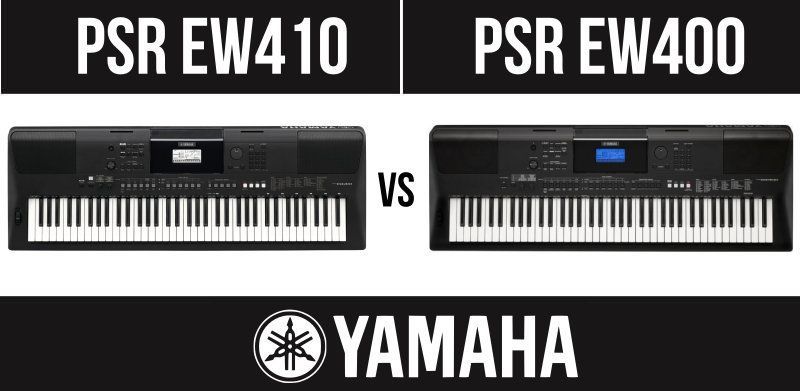
Another of the much needed comparisons when reviewing the Yamaha PSR EW410 is with its predecessor, the PSR EW400, with which it also shares many features among them the same amount of sounds, but exceeds in several respects, being an improvement of this model:
- The PSR EW410 has a higher number of rhythms, 235, versus 220 rhythms in the PSR EW400.
- The PSR EW400 does not have the Groove Creator function, although it does have the “DJ Patterns” function which is very similar.
- The PSR EW400 does not have the Quick Sampling feature that allows you to create new voices from recorded samples.
You can read more about this team in our full review of the Yamaha PSR EW400.
Yamaha PSR EW410 vs Yamaha PSR E363

The Yamaha PSR E363 is a team with less performance than the PSR EW410 (And also for a much lower price)Among its main differences are highlighted:
- The PSR E363 has 5 octaves versus the 6 octaves of the PSR EW410.
- The sound bank of the PSR E363 is much more limited, with 574 sounds versus 758 sounds of the PSR EW410.
- The acoustic piano sound of the PSR EW410 is of much higher quality than that of the PSR E363.
- The PSR E363 also brings much less rhythms, with only 165 rhythms versus the 235 of the PSR EW410.
- The speakers of the EW410 are much more powerful than those of the PSR E363.As for effects, they have the same Reverbs, Chorus and Equalizations, but the PSR E363 doesn’t have the 10 DSP effects of the PSR EW410.
- Finally, the PSR E363 does not have the functions of Groove Creator, Quick Sampling or the possibility to save audio in .WAV format.
You can read more about this team in our full review of the Yamaha PSR E363.
Yamaha PSR EW410 vs Yamaha PSR S670

The PSR-S line is a superior line to Yamaha’s PSR-E line so the PSR S670 will outperform the PSR EW410 in many respects, but bearing in mind that the PSR-EW410 is a 6 octave keyboard while the PSR-S670 is a 5 octave keyboard.
Their main differences are:
- The loudspeakers of the PSR S670 are of greater power, because they have 15W of power, versus 12W of power of the PSR EW410.
- Although the PSR S670 has far fewer voices (416), these voices are superior to the voices of the PSR EW410, as they have higher sample quality, natural reverberations and greater instrument detail.
- The PSR S670 has more effects in its DSP section with 44 factory Reverb settings plus 3 User
- Reverb settings on the PSR S670 versus only 12 factory Reverb settings on the PSR EW410, 71 factory Chorus settings plus 3 user Chorus on the PSR S670 versus 5 types of Chorus on the EW410 and a much more powerful DSP engine with 283 assignable factory effects and 10 user DSP effects on the PSR S670 versus only 10 effects on the EW410.
- On the PSR S670 it is also easier to navigate its functionalities, thanks to a greater number of dedicated controls.
You can read more about this team in our full review of the Yamaha PSR S670.
Where to Buy Yamaha PSR EW410?
Amazon
- Free Shipping and possibility of shipping in one day with Amazon Premium.
- Full Guarantee but they are no experts in music equipment
- Leader in fast shipments.
- Price that change a lot daily.
- The best option in USA and worldwide
Thomann
- Free Shipping
- Full warranty. If you have any problems, they take care of everything.
- 100% reliable payment.
- A leader in trouble-free shipping.
- Usually the Best Price
- Best Reputation: They are the leading online store in Europe and have the best catalog and information.
Conclusions
In short, Yamaha’s PSR EW410 is a great piece of equipment for beginner keyboardists who need a keyboard that accompanies them in their daily studio but can also be used in concert, as well as the great advantage of having 6 octaves, which means a greater range than other keyboards in this range that generally have only 5 octaves.
If you are interested in buying a new keyboard, you can read our complete list of cheap keyboards and our list of the best digital pianos and keyboards in price/quality ratio.You may also be interested:
For a similar price you have the following pianos and keyboards:
- YAMAHA PSR-EW300
- YAMAHA PSR-E263
- YAMAHA PSR-A350
- YAMAHA PSR F51
- YAMAHA PSR F50
- YAMAHA PSR EW400
- YAMAHA PSR E363
- YAMAHA PSR E353
- YAMAHA PSR E253
- YAMAHA NP-32 PIAGGERO
- YAMAHA EZ 220
- YAMAHA PSR EW410
- STARTONE MKR 61
- STARTONE MK-300
- STARTONE MK-200
- KORG TINY PIANO
- CASIO SA78
- CASIO SA 77
- CASIO SA 76
- CASIO SA 47
- CASIO SA 46
- CASIO LK-280
- CASIO LK-265
- CASIO LK-135
- CASIO CTK-2500
- CASIO CTK-240
- CASIO CTK 7200
- CASIO CTK 4400
- CASIO CTK 3500
- CASIO CTK 2200
- CASIO CTK 1500
- YAMAHA NP12
- ROLAND GO PIANO
- CASIO CTK1300
- CASIO CTK 6200
- CASIO CTK 3200
Did you like this article?
>>>>>>

