
- Home
- Author's Archive:

Digital Piano Startone MKR 61 Full Review. Is it a good choice?
Startone MKR 61 Review Complete Digital Piano. Is it a good choice?
The Startone brand is a derivative of Thomann, which has offered excellent product proposals for beginners. Now let’s take a look at this curious “portable keyboard”, the Startone MKR 61, with a price tag of €49/£44, which can be quite useful for certain people but never for learning piano due to the lack of basic functions for the same. These are its features:
- 61 keys
- 128 sounds (Different sounds of piano and other instruments)
- 128 rhythms (accompaniment rhythms that adapt to what you are playing. There are bossa nova rhythms, etc. Sometimes they are also known as accompaniment styles)
- 25 demo songs
- Monochrome screen
- Volume control
- Tempo change
- Recording function
- It has a sustain function (the sustain pedal of a piano or keyboard is used to keep the note playing even if you stop pressing the key) without pedal and vibrato
- USB midi connection (MIDI allows you to do such wonderful things as connect your keyboard to your computer, record a sound track and with certain programs click through what you’ve played to musical notes on a score. MIDI tracks store the information of the musical notes)
- Sound IN input
- Mini-headphone jack output
- Charging by USB
- It has a rechargeable battery
- Weight 1 Kg and dimensions (width x height x depth): 110 x 215 x 35m
As we can see, what is most surprising about this “keyboard” is its portable design, which would really let us take it almost anywhere. Its USB MIDI connection is also very appreciated and besides having a sustain function makes the MKR 61 a keyboard that could be suitable for certain circumstances. It is very portable and can be charged with USB.
Now that we have listed and described the features of this keyboard there is no better way than to take a look at the following two videos where they tell us more about the Startone MKR 61 and you can hear how its different sounds sound:
Related post you can be interested in
- Ranking with the best digital pianos
- My selection of cheap musical keyboards.
- Basic concepts you need to know about digital pianos.
- The best resources to learn to play the piano by yourself.
Now let’s compare the Startone MKR 61 with its more common alternatives. Also at the end of the post you will find a section with the best shopping possibilities for this digital piano. But you can go directly to that part of the post by pressing the following button.
Startone MKR 61 vs Startone MK-200
The first comparison we will have are these two Startone keyboards: the MKR 61, which is priced at €49/£44 and the MK-200 which is priced at €89/£79, having a £40 difference between them. We will put the features of each of these pianos in 2 different columns to make it easier to see the differences:
- Come on keyboards have 61 keys, those of the MK 200 have sensitivity, which means that you can make dynamics in the interpretations of that, when you press a strong key sounds higher than another when we press it less strong.
- The MK eres 61 has 128 different sounds or voices and 128 rhythms for accompaniment, plus 25 demo songs. The MK 200 has 320 different sounds or voices, 110 styles for accompaniment and 100 demo songs.
- The MK 200 has dual and split modes. Metronome and split mode on the keyboard. It also has modulation settings, a 4-track recorder, a sustain pedal input and a weight of 4.5 kg and dimensions of 940 x 360 x 136mm.
- The MKR 61 has a recording function as well, auxiliary input, headphone output, USB MIDI and weighs only 1 kg.
As we see in the face to face have very relevant differences, Where the MK 200 is the winner, mainly to the functions of: sensitivity in their keys, and Sustain pedal input that allows us to start the piano study in a very basic way.
|
Startone MKR 61 |
Startone MK-200 |
|---|---|
|
|
If you want to know more about this model don’t miss our review of the Startone MK-200.
Startone MKR 61 vs Casio SA 46
Now we will buy the Startone MKR 61 And as we said it has the price of €49/£44 and the Casio SA46 mini keyboard with a price of €39/£35. With a small difference of almost £10 we will analyze their differences and similarities here goes the face-to-face:
- The Startone MKR 61 has 61 keys, while the Casio SA 46 has 32 mini-keys. Both without touch sensitivity.
- The Startone has a number of 128 sounds, with 128 rhythms and 25 demo songs. The Casio has a quantity of 100 sounds, with 50 rhythms and 10 demo songs.
- The Startone The MKR 61 has a recording function as well, auxiliary input, headphone output, USB MIDI and a weight of only 1 kg.
- The Casio SA 46 has five steps for creating rhythms, two 0.5-watt speakers, a headphone output and still weighs only 1 kg.
There are two toy keyboards, neither of which is really suitable for learning to play the keyboard or piano in a decent way, but surely in certain circumstances it can be useful for a child or a person who has a very limited budget.
We will put the characteristics of each of these pianos in 2 different columns to make it easier to see the differences:
|
Startone MKR 61 |
Casio SA 46 |
|---|---|
|
|
And now a video of the Casio SA 46
If you want to know more about this model don’t miss our review of the Casio SA 46.
Startone MKR 61 vs Casio CTK-1500 (or CTK 1550, which are the same)
Finally, we will have the comparison of these two keyboards: the Startone MKR 61 which is priced at €49/£44 and the Casio CPK 1500 which is priced at about €95. With a difference of about €45, we will see their similarities and differences in the following face-to-face:
- Both have 61 keys with no sensitivity.
- The Startone has 128 sounds, and 128 rhythmic style for accompaniment and offers 25 demo songs. The Casio has 120 sounds, with 70 rhythms or styles for accompaniment and offers 50 demo songs, plus 32 notes of polyphony. Polyphony refers to the largest number of notes that can be played simultaneously on a computer.
- The Startone The MKR 61 has a recording function as well, auxiliary input, headphone output, USB MIDI and weighs only 1 kg.
- The Casio offers a learning system, transposition function, dance music effects aimed at making electronic music, a combined output for line and headphones and the 2-watt speakers. It weighs 3.3 kg and measures 946 x 307 x 92 mm.
As we see the Casio has many advantages over the Startone, is a keyboard with a very competitive price but it is true that it lacks the sensitivity on the keyboard to make dynamics, midi and an input for sustain pedal, without this it will be difficult to start learning to play the piano.
We will put the characteristics of each of these pianos in 2 different columns to make it easier to see the differences:
|
Startone MKR 61 |
Casio CTK-1500 |
|---|---|
|
|
And now a video of the Casio CTK-1550 that has the same sounds as the 1500 (you’ll notice how it sounds)
If you want to know more about this model don’t miss our review of the Casio CTK-1500.
Where to buy Startone MKR 61
Thomann
- Free Shipping.
- Full warranty. If you have any problems, they take care of everything.
- 100% reliable payment.
- Leader in trouble-free shipping.
- Usually Best price.
- Best Reputation: They are the leading online store in Europe and have the best catalogue and information.
Check below related models with similar price and features:
- Thomann DP 26
- Thomann SP 320
- Yamaha NP 32 Piaggero
- Korg Tiny Piano
- Startone MK 300
- Startone MK 200
- Yamaha PSR E463
- Yamaha PSR E363
- Startone MKR 61
- Roland GO KEYS
- Casio SA 46
- Casio SA 47
- Casio CTK 240
- Casio CT X700
- Yamaha EZ 220
- Yamaha PSR E263
- Yamaha PSR EW300
- Casio LK 280
- Casio SA 76
- Casio CTK 3500
- Casio LK 265
- Casio LK 136
- Casio CTK 1500
- Casio SA 77
- Yamaha Sonogenic SHS 500
- Casio SA 78
- Casio CTK 2500
- Yamaha YPT 260
- Roland GO PIANO
- Midiplus Stage 88
Did you like this post? > > > [/one_half_first]
</lang=”en”>
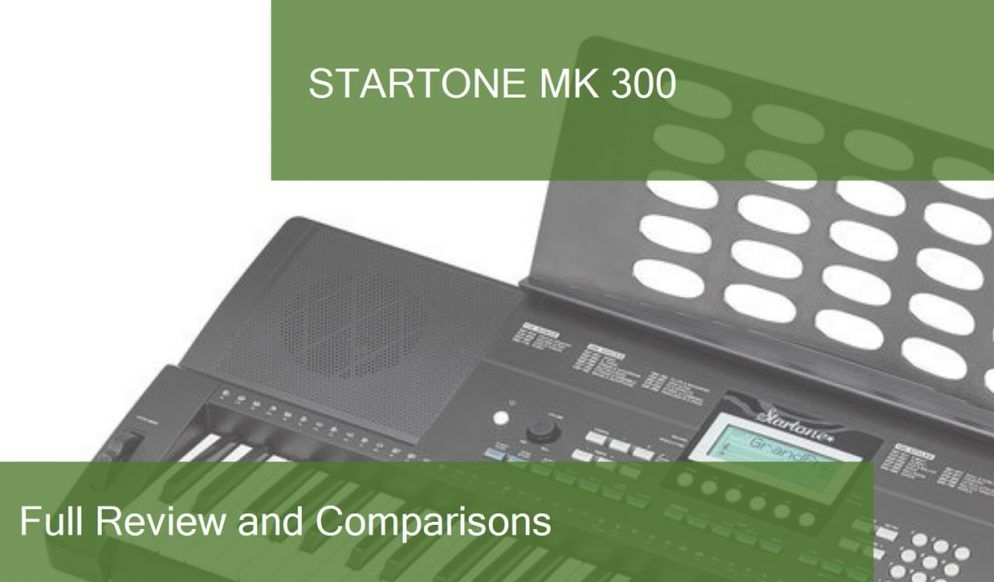
Digital Piano Startone MK 300 Full Review. Is it a good choice?
Complete Review Startone MK-300 Digital Piano. It it a good choice?
Startone is a brand of Thomann, a company based in Germany that specializes in the sale of musical instruments, audio equipment, professional audio and lighting. Today we will have a review of a keyboard for beginners or keyboardists who are looking for an economical keyboard but that meets their needs. With a value of about €115/£102, its features are:
- 61 keys with touch response (You can adjust the volume of the note depending on how you press it. And it is different from the counterbalance, which is the weight of the keys on a piano)
- 64 notes of polyphony (Number of notes that can be played at once. This includes accompaniments that also consume notes. So if you play on top of an accompaniment more notes will be accumulated)
- 390 voices (Various piano and other instrument sounds)
- 100 styles (Accompanying styles that adapt to the chords we are playing. For example they will put a bass and drums that will adapt and synchronize with the notes we are playing on the keyboard)
- 110 songs
- 8 demo songs
- Dual (Dual mode allows two sounds to be combined to create a more complete one. The combination of piano + stringed instrument sound is typical)
- sustain (The sustain pedal on a piano or keyboard is used to keep the note playing even if you stop pressing the key)
- Lower
- Metronome (Basic study element to study and practice the tempo of a piece of music)
- 4 recording memories
- Split (Split the keyboard into two different instruments)
- pitch bend (Functionality that changes the sound wave of what you play and then returns to its original state)
- Recording and reduction
- 2 x 10W speaker system
- Can be operated with batteries or power supply
- Includes power supply
- Connections: Headphones, Sustain
- USB to midi (MIDI allows you to do such wonderful things as connect your keyboard to your computer, record a sound track, and with certain programs, click through what you’ve played to musical notes on a score. MIDI tracks store the information of the musical notes)
- Dimensions (width x depth x height): 955 x 360 x 145mm
- Weight: 4.5kg
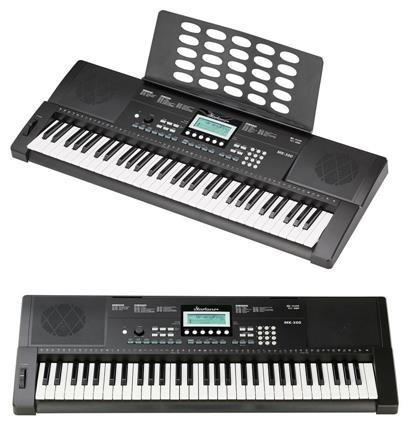
This keyboard is very interesting because it has sustain pedal input, MIDI and sensitivity on the keys for a very very cheap price. The truth is that it is a very competitive keyboard but you can notice the materials are a bit worse quality than in, for example, the Yamaha PSR E363 with which we will compare it later. It must be said that if you only have 100 euros of budget and you can’t spend more in any way it’s better to buy this than a model that has neither MIDI, nor pedal input nor sensitivity.
Now that we have listed and described the features of this keyboard there is no better way than to take a look at the following video where they tell us more about the Startone MK-300 and you can hear how its different sounds sound.
The video will show the connections it has and get a good idea of the sounds it brings and its possibilities.
Related post you can be interested in
- Ranking with the best digital pianos
- My selection of cheap musical keyboards.
- Basic concepts you need to know about digital pianos.
- The best resources to learn to play the piano by yourself.
Now let’s compare the Startone MK 300 with its more common alternatives. Also at the end of the post you will find a section with the best shopping possibilities for this digital piano. But you can go directly to that part of the post by pressing the following button.
Startone MK-300 vs Startone MK-200
We will now compare the MK-300 with a price of €115/£102 and the MK-200 with a price of €89/£79 both from Startone. Let’s then check if the price difference between “brothers” is similar to the features they offer:
- Both have 61 keys that are touch sensitive, this means that if we press a key hard it will sound louder than a key we press less hard.
- The MK 300 offers 390 different voices/tones and 100 rhythms/styles for accompaniment. While the Mk 200 gives us 320 different voices/tones and 110 rhythms/styles for accompaniment.
- Both keyboards provide demonstration songs, when the MK 300 has 8, the MK 200 offers 100. Interesting point if you want to learn the songs that come as demonstration.
- Both keyboards have: input for sustain pedal, metronome, 4 recording memories, audio play/record and Modes; Dual and Split.
- A notable difference is that on the MK 300 we have Pitch Bend (which is a wheel that when moved changes the pitch (height) of a note being played). When in the MK 200 we don’t have this option.
- In terms of speakers, the MK300 gives us 2 x 10W speakers with a powerful sound, while the MK 200 has 2 x 3W speakers, notably less powerful.
- In terms of weight, both are 4.5Kg, too light to be transported.
While the MK 200 is not a bad choice for beginners, as previously reported the MK300 has everything a person needs to start learning to play the piano in a decent way those other €25 are worth moving to the next level.
We will put the characteristics of each of these pianos in 2 different columns to make it easier to see the differences:
|
Startone MK-300 |
Startone MK-200 |
|---|---|
|
|
As we can see the MK 300 is a little higher than the MK 200 and the speakers are much more powerful. The truth is that for the good price that both have I would buy the MK 300 because with that power of speakers you can play in small restaurants even if it is a little more expensive.
Here is a video of the MK 200 connected to a computer as a MIDI controller.
If you want to know more about this alternative model do not miss our review of the Startone MK-200.
Startone MK-300 vs Yamaha PSR-E363
Now let’s compare the Startone MK300 with a price of €115/£102 together with the Yamaha PSR E363 which has a price of €198/£180, is it worth the price increase of almost €80? Let’s find out by putting its features face to face:
- We found that both keyboards have 61 keys with touch sensitivity and response. Remembering that sensitivity is the option to create dynamics (playing a strong note that sounds higher, as opposed to one that we play less strongly)
- The Startone offers 390 voices/tones with 100 rhythms/styles for accompaniment. When the Yamaha gives us 574 voices/tones with 165 rhythms/styles for accompaniments
- In demo songs, the MK 200 gives us 8 songs, while the PSR E363 gives us 145.
- On the Startone we have 4 recording memories, while on the Yamaha we have 5 with a 2 track sequencer.
- On the Yamaha PSR-E363 we have effects like: Reverb, Chorus, EQ master, harmony, and different arpeggios, apart from the Sustain pedal input. The Startone MK-300 offers no other effects than the Sustain pedal input and the Pitch Bend, which as mentioned above is the wheel for changing the pitch of a note while it is playing. The Yamaha doesn’t have a Pitch Bend.
- In loudspeakers, the Startone has 2 moderately powerful 10Ws, while the Yamaha integrates 2 less powerful 2.5Ws.
- A notable difference is that the Yamaha comes with different iPhone/iPad applications, which require an i-UX1 cable to be purchased separately. On the Startone we do not have this option.
- Both keyboards weigh almost the same, the Startone 4.5 kg, and the Yamaha 4.6 kg.
Here is a clear advantage of the Yamaha, taking into account its greater amount of sounds and rhythms or styles for accompaniment, its different effects and types of sounds and its availability to connect to an iPhone or iPad, make it a good option. The MK 300 stands out in its 64 notes of polyphony and its 10 watt speakers taking the lead in these aspects compared to the Yamaha. Remember also that Yamaha is almost twice as expensive as the Startone, check the videos and according to the sound quality, you will know if they are worth it or not.
Here is the table with the characteristics of each one:
|
Startone MK-300 |
Yamaha PSR-E363 |
|---|---|
|
|
The decision is not easy here. On the one hand the Yamaha PSR E363 has many more sounds and extra features like the two-track sequencer and the quality of the piano sounds.
The truth is that the Yamaha PSR is more popular although this Startone model is very good in its price. It even costs less than the Yamaha and has more powerful speakers. I like the sound quality of the Yamaha better though. In this case the criterion must be money.
Here is a video of the Yamaha PSR E363:
If you want to know more about this model (the best seller in its range) do not miss our review of the Yamaha PSR-E363.
Startone MK-300 vs Thomann SP 320
Now let’s compare these two items. While both are for beginners, the Startone MK300 is a digital keyboard with a price tag of €198/£180 and the Thomann SP 320 is a digital piano with a price tag of €239/£218. That we will test face to face to see if which one is more suitable for you according to what you are looking for:
- The Startone MK – 300 has 61 keys with touch response (sensitivity) and the Thomann SP 320 has 88 lightweight weighted keys with sensitivity as well. Counterbalance, is the weight that has the low keys and is gradually becoming lighter reaching the high keys. Sensitivity is the option to make dynamics, that is to say that when we press a stronger key it sounds higher compared to another one that is pressed with less force.
- The Startone MK300 provides 390 voices/tones with 100 accompaniment styles/rhythms, 64 polyphony notes and 8 demo songs. The Thomann SP 320 gives us 12 sounds, no rhythms/styles (since it is a piano), 32 notes of polyphony and 12 demo songs.
- The Startone has a sustain effect with the use of its pedal input, while the Thomann SP320 has a sustain effect: Reverb, Chorus and also its pedal input.
- The Startone MK300 has an option for audio recording and playback, when the Thomann SP320 does not have this option.
- The Startone MK300 has a Pitch Bend Wheel, which serves to change the pitch of the note while it is playing, the Thomann SP 320 does not have this feature.
- Both have: USB MIDI, to be connected to a computer and used as a MIDI controller in a music composition or production program, line output and headphone output.
- The Startone MK300 has a pair of 10W speakers, while the Thomann SP320 has a 2 x 20W speaker system.
- The Startone weighs 4.5 kg, and the Thomann weighs 9 kg. Almost twice as much, counting also the number of notes in the second.
Of course, if you want to learn piano more properly, the Thomann SP 320 is the cheapest digital piano available. Although I recommend others but in price the Thomann SP 320 beats many but I only advise it if your budget is very very low.
Here is the table with the characteristics of each one:
|
Startone MK-300 |
Thomann SP 320 |
|---|---|
|
|
And now a video of this piano
https://www.youtube.com/watch?v=o3KAuhpzPg8
If you want to know more about this model don’t miss our review of this Thomann SP-320.
Startone MK-300 vs Casio CT-S300 (Old Casio CTK 3500)
Now a comparison between two best-selling digital keyboards from different brands, on the one hand we have the Startone MK300 with a price of €198/£180 and on the other the Casio CT-S300 with a price of €177/£159. Let’s see which one is the best by comparing its features face to face:
- Both are 61-key keyboards with touch response sensitivity, remembering that sensitivity is having the option to create dynamics, when we press a strong key, it sounds louder than another pressed with less force.
- The Startone MK300 has 390 voices/tones, 64 notes of polyphony, with 100 styles/rhythms for accompaniment and 8 demo songs. The Casio CT300 has 400 voices/tones, 48 notes of polyphony, with 77 styles/rhythms for accompaniment. Polyphony means the number of notes that can be played at the same time.
- Both keyboards also have a Pitch Bend wheel, which is used to change the pitch of a note as it is played.
- Both have: USB MIDI, to be connected to a computer and use them as MIDI controllers in a music composition or production program, line output (very good for playing with powerful amplification equipment as it has more signal power), headphone output and input for sustain pedal.
- One advantage of the Casio CT-S300 is the learning function and the possibility of the App Chordana, which does not count in the Startone MK300.
- The Startone MK300 has a pair of 10W speakers, while the Casio CT-S300 has a 2.5W speaker system, below the Startone.
- In weight, the Startone is 4.5Kg while the Casio is 3.3 Kg.
The Casio CT S300 is another bestseller and competes very well with the Yamaha PSR E363.
Here is the table with the characteristics of each one:
|
Startone MK-300 |
Casio CT-S300 |
|---|---|
|
|
Here is a video of the Casio CT S300:
If you want to know more about this model, don’t miss our review of the Casio CT-3500, the previous model of the Casio CT-S300.
Where to buy Startone MK 300
Thomann
- Free Shipping.
- Full warranty. If you have any problems, they take care of everything.
- 100% reliable payment.
- Leader in trouble-free shipping.
- Usually Best price.
- Best Reputation: They are the leading online store in Europe and have the best catalogue and information.
Check below related models with similar price and features:
- Thomann DP 26
- Thomann SP 320
- Yamaha NP 32 Piaggero
- Korg Tiny Piano
- Startone MK 300
- Startone MK 200
- Yamaha PSR E463
- Yamaha PSR E363
- Startone MKR 61
- Roland GO KEYS
- Casio SA 46
- Casio SA 47
- Casio CTK 240
- Casio CT X700
- Yamaha EZ 220
- Yamaha PSR E263
- Yamaha PSR EW300
- Casio LK 280
- Casio SA 76
- Casio CTK 3500
- Casio LK 265
- Casio LK 136
- Casio CTK 1500
- Casio SA 77
- Yamaha Sonogenic SHS 500
- Casio SA 78
- Casio CTK 2500
- Yamaha YPT 260
- Roland GO PIANO
- Midiplus Stage 88

Digital Piano Startone MK 200 Full Review. Is it a good choice?
Startone MK-200 Review Complete Digital Piano. Is it a good choice?
Startone is a Thomann brand that offers very good musical instruments for beginners, now we will analyze the Startone MK 200 which is a very low range keyboard but it can be a curious option for people with a budget of less than 100 euros, as it costs €89/£79. The incredible thing about this keyboard is that for that price it comes with a sustain pedal connection and USB MIDI, which gives it many possible uses, the features it has are
- 61 keys with touch response (You can adjust the volume of the note depending on how you press it. And it is different from the counterbalance, which is the weight of the keys on a piano)
- 32 polyphonic voices (Number of notes that can be played at the same time. This includes the accompaniments that also consume notes. So if you play on top of an accompaniment more notes will be accumulated)
- 320 voices (Various piano and other instrument sounds)
- 110 styles (Accompanying styles that adapt to the chords we are playing. For example they will put a bass and a drum kit that will adapt and synchronize with the notes we are playing on the keyboard)
- 100 songs
- 100 demo songs
- Dual (Dual mode allows you to combine two sounds to create a more complete one. The combination of piano + stringed instrument sound is typical)
- Sustain pedal connection (The sustain pedal of a piano or keyboard is used to keep the note playing even if you stop pressing the key)
- Lower
- Metronome (Basic study element to study and practice the tempo of a piece of music)
- Memory with 4 tracks
- Possibility of splitting the keyboard
- Modulation can be switched On/Off
- 3W speaker system
- Can be operated with batteries or power supply
- Includes power supply
- Connections: Headphones, Sustain pedal and USB to Host
- It has a very light weight of 4.5 kg.
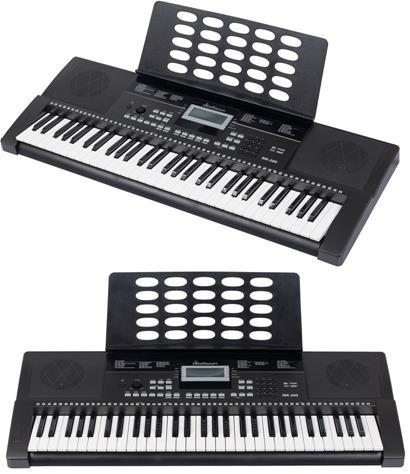
There is no video of the Startone MK 200 but its sound engine is practically the same as that of the Startone MK 300 so we leave you with this video where you can listen to a very famous song with strings accompaniment:
Related post you can be interested in
- Ranking with the best digital pianos
- My selection of cheap musical keyboards.
- Basic concepts you need to know about digital pianos.
- The best resources to learn to play the piano by yourself.
Now let’s compare the Startone MK 200 with its more common alternatives. Also at the end of the post you will find a section with the best shopping possibilities for this digital piano. But you can go directly to that part of the post by pressing the following button.
Startone MK-200 vs Startone MK-300
The startone MK 300 is a slightly superior model that costs €115/£102 but is very worthwhile in one respect. It has very powerful 10 W speakers, so you can take it to rehearsals and it is a great option as a secondary keyboard for any musician. We will put them face to face with the MK200 and its big brother the MK300:
- They both have 61 keys that are touch-sensitive, which means that if you press a key hard it will sound louder than a key you press less hard.
- The Mk 200 gives 320 different voices/tones and 110 rhythms/styles for accompaniment while the MK 300 offers 390 different voices/tones and 100 rhythms/styles for accompaniment.
- Both keyboards have demo songs for us, when the MK 300 has 8, the MK 200 offers 100. Interesting point if you want to learn the songs that come as a demo.
- Both keyboards have: input for sustain pedal, metronome, 4 recording memories, audio play/record and Modes; Dual and Split.
- A notable difference is that on the MK 300 we have Pitch Bend (which is a wheel that when moved changes the pitch of a note that is playing). When in the MK 200 we don’t have this option.
- In terms of speakers, the MK300 provides two 10W speakers with a powerful sound, while the MK 200 has two 3W speakers, notably less powerful.
- In terms of weight both have 4.5Kg, very light to be transported.
The list of characteristics of each keyboard is as follows:
|
Startone MK-200 |
The Startone MK-300 |
|---|---|
|
|
The Startone MK 300 is also superior in the amount of sounds and accompaniments and the truth is that for the small price difference it can be worth a lot. We leave you with a complete review to see:
If you want to know more about this model don’t miss our review of the Startone MK-300.
Startone MK-200 vs Casio CTK-1500 (Casio CTK 1550 has been released but is the same)
Both keyboards are for beginners, and very basic input. The Startone MK-200 as we have already seen has a price of €89/£79, when the Casio CTK-1500 has a price of 88 Euro we can say that they cost exactly the same. Their differences and similarities:
- Both have 61 keys that are touch-sensitive on the Startone only, this means that if you press a key hard it will sound louder than a key you press less hard.
- The Mk 200 gives 320 different voices/tones and 110 rhythms/styles for accompaniment while the CTK 1500 offers 120 different voices/tones and 70 rhythms/styles for accompaniment.
- Both keyboards give us demo songs, when the Casio has 50, the MK 200 gives us 100. Interesting point if you want to learn the songs that come as a demonstration.
- The Startone MK200 has input for sustain pedal, metronome, 4 recording memories, audio play/record and Modes; Dual and Split.
- In speakers, the MK200 gives us 2 x 3W speakers with a powerful sound, while the CTK-1500 has 2 x 2W speakers, notably less powerful.
- The Startone has a weight of 4.5Kg, when the Casio CTK 1500 has a weight of 3.3Kg.
I think it’s logical that the Startone has many more and better features for the same price, so in this comparison we have an undoubted winner, the Startone MK200.
See how the Startone MK200 brings many more features:
|
Startone MK-200 |
Casio CTK-1500 |
|---|---|
|
|
If you want to know more about this model visit the review of the Casio CTK-1500.
Startone MK-200 vs Yamaha PSR-E363
Well, in this case we compare two extremely popular models but which have a clear difference. The Startone MK 200 with a price of €89/£79 and the Yamaha PSR E363 that has a price of €198/£180 with a difference of more than 100 euros, but among the sounds of the Yamaha I must clarify that I like them better. I am talking about sampling quality and since they are pre-recorded, here is their face to face:
- They both have 61 keys that are only touch-sensitive on the Startone, which means that if we press a key hard it will sound louder than a key we press less hard.
- The Mk 200 gives 320 different voices/tones and 110 rhythms/styles for accompaniment while the PSR-E363 offers 574 different voices/tones and 165 rhythms/styles for accompaniment.
- Both keyboards give us demo songs, when the Startone has 100, the Yamaha offers 154. Interesting point if you want to learn the songs that come as a demonstration.
- Both keyboards have input for sustain pedal, metronome, recording memories, audio playback/recording and Modes; Dual and Split.
- In terms of speakers, the MK200 gives us 2 x 3W speakers with a powerful sound, while the PSR-E363 has 2 x 2.5W speakers, almost as powerful.
- The Startone weighs 4.5Kg, when the Yamaha weighs 4.6Kg they weigh almost the same.
If you have the money the Yamaha PSR E363 is the best option for this price range for less than 200 euros. See how the Yamaha PSR E363 brings many more features:
|
Startone MK-200 |
Yamaha PSR-E363 |
|---|---|
|
|
If you have the money the Yamaha PSR E363 is the best option for this price range for less than 200 euros:
If you want to know more about this model don’t miss our review of the Yamaha PSR-E363.
Where to buy Startone MK 200
Thomann
- Free Shipping.
- Full warranty. If you have any problems, they take care of everything.
- 100% reliable payment.
- Leader in trouble-free shipping.
- Usually Best price.
- Best Reputation: They are the leading online store in Europe and have the best catalogue and information.
Check below related models with similar price and features:
- Thomann DP 26
- Thomann SP 320
- Yamaha NP 32 Piaggero
- Korg Tiny Piano
- Startone MK 300
- Startone MK 200
- Yamaha PSR E463
- Yamaha PSR E363
- Startone MKR 61
- Roland GO KEYS
- Casio SA 46
- Casio SA 47
- Casio CTK 240
- Casio CT X700
- Yamaha EZ 220
- Yamaha PSR E263
- Yamaha PSR EW300
- Casio LK 280
- Casio SA 76
- Casio CTK 3500
- Casio LK 265
- Casio LK 136
- Casio CTK 1500
- Casio SA 77
- Yamaha sonogenic SHS 500
- Casio SA 78
- Casio CTK 2500
- Yamaha YPT 260
- Roland GO PIANO
- Midiplus Stage 88