
- Home
- Author's Archive:
Top Casio Digital Pianos and Keyboards
Casio is one of the main brands of musical instruments nowadays and their piano keyboards are quite popular.
In this guide we have made a selection of the best Casio keyboards. Many of them are real bestsellers and we will explain why. The keyboards we are going to show you have a price range between 100 and 800 euros. Obviously not all of them are good for the same thing. Some are keyboards for beginners or to use as a keyboard for composing. Other models in the selection are perfect for studying piano at almost any level, especially those with counterbalance.
At the beginning we show you a best seller like the Casio CDP S100 which is a best-selling portable and weighted keyboard digital piano. Then in the middle of the article several very attractive keyboards for beginners and to finish a digital piano designed to study at home. Although Casio is famous for its keyboards it also has digital pianos as quite decent furniture.
In addition we give you several options to buy so that you can see if it is convenient to buy these electronic products on Amazon or other stores like Thomann. The important thing is that many of the keyboards on the list have the basics. A sensitive keyboard, a sustain pedal input that holds the note in time even if it is not pressed, and a MIDI connection.
The keyboards that have 88 keys and weighted keyboard are so-called digital pianos and those with 61 electronic keyboards that are not intended to imitate an acoustic piano as much.

Jaime Echagüe
Author
Advice:
From this post you can control the price of these pianos quickly because you have direct links to several stores. If you save this post in bookmarks or favorites of your browser you will have it available easily and accessible.
Casio CDP S100 (instead of Casio CDP 130)
A marvel that Casio brought out earlier this year to replace the Casio CDP 130 and to compete with the Yamaha P45 at a similar price of 400 euros.
It’s meant to be portable. It occupies 30% less than the Casio CDP 130 and only about 10kg. It also works with small batteries and has an app to manage its features.
It is a piano with hammer action and sensitivity in the keys. Which are two different things. The counterbalance imitates the touch of a real piano and the sensitivity is so that the volume with which the note sounds depends on how loudly or how softly the key is pressed.
Let’s go with your characteristics:
- 88 keys with scaled hammer action (Scaled Hammer Action Keyboard II)
- 64 notes of polyphony (same as the Yamaha P45)
- 10 sounds
- It has a layer and layering function
- It has effects like Reverb and Chorus
- Metronome
- App function (‘Chordana play for piano’)
- 2 demo songs
- USB to Host Connection (MIDI)
- 1 headphone jack
- 1 jack for pedal
- Audio input for plugging in a mic or a play track (other than a mic that needs extra power or phantom)
- 2 x 8W speaker system (enough power to play in an enclosed space)
- Dimensions: 1322 x 232 x 99 mm (width x depth x height) and a very light weight of 10.5 kg
- Includes power supply and SP-3 sustain pedal (no big deal but it comes with it)
- Color: Black
Don’t miss the full review of the CASIO CDP S100
In USA check the Casio PX 160. If you press link below it will drive you to the Casio PX 160 cause Casio CDP S100 is not at USA right now. If you are in Europe Amazon link will drive you to the Casio CDP S100
I’m sure you’ll be interested in…
- See this section for possible discounts and offers
- Ranking with the best digital pianos in quality-price ratio
- The cheapest musical keyboards for beginners
- Learn piano by yourself and for free
Casio CT S300 (Old Casio CTK 3500)
The Casio CTK 3500 (no difference between the two) and its new version Casio CT S300 is the cheapest keyboard in the selection. It is a music keyboard with a wide range of sounds and does not exceed 200 euros.
It has a USB MIDI output so you can connect it to your computer and work with it with programs like Sibelius. So it’s perfect for composing.
It has a sustain pedal input which is not included and a 61-key sensitive but not hammer action Casio keyboard. At the end of the post we recommend a sustain pedal compatible with this keyboard.
It has a polyphonic memory of 48 voices which is not bad for that price and about 400 sounds of an average quality.
It’s the perfect keyboard to know if you like to play the keyboard or as a secondary keyboard to compose and take to rehearsals since it weighs 3.5 kg and you can take it wherever you want. However, if you want to learn the piano, it will only be good for the first year and it is not ideal for learning the piano.
We are talking about the most popular Casio keyboard that has ever existed in terms of value for money.
It has not very powerful 2W speakers.
- 400 sounds, some a little toy but the most important ones sound ok.
- Power supply included.
- Possibility of batteries.
The differences with your previous model are not many
- The speakers are a little more powerful in the new CT S300
- It weighs a little less than that and is always good to transport even on public transport.
- Accompanying styles with more sound quality
Let’s hear their sounds in this video
Casio CTK 240
The Casio CTK 240 keyboard is very popular from Casio. It’s a pretty basic keyboard but at a very low price:
- 49 keys without sensitivity or hammer action
- 12 polyphony voices (Number of notes that can sound at once. This includes accompaniments that also consume notes. So if you play on top of an accompaniment, more notes accumulate)
- 100 sounds (Different sounds of piano and other instruments)
- 100 styles (Accompanying styles that adapt to the chords we are playing. For example they will put a bass and a drums that will be adapted and synchronized with the notes that we are playing in the keyboard)
- 50 pre-recorded internal songs
- LCD display improves usability and makes it easy to use
- 2 not very powerful 1.6W loudspeakers
- Runs on batteries only
- Very light weight, at 2.8kg
It usually costs less than 100 euros and can be used by someone who wants to compose or have a secondary keyboard. But I really don’t recommend it to start playing the piano. The sounds are very basic and the Casio CTK 3500, of which we have spoken to you above, at least brings MIDI and sustain pedal. I don’t recommend such a basic keyboard to start with.
Also if you want to buy it despite what I have told you the best packs and prices you will find here:
Casio LK-280
A very interesting keyboard, for a price of less than 300 euro a musical keyboard very fun and with many utilities. Comes with:
- 61 illuminated and touch-sensitive keys
- 48 notes polyphony
- 600 sounds
- 180 styles
- 110 internal songs already configured
- Learning system (I really don’t like these systems very much)
- Transposition function
- LCD display for easy operation
- Metronome (Element of basic study to study and practice the tempo of a piece of music)
- Sampler function to record percussion loops or musical passages and then loop over them. Up to 10 seconds
- Recording up to 6 tracks
- Memory expansion slot for SD or SDHC cards up to 32 Gb
- SMF format player
- Microphone input that will go out to the speakers and allow us to sing while we play and put effects to the voice. Or record… It also includes a microphone
- USB midi connection
- Input for sustain pedal (The sustain pedal of a piano or keyboard is used to keep the note playing even if you don’t press the key)
- Headphone and line output for live performance
- 2 x 2.5W speakers that are ok for home rehearsal and practice
- Includes power supply and supports batteries. It is also very portable with a weight of 4.5 kg and dimensions of 948 x 350 x 103mm (W x D x H).
Don’t miss the review of this Casio keyboard. In that review you will find many interesting comparisons. It’s a very good option if you don’t have more than 300 euros.
You can buy it at the following:
Casio Celviano AP-470 Digital Piano (formerly AP-460)
This is the new model of the Casio Celviano AP460. It’s coming back:
Two new piano sounds: Steinway D and the other from Steinway Boston. 4 new accompaniments for layering and playing, spatial audio, key on and key off simulations, better speaker system and better HALL simulations.
This piano is the latest and most expensive of all the digital pianos we have selected. It is not the most purchased but it is a real hidden gem at a good price. The Celviano is very appreciated by many piano teachers for their students.
Casio has outdone himself with the sound of this piano. It has one of the most advanced digital counterbalancing systems available.
Don’t be fooled by its modest appearance, it is one of the best digital pianos ever made. It has strings and hammers to simulate a real piano and the digital sound coming out of its system does not lose quality in compression. Its price is a little bit higher than the other models we have presented to you but its closeness to the feeling of playing a real piano is tremendous.it has MIDI support, ebony and synthetic ivory keys, recording and USB port, metronome, three pedals, 20W speakers, headphone output. They’ve worked their way up to the top to keep the dust out.
Apart from all the features that a digital piano of that price usually has, what is tremendous is its “Tri-Sensor II” system of hammers and touch sensitivity. For now, the most powerful digital acoustic counterbalance system on the market.
We summarize its features here:
- 88 Scaled Hammer Action II (Tri-Sensor) synthetic ebony/ivory keys
- 22 piano sounds with the new ones we showed you before
- Multi-Dimensional Morphing AiR
- 256 polyphony voices (very powerful)
- Partition and layer functions
- DSP, chorus, ‘Brilliance’ and ‘Hall’ simulation
- 2-track sequencer
- It has a resonance effect and a hammer effect to better simulate the feeling of a real piano. Imitating the vibrations you feel when you play a real one.
- Cover and key deactivation simulator
- Audio recording / playback
- Of course it has a metronome, a transponder, etc, etc
- Triple footswitch for any level
- 2 headphone jacks
- USB to Host (this is the MIDI)
- USB to device
- 2 line outputs (L/Mono, R) with which it is possible to play live if necessary although it is a bit heavy compared to the portable digital pianos at the beginning.
- 4 x 2-way 2 x 20W speakers (better than AP 460)
- Dimensions including lectern: 1417 x 427 x 861mm (height x width x depth)
- A weight of 43 kg compared to 150 kg that can weigh a normal wall.
- Includes score book, music stand, headphone hook and power supply AD-E24250LW. Although it must be said that it does not come with a stool.
Pedal for Casio keyboard
Casio 88-key pianos come with a sustain pedal to get you started, but for little money you can buy “universal pedals” with a little more quality.
The sustain pedals are the musical accessories for your digital keyboard that you will need for sure. In addition to a good cover and an approved stand to be comfortable and avoid injuries.
If you have bought a 61-key model like the Casio CTK 3500, which at first do not come with sustain pedal – and the truth is that the first year of learning you can pull without, it but you should have one in the future to get all the expressive resources of your electronic keyboard.
If you buy your sustain pedal look first at Thomann when you buy the keyboard, but if you buy it later is an item too cheap so you will not get free postage. In that case you have the following good option as sustain pedal on Amazon:

Casio Keyboard Stand
There are several types of media and the truth is that they are an important accessory for your keyboard or digital piano. In this type of product, a good support is important because when you are playing your piano if the support is not good you will have a very uncomfortable vibration that is not pleasant. There are several very affordable models and undoubtedly the most sold is the next model of the Stagg brand:

Casio Keyboard Bench and Ergonomics Tips
If you are going to practice a lot with the keyboard, it is very important to have a suitable stool.
The height of your hands should be adequate so that you do not have to be forcing the position or you may develop tendinitis or other injuries.
Most people have different heights but a digital piano stand will always have the same height. So it’s the stool that has to be adjustable. Of course if you have a filly and you find a stool with the right height that you need that is perfect. In our next post you are going to see several videos and postural tips to avoid injuries.
I strongly encourage you to see it because for sure it provides a lot of useful information and avoids future headaches… and back pain. Visit our ergonomics guide for playing the piano and how to choose the best piano stool..

If you are interested in more musical instruments and especially pianos from other brands we advise you to have a look at our selection with the best digital pianos of the moment and have a look at my selection of Yamaha keyboards and pianos.
Do you want to know more about piano keys?
The piano is one of the easiest musical instruments to learn to play. But then when it comes to mastering it, things get complicated.It’s quite possible that you’ve ever wondered about the differences between black and white keys. Or that it is a chord or how it is that there can be several C notes in the same digital piano. We explain these doubts in our post that explains the keys of a piano.
Digital pianos are products that have revolutionized the piano studio in a very important factor that is to be able to study in silence thanks to headphones. And that’s where the Casio brand has made a remarkable contribution with every digital piano it’s designed. So it’s also important that you get one of these accessories. It doesn’t have to be special, headphones you feel comfortable wearing if you’ve been wearing them for a long time.
Speaking of studying piano, if you are looking for a piano or digital keyboard, it is very possible that you are also thinking of learning in a self-taught way and save a few dollars. At an initial level that is possible, and if you are very clever then maybe more. We therefore recommend that you take a look at our guide to learning piano, where we guide you through the free resources and paid products that exist for self-taught piano learning today.
In this article we included until recently the following models that now you can only find second-hand:
- Casio CTK 4400
- Casio CTK 7200
- Casio CDP 130 (the new one is the Casio CDP 135)
- Casio CDP 230
- Casio PX 160 (the new one is the Casio PX 165)
Please, vote if you liked this article
>>>>>
Piano Keyboard – How many keys does a piano have?
It’s curious but one of the most recurring questions people ask about the piano is, what is the difference between the black and white keys?
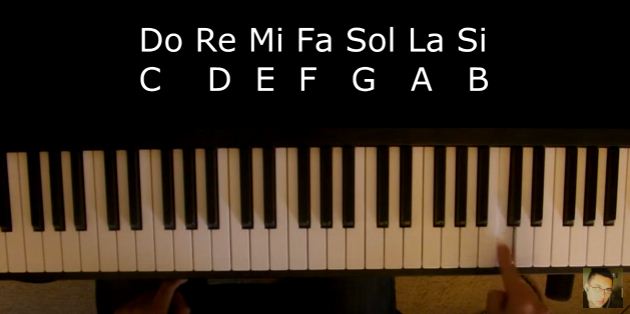
Many people by simple culture know that the musical notes are DO-RE-MI-FA-SOL-LA-SI (C-D-E-F-G-A-B in english system). But of course this can lead us to think. How is it possible that there are only seven notes if a piano has up to 88 keys and most 61 keyboards?
Jaime Echagüe
Author
Advice:
Don’t miss the selection of BuscarInstrumentos.com with the best piano keyboards of the moment, we evaluate the quality in relation to the price of the keyboard.
This is possible because the 7 notes we already know form a block that is called an octave and is repeated along the keyboard. The octaves to the left of the piano are the lowest notes and the octaves to the right are the highest.

Full octave from C to C in american notation
In the previous image we can see a complete block of keys. From the C on the left to the C on the right there is a distance of one octave: C-D-E-F-G-A-B-C.
This is a bit confusing because you’ll wonder how this C differs from the other and why there are no more notes. For pure usability our 7 note tonal system was defined and then these are repeated towards the treble or bass in blocks of 7 notes. At a simple convention. In the background, each note is associated with a specific hertz. So a serious C will have some hertz and a more acute C will have some hertz. Both notes, although called C, are different sounds.
It must be taken into account that although they are different sounds between one DO and another there will always be a distance that can be measured in octaves. Equal between a serious SI and a more acute SI.
The Nordic and Anglo-Saxon countries call notes with German notation (although it is also called American notation). In the following image you have the equivalence, ours is the Italian school.
What is the difference between black and white keys?
I’m sure you’ll be interested in…
- Ranking with the best digital pianos in quality-price ratio
- The cheapest musical keyboards for beginners
- Learn piano by yourself and for free
As we have already explained to you, our tonal convention system is made up of 7 notes. These natural notes are C-D-E-F-G-A-B and are the white keys. And that means there are no notes in between? Well, there are, and these are the black keys.
The distance between the keys or notes could be measured in Hertz but this is not the case. They are measured in tones and semitones and not all notes have the same distance between them. According to our tonal system between the C and the B there is no intermediate note. Just like between E and F. What it is when we see two white keys in a row without a black key in the middle.
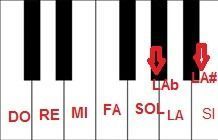
To explain the black keys I will try to be as clear as possible with an example. The black key between A (LA) and G (SOL) is a musical note in between and can be called in two ways; F sharp (represented as F#) or G flat (represented by Gb). Both notes are the same note in Hertz, the distance from a white key to its immediate black key will always be half tone. And the distance between two whites if there is a black key in the middle will be one whole tone or 2 semitones.
It is a more complex concept but a F sharp is a note F with a semitone added, which is the same as Gb which means to subtract a semitone. At the end you look at it as you look at it you fall in the black key that is between them. We put you the following image with other examples so that you see the one that means flat and sharps:
If you are left with any doubt, watch this video with which you will surely understand everything perfectly.
Virtual Piano Keyboard or a real piano keyboard?
So far we have explained to you what the keyboard of a piano is like and what each key is like. Now you might want to know how to test sounds on a real or virtual keyboard.
If you don’t have a real electronic piano keyboard you can use a piano keyboard simulator to do the first experiments. The most comfortable thing is to use a tablet because its touch screen is the closest thing to a piano and the specific iPad brings the GarageBand. With a fairly intuitive and simple piano extension… it is free and has many more instruments.
For Android you have Perfect Piano that is quite well in its free version.
The tactile piano simulators can be used for the first approaches but are rather limited to learn piano. They’re good for testing chords and seeing how they sound, that’s for sure.
A piano keyboard is a keyboard that tries to imitate an acoustic piano as much as possible. The most important thing for this is that it has at least 61 keys and that these are sensitive to the force with which they are pressed. On the other hand if the keys have weight (Hammer Action) they will get closer to the real touch of a real piano.
The above factors are very important when playing the piano with expressiveness and nuances. Today you have keyboards and digital pianos that emulate acoustic pianos very well. So we can study music perfectly about them and save a lot of money.
If you are thinking of buying a digital piano keyboard visit our guide of the piano where you will know what types there are, the different sizes and measures you have at your disposal and all the possibilities they offer you to compose your own music.
You can start with a 61-key piano keyboard, for example. Less than 61 keys we do not recommend because that will limit you a lot in the future. You have Yamaha piano keyboards at a good price for example.
If you want to know more about music theory and how to play the piano visit our free piano tutorial.On the other hand you have to know that nowadays with the new technologies an incredible world is opened in the learning of the piano. Even self-taught. If you want to know more, don’t hesitate to visit our piano learning guide.If you liked the article and think it could be useful to someone, don’t hesitate to share it on your social networks. Thanks for reading!
Vote if you liked this article 🙂
Digital Piano Casio CTK 7200 Full Review. Is it worth it?
Analysis and Where to Buy Casio CTK 7200: Review and Opinion
Casio is a brand with several lines of keyboards, the CTK 7200 is an economical choice for those looking to start in the world of piano or use a keyboard for amateur music production.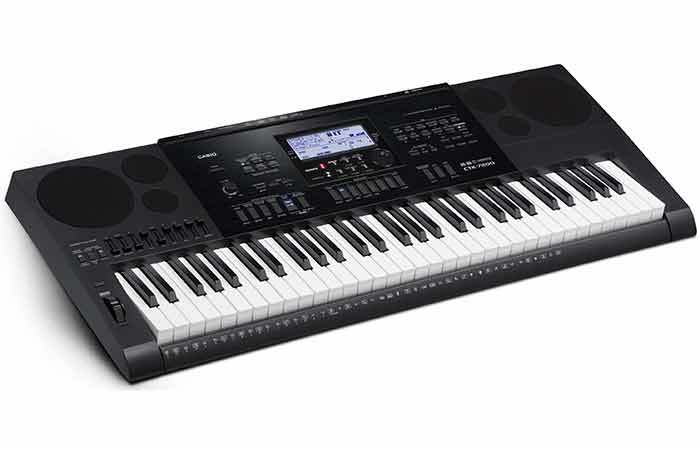 The 61 pressure-sensitive keys, the variety of voices, functions and effects added to the option of use with batteries make the CTK 7200 a keyboard to consider especially for amateurs.
Features
The CTK 7200 is a simple keyboard, but with interesting features mainly for amateur keyboardists. The technical characteristics of this model are shown below:
- Keyboard with 61 pressure-sensitive keys
- Technology with 2 levels of pressure sensitivity
- 64-note polyphony
- 820 voices with 50 organ tones created with harmonic bar
- 260 rhythms
- Reverb of 10 types
- DSP – 100 default and 100 user-created
- 5-type choir (not compatible with simultaneous use of DSP)
- 5-level equalizer (soft, bright, bass, powerful, and off)
- Automatic harmonization with 12 effects
- Arpeggio control with 150 effects
- Automatic accompaniment mode
- 5 Demonstration melodies
- Metronome
- 32-channel mixer
- Recorder for 5 files maximum (maximum duration of 13 minutes per file)
- Adjustment memory
- Modulation button
- Transposition of keys
- Input for sustain pedal or assignable pedal
- Inlet for USB and SD memory stick
- MIDI
- USB Output Type B (A-B cable is required to connect to a PC)
- Audio input
- Headphone jack
- Line output I/mono /D
- Option of use with 6 size D batteries or AC adapter
- 2 speakers of 7w each
- Weight without batteries 6kg
I’m sure you’ll be interested in…
- Ranking with the best digital pianos in quality-price ratio
- The cheapest musical keyboards for beginners
- Learn piano by yourself and for free
Sound
The sound quality of the Casio CTK 7200 is good considering the range of keyboards with which it competes. The voices included in this model have good sound clarity and their alternatives for music production are good.
Below is a video of electronic music with the Casio CTK 7200:
Below is a video of a Casio CTK 7200 used for Cumbia:
As you can see in the videos above, the Casio CTK 7200 is a keyboard with enough sound quality to perform in virtually any music genre.
Connectivity
The connectivity of the CTK 7200 is sufficient for amateur music production, however, it lacks alternatives that often bring the keyboards focused on professional music production, for example: XLR connection, output for 2 headphones and balanced inputs and outputs, etc..
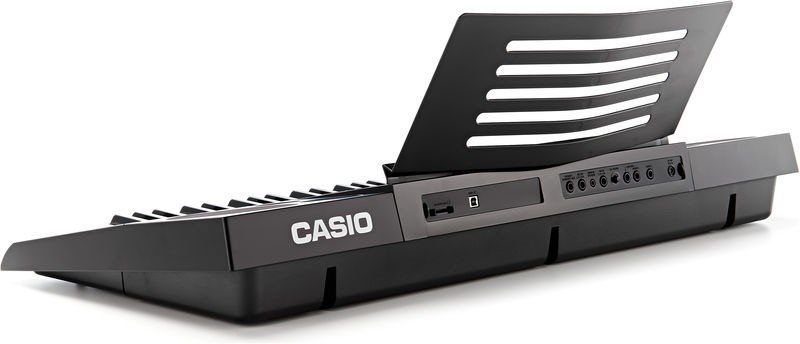
The Casio CTK 7200 has the basics, i.e. headphone input, audio output, in-line output (for connection to an amplifier), USB type B and pedal input, and even a battery-powered option.
Advantages and disadvantages of the CTK 7200
The advantages of this model are:
- Variety of voices and rhythms
- Music Production Functions
- Price
- Portability
- Battery operated option
The disadvantages of this model are:
- Connectivity
- Keyboard
- Sound quality
The Casio CTK 7200 is a very good keyboard, of that there is no doubt, however, it has some points to consider, the keys of this model are not weighted so playing at a high speed becomes complicated, the connectivity is basic and the sound quality is limited in comparison with other models, however, the variety of functions and rhythms, the possibility to use with batteries and the price are interesting advantages of this model.
Casio CTK 7200 Vs Yamaha PSR e453
The CTK 7200 and the Yamaha PSR e453 are two models focused on portable music production, below are the similarities and differences between the two models:
- Both have 61-key pressure sensitive keyboards (without counterweight)
- Yamaha incorporates 4 levels of pressure sensitivity, while it incorporates almost only 2.
- The CTK 7200 features 64 polyphony notes, while Yamaha incorporates 48 on the PSR e453.Casio incorporates 820 voices with 50 organ tones created with a harmonic bar, while Yamaha has 758.
- The CTK 7200 has 260 rhythms and the Yamaha has 64 rhythms.
- Yamaha incorporates Reverb of 9 types, chorus of 5 types, DSP of 10 types equalizer of 6 levels and harmony of 26 types while Casio incorporates reverb of 10 types, DSP – 100 predetermined and 100 created by the user chorus of 5 types, equalizer of 5 levels, automatic harmony with 12 types and arpeggio control with 150 effects.
- Both models have an option for use with batteries
- The connectivity of both models is virtually identical. Both models have auxiliary, USB, sustain pedal input, MIDI, etc. The only difference is that Casio incorporates the option of using an SD memory to record or import files.
- Yamaha’s speakers are 6w each, while Casio incorporates 7w.
The competition between the two models is very close, however, the winner is all the Casio CTK 7200, in almost all areas Casio offers superior performance to Yamaha, the quality of the keyboard (sensitive keys with 4 levels) is the only point where the PSR e453 is victorious.
Casio CTK 7200 Vs Casio CTK 7600
The CTK 7200 and WK 7600 are two alternatives with very similar features. The similarities and differences between the two models are shown below:
- The CTK 7200 has a keyboard with 61 keys, while the WK has 76 keys, both models have a piano style keyboard (the keys are not hollow, but they are not weighted).
- Both models have a 64-note polyphony.
- Both the CTK 7200 and the WK 7600 have the same general functions and features, including: number of voices, accompanying levels of effects, connectivity, possibility of being used with batteries, etc.
- The weight of the CTK 7200 is 6kg, while the WK 7600 has a weight of 8.3kg.
Both the CTK 7200 and the WK 7600 have the same features, the only difference between the two models is the keyboard size. The WK 7600 is a clear winner in the comparison as it has a 76-key keyboard, while the CTK 7200 has 61.
Casio CTK 7200 Vs Yamaha PSR s650
The comparison between the two models is presented below:
- Both have a 61-key keyboard with pressure sensitivity without weighted keys, however, the shape of the CTK 7200’s keys simulates those of a piano, while those of the PSR s650 are organ-style.
- Both Casio and Yamaha offer 64-note polyphony.Casio incorporates 820 voices with 50 organ tones created with a harmonic bar, while Yamaha has 837.
- Yamaha has more variety of effects, including 35 reverb types, 44 DSP chorus types, 237 DSP chorus types and 5 EQ configurations. While Casio incorporates 10 type reverb, DSP – 100 default and 100 user-created chorus of 5 types, 5 level equalizer, automatic harmony with 12 types and arpeggio control with 150 effects.
- The connectivity of both models is similar, since both models emit headphones, sustain pedal and USB, however, the CTK 7200 has input for SD memories.
- Casio offers option for use with batteriesYamaha’s speakers are 12w each while Casio has two 7w speakers.
- The CTK 7200 is 1.3kg lighter.
The comparison between both models is complicated, Yamaha has more variety of voices, effects and loudspeakers more powerful, however, Casio offers better connectivity and portability, as it allows the use of batteries and SD memory.
Conclusion
Before buying a keyboard you must make sure you choose the right model for the activity you will do.
The casio CTK 7200 is an economical option for those looking to make amateur music production and portability, this model is recommended if you are an amateur musician with a limited budget, but if you plan to introduce yourself into the world of piano or musical composition the recommendation is to invest in a more advanced keyboard.
If you are looking for a cheap option we recommend you to check our guide on digital pianos and cheap keyboards, there you will find other alternatives, if on the contrary you look for a better option you can check our guide of the best digital pianos and keyboards in relation quality and price.
Where to buy Casio CTK 7200?
You can buy it at a local distributor or through the internet, we recommend the latter option because you can save a lot of money. If you opt for an online store verify that it has adequate purchase conditions and transport to your location. We recommend that if you live at America or Asia check Amazon but if you live at Europe check Thomann:
Amazon
- Free Shipping and possibility of shipping in one day with Amazon Premium.
- Full Guarantee but they are no experts in music equipment
- Leader in fast shipments.
- Price that change a lot daily.
- The best option in USA and worldwide
Thomann
- Free Shipping
- Full warranty. If you have any problems, they take care of everything.
- 100% reliable payment.
- Leader in trouble-free shipping.
- Usually best price.
- Best Reputation: They are the leading online store in Europe and have the best catalogue and information.
For a similar price you have the following pianos and keyboards:
- YAMAHA PSR-EW300
- YAMAHA PSR-E263
- YAMAHA PSR-A350
- YAMAHA PSR F51
- YAMAHA PSR F50
- YAMAHA PSR EW400
- YAMAHA PSR E363
- YAMAHA PSR E353
- YAMAHA PSR E253
- YAMAHA NP-32 PIAGGERO
- YAMAHA EZ 220
- YAMAHA PSR EW410
- STARTONE MKR 61
- STARTONE MK-300
- STARTONE MK-200
- KORG TINY PIANO
- CASIO SA78
- CASIO SA 77
- CASIO SA 76
- CASIO SA 47
- CASIO SA 46
- CASIO LK-280
- CASIO LK-265
- CASIO LK-135
- CASIO CTK-2500
- CASIO CTK-240
- CASIO CTK 4400
- CASIO CTK 3500
- CASIO CTK 2200
- CASIO CTK 1500
- YAMAHA NP12
- ROLAND GO PIANO
- CASIO CTK1300
- CASIO CTK 6200
- CASIO CTK 3200
Do you have this keyboard? Or do you have any questions? Write to us in the comments section.