
- Home
- Author's Archive:
Top 5 Yamaha Digital Pianos [2021]
The best Yamaha Keyboards and Pianos in 2021. Buying Guide and Opinions
Before going on to talk about the models we have selected, let’s analyze the Yamaha brand a bit so that you have all the information you need. Then we will describe the best Yamaha keyboards according to their price.
Also don’t forget to read our post with the selection of the best electronic pianos of the moment in relation to quality and price and our analysis with the cheapest musical keyboards of the moment and that also give you the best option by a low cost 🙂
Yamaha is today one of the largest manufacturers of musical instruments worldwide and is famous for the quality and tuning accuracy of its electronic keyboards. In the market of piano keyboards it competes mainly with Casio and Roland. Being this a very close battle.
About who is the historical pioneer of electronic keyboards the prize is not really for Yamaha. But for Roland who was the first to bring out interesting models in the 70’s. By interesting we mean pianos that are sensitive to touch and simulate the weighted keyboard system of an acoustic piano. That means, that you can regulate the force with which the note sounds based on the force with which you press the key. The first model that Roland brought out in this sense was the EP-30 Electronic Piano in 1974.

Jaime Echagüe
Author
Advice:
From this post you can control the prices of the most interesting pianos quickly because you have direct links to several stores. If you save this post in bookmarks or favorites of your browser you will have it available easily and accessible.
What about the current status of Yamaha keyboards?
Although Roland took the lead in Yamaha’s counterbalanced keyboards, he has been building high-quality acoustic pianos for almost 100 years, so he knew what kind of terrain he was moving in. So he started investing in his weighted keyboard system. And today we can say that he has the best systems and that is why many of his piano keyboards are market leaders over Roland and Casio.
I’m sure you’ll be interested in…
- See this section for possible discounts and offers
- Ranking with the best digital pianos in quality-price ratio
- The cheapest musical keyboards for beginners
- Learn piano by yourself and for free
Which Yamaha keyboard to buy?
It depends on what you want it for. Yamaha offers good sound and quality in all formats but it would be a lie to tell you that a 150 Euro keyboard is the same as a 500 Euro one.
For a keyboard to be more or less useful to you we recommend that it has at least a sensitive keyboard (this does not imply that it is weighted), 61 keys minimum, sustain pedal input to hold the note even if the key is not pressed and it is recommended that it has a MIDI output to connect to the computer.
Based on the above, we will make a review of several models and with several prices below. But they must have at least 61 keys and a good reputation.
Yamaha Hammer Action System Types
Some of the ones we will show you have a counterbalancing system in which it imitates the real one of hammers, which is the most suitable. Although we will put you in the selection of keyboards without this system that will be more affordable. The Hammer Action is the feeling that the piano keys is heavy and the sensitivity that depends on how you press it sounds stronger its sound.
GHS System: The most common of the Hammer Action systems. It does not make the piano keyboard very expensive and gives you a very good and acceptable Hammer Action feeling.
GH System: It also has an improved system between the weights that imitates the touch of a Grand Piano. The bass has a heavier touch and the treble is lighter.
Then there are the GH3, NW-GH systems that have different touches for different preferences. But it’s already for more expensive digital pianos. Here’s the official reference for the Yamaha Graded Hammer Action Types
The best selection of Yamaha keyboards in 2020
We’re going to give you a selection of Yamaha music keyboards that will be very useful if you’re thinking of buying a keyboard of this brand. There are several options and we will try to be very objective and fair. If you would like to look at a selection of piano keyboards from various brands then go to our selection of digital pianos with the best value for money.
Yamaha P45 Keyboard (Old Yamaha P35)
Now we are going to talk about the most purchased digital piano keyboard in Europe. In this case it is the keyboard if you want to imitate the behavior of an acoustic piano. It has less sounds but of extreme quality.
The Yamaha P45 has 88 keys as an acoustic piano, it has a sustain pedal and a weighted keyboard with Yamaha’s GHS technology. It costs around €425/$450/£389 and you won’t find a better digital piano for less money. This makes it suitable for the piano studio as well as the conservatory for many years.
 Features:
- 10 professional piano sounds, sound to Grand Piano, high quality reverb, and chorus effect
- 64 voice-polyphony
- 88-key Hammer Action GHS keyboard with 4 sensitivities
- Sustain pedal included
- Music holder included
- Weight of 11,5 kg
- Headphones output USB Midi
- Metronome
- Perfect for first Conservatory years
The Yamaha P45 is the evolution of the Yamaha P35 which is already out of production. Don’t hesitate to buy the Yamaha P45 because it’s better and cheaper. Yamaha has given it absolute priority.
If you want to buy it in America or Asia the first and better option is Amazon. But If you live at Europe check the Thomann links of this post.
Yamaha PSR E363 Keyboard (Old Yamaha PSR E353)
The Yamaha PSR line keyboards are electronic keyboards designed to provide the user with a lot of sound. They are not intended to imitate an acoustic piano.
We like them a lot because They costs around the minimums we said before and also has a very cheap price, less than 200 euros. Now they have released the new version, which is the Yamaha PSR E363, which improves the polyphony of their previous model from 32 notes to 48 notes. An interesting change to compete with the new Casio CT S300 (Old Casio CTK 3500).
The Yamaha PSR E363 and the Yamaha PSR E353 have a sensitive 61-key keyboard. So you can do volume dynamics. It also has sustain pedal input that although not included and is a basic expressive resource for playing the piano.
Something very remarkable is that for its price it comes with a Midi USB, which allows you to connect it to your computer and do things like write scores while playing with programs like Sibelius.
Apart from all this the Yamaha PSR E353 has:
- A wide range of sounds and instruments. More than 500 with accompaniments and sequencer functions.
- It is very portable as it only weighs 4 kg and can be operated with batteries.
- Stand and power supply included.
- Metronome and reverb and chorus effector.
- 2.5W speakers and headset output.
It’s the perfect keyboard for the first year of learning and trying it out. And then you can use it as a composition keyboard or take it to rehearsals because it’s lightweight. For live performances in small restaurants, it’s a bit short, although you could connect it to a small amplifier through the headphone output.
There is a slightly cheaper model, the Yamaha PSR E253, but it is not really profitable, the difference is 20 euros and it has neither MIDI nor a sensitive keyboard. So we don’t include it in the list or recommend it.
It’s not good for learning the piano in the first year because you’ll need a weighted keyboard after a few years. We leave you a video and the option to buy it and then the rest of the models in the selection.
Here you have it at the best price monitored to date:
Digital Piano Yamaha P125 (old Yamaha P115)
We continue with the portable digital pianos. The Yamaha P115 is a bit better than the Yamaha P45 and if you’re a bit more budget conscious, it’s a keyboard that will last a lifetime.
Now its new version is on the market. You can see it in our review about the Yamaha P125. It basically has the double of the functions as some piano sounds. This is a good improvement but it doesn’t make much difference between the two models either.
For around €566/$650/ the Yamaha P125 and Yamaha P115 is probably the most balanced piano keyboard available. It has absolutely everything for a very low price.
 It has the same GHS hammer action as the Yamaha P45 but its sound has been sampled with CF3S technology, which is superior to the AWN of the Yamaha P45. So the quality of the piano sound is even better.
Also very powerful as a stage piano. On one side it has a line output to connect to any mixer or PA. The Yamaha P45 can be connected through the headphone output but in many cases you will need to extend the signal power with a power box.
The Yamaha P125 and Yamaha P115 come with 7W speakers that will be good for playing in rehearsals or small restaurants without extra amplification.
Another great advantage of these two models is that although they have a sustain pedal included, they can be used with a triple pedalboard, which will allow you to study the whole conservatory. We list other features that bring both
- Super-powerful 192-voice polyphony.
- Dual mode to split the keyboard in 2 and be able to play teacher and student at the same time.
- 10 professional piano sounds, also has rhythms and accompaniments of exceptional quality. Double on the P125.
- Superboost button that gives more power to the sound. A kind of turbo for live performance.
- USB Midi.
- 2 stereo outputs and 2 headphone outputs.
- Recording of up to 2 songs.
- Intelligent acoustic control, tempo, metronome and adjustable tuning.
- Free app with a lot of useful features.
- Resonance Dumper.
- It has a power supply and is very portable with a weight of 11.8 kg.
We leave you a video review for the Yamaha P125 and then another one we made with Yamaha of its predecessor the Yamaha P115.
Yamaha Digital Piano YDP 144
Now we’re going with a digital piano designed for home study. The Yamaha YDP 144 is the best-selling model in the 700 – 800 euro range. It costs around €777/£715 It is a very well-balanced piano and a great study tool for beginners and intermediate levels. It is also suitable for higher levels if you do not have a large budget. Of course, if you study more than 4 hours a day it will last you much less.
It has 10 piano sounds and a GHS weighted keyboard. On the other hand it has the following effects to make it seem like we are playing a real acoustic piano;
- Intelligent Acoustic Control.
- Acoustic Optimizer.
- Stereophonic Optimizer
- Damping Resonance.
- Key-Off samples.
It also comes with a triple pedalboard and allows recording. You can play up to two people with the duo mode and two different headphones. Its speakers are powerful but if you are looking for power to rehearse with others I recommend the Yamaha P125 because the Yamaha YDP 144 is designed not to be moved. It has a weight of 38 kg and dimensions of 1357 x 815 x 422 mm. It also has MIDI to connect it to the computer
If you are interested in this type of piano that is more like an upright visit the Yamaha YDP 144 review.
To buy it you have the following options:
Yamaha PSR E463 keyboard (Old Yamaha 453)
An improved version of the Yamaha PSR E453 and which is the most powerful version of the PSR E entry-level keyboards (the PSR S is the most professional line)
As for the latest model, what’s new is:
- Possibility of sampling with its Quick Sampling engine to create user-specific sounds.
- 15 more beats than the PSR E453 including more Latin beats.
- Ability to record audio in .WAV format (80 minutes of audio)
- The PSR E463 features its Groove Creator function to create custom rhythms from patterns.
Now let’s list its general features and of course don’t miss the Yamaha PSR E463 review with very interesting comparisons.
- 10 acoustic pianos.
- 8 electric pianos.
- 15 organs.
- 6 accordions.
- 13 guitars.
- 17 basses.
- 19 string sounds.
- 5 chorus sounds.
- 15 saxophones.
- 10 trumpets.
- 15 brass sounds.
- 9 flutes.
- 28 solo synthesizers.
- 18 pad synthesizers.
- 12 percussions.
- 37 ethnic sounds.
Of course it has a quality proportional to the price that differentiates it from the Yamaha PSR 363. One good thing is that it has more Latin sounds than its predecessor.
If you’re not going to buy a weighted keyboard piano, I’d go for the cheapest one on the list with USB MIDI and a pedal, which is the 363. The 463 comes in handy if you’re aware that you want a lot of sounds and don’t need to learn piano with it.
Check our Yamaha PSR E463 review if you want to know more.
Yamaha PSR F51 Keyboard (Old PSR F50)
We include this keyboard but with warnings. It is one of the best for less than 100 euros and we put it to give an option but we do not recommend it because for a little more you have the first of the list, the Yamaha PSR E353 that has all the basics.
The Yamaha PSR F51 has 61 keys and quite a few sounds but it has neither a sustain pedal input nor a sensitive keyboard. So it’s very limited because it doesn’t even have a Midi USB output. It also has no sensitivity on the keys.
If you buy a keyboard like this one, it’s only if you want it to make chords and compose but not having USB MIDI you are limiting yourself a lot even for that.
Of course if you don’t have a budget you’d better buy the Yamaha PSR F51 but keep in mind that it is very limited and we will always recommend the Yamaha PSR E363 seen before. Then you can sell it second-hand if you don’t like it and save money at the end.
With all this information we finished our selection with the best Yamaha keyboards, we hope you have found it very useful. As we have said before, if you want to see other brands we recommend our selection with the best digital pianos. Below you will find all our reviews on Yamaha keyboards and pianos as well as other interesting post. Thank you for reading!
Digital Piano Thomann SP 5600 Full Review. Is it a good choice?
Digital Piano Thomann SP 5600 Full Review. Is it a good choice?
Thomann has always been known for producing digital pianos with a very good quality/price ratio. The SP 5600 is no exception.
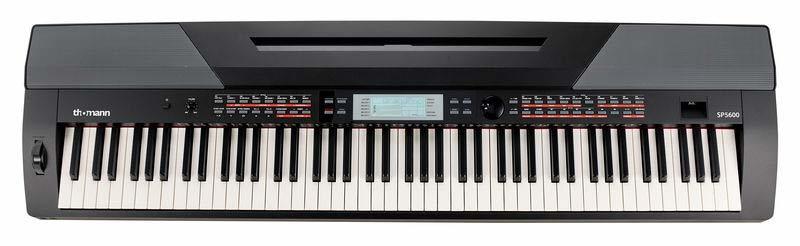
The SP 5600 stands out as an interesting option for those looking for a digital piano for live performances of 88 keys with hammer action (weighted keys), as this model has great versatility, at a reasonable price.
Features
Between digital pianos or stage keyboards, the Thomann SP 5600 meets several basic requirements. The specifications of this model are presented below:
- 88-key keyboard with hammer action (weighted keys) and pressure sensitivity.
- 600 voices
- 230 styles
- 128-note polyphony
- 120 internal songs
- 5 demo songs
- Function for Arrangements
- Metronome
- Effects – Master EQ, Reverb, Chorus, Sequencer, Harmony
- DSP
- Pitch Bend
- Input for sustain pedal (included)
- AUX IN/OUT connection
- 2 Headphone Outputs
- MIDI input
- USB
- 2 Speakers of 10w each.
- Dimensions 1.35m x 36.6cm x13.7cm
- Weight 13.8kg
Sound
I’m sure you’ll be interested in…
- Ranking with the best digital pianos in quality-price ratio
- The cheapest musical keyboards for beginners
- Learn piano by yourself and for free
Despite having only 128 polyphony notes, the Thomann SP 5600 has good quality and clean sound, in addition, the two integrated speakers have good sound power. The following video shows a demo of some of the voices of the Thomann SP 5600:
As you can see in the video above, the clarity and clean sound that offers the SP 5600 is good in all voices, plus the rhythms and styles that come included are useful to make musical composition.
Connectivity.
The SP 5600’s connectivity is basic, but covers everything you need to perform live, especially if used as a digital piano.
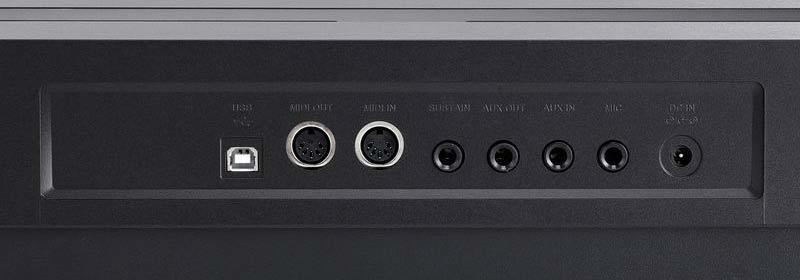
The SP 5600 features MIDI, USB, auxiliary input and output, 2 headphone ports, and a sustain pedal input. Connectivity is basic and can be sufficient for most users, although for those who use a triple footswitch, damper pedal, or some other accessory the SP 5600 will not be useful.
Advantages and disadvantages of the SP 5600
The advantages of this model are:
- 88 hammer action keys
- Versatility
- Variety of Voices
- Sound Quality
- Built-in speakers
The disadvantages of this model are:
- Connectivity
The SP 5600 is an excellent alternative in relation price and benefit, analyzing it in its right dimension it offers good quality of sound and a variety of functions, which added to its 88 weighted keys offer great versatility, the only point against to emphasize is that other keyboards of the stage have more alternatives of connectivity like inputs for pedals, XLR inputs, Wifi, etc.
Thomann SP 5600 vs Yamaha P45
The SP 5600 and the Yamaha P45 are two keyboards with similar characteristics, the comparison is shown below:
- Both models have 88 hammer action keys
- The polyphony of the P45 is 64 notes, while the SP 5600 offers 128 notes.
- The SP 5600 offers 600 voices, while the P45 includes only 10.
- Both models include effects, however, the SP 5600 includes 230 styles, while the P45 does not include any.
- The Thomann SP 5600 includes 2 10w speakers, while the Yamaha P45 has 2 6w speakers.
- The P45 has a MIDI and sustain pedal, while the SP 5600 has auxiliary input and output, 2 headphones, MIDI, and USB inputs.
The Thomann SP 5600 is far superior to the Yamaha P45, however, it should be noted that while Thomann focuses on a stage piano, Yamaha places the P45 as a digital studio piano for beginners. In the comparison the Thomann SP 5600 is victorious, however, it is necessary to emphasize that the sound quality, variety of functions, and versatility of this model are superior. Yamaha P45 is the winner in price.
Thomann SP 5600 vs Casio CDP 130
The Casio CDP 130 has a different approach to the SP 5600, however, has features that make it an alternative. The comparison between the two models is shown below:
- Both models have 88 hammer action and pressure-sensitive keys.
- The polyphony of the CDP 130 is 48 notes, while the SP 5600 offers 128 notes.
- The SP 5600 offers 600 voices, while the CDP 130 includes only 10.
- Both models include effects, however, the SP 5600 includes 230 styles, while the P45 does not include any.
- The Thomann SP 5600 includes 2 10w speakers, while the Casio CDP 130 has 2 8w speakers.
- The CDP 130 has headphones, MIDI, pedal, and USB input, while the SP 5600 has auxiliary input and output, 2 headphones, MIDI, and USB inputs. Both models have pedal input.
The Thomann SP 5600 is far superior to the Casio CDP 130 in that it not only has more voices and styles but the better sound quality, more powerful speakers, and better connectivity.
Here again choice is depending on your budget. Of course is not easy to decide between the Casio CDP and the Yamaha P45.
Conclusion
Before choosing a digital keyboard or piano, it is necessary to consider the functions that you will actually use, as in this way you will be able to acquire the right model. If you want a piano to start studying, the SP 5600 is a great alternative, as it incorporates all the basics and a little more.
The Yamaha P45 and Casio CDP 130 cover with the essentials, however, the recommendation is to go for the Thomann.
For those who want a digital piano for live performances with elementary functions at an affordable price, the SP 5600 is an excellent choice, as it has everything indispensable for this activity, however, for those thinking of purchasing a musical production piano the SP 5600 is not a good idea, as it lacks elementary things.
If you are looking for a digital piano for music production you can check out the Yamaha Genos. If you are looking for different alternatives to compare, you can review our guide to the best digital pianos and keyboards in terms of price and quality. And if you are looking for an inexpensive option we recommend you visit our guide to cheap pianos and keyboards.
Where to buy the Thomann SP 5600?
You can buy the SP 5600 at any brand distributor, however, it is always a better idea to buy via the internet, as this will save you money. Before buying in an online store make sure you find the correct transport and purchase conditions. Our recommendation to buy the SP 5600 at the best price available in the market is:
Thomann
- Free Shipping
- Full warranty. If you have any problems, they take care of everything.
- 100% reliable payment.
- A leader in trouble-free shipping.
- Usually the best price.
- Best Reputation: They are the leading online store in Europe and have the best catalog and information.
For a similar price you have the following pianos and keyboards:
- YAMAHA YDP-S34 ARIUS
- YAMAHA YDP 163
- YAMAHA YDP 143
- YAMAHA PSR S770
- YAMAHA PSR S670
- YAMAHA PSR E453
- YAMAHA PSR E443
- YAMAHA P45
- YAMAHA P255
- YAMAHA P125
- YAMAHA P-121
- YAMAHA P115
- YAMAHA P105
- YAMAHA DGX 660
- YAMAHA ARIUS YDP 142
- YAMAHA PSR S775
- YAMAHA PSR E463
- YAMAHA P35
- THOMANN SP 5600
- THOMANN DP-33
- THOMANN DP-31
- ROLAND GO KEYS
- ROLAND FP-60
- ROLAND FP 80
- PIANO THOMANN SP 320
- KURZWEIL SPS4-8
- KURZWEIL SP6
- KURZWEIL SP4-8
- KURZWEIL FORTE SE
- KURZWEIL FORTE 8
- KURZWEIL ARTIS 7
- KORG PA-700 ORIENTAL
- KORG PA-700
- KORG PA600
- KORG PA-300
- KORG PA-1000
- KORG HAVIAN 30
- KORG GRANDSTAGE 88
- CASIO PX-870 PRIVIA
- CASIO PX-770 PRIVIA
- CASIO PX-5S PRIVIA PRO
- CASIO PX-560 PRIVIA
- CASIO PX-360 PRIVIA
- CASIO PX 160
- CASIO CT-X800
- CASIO CT-X700
- CASIO CT-X5000
- CASIO CT-X3000
- CASIO CDP 130
- THOMANN DP 26
- ROLAND FP 90
- ROLAND FP 30
- ROLAND FA 06
- ROLAND BK 5
- KORG SP 280
- KORG LP 380
- KORG B1
- KAWAI ES8
- KAWAI ES110
- KAWAI ES100
- KAWAI CN27
- KAWAI CN25
- CASIO CDP 230
- CASIO CDP S100
Do you have this piano? share your experience in the comments section
Digital Piano Yamaha Genos Full Review. Is it worth it?
Yamaha Genos Opinion & Analysis: Where to Buy It
For all those who are looking for a keyboard for music production or live performances, the Yamaha Genos is an alternative to consider.

The 76 pressure-sensitive keys, the large touch screen, and the variety of functions and settings make the Genos a very interesting keyboard for music composers.
Features
The Yamaha Genos is a keyboard with a focus on musical production, below is a fact sheet of its characteristics:
- 76-key keyboard with pressure sensitivity
- 7-level pressure sensitivity (normal, easy1, easy2, soft1, soft2, soft1, hard1, and hard2)
- 256 notes polyphony (128 predefined voice and 128 expansion voice)
- 1652 Voices and 58 Drum/SFX kits – 1.8gb available to expand voices
- Effects ( 59 Reverb + 3 User, 107 Chorus +3 User, 358 DSP with VCM and 3 User, 5 Master Compressor, 5 Master, 5 Master EQ, 28 Part EQ)
- 54 Harmony Vocal Effects
- Vocal Effect Microphone, noise cancellation, compression, 3-band equalizer, and 23 vocal effects.
- 550 Accompaniments ( 491 Pro, 39 Session, 10 Free Play and 10 DJ)
- 4 Pads x 448 banks
- 9 demo songs
- Internal recorder with capacity for 16 songs.
- Fast recording mode, multitrack, and step.
- WAV and MP3 audio player and recorder format
- 9-inch touch screen
- 19 Controllers (1 Joystick, 6 assignable Knobs, 9 assignable sliders, and 3 Switches)
- AMW Sound Generator sampling with AEM technology
- 58gb internal memory
- USB for memory expansion
- Input for stereo headphones
- 3 pedal inputs (Sustain, Art and volume with assignable functions)
- Microphone Input with Phantom Power ( +48V)
- MIDI Input and Output A and B
- Auxiliary Input
- Coaxial Digital Output
- USB to Host and USB to a device (x3)
- Wifi (Standard network card)
Sound
I’m sure you’ll be interested in…
- Ranking with the best digital pianos in quality-price ratio
- The cheapest musical keyboards for beginners
- Other Yamaha Digital Piano Reviews
- Learn piano by yourself and for free
The sound quality of the Yamaha Menos is very good, the cleanliness and clarity that the sound generator is able to reproduce are remarkable, however, it is necessary to consider that much of the sound quality of the Genos depends on the amplifier, as this model does not have integrated speakers.Below is a very complete demo of Yamaha Genos.
As can be seen in the previous video, the Yamaha Genos has a great versatility that allows professional musical production.Below is a provided demo of Yamaha with some effect settings:
Connectivity
When it comes to connectivity, the Genos has it all – this Yamaha model has advanced connectivity options that will meet the expectations of any keyboardist or composer.

This Yamaha model includes virtually every type of ticket. It has USB inputs (USB to Host and USB to device), 2 MIDI input and output modules, 1 microphone input with Phantom Power (+48V), 1 Auxiliary input, 1 coaxial digital output, and even Wifi connectivity.

As you can see in the image above the Yamaha Genos has everything you need for music production, the connectivity of this model allows you to create a recording station.
Advantages and disadvantages of Yamaha Genos
The advantages of this model are:
- Voices
- Functions
- Connectivity
- Personalization
- Touch Screen
The disadvantages of this model are:
- 76-key keypad
- Polyphony of Sound
It is difficult to find disadvantages in the Yamaha Genos, as this model has great features. It only points against are the size of the keyboard and the polyphony of sound. Although 76 keys are enough to interpret practically any piece or compose, it may annoy some pianists. As for polyphony, there are alternatives that offer full polyphony, however, 256 notes are very acceptable.
The scale tilts in favor of the Yamaha Genos since connectivity, personalization and variety of voices are indisputable advantages, in addition, its 9-inch touch screen facilitates the task of configuration.
Yamaha Genos vs Korg PA4X
The KORG PA4X is an alternative very similar to the Yamaha Genos, below are the differences and similarities between the two models:
- The PA4X is available in 61- and 76-key versions both with semi-weighted and pressure-sensitive keys, whilst the Genos has only one version with 76 pressure-sensitive keys.
- The Yamaha polyphony is 256 notes, whilst Korg only offers 128 notes.
- The variety of effects of the Genos is far superior as it has more than 534 effects, whilst the PA4X has 298.
- The PA4X has 1900 voices, whilst the Yamaha Genos has 1652.In terms of style, the PA4X has more than 550, whilst Yamaha incorporates 550.
- Both models have a touch screen, however, the Genos has a 9-inch screen and the PA4X has a 7-inch screen.
- The Genos has an internal 58 GB hard disk and the PA4X has a hard disk (Korg does not specify capacity) in the 76-key model.
- In terms of connectivity they have practically the same, however, Yamaha incorporates Wifi connection, whilst Korg chooses to add a port for microSD memory.
The comparison between these two models is complicated, as both Yamaha and Korg have similar features. If you want an option with better polyphony of sound and connectivity, the Yamaha Genos is the best alternative, nevertheless, if you prefer to have a more variety of voices, you can surely go for the Korg.
Yamaha Genos vs Tyros 5
Yamaha’s Tyros 5 is another alternative for those who want a keyboard for music production or playing on stage. The similarities and differences between these two models are shown below:
- The Yamaha Tyros 5 is available in 61- and 76-key versions both with semi-weighted and pressure-sensitive keys, whilst the Genos has only one version with 76 pressure-sensitive keys.
- The Genos polyphony is 256 notes, whilst the Tyros is 128.
- The Yamaha Genos has 1652 voices and the Tyros 5 has 1796.
- Both models have a touch screen, the Genos includes a 9-inch screen, whilst the Tyros 7.5 in its two versions.
- The Yamaha Genos has an internal memory of 58GB and space for a hard disk, whilst the Tyros 5 only has the slot to connect a hard disk.
- Genos incorporates 550 styles whilst the Tyros 539.
- Both models have virtually the same connectivity, the only difference is that the Yamaha Genos incorporates Wifi connectivity.
Definitely the Genos is a superior model, however, the Tyros 5 is a very good choice. The main difference between both models is the sound quality if you are looking for a model with better sound quality and wifi the Genos is for you.
Yamaha Genos vs Montage
The Yamaha Montage 8 is an 88-key weighted digital piano focused on music production and live performances. The comparison between Genos and Montage 8 is presented below:
- The Yamaha Montage 8 has 88 weighted and pressure-sensitive keys whilst the Genos has 76 semi-weighted and pressure-sensitive keys.
- The sound polyphony of the Genos is 256 notes, whilst the Montage 8 incorporates 128.
- Both models have a touch screen, Montage 8 has a 7-inch screen and Genos has a 9-inch screen.
- The Genos has sound generator AMW and the Montage with AMW2
- The variety of voices in the Montage 8 is greater, as it has 1900 voices, whilst the Genos incorporates 1652.
- The connectivity of both models is practically identical, however, the Genos includes Wifi connection.
Montage 8 is a superior keyboard over the Genos since the 88 weighted keys will help to stimulate the piano, allowing them to interpret pieces of high speed with pressure. On the other hand, the generator of the sound of this model is of a new generation and incorporates a greater number of voices.
Conclusion
Before buying a digital instrument, make sure you know in detail the functions you require, so you can choose the right option for you.If you are just starting out in the world of piano or musical composition you may want a cheaper alternative, in which case we recommend that you read our guide to the best pianos and keyboards in terms of price and benefit.The Yamaha Genos is an excellent choice for any musician who wants to compose music, although a pianist probably prefers the Montage 8 because of the characteristics of its keys.
Where to buy Yamaha Genos?
You can purchase Yamaha Genos from any authorized dealer, although we recommend that you make a purchase online, as in this way you can save money. In order to choose a virtual store, you only have to verify that the conditions of purchase and the offered transport are adequate. If you want to buy the Yamaha Genos at the best price do not hesitate to click on the following options:
Amazon
- Free Shipping and the possibility of shipping in one day with Amazon Premium.
- Full Guarantee but they are no experts in music equipment
- A leader in fast shipments.
- The price change a lot daily.
- The best option in USA and ASIA
Thomann
- Free Shipping.
- Full warranty. If you have any problems, they take care of everything.
- A leader in trouble-free shipping.
- Best reputation in Europe.
For a similar price you have the following pianos and keyboards:
- YAMAHA PSR-A3000
- YAMAHA PSR S975
- YAMAHA PSR S970
- YAMAHA P-515
- YAMAHA MX61
- YAMAHA MONTAGE 8
- YAMAHA GENOS
- YAMAHA CP40 STAGE
- YAMAHA CP4
- YAMAHA CP300
- YAMAHA CP1
- YAMAHA CLP 685
- WALDORF ZARENBOURG
- STUDIOLOGIC NUMA STAGE
- STUDIOLOGIC NUMA CONCERT
- STUDIOLOGIC NUMA COMPACT 2X
- STUDIOLOGIC NUMA COMPACT 2
- ROLAND RD 2000
- ROLAND KIYOLA KF-10
- NORD PIANO 3
- KORG SV1 88
- KORG SV1 73
- CRUMAR SEVEN
- CLAVIA NORD STAGE 3 HP76
- CLAVIA NORD STAGE 3 COMPACT
- CLAVIA NORD PIANO 4
- CLAVIA NORD ELECTRO 6D 73
- CLAVIA NORD ELECTRO 6D 61
- CLAVIA NORD ELECTRO 6
- ROLAND TB-3
- ROLAND SYSTEM-1
- NORD STAGE 3