
- Home
- Author's Archive:
Digital Piano Piano Thomann SP 320 Full Review. Is it worth it?
Thomann SP 320 Piano Analysis: Review and Opinion
For those who complain about not being able to carry their piano everywhere, Thomann solves the problem with the SP 320, a keyboard to consider for those who seek portability without losing the 88 keys.

88 keys with weight and pressure sensitivity and basic functions of a digital piano for less than 300€ sounds great, as the Thomann SP 320 fulfills those benefits.
Features
I’m sure you’ll be interested in…
- Ranking with the best digital pianos in quality-price ratio
- The cheapest musical keyboards for beginners
- Learn piano by yourself and for free
The SP 320 is a basic option with very good performance for those who are looking for a digital piano at a good price. The features of the Thomann SP 320 are shown below:
- 88 weighted keys (they don’t have the real weight of a piano) and with pressure sensitivity
- 12 Voices
- 32 notes of polyphony
- 12 demo songs included
- Layer Mode
- Reverb and Chorus Effects
- Metronome
- Headphone jack
- USB MIDI Input and USB Audio
- Line Output (L/R)
- Input for sustain pedal
- Battery operated option
- 2 speakers of 20 watts each.
- Dimensions 1.27m x 27.5 cm x 8.5cm (without lectern)
- Weight 9 Kg.
As you can see from the specifications the SP320, is a piano with the indispensable functions, ideal for those who are looking for something portable or want to get started in the world of the piano. This model includes a sustain pedal and lectern. It is a perfect piano to play on the street.
Sound
The sound quality of the SP320 is good, much better than you would expect in a 250€ keyboard, the speakers of this model have much higher power than average. Despite having 32 notes of polyphony the SP 320 has great cleanliness and clarity in the sound. The following video shows a cover of Havasi – The Storm, played in an SP320:
As can be seen in the previous video, the SP 320 allows the interpreter to play with the right nuances, giving strength and softness to represent the piece properly.
Connectivity
Not surprisingly, the Thomann SP 320 has basic connectivity, but for many, the options provided by this model will be just enough.

The SP 320 has the minimum necessary, headphone input, in-line output, USB connection, option for use with batteries, and a sustain pedal port (pedal included in the purchase of the keyboard).
Advantages and disadvantages of the SP 320
The advantages of this model are:
- 88-key keypad
- Price
- Sound
- Accessories
- Portability
The disadvantages of this model are:
- Keyboard without real weight
- Connectivity
- Functions
The quality of the Thomann SP320 is very good, especially considering that it is a digital piano of less than 250€.
But first, we will cover the disadvantages:
- The first disadvantage of this model is the weight on the keys because despite having a Hammer Action keyboard, the weight is not identical to that of a piano.
- The second disadvantage is the connectivity, the SP320 lacks Bluetooth, additional input for headphones, triple footswitch, etc.
- The last disadvantage is the functions. The SP320 is a very simple keyboard that includes 2 effects, a metronome, and 12 voices. Now, let’s move on to the advantages of this model:
- The keyboard is 88 keys and weighs 9 Kg., can be used with batteries.
- Costs less than 250 €, has two speakers of 20w each, and has included the sustain pedal. SP320 is a low-cost alternative to consider.
- The Thomann SP 320 costs around €239/£215.
Thomann SP 320 vs Yamaha PSR E363
The SP320 and the Yamaha PSR 363 belong to two totally different worlds, however, they can go into the comparison, as both are popular models for beginner pianists or keyboardists looking for portability. The Thomann SP 320 costs around €239/£215 while the Yamaha PSR E363 is around €198/$239/£179. The similarities and differences between these two models are shown below:
- The Thomann SP 320 features a full keyboard, pressure sensitivity, and lightweight but weighted keys, while the PSR 363 features 61 pressure-sensitive keys.
- The polyphony of the SP 320 is lower, as it has 32 notes, whilst the PSR 363 has 48 notes.
- The PSR 363 has 574 voices, while the SP320 has only 12.
- The variety of effects in the PSR 363 is greater, since it has 165 accompaniments, while the SP 320 has reverb and chorus.
- The SP 320 speakers are 20w, while the PSR has 2.5w.
- The PSR 365 weighs 4 Kg. and the SP320 9 Kg.
- Both models have MIDI and sustain pedal input.
If you’re a pianist, the Thomann SP 320 will be more attractive because it has an 88-key keyboard, more sound power, includes a sustain pedal, and has all the necessary voices, however, if you lean down the path of versatility, the PSR 365 may be a better alternative for you. It should be noted that the Thomann SP 320 is a better alternative for a beginner who wants to learn piano, as it simulates an acoustic piano more precisely.
If you’re interested, you can visit our review of the Yamaha PSR E363.
Thomann SP 320 vs Casio CTK 3500
The Casio CTK 3500 and the Thomann SP 320 fight for a place among portable keyboards. Below is a comparison of both models: The Thomann SP 320 features an 88-key keyboard with pressure sensitivity and light but weighted keys (lighter than an acoustic piano), whilst the CTK 3500 has 61 pressure-sensitive keys.
- The Casio has 400 voices, while Thomann incorporates only 12 in the SP 320.
- The polyphony of the SP 320 is lower, as it has 32 notes, while the Casio has 48 notes.
- The CTK 3500 has a greater variety of rhythms.
- The sound power of the SP 320 is much better, as it has speakers of 20w each, while the CTK 3500 has 2.5w.
- Both models can be connected to the PC, used with batteries, and add a sustain pedal (Thomann includes the pedal).
- The weight of SP 320 is 9 Kg. while Casio weighs 3.5 Kg.
Both models maintain good quality in relation to the price, however, the choice depends on the activity to perform, for a pianist or apprentice of the piano the SP 320 is a better alternative since it has a full keyboard more sound power, and sustain pedal included, but those who seek to make a musical composition or have a little more portability the Casio CTK 3500 is a good choice.
If you’re interested, you can visit our review of the Casio CTK-3500.
Thomann SP 320 vs Thomann DP 26
The Thomann DP26 is a very strong competitor to the SP320. The Thomann SP 320 costs around €239/£215 while the Thomann DP26 is around €309/£279. The comparison between the two models is shown below:
- The SP 320 has 88 pressure-sensitive and weighted keys (lower than an acoustic piano) while the DP 26 has 88 weighted keys with pressure sensitivity and a hammer action system (simulates an acoustic piano).
- The polyphony of the DP 26 is superior, as it has 64 notes, while the SP 320 has only 32.
- The SP 320 has 12 voices, while the DP 26 has 20 voices.
- The functions of the PD 26 are more advanced, with more alternatives for personalization, effects, accompaniments, styles, etc.
- DP 26 has left and right-hand teaching system.
- The connectivity on both models is similar, however, the DP 26 incorporates an additional headphone jack.
- The SP 320 speakers are 20w, while the DP 26 has 10w speakers.
- The weight of the SP 320 is 9 Kg. and the DP 26 is 12.6 Kg.
The clear winner is the DP 26 as it incorporates better keyboard quality, simulates a piano more accurately, has more voices and teaching functions, however, the SP 320 is an interesting alternative for those looking for an 88-key keyboard for use with batteries, with essential functions and at a low price.
If you’re interested, you can visit our review of the Thomann DP26.
Conclusion
Before choosing a keyboard or digital piano, make sure you know the functions you require, as this way you will be able to acquire the best alternative for the use you will have on it. The Thomann SP 320 is an excellent choice for beginners to the piano world or those pianists who want a cheap, portable 88-key digital piano.
If you can invest a few more Euros, the Thomann DP 26 is a better choice as it incorporates more features and better technology. If you’re looking for a digital piano of far superior quality that simulates an acoustic piano you can take a look at the Roland FP 90.
If you are looking for a digital piano or keyboard with standard features you should take a look at our guide to the best digital pianos and keyboards at value for money and if you’re looking for a low-cost option check out our guide to cheap digital pianos and keyboards.
Where to buy the Thomann SP 320
The best alternative to buy your Thomann SP 320 is over the Internet because this way you can save. Our recommendation to purchase SP 320 is as follows:
Thomann
- Free Shipping
- Full warranty. If you have any problems, they take care of everything.
- 100% reliable payment.
- A leader in trouble-free shipping.
- Main Shop to buy it cause it is his brand.
- Best Reputation: They are the leading online store in Europe and have the best catalog and information.
For a similar price you have the following pianos and keyboards:
- YAMAHA YDP-S34 ARIUS
- YAMAHA YDP 163
- YAMAHA YDP 143
- YAMAHA PSR S770
- YAMAHA PSR S670
- YAMAHA PSR E453
- YAMAHA PSR E443
- YAMAHA P45
- YAMAHA P255
- YAMAHA P125
- YAMAHA P-121
- YAMAHA P115
- YAMAHA P105
- YAMAHA DGX 660
- YAMAHA ARIUS YDP 142
- YAMAHA PSR S775
- YAMAHA PSR E463
- YAMAHA P35
- THOMANN SP 5600
- THOMANN DP-33
- THOMANN DP-31
- ROLAND GO KEYS
- ROLAND FP-60
- ROLAND FP 80
- PIANO THOMANN SP 320
- KURZWEIL SPS4-8
- KURZWEIL SP6
- KURZWEIL SP4-8
- KURZWEIL FORTE SE
- KURZWEIL FORTE 8
- KURZWEIL ARTIS 7
- KORG PA-700 ORIENTAL
- KORG PA-700
- KORG PA600
- KORG PA-300
- KORG PA-1000
- KORG HAVIAN 30
- KORG GRANDSTAGE 88
- CASIO PX-870 PRIVIA
- CASIO PX-770 PRIVIA
- CASIO PX-5S PRIVIA PRO
- CASIO PX-560 PRIVIA
- CASIO PX-360 PRIVIA
- CASIO PX 160
- CASIO CT-X800
- CASIO CT-X700
- CASIO CT-X5000
- CASIO CT-X3000
- CASIO CDP 130
- THOMANN DP 26
- ROLAND FP 90
- ROLAND FP 30
- ROLAND FA 06
- ROLAND BK 5
- KORG SP 280
- KORG LP 380
- KORG B1
- KAWAI ES8
- KAWAI ES110
- KAWAI ES100
- KAWAI CN27
- KAWAI CN25
- CASIO CDP 230
- CASIO CDP S100
Digital Piano Yamaha YDP 163 Full Review. Is it a good choice?
Where to Buy Yamaha YDP 163: Review and Opinion
Yamaha has always been known for designing good quality musical instruments, with basic and professional product lines. Within the range of the most advanced digital pianos is the YDP 163, a digital piano to consider for any pianist.
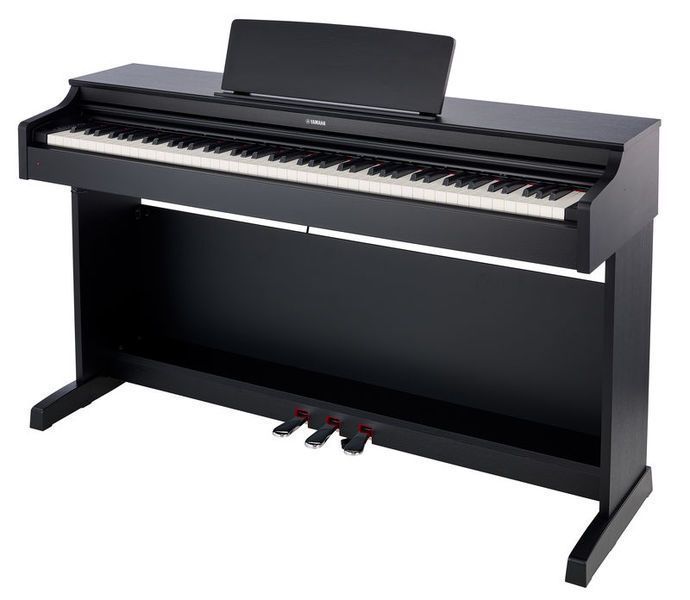
Pianists are always looking for keyboards capable of simulating a piano, i.e. with 88 weighted keys and pressure sensitivity, the Yamaha YDP 163 not only includes these features but its functions perfectly meet the expectations of virtually any pianist.
Where to buy it?Features
The YDP 163 is a digital piano that incorporates a full keyboard, similar to that of a piano, plus a sound engine capable of imitating a Yamaha concert piano. The technical specifications of the YDP 163 are shown below:
- 88-key weighted and pressure-sensitive keypad ( GH3)
- 3-level sensitivity (Hard/Medium/ Soft) and fixed mode (Fixed)
- Pure CF Sound Engine (capable of reproducing the sound of a Yamaha concert piano)polyphony of 192 notes.
- 10 Voices
- Reverb of 4 types with IAC (Intelligent Acoustic Control)10 demo songs
- Recorder with capacity for 1 song
- Metronome
- Input for two stereo headphones
- USB To Host
- Triple footswitch input (included)
- 2 Speakers 20w
- Electricity consumption 12w
- Dimensions 1.35m x 84.9cm x 42.2cm
- Weight 42kg
I’m sure you’ll be interested in…
- Ranking with the best digital pianos in quality-price ratio
- The cheapest musical keyboards for beginners
- Other Yamaha Digital Piano Reviews
- Learn piano by yourself and for free
Sound
The sound quality of the Yamaha YDP 163 is amazing, the main piano voice is inspired by the concert piano CF3 and has a very clean and clear sound. The following video shows the original Yamaha demo:
The previous video shows us the quality of the keyboard, however, for those who want another sample to appreciate the sound of this model we leave a video which presents an interpretation of a fragment of Para Elisa, Claro de Luna, and other musical pieces in a YDP 163:
In the previous interpretation, we can notice how the keyboard of the YDP 163 has a good response to the speed and pressure on the keys, generating great sound quality at all times.
Connectivity
On connectivity issues the YDP 163 comes a bit limited, however, it has what it takes for most pianists.
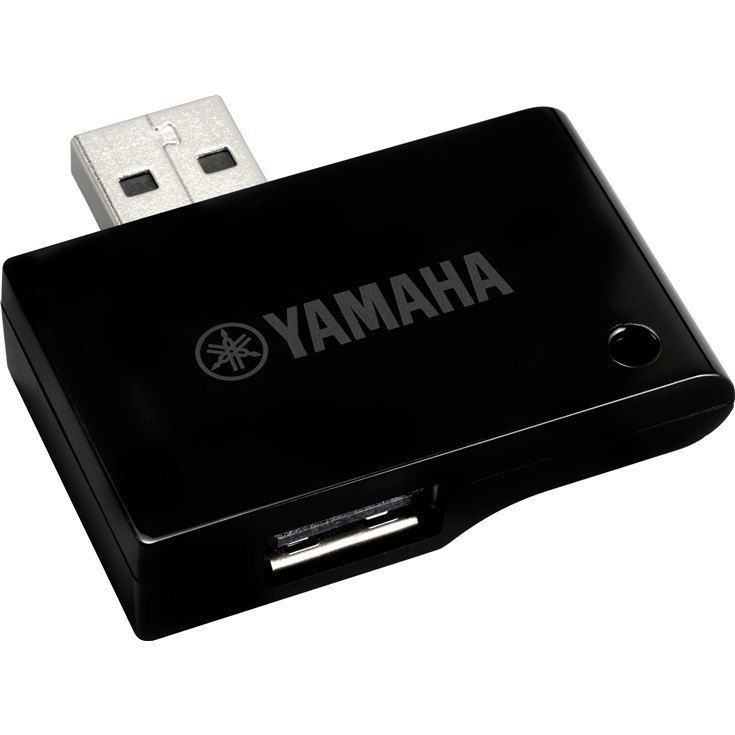
UD-BT01- Bluetooth device
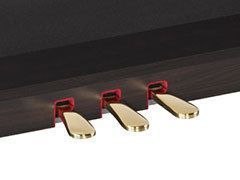
The YDP 163 features a USB To host, two headphone jacks and a triple footswitch input included. For those who miss the connectivity with devices is available the accessory UD-BT01 that serves for wireless Bluetooth connectivity with iOS and Mac and can be used with Yamaha applications to synchronize the score.
Advantages and disadvantages of Yamaha YDP 163
The advantages of this model are:
- 88-key weighted and pressure-sensitive keypad
- Quality
- Sound
The disadvantages of this model are:
- Connectivity
The YDP 163 is a very different digital piano, has few functions but great quality in them, the focus is 100% directed to imitate a CF3, Yamaha concert piano. Keyboard quality and sound are the highlights, as the piano voice really simulates a concert piano. Among the disadvantages is connectivity, especially if you are looking for a piano to record or use on stage the YDP 163 is somewhat short, however, it is possible to improve connectivity by means of accessories.
Yamaha YDP 163 vs YDP 143
Yamaha’s Arius family has several models focused on simulating an acoustic piano. YDP 163 and YDP 143 are virtually identical, both sharing construction and functions.
The only differences between the two models are the loudspeakers, dimensions, and weight. The YDP 163 has two speakers of 20w each and weighs 42kg, while the YDP 143 has two speakers of 6w each and weighs 38kg.
The decision between both models is simple, if you require a digital piano with more sound power you must go for the YDP 163, otherwise, a YDP 143 covers the same needs.
If you want to read our complete review of Yamaha YDP 143 click here >>
Yamaha YDP 163 vs CLP 625
The Japanese brand has the Clavinova series which like Arius focuses on digital pianos, however, the Clavinova series models have better features. Similarities and differences between the two models are presented below:
- Both models have a keyboard with 88 weighted keys and pressure sensitivity, however, the CPL625 has the GH3X keyboard, a version that includes Graded Hammer 3X technology, responsible for better simulating the escape generated in an acoustic piano.
- Both models feature 3 sensitivity modes and a fixed mode.
- The YDP 163 sound generator is based on the CF3, while the CPL 625 sound generator is based on the CFX, Bösendorfer Imperial, CFX Binaural Sampling.
- The polyphony of the YDP 163 is 192 notes, while the CPL 625 has 256 notes.
- Both models have 10 voices.
- The connectivity of both models is identical, only have USB to host input, pedals (triple footswitch included in both), and 2 headphones.
- The speakers included in both models are 20W.
The YPD 163 is one of the most advanced models of the Arius series, while the CPL 625 is one of the most basic models of the Clavinova series, both have very similar features, however, in terms of quality the CPL 625 wins because it has more polyphony and better quality on the keyboard, despite this the two models are virtually identical in functions and connectivity.
Yamaha YDP 163 vs P255
Yamaha’s P Series also focuses on imitating acoustic pianos, however, the models in this series are usually more basic. Below is a comparison between YDP 163 and P255. Both models feature an 88-key weighted keyboard with pressure sensitivity, however, the P255 has the GH keyboard and the YDP 163 has the GH3 version, providing an experience more like an acoustic piano.
- The polyphony of the P255 is 256 notes, while the YDP 163 has 192 polyphony.
- The sound engine of the YDP 163 is the CF3, focused on imitating the CF3 concert piano, while the P255 has the CF.
- The YDP 163 has 10 voices and the P255 has 24 voices.
- The connectivity of the P255 is more extensive and has an input for pedal sustain, pedal join, 2 headphones, auxiliary (input and output), USB to device, and USB to host, while the YDP 163 only has an input for 2 headphones, triple footswitch (included) and USB to host.
- The YDP 163 speakers are 20w each, while the P255 has 15w each.
- The weight of the YDP 163 is 42kg, while the P255 weighs 17.3kg (without support).
Both Yamaha models are high quality, the P255 is ideal for those looking for more portability, versatility and better connectivity, ideal for playing at home or concerts, however, those looking for a digital piano for home or a piano academy, with greater similarities to an acoustic piano should go for the YDP 163.
If you want to read our full review of the Yamaha P255 click here >>
Yamaha YDP 163 vs Kawai ES110
The Kawai ES110 is also a digital piano with a focus on simulating an acoustic piano. The similarities and differences between YDP 163 and ES110 are presented below:
- Both models have 88-key weighted pressure-sensitive keyboards. Kawai’s technology is
- Responsive Hammer, while Yamaha offers GH3, both focused on simulating the behavior of a piano.
- Both models feature 192-note polyphony. Kawai incorporates 19 voices while Yamaha incorporates 10.
- The ES110 includes a system of piano lessons called Alfred’s Basic Piano, while Yamaha incorporates only one book with 50 popular scores.
- The recorder included in the ES110 has 4 recording memories, while the YDP 163 only has 1.
- The YDP 163 speakers are 20w each, while the Kawai speakers are 7w.
The ES110 features inline input and output, midi input and output, 2 headphone inputs, Bluetooth, and Bluetooth MIDI connectivity, pedal input, and triple footswitch (includes sustain pedal), while the YDP 163 incorporates only two headphone inputs, a USB to host and the triple footswitch (included).
The ES110 weighs 12kg (without base) and the YDP 163 42kg.
Despite the great quality of the Yamaha YDP 163, the Kawai ES110 is a clear winner as it has a keyboard of very similar quality (different technology), in terms of sound also has similar characteristics, but in terms of functionality, versatility, and connectivity Kawai offers a more complete instrument, in addition to offering a keyboard with 30kg less weight.
Conclusion
Before choosing the ideal keyboard or digital piano for you it is necessary that you define well the use it will have and the functions that you really need, since you can save a lot by acquiring a model that includes only what you really need.
The Yamaha YDP 163 is a high-quality keyboard with a very nice design, the characteristics of this model are focused to imitate a concert piano. The YDP 163 is ideal for those who are looking for an instrument for their living room and do not require mobility, however, those who require a high-quality digital piano and more portable should opt for another model, for example, the Kawai ES110.
Those looking for a high-quality digital piano can consider purchasing the Yamaha YDP 163, for those who do not require great sound power can opt for the YDP 143 but those who require better connectivity and portability, without sacrificing quality should choose the Kawai ES110.
If you’re looking for a different digital piano or keyboard you should take a look at our guide to the best pianos and keyboards in terms of price and benefit.
Where to Buy Yamaha YDP 163
For electronic pianos of this type, you can get the best price online. At America and Asia check Amazon. At Europe check Thomann
We update the prices to the new YDP 164 (is the new model) that has a better sound for the same price
Amazon
- Free Shipping and the possibility of shipping in one day with Amazon Premium.
- Full Guarantee but they are no experts in music equipment
- A leader in fast shipments.
- The price change a lot daily.
- The best option in USA and Asia
Thomann
- Free Shipping
- Full warranty. If you have any problems, they take care of everything.
- 100% reliable payment.
- A leader in trouble-free shipping.
- Usually the best price.
- Best Reputation: They are the leading online store in Europe and have the best catalogue and information.
For a similar price you have the following pianos and keyboards:
- yamaha YDP-S34 Arius
- yamaha YDP 163
- yamaha YDP 143
- yamaha PSR S770
- yamaha PSR S670
- yamaha PSR E453
- yamaha PSR E443
- yamaha P45
- yamaha P255
- yamaha P125
- yamaha P-121
- yamaha P115
- yamaha P105
- yamaha DGX 660
- yamaha Arius YDP 142
- yamaha PSR S775
- yamaha PSR E463
- yamaha p35
- Thomann SP 5600
- Thomann DP-33
- Thomann DP-31
- roland Juno DS61
- roland JD XI
- roland Go Keys
- roland FP-60
- roland FP 80
- Piano Thomann SP 320
- Moog Sub Phatty
- Moog Mother 32
- Minimoog Model D
- Kurzweil SPS4-8
- Kurzweil SP6
- Kurzweil SP4-8
- Kurzweil Forte SE
- Kurzweil Forte 8
- Kurzweil Artis 7
- korg PA-700 Oriental
- korg PA-700
- korg PA600
- korg PA-300
- korg PA-1000
- korg Kross
- korg Kronos
- korg Havian 30
- korg Grandstage 88
- casio PX-870 Privia
- casio PX-770 Privia
- casio PX-5S Privia Pro
- casio PX-560 Privia
- casio PX-360 Privia
- casio PX 160
- casio CT-X800
- casio CT-X700
- casio CT-X5000
- casio CT-X3000
- casio Cdp 130
- Thomann DP 26
- roland FP 90
- roland FP 30
- roland FA 06
- roland BK 5
- korg SP 280
- korg Monologue
- korg Minilogue
- korg Microkorg
- korg LP 380
- korg B1
- kawai ES8
- kawai ES110
- kawai ES100
- kawai CN27
- kawai CN25
- casio Cdp 230
- Arturia Microbrute
- Casio CDP S100
Did you like this article? >>>
Digital Piano Korg LP 380 Full Review. Is it worth it?
Where to Buy the Korg LP380: Review and Opinion
Although Korg is a brand that sounds more in synthesizers and keyboards for music production, the Japanese brand always produces high quality instruments and the Korg LP380 is no exception. It costs around €733/$1150/£689.
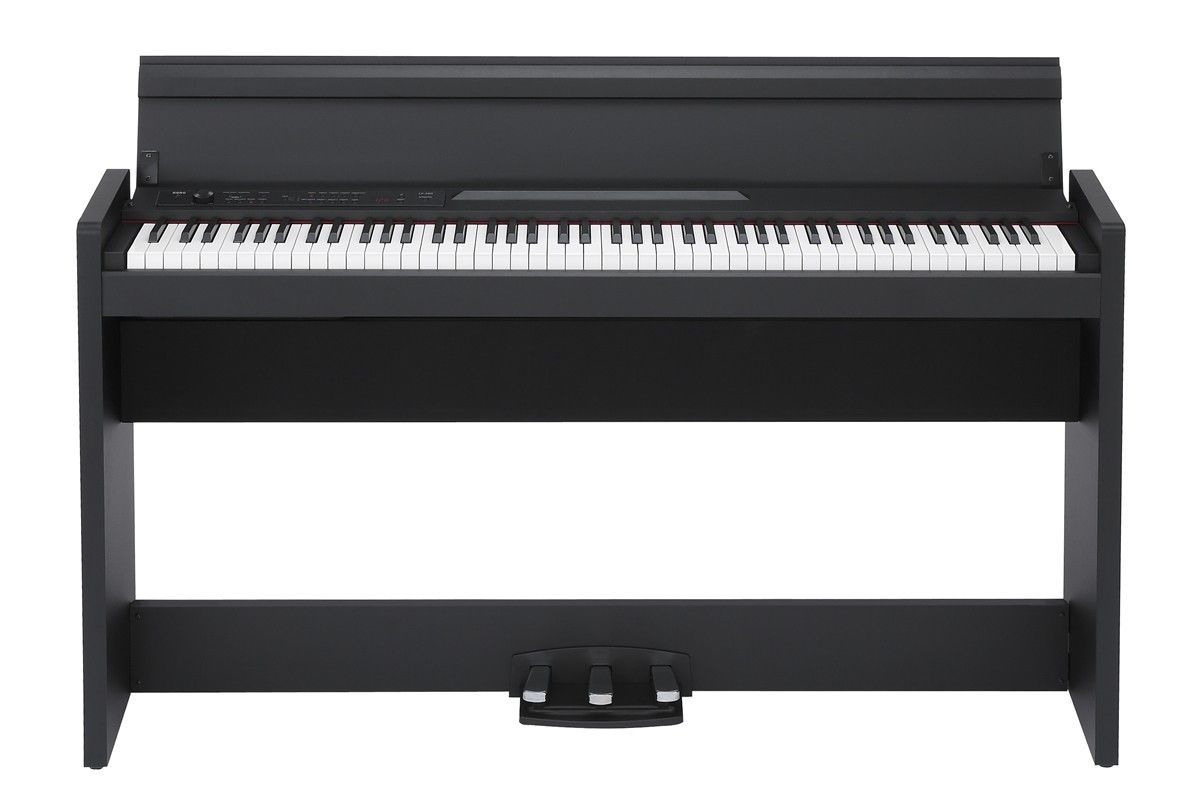
Piano lovers will be pleased with a keyboard under €1,000 (~1200$) that features 88 weighted keys and pressure sensitivity, as well as a keyboard setup and customization mode. The Korg LP380 is a very interesting option for those who are looking for a digital piano.
Features
The LP380 is an ideal alternative for pianists, the focus is entirely oriented to simulate an acoustic piano. The specifications of this model are presented below:
- 88-balanced, pressure-sensitive keyboard with Real Weighted Hammer Action 3 technology.
- Touch customization with 3 modes (Configuration and customization of pressure sensitivity)120-note polyphony.
- 30 Voices ( 5 of Acoustic Piano , Electric Grand, 6 of Electric Piano , Harpsichord, Vibraphone, Marimba, Acoustic Guitar, 3 of Jazz Organ and others)
- Effects (Reverb, Brillance and Chorus) – 3 Levels in each effect.
- Metronome
- 30 demo songs
- Line Input and Output
- Midi Input and Output
- 2 Headphone Ports
- Input for pedal (Triple footswitch, damper, soft, sostenuto and half pedal)
- 2 Speakers 22w
- Electricity consumption 15w
- Weight 37kg (including stand)
- Dimensions: 1.35 m x 35.1cm x 77.2cm.
I’m sure you’ll be interested in…
- Ranking with the best digital pianos in quality-price ratio
- The cheapest musical keyboards for beginners
- Learn piano by yourself and for free
Sound
The sound of the LP380 is of great quality, despite having only 120 notes of polyphony, it is capable of producing a clean and clear sound, in addition the integrated speakers have sufficient power to practice at home and even present on stage.Below is the official video of the Korg LP380:
In Korg’s official video we can see “La Campanella” by Franz Liszt, a high level piece, where you can notice the clarity of the sound and the sensitivity of the keyboard.For those who are interested in something more than just piano this is the next demonstration of the Korg LP380:
The Korg LP380 has great quality and sound power in all voices, making it an interesting alternative for any pianist.
Connectivity
The connectivity of the Korg LP380 is good, it features all the basics and has almost everything necessary for a pianist.
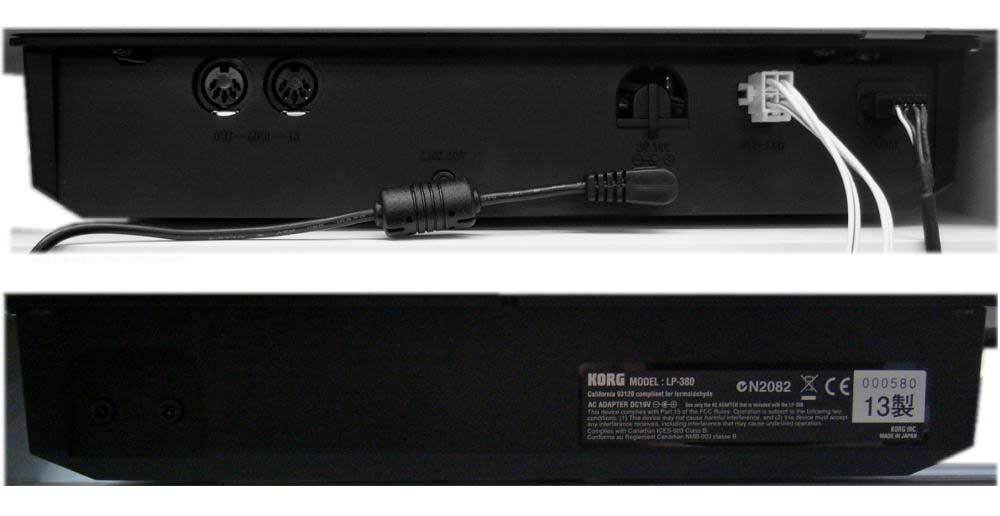
It is very probable that some people miss the USB port or the bluetooth connectivity, however, with the MIDI input and output you can record perfectly well, in addition the LP380 has several options for pedals, considering from the triple footswitch (which usually comes included) to a half pedal.
Advantages and disadvantages of the Korg LP 380
The advantages of this model are:
- Price
- Sound
- 88 keys
- Personalization
The disadvantages of this model are:
- Connectivity
- Polyphony
- Voices
The Korg LP 380 is a great quality digital piano, however, it is not for everyone, the connectivity, polyphony and the number of voices available are 3 limitations to consider, especially if you intend to use the keyboard on a stage. Despite the disadvantages, the LP 380 is a model with very good power and sound quality and features a keyboard with 88 weighted keys and pressure sensitivity that has various customization options.
Korg LP 380 Vs Yamaha YDP 143 (new Yamaha YDP 144)
Korg and Yamaha designed digital pianos with a similar approach, both the Korg LP380 which costs around costs around €733/$1150/£689 and the Yamaha YDP 143 (new model reviewed at this linked review) are ideal for piano students and pianists who require a good quality choice, which costs €777/$1200/£715. The similarities and differences between the two models are shown below:
- Both the Korg and Yamaha have an 88-key keyboard with weighted keys and pressure sensitivity, however, Yamaha does not specify whether the YDP 143 has real weight on the keys, while the LP 380 has a technology called Real Weighted Hammer Action 3, focused on imitating the sensitivity of a piano through weight and response to pressure.
- The Yamaha YDP 143 has 4 pressure levels on the keyboard (Hard, Medium, Soft and Fixed), while the Korg LP 380 has a customization of 3 levels,
- The sound polyphony of the Yamaha YDP 143 is 192 notes, while the Korg has 120 notes.
- The Korg has 30 piano sounds while the Yamaha has 10.
- Yamaha incorporates reverb effect of 4 types and Korg has reverb, brillance and Chorus with 3 types (levels).
- Both models have connectivity for triple footswitch, however, Korg has an alternative to place a half footswitch.
- Korg features MIDI input and output, in-line input and output, and input for 2 headphones, while
- Yamaha features input for 2 headphones and a USB to host port.
- Korg speakers are more powerful with 25w each, while Yamaha incorporates 6w speakers.
- The Yamaha YPD 143 includes a book with 50 songs.
Both models have great quality, however, if you are in search of sound power, effects, variety of voices and quality in the keys the Korg LP 380 is the best alternative, if you are looking for a keyboard with more polyphony and USB connectivity the Yamaha YDP 143 is an excellent choice.
Korg LP 380 Vs Roland FP30
The Roland FP30 which costs around €625/$730/£566, is very similar to the Korg LP380 which costs around costs around €733/$1150/£689, but with a slightly different focus. The similarities and differences between the two models are presented below:
- Both models have an 88-key keyboard with sensitivity to pressure and weighted keys, however, Korg adds real weight to the keys by simulating an acoustic piano.
- The polyphony is practically identical, Roland has 128 notes, while Korg offers 120 notes.
- Korg incorporates 30 voices, while roland has 33 voices.
- Both models have effects and 4 configuration levels
- The Roland’s connectivity is more complete with USB and Bluetooth, plus 2 headphone input ports and the output port.
- Roland offers the App Piano Partner 2 available for Android and iOS, through the app you can synchronize a mobile or a Tablet using bluetooth and follow scores without having to change pages, record and other functions.
- Both models have option for triple footswitch.
- Korg has more sound power, as its speakers are 25w each, while Roland includes 11w speakers.
- The Korg’s weight is 37kg with base, while Roland’s FP30 weighs 23kg with base.
The comparison between both models is complicated, both options are of high quality. The Roland FP30 offers great connectivity features, however, it does not have great sound power, nor keys with real weight, although it can be a great option for those seeking synchronization with the mobile. The Korg LP 380 is an option for those who are looking for a keyboard that simulates a piano through the weight of the keys and focuses on sound quality and power. Of course Roland Fp 30 is a good choice for its price. Around 500€ (~650$)
Korg LP 380 Vs Yamaha P115
The Yamaha P115 (and the new model Yamaha P25, the only difference is that it comes with 14 new piano songs) is a very popular choice among piano students, as it has adequate features to begin learning this instrument. Below are the similarities and differences between Yamaha P115 and Korg LP 380:
- Both models feature an 88-key keyboard with weighted keys and pressure sensitivity, however, Yamaha does not specify whether the P115 has real weight on the keys, while the LP 380 has a technology called Real Weighted Hammer Action 3, focused on imitating the sensitivity of a piano through weight and pressure response.
- The Yamaha P115 features 4 pressure levels on the keyboard (Hard, Medium, Soft and Fixed), while the Korg LP 380 has a customization of 3 levels,
- The Yamaha polyphony is bigger, with 192 notes, while the LP 380 has 120.
- Korg incorporates 30 voices, Yamaha P125 has 24 piano songs.
- The P115 features a reverb effect of 4 types and Korg has reverb, brillance and Chorus with 3 types (levels).
- The sound power of the Korg LP 380 is better, as it features 2 speakers of 25w each, while the Yamaha P115 features 7w speakers each.
- The Korg’s connectivity is better, since it has in-line input and output, MIDI, 2 headphone inputs and the pedal port, while the P115 has USB to host, 2 headphone inputs and pedal input but does not have MIDI available.
- Both models have an option for triple pedal and half pedal.
- Yamaha P125 cost around 500€ (~650$)
The Korg LP 380 is a more complete option than the Yamaha P115, among the characteristics to emphasize is the quality in the keys, because the real weight that Korg offers perfectly simulates a piano, allowing to interpret any piece properly, on the other hand the sound power of the LP380 is much superior, so if you are looking for a piano to study and play in presentations the Korg LP 380 is better alternative.
Korg LP 380 Vs Korg C1 air
Korg offers 2 models with practically identical features, both the LP380 and the Korg C1 Air are two options focused on imitating a piano, and it costs around €844/$1500/£777. The similarities and differences between the two models are shown below:
- Both models share the same keyboard technology with 88 weighted (actual weight) keys and pressure sensitivity.
- The polyphony of both models is 120 notes.
- The temperament of the LP380 is of 9 types, while that of the C1 air is of 3 types.
- Both models feature 30 voices and options for tuning and customizing the keyboard.
- The connectivity of both models is practically identical, the only difference is that the C1 air has bluetooth.
- The sound power of both models is identical.
The differences between the LP 380 and the Korg C1 air are really minimal, the main difference is the temperament where the LP 380 is a winner and the bluetooth connectivity where the C1 air is a better alternative, however, in quality, sound power and keyboard functionality both models are identical.
Conclusion
Before choosing a keyboard model, make sure you know your needs, this way you will be able to find an option that adapts to your budget and has the functions that you really need.For those looking for a digital piano of less than 1000€ capable of simulating the sensation of using an acoustic piano, the Korg LP 380 is an excellent choice, as the technology on the keyboard of this model is capable of reproducing the experience of playing an acoustic piano, it also has 2 very powerful loudspeakers, ideal for those who also intend to play in public.
If you are looking for a more advanced alternative you should check out the Roland FP 90, a keyboard with higher sound quality and better features, however, if you are looking for a different option you can check our guide to the best digital pianos and keyboards in terms of quality and price.
Where to buy the Korg LP 380
This piano can be obtained online at a much better price than in physical stores. But you need it to be a store with a very good reputation and warranty. Here are some of them:
Amazon
- Free Shipping and possibility of shipping in one day with Amazon Premium.
- Full Guarantee but they are no experts in music equipment
- Leader in fast shipments.
- Price that change a lot daily.
- The best option in USA and ASIA
Thomann
- Free Shipping
- Full warranty. If you have any problems, they take care of everything.
- 100% reliable payment.
- Leader in trouble-free shipping.
- Usually Best price.
- Best Reputation: They are the leading online store in Europe and have the best catalogue and information.
For a similar price you have the following pianos and keyboards:
- YAMAHA YDP-S34 ARIUS
- YAMAHA YDP 163
- YAMAHA YDP 143
- YAMAHA PSR S770
- YAMAHA PSR S670
- YAMAHA PSR E453
- YAMAHA PSR E443
- YAMAHA P45
- YAMAHA P255
- YAMAHA P125
- YAMAHA P-121
- YAMAHA P115
- YAMAHA P105
- YAMAHA DGX 660
- YAMAHA ARIUS YDP 142
- YAMAHA PSR S775
- YAMAHA PSR E463
- YAMAHA P35
- THOMANN SP 5600
- THOMANN DP-33
- THOMANN DP-31
- ROLAND GO KEYS
- ROLAND FP-60
- ROLAND FP 80
- PIANO THOMANN SP 320
- KURZWEIL SPS4-8
- KURZWEIL SP6
- KURZWEIL SP4-8
- KURZWEIL FORTE SE
- KURZWEIL FORTE 8
- KURZWEIL ARTIS 7
- KORG PA-700 ORIENTAL
- KORG PA-700
- KORG PA600
- KORG PA-300
- KORG PA-1000
- KORG HAVIAN 30
- KORG GRANDSTAGE 88
- CASIO PX-870 PRIVIA
- CASIO PX-770 PRIVIA
- CASIO PX-5S PRIVIA PRO
- CASIO PX-560 PRIVIA
- CASIO PX-360 PRIVIA
- CASIO PX 160
- CASIO CT-X800
- CASIO CT-X700
- CASIO CT-X5000
- CASIO CT-X3000
- CASIO CDP 130
- THOMANN DP 26
- ROLAND FP 90
- ROLAND FP 30
- ROLAND FA 06
- ROLAND BK 5
- KORG SP 280
- KORG B1
- KAWAI ES8
- KAWAI ES110
- KAWAI ES100
- KAWAI CN27
- KAWAI CN25
- CASIO CDP 230
- CASIO CDP S100
Do you have this piano? If so, or if you have any doubts, leave your comment here. Thank you!