
- Home
- Author's Archive:
Digital Piano Thomann DP 26 Full Review. Is it worth it?
Where to Buy Thomann DP 26: Review and Opinion
If you have €300 and are looking for a digital piano with 88 weighted and pressure-sensitive keys, the Thomann DP 26 is an ideal choice for you.

The German brand really strived to design an instrument with very good features at a considerable price, the DP 26 is an excellent alternative for those pianists who require a keyboard to move or who are looking for a keyboard to take lessons.
Buy your Thomann DP26 with the best discount available in the market by clicking on the button below:
Features
The Thomann DP 26 has essential features for any pianist, the 88 weighted keys and its teaching system for left and right hand are two examples to highlight. Features:
- 88-key weighted pressure-sensitive keyboard with a hammer action system
- 20 Voices
- 64-voice polyphony
- LED display
- 60 preset songs and 2 demo songs
- Layer and split function
- 50 styles
- Pitch bend wheel
- Effects
- Master Equalizer
- Chorus
- Reverb
- Duet
- Harmony
- Sequencer of melody + accompaniment
- Teaching function for left and right hand
- Metronome
- Transposer
- 2 x 10W speakers
- 2 headphone sockets
- MIDI output
- USB MIDI
- Auxiliary input and output
- Sustain pedal input
- Slot for lectern
- Included accessories (lectern and sustain pedal)
- Dimensions 1.36m x 36.6cm x 13.7cm weight 12.9kg
I’m sure you’ll be interested in…
- Ranking with the best digital pianos in quality-price ratio
- The cheapest musical keyboards for beginners
- Learn piano by yourself and for free
Sound
The DP 26 has a pretty good sound and is that despite its 64 polyphony notes, Thomann did a good job on cleanliness and quality. A sound test of the previous model (is the same sound) is presented below:
In the previous video we can see that despite the 64 notes of polyphony the sound is good, the 20 voices included in the DP 26 have a quite acceptable quality.
Connectivity
In terms of connectivity, the Thomann DP 26 has the basics, the minimum necessary for any pianist, and covers the requirements to be able to make live presentations and connect to a PC.

The DP 26 has a headphone output, sustain pedal, auxiliary and MIDI connection, so you do not have to worry about it. While there are other models that have different connectivity options and are more complete, it is also true that for most users the connectivity of PD 26 is more than enough.
Advantages and disadvantages of the Thomann DP 26
The advantages of this model are:
- 88-key weighted keyboard with pressure sensitivity
- Connectivity
- Price
- Weight
The disadvantages of this model are:
- 64 polyphony notes
- Variety of voices
The Thomann DP 26 is an option with 88 weighted keys that have good connectivity and is relatively portable for a very affordable price, which makes it a very attractive option, however, among the disadvantages are the variety of voices and 64 polyphony notes. It is necessary to point out that the sound quality is not bad for the price its have. The sampling quality is not a good as a Nord Piano for example. But most people wouldn´t feel the difference.
Thomann DP 26 vs Yamaha P45
The German brand was able to design a very competitive keyboard, generally superior to Yamaha’s offer, as the DP 26 incorporates the features and functions of a digital stage piano. For this comparison, we will take as reference the Yamaha P45.
These are the similarities and differences between the two models:
- Both models feature a keyboard with 88 weighted and pressure-sensitive keys.
- The connectivity of the DP 26 is far superior to that of Yamaha’s P45, as the P45 lacks MIDI and auxiliary output.
- The Thomann’s speakers are 10w, while Yamaha incorporates 6w speakers.
- The Yamaha P45 commonly has a higher cost of approximately 50€.
- Thomann includes 20 voices on its keyboard, while the Yamaha P45 has only 10.
In general, Yamaha and Thomann have similar characteristics, however, an important factor to consider is that the Thomann DP 26 includes effects, styles, accompaniments, and connectivity similar to that of a stage keyboard, while Yamaha keyboards of the similar line usually do not have these functions. In the case of the previous comparison between the DP 26 and the P45, the clear winner is Thomann, as it has better features and a better price.
If you require more information about the P45 or have any questions we recommend you review our full review of the Yamaha P45 click here.
Thomann DP 26 vs Thomann SP 5600
The German brand has different options with similar functions, the DP 26 and the SP 5600 are two models with similar characteristics. The comparison between the two models is shown below:
- Both have an 88-balanced, pressure-sensitive keyboard.
- The SP 5600 has 600 voices, while the DP 26 has only 20 voices.
- The variety of styles and internal songs in the SP 5600 is greater, as this model offers 120 internal songs and 230 styles, while the DP 26 has 50 styles and 2 songs.
- The DP 26 has 64 polyphony notes and the SP 5600 has 128 polyphony notes.
- The SP 5600’s connectivity is better because it has a microphone input.
- The price of PD 26 is 59€ lower.
The only advantage of the DP 26 over the SP 5600 is the price, since the Thomann SP 5600 has better sound quality, offers a greater variety of functions, and has better connectivity, however, if your idea is to learn piano, probably saving 59€ might be something interesting, plus the DP 26 is more than enough to take lessons.
If you require more information about this model or have any questions we recommend you review our full review of the Thomann SP 5600 here.
Thomann DP 26 vs Thomann SP 320
The DP 26 and SP 320 are two Thomann alternatives with virtually the same functions. The comparison between the two models is shown below:
- Both models have an 88-key keypad, however, the SP 320 does not have good weighted keys (it is a kind of weighted effect, but still, is better than nothing, of course).
- The polyphony of the DP 26 is 64 notes, while the SP 320 is 32 notes.
- The DP 26 has 20 voices, while the SP 320 includes only 12 voices.
- The speakers of the SP 320 are superior as it has 2, each one is 20w, while the DP 26 has two speakers of 10w each.
- The weight of the SP 320 is 9 Kg, while the DP 26 weighs 12.9kg.
- The functions of the DP 26 are better, as it has 50 effects, keyboard split function, lesson mode and a pitch bend.
- The SP 320 can be used with batteries, while the DP 26 does not have this option.
The comparison between the DP 26 and the SP 320 makes the DP 26 a clear winner, however, it is important to mention that if you are looking for a cheaper keyboard with good features and more portability the SP 320 could be for you, but for those looking for a more professional keyboard with better construction, better functions, sound quality and connectivity, the DP 26 is an excellent choice. The good thing is that DP 32 usually cost less than 250 €.
If you require more information about this model or have any questions we recommend you review our full review of the Thomann SP320 here.
Conclusion
Before choosing a keyboard or digital piano, be sure to define the main function you will give to it, as only then you will be able to acquire a model that has the ideal characteristics for your use.
The DP 26 covers the basic needs of a stage pianist, however, for those who require a more professional option can turn to the SP 5600.
If you are looking for an option to learn piano the DP 26 is a very interesting alternative, however, if you want to consult other high-quality options you can review our guide to the best keyboards and digital pianos in relation to price benefit.Remember that the best idea is to buy a keyboard or digital piano that only covers the needs you have, you should never be guided by functions or features that are not necessary for your activity.
Where to buy the Thomann DP 26
It will always be better to purchase through an online store, as this way you can get a better price, however, it is important to buy in an online store that offers you the right transport and the best conditions of purchase. If you want to buy the Thomann DP 26 with the best conditions of purchase and the best price click on the button below:
For a similar price you have the following pianos and keyboards:
- YAMAHA YDP-S34 ARIUS
- YAMAHA YDP 163
- YAMAHA YDP 143
- YAMAHA PSR S770
- YAMAHA PSR S670
- YAMAHA PSR E453
- YAMAHA PSR E443
- YAMAHA P45
- YAMAHA P255
- YAMAHA P125
- YAMAHA P-121
- YAMAHA P115
- YAMAHA P105
- YAMAHA DGX 660
- YAMAHA ARIUS YDP 142
- YAMAHA PSR S775
- YAMAHA PSR E463
- YAMAHA P35
- THOMANN SP 5600
- THOMANN DP-33
- THOMANN DP-31
- ROLAND GO KEYS
- ROLAND FP-60
- ROLAND FP 80
- PIANO THOMANN SP 320
- KURZWEIL SPS4-8
- KURZWEIL SP6
- KURZWEIL SP4-8
- KURZWEIL FORTE SE
- KURZWEIL FORTE 8
- KURZWEIL ARTIS 7
- KORG PA-700 ORIENTAL
- KORG PA-700
- KORG PA600
- KORG PA-300
- KORG PA-1000
- KORG HAVIAN 30
- KORG GRANDSTAGE 88
- CASIO PX-870 PRIVIA
- CASIO PX-770 PRIVIA
- CASIO PX-5S PRIVIA PRO
- CASIO PX-560 PRIVIA
- CASIO PX-360 PRIVIA
- CASIO PX 160
- CASIO CT-X800
- CASIO CT-X700
- CASIO CT-X5000
- CASIO CT-X3000
- CASIO CDP 130
- ROLAND FP 90
- ROLAND FP 30
- ROLAND FA 06
- ROLAND BK 5
- KORG SP 280
- KORG LP 380
- KORG B1
- KAWAI ES8
- KAWAI ES110
- KAWAI ES100
- KAWAI CN27
- KAWAI CN25
- CASIO CDP 230
- CASIO CDP S100
Have you ever had this piano? In that case do not hesitate to leave us your opinion in the comments. Thank you very much for reading us!
Digital Piano Nord Piano 3 Full Review. Is is the best Piano option?
Where to Buy the Nord Piano 3: Review and Opinion
Nord is a brand with a great focus on professional musicians, as virtually all of its models have ideal features for live performances.
I’m sure you’ll be interested in…
- Ranking with the best digital pianos in quality-price ratio
- The cheapest musical keyboards for beginners
- Learn piano by yourself and for free

The Nord Piano 3, is a keyboard that as its name indicates perfectly simulates a piano, offering the best of both worlds, synthesizer features, and keyboard 88 weighted keys with a triple pressure sensor.
New: Nord Piano 4 is already here
Features
The Nord Piano 3 is a very complete keyboard, its synthesizer functions and its piano approach make it a very interesting choice for pianists and keyboardists. The features of this model are shown below:
- 88-key pressure-sensitive keyboard with triple sensor and weighted keys with grand weighted action system and virtual hammer action.OLED display
- 6 types of piano voice (Grand, Upright, Electric 1, Electric 2, Clavinet, and Harpsichord) Each voice available with 9 versions.
- 1gb memory for a bookstore
- 256mb of memory for sample library
- Layer and Split function (keyboard divided into 5 sections)
- 40/60 polyphony (stereo/ mono)
- 2 types of effects
- Effect 1: Pan, Tremolo, Wah, Ring Modulator (3 types of depth of effect) Effects: Pan, Aro, and Wah can be controlled with pedal
- Effect 2: Phase 1 and 2, Chorus 1 and 2 and vibe ( 2 types of depth in each )
- 2 Unbalanced L/R audio outputs ( 6.35mm)
- 1 stereo monitor input 3.5mm
- 1 stereo headphones input 3.5mm
- 1 piano pedal input 6.5mm (Possibility to use the triple Nord pedal included in the keyboard or pedals like Roland DP-2 and DP-6 or Yamaha FC-4 and FC-5, Fatar VFP1-25, etc.).
- USB input type B
- MIDI Input and Output 5 DIN Pin
- Monitor Input
- Triple footswitch Nord
- Dimensions 128.7 cm x 12.1 cm x 34.0 cm
- Weight 18.2kg
Sound
Despite the polyphony available in Nord, the Piano 3 is a keyboard with very good sound quality, one of the best advantages of this model is the level of similarity to an acoustic piano since the Nord Piano 3 has a piano voice of very high quality.
Below is the official demo of the Nord Piano 3:
Connectivity
In terms of connectivity, the Piano 3 is a very complete option, it is possible to say that it has everything for those who seek to make live presentations or musical production.

MIDI and USB connectivity, plus the versatility of using pedals and accessories from other manufacturers make the Nord Piano 3 a very attractive choice for any musician.
Advantages and disadvantages of Nord Piano 3
The advantages of this model are:
- Keyboard quality
- Connectivity
- Sound
- Versatility
- Weight
The disadvantages of this model are:
- Limitations on the number of voices
- No built-in speakers
The Nord Piano 3 is an option with more advantages than disadvantages, it is even possible to say that the disadvantages are totally irrelevant, especially if the user is a pianist or keyboardist focused on using piano voice or similar and who has an amplifier, the only disadvantage to consider is the polyphony, however, does not significantly affect the sound quality. Among the best qualities of the Piano 3 is the quality of the keyboard and the versatility, these two points make it an option to consider.
Nord Piano 3 vs Nord Stage 3
Nord offers the Piano 3 and Stage 3, two similar options focused on live performances but with slightly different performance. The comparison between the two models is shown below:
- The Nord Stage 3 is available in three keyboard sizes, while the Nord Piano 3 has only one version with 88 keys.
- The 88 keys on the Nord Piano 3 are weighted and pressure-sensitive, as well as having a triple switch system accurately simulating a grand piano, while Stage 3 has weighted keys and sensitivity without additional technology.
- The Nord Piano 3 allows us to divide the keyboard into 2 sections and Stage 3 allows in 4. The capacity of Stage 3 is 2gb, while Piano 3 has 1gb.
- The Nord Stage 3 has more piano voices, as they have 120, while the Piano 3 has 54.
- The Stage 3 polyphony is larger, with full polyphony in synthesizer and 120 notes in the piano, while the Piano 3 has polyphony with 40 notes in stereo and 60 in mono.
The Nord Stage 3 is a clear winner, as this model wins in all areas except the quality of the keyboard. On the other hand, the Nord Piano 3 has a keyboard more like a grand piano, so it is ideal for those who prefer the experience of playing the piano over functions and sound quality, however, for those who want a more complete choice or prefer to sacrifice a little experience to gain functionality and quality, the Nord Stage 3 is the best choice.
If you want to know more about Nord Stage 3, don’t hesitate to visit our analysis and opinion.
Nord Piano 3 vs Yamaha CP4
These two models are direct competitors, as both have an approach to performing live and simulating a piano. The similarities and differences between the two models are shown below:
- Both have an 88-key keyboard with weighted keys and pressure sensitivity, however, Nord incorporates more technology on the Piano 3 keyboard, as this version includes a triple pressure sensor and virtual hammer technology to simulate a grand piano.
- The polyphony of the CP4 is 128 notes, while that of the Piano 3 is 40/60 in stereo and mono.
- The CP4 has 433 voices, while the Piano 3 has 15 voices.
- Nord offers more options for voices dedicated to piano and similar, as each of the piano voices offers 9 different versions, simulating instruments of different brands.
- The variety of effects of the Nord Piano 3 is greater since it has 2 categories of effects and different levels of depth of the same ones.
- Nord is a more versatile keyboard since it allows the use of Roland and Yamaha pedals, while the CP4 is only designed to be used with brand accessories.
The comparison between the Yamaha CP4 and the Nord Piano 3 is very close, both models have a great diversity of functions, however, for those seeking a keyboard with a variety of voices the CP4 is a great choice, while the Nord Piano 3 is a better choice for those who prefer keyboard quality, diversity of piano voices and versatility.
If you want to know more about the Yamaha CP4, don’t hesitate to visit our review and opinion.
Nord Piano 3 vs Roland RD 2000
The Nord Piano 3 and the Roland RD 2000 are two keyboards with very similar features and functions, the two models are focused on simulating a piano and offering a diversity of functions for musical production. Below is a comparison of both models:
- Both the RD 2000 and the Nord Piano 3 have 88 weighted and pressure-sensitive keys with piano mimicry technology, in this case, both brands have an approach to keyboard construction quality, offering very similar systems.
- Both models offer similar connectivity, have sustain pedal and triple pedal available, although they also have accessories such as the damper pedal.
- The pedal technology of the RD 2000 and the Nord Piano 3 allows to simulate the sustain pedal to perfection because it responds to the pressure, however, the Nord Piano 3 has dynamic functions for the pedal, in which you can configure and customize the sustain pedal. In storage, the Piano 3 is better, as it has memory available for two libraries, 1gb of memory focused on the piano library “Nord Piano Library” and 256mb for the sampling library “Nord sample library, while the Roland RD 2000 only offers a USB port designed to place external memory.
- Roland has a clear advantage in the variety of shades, with 1100 different shades, while Nord offers 6 shades.
- Nord offers technology to simulate different piano brands, which includes 9 different models, while Roland only produces the 5 piano voices designed by the brand.
- Roland and Nord offer similar connectivity, however, Roland offers XLR audio input and output, while Nord only offers ¼.
- The RD 2000 has 2 sound generators, being the best choice in terms of optimization and sound quality.
The characteristics of both models are very similar, however, for those seeking a keyboard focused solely on piano and music production, with good versatility the Nord Piano 3 can be a good alternative, on the contrary, those seeking quality and greater diversity of functions should go for the RD 2000, as it is the most complete option.
If you want to know more about the Roland RD 2000, don’t hesitate to visit our review and opinion.
Conclusion
It is always good to verify that the keyboard you choose meets the requirements for your activity, as each musician requires particular functions and must choose an instrument that suits them.
The Nord Piano 3 is a high-quality instrument, ideal for those looking for a digital piano for live performances that offers diversity in the use of accessories and high quality on the keyboard.
If you are looking for a different alternative, we recommend you read our guide to the best digital pianos and keyboards in terms of price and benefit.
Where to buy the Nord Piano 3
Remember that buying online will help you save some euros, however, it is important to ensure that the store you use offers the correct transport and good conditions of purchase. If you want to buy your Nord Piano 3 at the best price available in the market do not hesitate to click on the button below. We updated the links to the Nord Piano 4
Amazon
- Free Shipping and the possibility of shipping in one day with Amazon Premium.
- Full Guarantee but they are no experts in music equipment
- A leader in fast shipments.
- The price change a lot daily.
- The best option in USA and worldwide
At Europe check Thomann:
They have also already released the new Nord Piano 4.
Don’t hesitate to leave your comments below. We always want to hear from you!
For a similar price you have the following pianos and keyboards:
- YAMAHA PSR-A3000
- YAMAHA PSR S975
- YAMAHA PSR S970
- YAMAHA P-515
- YAMAHA MONTAGE 8
- YAMAHA GENOS
- YAMAHA CP40 STAGE
- YAMAHA CP4
- YAMAHA CP300
- YAMAHA CP1
- YAMAHA CLP 685
- WALDORF ZARENBOURG
- STUDIOLOGIC NUMA STAGE
- STUDIOLOGIC NUMA CONCERT
- STUDIOLOGIC NUMA COMPACT 2X
- STUDIOLOGIC NUMA COMPACT 2
- ROLAND RD 2000
- ROLAND KIYOLA KF-10
- NORD PIANO 3
- KORG SV1 88
- KORG SV1 73
- CRUMAR SEVEN
- CLAVIA NORD STAGE 3 HP76
- CLAVIA NORD STAGE 3 COMPACT
- CLAVIA NORD PIANO 4
- CLAVIA NORD ELECTRO 6D 73
- CLAVIA NORD ELECTRO 6D 61
- CLAVIA NORD ELECTRO 6
- NORD STAGE 3
Digital Piano Nord Stage 3 Full Review. Is it worth it?
Analysis and Opinion Nord Stage 3: Review and Where to Buy
Nord has always focused on professional musicians, Stage 3 is a keyboard that as its name indicates is designed for live performances, ideal for stages, but is also an option to consider for a music studio.
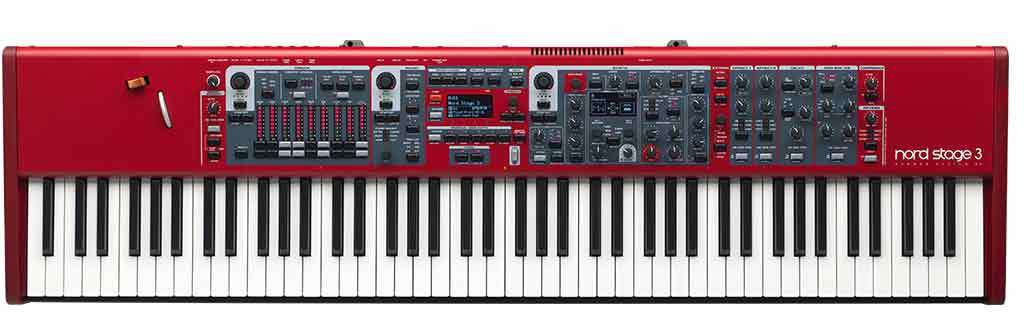
The Swedish brand has always been characterized by its handmade instruments and very high quality, the Nord Stage 3 is no exception to the rule, as it has a large internal memory capacity, diversity of effects and functions, and weighted wooden keys with sensitivity to pressure in the version of 88 keys.
Where to buy the Nord Stage 3 88 keys?
Amazon
- Free Shipping and the possibility of shipping in one day with Amazon Premium.
- Full Guarantee but they are no experts in music equipment
- A leader in fast shipments.
- The price change a lot daily.
- The best option in USA and ASIA
Thomann
- Free Shipping
- Full warranty. If you have any problems, they take care of everything.
- 100% reliable payment.
- A leader in trouble-free shipping.
- Usually Best Price.
- Best Reputation: They are the leading online store in Europe and have the best catalog and information.
Features
The Nord Stage 3 has 3 versions available with identical functions but different size and keyboard characteristics. The most advanced version has 88 wooden keys with counterweight, then there is a smaller version of 76 keys with an auction system similar to the weighted keys and finally, there is the compact version of 61 semi-weighted keys, all versions have pressure sensitivity.
I’m sure you’ll be interested in…
- See this section for possible discounts and offers
- Ranking with the best digital pianos in quality-price ratio
- The cheapest musical keyboards for beginners
- Learn piano by yourself and for free
Specifications:
- 88-key weighted wooden keyboard / 76-key keyboard with action hammer system / 61-key semi-weighted keyboard.
- Pressure-sensitive keyboard in all available sizes (88, 76 and 61 keys)
- Oled screen for oscillator functions
- polyphony of 120 notes in Piano
- complete polyphony in Organo
- Piano Mode with 2gb memory, 6 types and 20 models (120 voices)
- Creative Filters and Layers
- 34 Miscellaneous Voices
- Library of songs, effects, and synthesizer with a capacity of 480 MB and option to import and export files.
- Synthesizer with extended polyphony
- Effects
- Two types of effects
- Effect 1: Tremolo, ring modulator, Auto Pan, Wah-Wah, Auto Wah 1, Auto Wah 2
- Effect 2: Flanger, Vibe, 2 Frasers, 2 Choirs
- 3 Types of loudspeaker simulation (JC, Twin, and Small)
- 3-band equalizer ( 100hz, 200 Hz – 8 kHz and 4khz)
- Compressor with accelerated mode
- Effects synchronizer with time clock
- Reverb with 6 algorithms
- 4 audio inputs 6.35mm (¼) without balance
- 1 6.35 mm stereo headphone jack (¼)
- 1 Stereo input monitor (1/8) 3.5mm
- Sustain pedal input (1/4) 6.35mm (Compatible with Roland DP-2 and DP-6 pedals, Yamaha FC-4 and FC-5, Fatar VFP1-25, etc.)
- Input for sustain pedal compatible with triple Nord pedalboard
- Input Rotor pedal 6.35mm (Rotor pedal or Switch)
- 6.35mm Organ Swell pedal input – Control/Expression pedal ( Yamaha FC-7, Roland EV-5, etc.)
- Input Pedal Control 6.35mm – Control/Expression pedal ( Yamaha FC-7, Roland EV-5, etc.)
- Input for Program change pedal 6.35mm – Momentary two-button pedal (Boss FS-6, Boss FS-7, etc.)
- MIDI input and output with 5-pin DIN connector
- USB Type B for MIDI, Updates and Data Transfer
- Dimensions and weight: 88 keys: 1287 mm (50.7″), 118 mm (4.7″), 334 mm (13″), weight 19kg 76 keys: 1122 mm (44″), 127 mm (5″), 347 mm (13.6″), weight 12.5 kg and 61 keys: 1070 mm (42″), 104 mm (4″), 302 mm (12″), weight 10kg.
This keyboard then has a 76-key edition and then a compact version.
Sound
The sound quality of Nord is always outstanding, the Nord Stage 3 is a clear example of this, the complete polyphony for organ and synthesizer and its 120 notes of polyphony in piano produce a really good sound, in addition, the cleanliness and clarity in the voices are outstanding in this model.
Below is the official Nord Stage 3
Displays different voices and effects:
As can be seen in the two previous videos the sound quality is very good in the various voices and effects included, making the Nord Stage 3 a very attractive option for those seeking an option for music production, although the focus of this model is for live presentations, as the sound quality produced is ideal for a stage.
Connectivity
The connectivity of the Nord Stage 3 is ideal for a live performance or music production, as it has everything you need.

It is necessary to highlight the options offered by this model for control pedals, sustain, damper, etc. Since it even allows you to connect pedals from other brands, having a great versatility, the MIDI and USB options provide absolute connectivity with a computer, so you can import and export files, settings, and everything you need.
Advantages and disadvantages of Nord Stage 3
Advantages of this model: Option of 3 different sizes without losing functionalities (only modifying the quality of the keyboard)
- 88-key version with weighted wooden and pressure-sensitive keys
- Sound Quality
- Connectivity
- Versatility
- Weight and portability
The disadvantages of this model:
- No built-in speakers
- The polyphony on the piano is only 120 notes
- The screen is not touch screen
Analyzing in detail the Nord Stage 3 we can see that it has more advantages since the quality of sound and the options of connectivity are two important strong points, nevertheless, the versatility that offers this model when allowing to use accessories of other marks is something to emphasize and finally the weight is smaller to the average of keyboards of musical production. Among the disadvantages, the only one to consider is the polyphony of 120 notes in the piano, however, the sound quality is very good in this mode and the Nord Stage 3 stands out for offering complete polyphony in synthesizer and organ. The Clavia Nord Stage 3 88 is around €3.490/$4500/£3,175.
Nord Stage 3 vs Nord Stage 2
The Nord Stage 3 has a direct rival with very similar characteristics, the Swedish brand showed a very competitive option in its previous version Nord Stage 2. Below are the main differences and similarities between the two models:
- Both models have three versions, however, in the case of Stage 2, the version with 88 and 76 keys has counterweight and sensitivity to pressure, while in Stage 3 only the version with 88 keys has weight, the one with 76 has an action hammer system.
- The Nord Stage 3 allows the keyboard to be divided into 4 zones, while the Nord Stage 2 allows only 3 zones.
- The internal memory of Stage 3 is 2gb while Stage 2 has 1 GB.
- The song mode is available only in the Nord Stage 3, having available 8 lists with 50 slots for songs.
- The variety of piano voices in Stage 3 is superior, with 120 against 54 of the previous model.
- The piano sound in Nord Stage 3 is superior, with 120 polyphony notes in stereo and mono, while Stage 2 has only 40 in stereo and 60 in mono.
- The Nord Stage 3 has piano filters, while the previous version has no filters available.
As expected the Nord Stage 3 is the clear winner in this comparison, at first glance was seen to come that this new model surpassed its predecessor, the sound quality, memory, variety of voices, and functions available are superior in Stage 3, putting him as a clear winner against Stage 2.
Nord Stage 3 vs Yamaha Montage 8
The Nord Stage and Yamaha Montage are two direct competitors, as they have a lot of similarities. Below is a comparison of both models:
- Both models have 88 weighted and pressure-sensitive keys, and in both cases, there is the possibility of having 76 or 61 keys with very similar functions, which makes these two lines direct competition.
- The 88-key version on the Nord Stage 3 incorporates weighted, pressure-sensitive wooden keys, while Yamaha has no wooden keys.
- The Nord Stage 3 has 6 algorithms to process sound while the Montage has 8.
- Both models have virtually the same connectivity, the only difference being that the 6.35mm audio outputs of the Yamaha Montage 8 are balanced and the Nord has a rotor pedal output.
- The Nord Stage 3 maintains internal storage of 2gb, while the Yamaha has no internal storage.
- The polyphony of the Nord Stage 3 is superior as it has a complete polyphony in synthesizer and organ and 120 notes in the piano, while the Yamaha has a global polyphony of 120 notes.
- The Nord stage has 31 controllers for different functions while the Montage 8 has only 24.
- The user interface of the Yamaha Montage 8 is more user friendly as it has a touch screen.
- The Yamaha Montage 8 has 4 different effects and more than 200 types, while the Nord Stage 3 has 2 customizable effects with 14 types.
- The versatility of Stage 3 is greater than that of Montage 8 as it allows the use of pedals and accessories from brands such as Roland, Yamaha, and others.
- The weight of the 88-key Nord Stage 3 is 19 while the Yamaha weighs 29kg.
The Yamaha Montage 8 is a more complete keyboard than the Nord Stage 3, as it has more features, more voices, and a very user-friendly interface, however, if you want a keyboard that continually updates its operating system, maintains sound quality in the synthesizer, and has great internal storage and versatility the Nord Stage 3 is an excellent choice. The Clavia Nord Stage 3 88 is around €3.490/$4500/£3,175 and the Yamaha Montage 8 is around €3.555/$4000/£3,266.
If you’re interested, you can visit our review of the Yamaha Montage 8.
Nord Stage 3 vs Nord Piano 3
Nord Stage 3 and Nord Piano 3 are two similar options focused on live performances but with slightly different performances. The comparison between the two models is shown below:
- The Nord Stage 3 is available in three keyboard sizes, while the Nord Piano 3 has only one version with 88 keys.
- The 88 keys on the Nord Piano 3 are weighted and pressure-sensitive, as well as having a triple switch system accurately simulating a grand piano, while Stage 3 has weighted keys and sensitivity without additional technology.
- The Nord Piano 3 allows us to divide the keyboard into 2 sections and Stage 3 allows in 4.
- The capacity of Stage 3 is 2gb, while Piano 3 has 1gb.
- The Nord Stage 3 has more piano voices, as they have 120, while the Piano 3 has 54.
- The Stage 3 polyphony is larger, with full polyphony in synthesizer and 120 notes in the piano, while the Piano 3 has polyphony with 40 notes in stereo and 60 in mono.
The scale clearly leans towards the Nord Stage 3 as it is a much more complete option, which wins in all areas except the quality of the keyboard. The Nord Piano 3 has a keyboard more like a grand piano, so it is ideal for those who prefer the experience of playing the piano over functions and sound quality, however, for those who want a more complete choice or prefer to sacrifice a little experience to gain functionality and quality, the Nord Stage 3 is the best choice.
If you’re interested, you can visit our review of the Nord Piano 3.
Nord Stage 3 vs Roland RD 2000
The comparison between Stage 3 and Roland RD 2000 is very interesting, as they are two options with very similar characteristics. The differences and similarities are presented below:
- The Nord Stage 3 comes in 3 different sizes while maintaining the same functions, while the RD 2000 is only available in 88 keys.
- Both models have 88 weighted and pressure-sensitive keys (Considering the Nord Stage 3 of 88 keys).
- The possibility of customizing Stage 3 is greater as it has inputs for different types of pedals and it is even possible to connect pedals from other brands.
- The RD 2000 has 2 sound generators, while the Nord Stage 3 has only 1.
- The polyphony of the RD2000 is superior in Piano voice as it has full polyphony while Stage 3 has 120 notes, however, the polyphony of the synthesizer of the Nord Stage 3 is better as it has full polyphony while the Roland only has 128 notes. Stage 3 has 6 types of Reverb while the RD 2000 has 4.
- The storage capacity of Stage 3 is higher, as it counts on 2gb, while the Roland RD 2000 has only one USB port to add storage.
The competition between these two models is complicated, as each model has a different approach. If you are looking for a keyboard that allows you to have a great quality piano voice the Roland RD 2000 is for you, but if you prefer a more complete option, versatile and with better performance for music production the Nord Stage 3 is a better idea.
If you’re interested, you can visit our review of the Roland RD 2000.
Conclusions
Before deciding on the ideal keyboard for you, it is necessary to identify the use you will make of it, since only then will you be able to select the one that has all the necessary characteristics for your activity.
Nord Stage 3 is an option for pianists and keyboard players looking to use synthesizer functions, make music recordings, and incorporate effects without losing the experience of playing the piano.
If you are looking for a keyboard for music production and live performances with good polyphony, storage capacity, advanced features, and versatility in accessories the Nord Stage 3 is an excellent choice. If on the contrary, you prefer some different alternative we recommend you visit our guide of the best digital pianos and keyboards in relation to price and benefit.
Where to Buy Nord Stage 3
It is best to buy in an online store, as you can get a better price and purchase conditions, however, before you click on buy make sure that the store offers adequate transportation and convenient conditions of purchase. If you want to buy at the best available price do not hesitate to click on the following button. For Asia and America check Amazon, for Europe Thomann
For a similar price you have the following pianos and keyboards:
- YAMAHA PSR-A3000
- YAMAHA PSR S975
- YAMAHA PSR S970
- YAMAHA P-515
- YAMAHA MONTAGE 8
- YAMAHA GENOS
- YAMAHA CP40 STAGE
- YAMAHA CP4
- YAMAHA CP300
- YAMAHA CP1
- YAMAHA CLP 685
- WALDORF ZARENBOURG
- STUDIOLOGIC NUMA STAGE
- STUDIOLOGIC NUMA CONCERT
- STUDIOLOGIC NUMA COMPACT 2X
- STUDIOLOGIC NUMA COMPACT 2
- ROLAND RD 2000
- ROLAND KIYOLA KF-10
- NORD PIANO 3
- KORG SV1 88
- KORG SV1 73
- CRUMAR SEVEN
- CLAVIA NORD STAGE 3 HP76
- CLAVIA NORD STAGE 3 COMPACT
- CLAVIA NORD PIANO 4
- CLAVIA NORD ELECTRO 6D 73
- CLAVIA NORD ELECTRO 6D 61
- CLAVIA NORD ELECTRO 6
Did you like this article?