
- Home
- Author's Archive:
Top Kawai Digital Pianos
Top Kawai Digital Pianos
The Japanese brand Kawai has been active in piano manufacturing since 1927 and those almost 100 years of experience have put them in the spotlight as one of the most important manufacturers in the world of grand, half grand and upright pianos. This experience has also led the company to stand out in the world of digital pianos, where they stand out for their quality.
Kawai manufactures keyboards and pianos of a certain quality. There are ranges in which it does not compete like the 61-key musical keyboards.
It competes more in digital pianos that imitate an upright and portable digital pianos. Range in which it has several top sales.
Let’s check the most popular Kawai pianos:
Kawai ES110 (Old Kawai ES 100)
Kawai’s most popular model, competing with the Yamaha P125 and Roland FP 30 in the €500 to €600 range.

Let’s go with your characteristics:
- 88 Responsive Hammer Compact Action (RH-C) and Harmonic Imaging Sound weighted keys
- 8 piano sounds + 11 other sounds like strings (high quality sounds)
- Bluetooth MIDI technology (to be connected to the computer)
- 192 notes of polyphony that are more than enough to play anything
- 100 accompaniment styles
- Layer mode
- Partition mode
- 10 demo songs
- Transposition
- Metronome
- You can record what you play
- Resonance ‘damper’ to improve the feeling of playing an acoustic piano
- 2 headphone jacks
- Bluetooth 4.0
- Line-out (L/Mono, R) for live play
- MIDI Input/Output
- Power Supply Jack
- 2 x 7W speaker system
- Dimensions: 1,312 x 286 x 145mm (width x depth x height)
- Dimensions with the HML-1 stand (not included): 1.312 x 286 x 820mm (width x depth x height)
- A very portable weight of 12kg
- Includes F10H sustain pedal, lectern and F-350 power supply
Emulates only the resonance of the damper pedal
I’m sure you’ll be interested in…
- See this section for possible discounts and offers
- Ranking with the best digital pianos in quality-price ratio
- The cheapest musical keyboards for beginners
- Learn piano by yourself and for free
The weighted keyboard feeling is famous for the best in its range. Let’s go with a video of this top seller:
You can read our full review of the Kawai ES110.
To buy it you have the following options:
Kawai ES8
It has a hammer action system in all its notes to better emulate the feel of the keys of an acoustic piano.
It is a more powerful version of the Kawai ES 110 which is around 1200 euros although it is not as popular in sales but is very competitive in its range. Let’s go with its features that are obviously better;
- 88 sensitive hammer action keys ‘Hammer III’ (RHIII) with pressure point simulation and triple sensor
- Harmonic Imaging XL’ sound enhancement effect
- 34 very high quality sounds
- Tremendous polyphony 256 notes of polyphony
- 100 styles with variation
- Transposition function
- Intonation
- String response effect to enhance the experience of playing a real piano
- Dual and split mode
- 4-hand mode for two people to touch
- Recording
- Metronome
- 2 headphone jacks
- MIDI Input/Output
- Line input for connecting a microphone or similar
- Line output for live performances
- USB to Host
- USB to device
- Very powerful 15″ 2-speaker system
- Dimensions: 1362 x 361 x 149mm (width x depth x height)
- Weight: 22.5kg, also comes with a good sustain pedal
It should be noted that it emulates the resonance of the damper pedal and the piano strings and has 34 sound banks.
On the other hand, it is quite heavy, although with the amount of features it has, it is not bad.
Let’s go with a video of this piano:
https://www.youtube.com/watch?v=QoAB9UJGHZU&t=13s
You can read our full review of the Kawai ES8.
To buy it you have the following possibilities:
Kawai CN-29 (Old CN 27)
Now let’s go with the portable piano from the CN line, the ultra-famous CN 29. A perfect piano if you want to study at home and are not as interested in transporting the piano. It usually costs around 1200 euros.
It has a hammer weighted action in all its notes to better emulate the feeling of the keys of an acoustic piano.
It emulates the resonance of two of its factors.
It has 19 sound banks.
Let’s go through its full features:
- 88 sensitive keys with hammer action (hammer III)
- 3 sensors that significantly improve sensitivity
- Ivory touch keys and ‘Let-Off’ simulation (escape effects, are nuances when the hammer hits the string in the piano system, you can configure various effects)
- 19 different high quality piano sounds
- 192 notes of polyphony. The notes that can sound at once on a piano including those that can sound when you play over an accompaniment.
- Midi bluetooth technology. The MIDI is super important to connect to the computer and work with music production programs.
- Lesson function. I personally find these functions useless in any piano.
- High quality effects
- Dual function or layering to play a piano sound + an accompaniment style such as a violin accompaniment (which sounds in the background while you play).
- 4-hand mode to divide the piano in two and play with someone.
- Metronome
- Transposition function
- 19 demo songs
- 1 track sequencer (3 songs, 10,000 notes). For recording.
- Keyboard cover
- 3 pedals with ‘Grand Feel Action’. Including the most important one which is the sustain pedal that allows you to keep the note in time if you stop pressing the key.
- 2 headphone outputs
- USB to Host (USB MIDI)
- MIDI Input/Output
- Bluetooth 4.1
- Two 20-watt Onkyo speaker system powerful enough to play with other instruments without the need for an extra amplifier.
- Dimensions: 1360 x 405 x 860 mm
- Weight: 43 kg
Let’s go with a video demo:
https://www.youtube.com/watch?v=7yfhOBgPD60
It has 2 very good speakers. This is a best seller, don’t miss our full review of the CN29.
You can buy them in the following stores:
Kawai MP-11SE
The Kawai MP 11SE stands out for having 3 independent sections, Piano, Electric Piano and Sub (which groups basses, strings and pads) each one of the parts with its own effects and parameters and allowing this digital piano to create combinations of the 3 motors at the same time to achieve complete and interesting sounds. You can check our Kawai MP-11 review.
We are talking about a very professional digital piano that usually costs around 2300 euros. Although it is bought less than the others in its range, it is also a top seller.
Let’s go with its characteristics
- 88 weighted keys (Weight that the keys of an acoustic piano have and that digital pianos try to imitate to equal the touch of the piano. The keys in the high register are heavier and in the high register less. This is different from the sensitivity on the keyboard which serves to regulate the volume of the note. But a counterbalanced keyboard always has sensitivity in the wooden keys that imitate the ivory touch very well. Keys with touch sensitivity very well achieved.
- Grand Feel piano touch enhancement action with 3 sensors per key. This is actually one of the best acoustic piano simulations ever made. Very successful (that’s why it’s worth what it’s worth)
- Includes the famous Shigeru Kawai SK-EX and SK-5 piano sounds (various piano and other instrument sounds)
- 40 sounds
- Includes 208 configuration memories to further expand your possibilities
- 256 notes of polyphony (Number of notes that can be played at once. This includes accompaniments that also consume notes. So if you play over an accompaniment more notes will be accumulated)
- No speakers, but an amplifier simulator
- DSP (Digital Signal Processing) effects. These are digital effects that modify the sound of the keyboard)
- Recording in midi format (MIDI allows you to do such wonderful things as connecting the keyboard to the computer, recording a sound track and with certain programs passing with a click what you have played to musical notes in a score. MIDI tracks store the information of the musical notes), mp3/WAV.
- It also has USB midi and conventional MIDI output
- 128 x 64 pixel, self-lighted LCD display with good visibility
- Metronome (Basic study element to study and practice the tempo of a piece of music)
- Pitch bend wheel (Functionality that changes the sound wave of what you play and then returns to its original state)
- Modulation wheel
- A weight of 34 kg and dimensions of 1380 x 452 x 190mm (width x depth x height)
- Includes sustain pedal (The sustain pedal on a piano or keyboard is used to keep the note playing even if you stop pressing the key) GFP-30
- Line output in all formats to connect to any amplifier or PA
- XLR outputs
- Helmets
- Input for ‘Damper’/’Soft’ pedal
- Input for Footswitch (configurable)
- Input for Expression pedal (configurable)
- USB input for pendrive and other devices
And now we go to a video of this marvel digital piano:
And you can buy them at the following stores:
Kawai MP-7SE
Although this piano is very similar to the MP-11SE with no separate sections and a slightly more limited sound bank, it has the same acoustic piano sounds and is less popular than the Kawai ES 8 seen before. It is also around 1300 euros.

Let’s go with your characteristics:
- 88 weighted keys (RH3) that imitate the feel of ivory
- Each key the three sensors that Kawai uses
- Includes the famous Shigeru Kawai SK-EX and SK-5 piano sounds
- 256 high quality sounds
- 256 possible configurations for the sounds
- 256 notes of polyphony that’s not bad
- 129 different effects and variations
- It doesn’t have speakers but it has an amplifier simulator
- DSP-type effects
- Mp3/WAV recording possible
- Fairly large LCD screen of 128 x 64 pixels
- Metronome
- Includes ‘Virtual ToneWheel’ Organ
- Weight 22.5 kg and dimensions 1352 x 339 x 172mm (width x depth x height)
- Includes F-10H sustain pedal
- Jack line output (L/Mono, R or 2 Mono) to connect to any amplification equipment
- Line input Jack
- Helmet Entrance
- It has USB MIDI and conventional
- USB input for pendrives and devices
Let’s go with a video of this keyboard:
If you want to know more here’s our review of the Kawai MP 7.
You can buy them at the following stores:
If you liked this article, you can read it too:

FREE Piano Course for Beginners
Course to learn to play the piano from scratch
Welcome to the beginner piano course at buscarinstrumentos.com. Our intention with this course is to complement and improve the contents that are on the net to learn to play the piano for beginners. The more courses you take, the better, so we invite you to practice with us.
How to use this course?
I’m sure you’ll be interested in…
- Ranking with the best digital pianos in quality-price ratio
- The cheapest musical keyboards for beginners
- Learn piano by yourself and for free
The course is grouped in dropdown lists so that you have everything on the same page and don’t get lost among infinite links. You only have to unfold the lesson by clicking on its title. We encourage you to read the lessons in order, at least to start and go slowly. Well, the course is designed to go little by little and you can progress without being overwhelmed and that way always be motivated.
How to learn to play the piano?
In this tutorial we will give you the basic tools to learn the first songs. But it’s important that you then evolve and progress. So if you’d also like to take a look at our resource guide for learning piano.
Sometimes you may wonder how to play the piano. At this point I want to specify that the technique is the same but it is better to go from a piano to a keyboard and the inverse.
There’s another very interesting option. That although they are paid app and interactive programs that guide you in learning the keyboard and are much cheaper than a private teacher. These apps for midi or through their microphone are able to know which keys you are pressing and they correct you if necessary to know if you do it right or wrong. If you are interested visit our guide with apps and webs to learn piano.
Now we’ll leave you our piano tutorial course for beginners. Enjoy it!
LESSON 1 – What do I need to start the course?
Clearly, the first thing you’ll need is a keyboard and time to practice. To begin with, almost any keyboard is good for you, although it should have at least 61 keys and if possible 88 better. There are very cheap keyboards for that price. The important thing when you buy a keyboard is to make sure that it has speakers and do not confuse it with a MIDI keyboard to connect to the computer. There are keyboards that have both, MIDI output port and speakers to sound by themselves, those you can buy without problems. The CASIO brand has very suitable models.
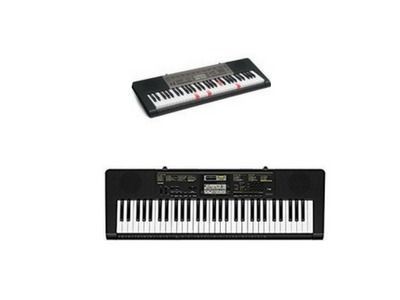
Don’t miss our selection with the best cheap keyboards of the moment:
Practicing a musical instrument requires a certain amount of time each day. You could start practicing for about an hour a day. To play the keyboard look for a comfortable seat, without arms. It can have a backrest but no arms because it would hinder you to play.
Many times it is more important the daily and constant study that the number of hours that you put yourself to play the instrument. You’d better study half an hour a day than three hours a day and then go two days without touching. If you play every day you will see how you progress and get hooked on this wonderful passion that is playing the piano.
Can you learn to play the piano at home without disturbing your neighbors?
Most of the keyboards you can find nowadays are electronic, besides cheap they usually have an exit for headphones. This way you can play and just listen to it without disturbing your neighbors or your roommates.
LESSON 2 – The Proper Posture for Playing the Piano
Maintaining proper posture when playing a piano is vital to avoid future injuries. We are going to spend many hours in front of our piano so it is important to take care of our health in order to be able to enjoy our instrument a lot.
We have to keep our shoulders relaxed and our buttocks as close to the edge of the sidewalk as we can so that we can move correctly along the keyboard. The elbows have to be more or less at the height of the keyboard. That’s why it’s necessary to have a good adjustable stool. In this video it’s explained great:
LESSON 3 – Musical notes and piano keys
Okay, now that you’re in front of a keyboard we’re gonna explain what you’re looking at. You’ll be in front of a keyboard with black and white keys. A real piano has 88 keys, but it’s quite possible that you’re on a 61-key or 32-key keyboard because they’re the most affordable keyboards. Although this is more than enough for the course.
The white keys represent the musical notes do-re-mi-fa-sol-la-si (equivalence to C-D-E-F-G-A-B) and each of the keys receives the name of the key it represents. If a DO (C english system) sounds when a key is pressed, that is the name of that key.
You may be wondering, and what are the black keys? Well, they’re variations of those notes. For example the black key next to a C on the right side is called C#. And it’s a little sharper DO. This is a little more complex but for now you just need to know this.
An octave is an interval of 8 notes. For example DO-RE-MI-FA-SOL-LA-SI-DO is the distance from one DO to another DO. As only these notes exist, this interval is repeated along the keyboard, as can be seen in the following explanatory video:
What’s an octave in music?
In order to give a little support to the course and not to concentrate everything on the same post we have extended this topic in our post about the piano keys and the differences between them. Just in case the video and this text aren’t enough for you. If you have found out well with this text and the video continues reading this post.
LESSON 4 – Our First Scale and Let’s Play!
At this point you already know that they are the keys of a piano and even if you don’t understand many concepts you are already able to start playing notes on the piano. The first thing we’ll do is play an octave from left to right. The notes on the left are the lowest on the piano and the notes on the right are the highest..
When we do this octave we are actually doing what is called a scale. For now, let this concept simply ring a bell. In the following video you will see how the C scale is done, so do it on your keyboard in the same way.
LESSON 5 – Chords, what they are and how they are built
First of all let’s answer the question of what is a chord. One of the wonders of the piano is that we can press several keys at once and they will sound at the same time. The sound produced by pressing several notes at once is what is called a chord. So we can say that a chord is a sound formed by several musical notes sounding simultaneously.
There are many chords but basically the ones you have to learn first are the major chords and the minor chords. These chords are formed by three notes and have certain rules to be built.
It is often said that the major chords are cheerful and the minor chords sound gloomy or sad. We’re going to explain how the major and minor chords of the C-DO scale are formed. View in previous lesson.
What is a tone and a semitone?
They’re units of measure. To guide you we will tell you that between a white key and another also white key that has a black key in between there is a whole tone.
When we have two whites in a row with no black in between, there is only half a tone. Just like between a white and the adjacent black keys there is a semitone of distance. We explain it to you in the following image with the DO-C scale. Also in the following image you have an introduction to the American notation. The English world calls notes by letters. You have the equivalence in the image.
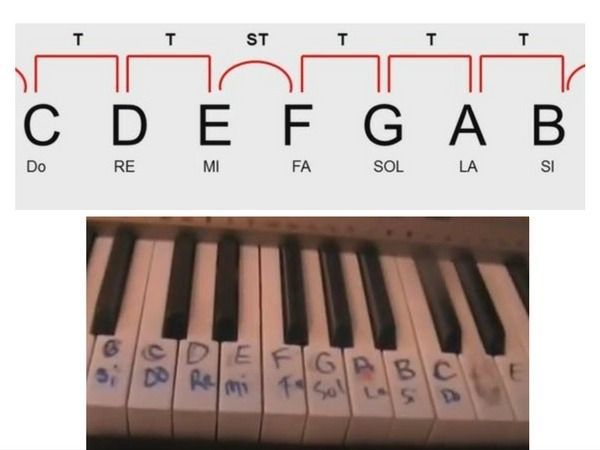
The previous image is vital to understand visually in the piano the distance of the notes in tones and semitones. Once this is understood we can give the pattern to form the major chord of OD which is formed by three notes. The main one is the C itself, the second one is 2 Tones that will be E and the third one that will be a tone and a half of E, so if we have the image it will be G. That is to say, the major chord of C is formed by the C-E-G. All this reading from left to right.
If we want to form the D major chord we would count two tones, from D to E are 1 Tone, from E to F half tone, but as they are two tones we get to black key between F and G, which would be the F#, we already have the second note of the chord. To calculate the third it would be from the F# to count tone and half to the right, we would pass to the white one of the G that you would be half tone, by the black one between G and LA that is another half tone and we would arrive at the A. We already have the full D major chord.
If we set the D major chord to D-F#-A, so that between D and F there are two tones and between F# and A and a half tone. And as you may have noticed when there are white keys together with no black in between, there is a half-tone distance between them.
Well, at this point if you have understood the two examples of E major and C major you are already able to form the major chords, one for each note C-D-E-F-G-A-B but what about the minor ones? Well, they form following another pattern from the original note and we’ll give it to you next
A minor chord is also formed from three notes. And these will be the chords of minor C, minor D, etc. The distance between the first and second note is tone and half the distance between the second note and third 2 tones. The chord of for example LA Minor will be A-C-E.
This course is not intended to overload your brain with music theory. But to get you playing your first song soon. This that we have explained to you is a little the “hard” part of the tutorial. So if you’ve understood, you can go on without a problem. In the following lesson we will give you all calculated major chords and their equivalent in American notation. It’s always good to know. If you have any doubts, we leave you a couple of very useful videos to understand all this.
Lesson 6 – The major and minor chords calculated also with American notation
Major chords:
- C Major: C-E-G, American notation: C
- G Major: G-B-D, American notation: G
- F Major: F-A-C, American notation: F
- C Major: C-E-G, American notation: C
- D Major: D-F#-A, American notation: D
- Bb Major: Bb-D-F, American notation: Bb
- A Major: A-C#-E, American notation: A
- Eb Major: Eb-G-Bb, American notation: Eb
- E major: E-G#-B, American notation: E
- Ab Major: Ab-C-Eb, American notation: Ab
- B Major: B-D#-F#, American notation: B
- Db Major: Db-F-Ab, American notation: Db
- F# Major: F#-A#-C#, American notation: F#
- Gb Major: Gb-Bb-Db, American notation: Gb
- C# Major: C#-E#-G#, American notation: C#
- Cb Major: Cb-Eb-Bb, American notation: Cb
What’s that “b” symbol in Bb?
Well, that symbol represents the flat, which subtracts half a tone from the note. Translated to piano if for example we have the white key “A”, the black key next to the left would be half a low tone. With what we could say Ab, on the other hand if we press the black key of the right it would be to increase half a tone, or to make it half a tone more acute. That black note on the right would be called La# (that symbol means sharp).
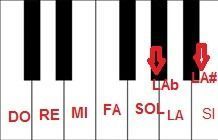
As you might have guessed a La# is the same as a Sib or Bb, they are two ways of calling the same note. Why you don’t need to know these two approaches now, we’re introducing you. It’s just to ring a bell in the future.
Minor Chords
- A Minor: A-C-E, American Notation: Am
- D Minor: D-F-A, American Notation: Dm
- B Minor: B-D-F#, American Notation: Bm
- G Minor: G-Bb-D, American Notation: Gm
- C Minor: C-Eb-G, American Notation: Cm
- C# Minor: C#-E-G#, American notation: C#m
- F Minor: F-Ab-C, American Notation: Fm
- G# Minor: G#-B-D#, American notation: G#m
- Bb Minor: Bb-Db-F, American Notation: Bbm
- D# Minor: D#-F#-A#, American notation: D#m
- Eb Minor: Eb-Gb-Bb, American notation: Ebm
- A# Minor: A#-C#-E#, American notation: A#m
- Ab Minor: Ab-Cb-Eb, American Notation: Abm
LESSON 7 – Right Hand and Left Hand Technique on the Piano
Well, at this point we’ve already understood several concepts. We are aware of what we are seeing on the keyboard, we know what a chord is and we know a few. But how do you use each hand?
The aim of this course is that you start playing the piano as soon as possible and fall in love with it so we will tell you the basic technique. The normal way to start is to make the chord with the left hand and with the right hand to play the melody of the song. As if our left hand were the guitar and our right hand the voice that sings the melody.
It’s the great thing about the piano, which allows us to use both hands and that’s very powerful.
First of all you have to work a little independence of your hands because otherwise you are going to make a mess. It is important that you are able to play a chord with your left hand and at the same time play a melody with your right hand. At the same time you do everything in a rhythm.
Don’t get overwhelmed ;)! The important thing about music is to start with very simple exercises and then progressively increase the difficulty. If you start with very difficult things you will get a little desperate but if you do things in the right order you will see how you progress without almost realizing it.
First it begins by the following video in which very basic exercises of fingering and independence of the hands are raised. Work them for a few days until you have them well internalized. In this video you will find exercises for the left hand, exercises to release the hand and everything you need to educate the hand of a piano beginner.
Also watch this video that will tell you about the proper technique to play. How to put your fingers, the right curvature and the perfect hand position.
What we want with this course is to gather the right material in the right order and not go crazy with all the information that there is Internet. We love the exercise that comes after the previous video and here we put it.
The problem with many courses on Youtube is that they jump from one video to another at a very high level, but don’t worry, we’ll select them for you and put them in order so you don’t despair. The following technical exercises will be great for you to start playing something meaningful on the piano. But do not forget before practicing for several days the exercises of independence of hands of the first video of the section.
LESSON 8 – Let’s play our first songs on the piano
Well, already at this point we should be able to play our first songs or themes. Of course they’ll be simple. But now we can think, I’m playing music on a piano! And that sure motivates us to keep going.
In this video you will end playing an easy piano song.
Well, if you’ve managed to play the song you might dare to play a classic piano beginner. Beethoven’s “Fur Elisa”. Although at the beginning for a low quality video do not be fooled and look at the whole video, because what is important and great is how well it decomposes each part of the song. The video explains very well what you have to do with your left hand and your right hand.
It is very important for this video that you have practiced for days the exercises of lesson 7, otherwise it will cost you much to touch the subject and that is not the way to learn. You must have the basis of independence from well-trained hands.
Well, in this section we have already finished the course for beginners and we congratulate you if you have come this far. You still have a lot to learn but we hope that what you learn will inspire you and motivate you to never let the music out of your life. In the following lesson we give you some extra content so that you can deep in your knowledge of music theory.
LESSON 9 – Extras of harmony, inversions of chords and degrees
During the course we have guided you so that you can play the piano without knowledge of musical theory. It is true that we have explained certain basic concepts such as that it is a tone and a semitone. Or how to build a major or minor chord.
If you have reached this lesson we understand that you want to go a little further. So we’re going to give you some content so that you can go deeper into the chords and learn new combinations.
What is a scale and the degrees of a scale?
The scales are groups of 8 notes, in this course we have learned the simplest that is C, composed by the notes C-D-E-F-G-A-B-C. But let’s go deeper into the structure of scales and learn the concept of degrees.
Within the scales there are more important notes than others, the tonic is the most important and then there are more notes with other names. The chords are built from these concepts. So look at the following video where this is explained very well.
Well, once we understand the above concepts we can move on to talk about chord inversions, which is a very useful resource to expand our vocabulary on the piano. In the following video we will learn the rules for calculating these investments. It starts very simply by explaining the C-DO major chord (major DO-C triad) and the possible investments for this chord.
If you liked this course don’t hesitate to share it with your friends or people who might find it useful on social networks. Thank you very much for reading us and we invite you to see all the contents of our website, which we are sure you will find interesting.
Vote if you liked this article 🙂
Top Roland Digital Pianos
The best Roland keyboards
Roland is one of the most prestigious brands of musical instruments worldwide, its variety of keyboards makes it an option to consider for virtually any type of musician. This guide will show you a selection of the best Roland keyboards, including alternatives for virtually any keyboardist or pianist.
The keyboards shown in this guide cost more than 250 euros, including models ideal for beginners, pianists and synthesizers for music composition and production.
Roland FP 10
The Roland FP is Roland’s new choice to compete with the Yamaha P45. The Roland FP 10 comes to compete in the 400 euro portable counterbalanced piano range.
They stand out for their features at a very balanced price:
- 88 weighted keys
- 96-note polyphony, which are the notes that can be played at the same time
- 15 piano sounds and effects.
- 2 split zones to divide your keyboard into several instruments
- Layer function to combine piano and strings for example
- Headset output
- Includes sustain pedal
- USB MIDI and Bluethooth MIDI 4.0 output
- Weight 12.3 kg
- Dimensions (W x D x H): 1284 x 258 x 140 mm
- 6W speakers
Here’s a video for you to hear what the Roland FP 10 sounds like
The Roland FP 10 is a very balanced option and I really recommend it if you want a portable digital piano at a good price. If you have 100 euros more of course I will always recommend the Roland FP 30 to its big brother because it is the best selling portable piano at the moment. If you want to go deeper into these comparisons don’t miss my review of the Roland FP 10.
You can buy it safely in the following stores:
I’m sure you’ll be interested in…
- Ranking with the best digital pianos in quality-price ratio
- The cheapest musical keyboards for beginners
- Learn piano by yourself and for free
Roland Go Piano
The Go Piano is one of the best alternatives available in the market that compete within the 61-key pressure-sensitive and responsive portable keyboards without counterweight.
The portability of this model is one of its main virtues as it weighs only 3.9kg, measures 87.7cm x 27.1cm x 8.2cm and has a power option with 6 AA batteries (duration of 6 hours on average)
This Roland model has 40 voices, a 128 note polyphony, which is quite good for the price and features of this model, has option for sustain pedal, bluetooth and connectivity with applications for study and music production of Roland (although it should be noted that this model is not the best alternative for music production)
The sound quality is good, below is a video where you can see it:
The Roland Go Piano is an excellent alternative for those who require a portable keyboard with good features, sound quality, portability and connectivity are factors to highlight.
Don’t miss the in-depth review of the Roland Go Piano either.
What is the price and where can you buy the Roland Go Piano?
The usual price of this model is 320 euros, there are options where you can buy it at a better price, we recommend two alternatives of virtual store that offer the Roland Piano Go at the best price available in the market:
Roland FP30
The Roland FP 30 is an excellent alternative for beginner pianists and those who want a very good quality digital piano for less than 600 euros. The 88 weighted hammer action keys , 128-voice polyphony, 35 high quality voices, and the included sustain pedal makes this model a good choice pianists. A highlight of the FP30 is the sound quality, as the 35 voices included perform well above the average of competitors in the price range. The sound quality of the Roland FP30 is shown below.
What is the price and where can you buy the Roland FP30?
The regular price of the Roland FP30 is 685 euro, however, we leave you two alternatives where you can get it for less than 600 euro:
Roland FP90
The Roland FP90 could be said to be the big brother of the FP30, this model has more advanced features, ideal for any pianist.
The functions of the Roland FP90 are ideal for practicing piano, as this model supports triple pedal, has 88-key keyboard made of plastic and wood with exhaust technology (very similar to an acoustic piano) and has a wide variety of effects, and 350 sounds.
In terms of connectivity, the FP90 has it all: MIDI, USB type A and B, online input and output, Bluetooth, and sustain pedal port. The highlight of the FP90 is the sound quality, with full polyphony using piano and organ sounds, and 384 voices-polyphony for the other sounds. Below is a video with the sound quality of FP90:
The sound of the FP90 is customizable in the piano sound, giving a great advantage over most of the competitors.
What is the price and where can you buy the Roland FP90 ?
The usual price of the Roland FP90 is 1980 euro, however in the following options you could get it for less than 1700 euro:
Roland RD 2000
The Roland RD 2000 is a high quality keyboard totally focused on music production, although it is also an excellent alternative for those who perform live.
The best function of the RD 2000 is the quality of the 88 weighted hammer action keys (made of wood and plastic), the 2 sound generators that allow for a complete polyphony in the piano and organ voice, and the 1100 sounds available on this model.
The functions focused on musical production that this model has are quite interesting, since it has 20 controllers to make adjustments, 300 programs, 200 patterns of rhythms and a great variety of effects.
The RD 2000 has an advanced connectivity that includes XLR, MIDI ports, 2 pedal inputs, USB A and B, etc. It is necessary to emphasize that this model does not have integrated speakers so you will need an amplifier.
What is the price and where can you buy the Roland RD 2000?
The Roland RD 2000 is a specialized keyboard that you can hardly find in a local instrument store. However, we have an option where you can buy it at the best price available in the market:
Roland FA 06
The Roland FA 06 is one of Roland’s iconic models. This model features 61 keys with dynamic sensitivity (not weighted), 2000 voices with SuperNatural engine and a color LCD screen.
The FA 06 is an excellent alternative for those who want to make music production and do not require 88 keys, as the functions of this model are more around sampling, a point to highlight are the 16 pads (with 4 banks each), and inputs for guitar and microphone.
Roland offers complete connectivity in this model, including USB, SD, pedal connection, MIDI, iPad integration, and microphone/guitar input. The Roland FA 06 is a model focused on musical production, however, it is possible for a pianist to prefer the full keyboard and the features offered by the RD 2000.
What is the price and where can you buy the Roland FA 06?
The FA 06 is a complicated model to get in a local store, however, we give you two alternatives where you can buy it at the best available price:
Roland Juno DS 61 and DS 88
The DS Juno 61 is a classic Roland synthesizer, the first model of this line came out in 1982. This model has 61 sensitive keys, although there is also the DS 88 model which has a full keyboard.
The Roland DS Juno 61 features a 128-voice polyphony, 1200 factory sounds and 256 user-created sound spaces, as well as 30 drum kits and 64 preset banks.
The main advantage of this model is the customization, since it is possible to combine sounds in dual mode or Split and add effects to perform music production.while it is true that the Juno DS 61 is not comparable to the RD 2000, it is also true that its synthesizer characteristics make it a model to consider for those who want an option dedicated entirely to music production.
What is the price and where can you buy the Roland DS Juno 61?
The best alternative to buy the DS Juno 61 is through a virtual store, we give you 3 options where you can buy it at the best price available in the market:
I hope you liked this article. If you want to know about digital pianos of more brands, do not miss our selection with the best digital pianos. You also have our selection with the cheapest and most convenient keyboards.
Vote pls!>>