
- Home
- Author's Archive:

Review MIDI keyboard Alesis Vortex Wireless 2. Where to buy it?
Alesis is a company founded in the United States in 1980 that designs and markets electronic musical instruments, digital audio processors, audio mixers, drum amplifiers, digital audio interface amplifiers, recording equipment, drum machines, professional audio and electronic percussion products. I’ll tell you how this post is built. First I list the features of this Alesis Vortex Wireless 2 keyboard. Then you have a video or two, purchase links and useful comments from other users and then you have one of the most useful parts; comparison tables with similar keyboards so you can compare.
- Controller with an acceleration sensor
- Portable Performance-Keyboard with shoulder strap
- 37 keys with sensitive dynamics and Aftertouch
- Eight Pads with dynamic sensitivity and RGB lighting
- Eight illuminated faders for volume or parameter adjustment
- Programmable tilt sensor with On/Off switch
- Volume controller
- Pitch-Bend Wheel
- Touchstrip
- Sustain switch and octave on the handle
- USB connection
- Standard 5-pin DIN MIDI connection
- USB cable-free connection with Mac or PC
- Powered by USB port or 4 AA batteries
- Size: 89,4 x 25,4 x 7,4 cm
- Weight: 2.9 kg
- Software: Hybrid 3, Loom 2, Vacuum Pro and Xpand!2 from AIR Music Technology, TimewARP 2600, as well as Ableton Live Lite

In other control functions we found: Eight Pads with dynamic sensitivity and RGB illumination, Eight illuminated faders for volume or parameter adjustment, octave up/down buttons, sustain button, volume controller, pitch bend wheel and more.
Connections: USB connection and MIDI output. Close to these are the shoulder strap pins. And it includes the software licenses: Hybrid 3, Loom 2, Vacuum Pro and Xpand!2 from AIR Music Technology, TimewARP 2600, as well as Ableton Live Lite
Now that we have seen the features of this Alesis Vortex Wireless 2 keyboard look at these related videos to learn more.
Posts you may be interested in
- Ranking with the best midi keyboards
- My selection of cheap midi keyboards.
- Best MIDI Software to work with.
- MIDI Basic Guide.
- Midi Keyboards by Brand.
Alesis Vortex Wireless 2 vs Akai LPK 25 wireless
The Alesis Vortex Wireless 2 MIDI Keyboard is priced at €222/£195/$219 while the Akai LPK 25 wireless is priced at €55/£49/$58. Let’s move on to the face-to-face:
- The Alesis Vortex Wireless 2 offers 37 sensitive full-size keys with aftertouch. The Akai LPK 25 wireless offers 25 mini-sensitive keys.
- The Alesis Vortex Wireless 2 offers 8 Pads with dynamic sensitivity and RGB illumination, 8 illuminated faders for volume or parameter adjustment, octave up/down buttons, sustain button, volume control, pitch bend wheel and more. When the Akai LPK 25 wireless offers arpeggiator buttons, octave up/down, tap tempo and Bluetooth connection.
- In connections, the Alesis integrates USB connection and MIDI output, while the Akai has a USB connection and sustain pedal input. Both have the ability to be used wirelessly, via a Bluetooth connection.
- The Alesis includes the following software licenses: Hybrid 3, Loom 2, Vacuum Pro and Xpand!2 from AIR Music Technology, TimewARP 2600, as well as Ableton Live Lite. And the Akai LPK 25 wireless includes PC and Mac compatible editing software.
Let’s put the features of these keyboards in a table so you can compare
|
Alesis Vortex Wireless 2 |
Akai LPK 25 wireless |
|---|---|
|
|
In our first comparison, we have two slightly different but relevantly similar MIDI controllers. On the one hand, the Alesis Vortex Wireless 2 which offers 37 sensitive full-size keys with aftertouch, Eight Pads with dynamic sensitivity and RGB illumination, Eight illuminated faders for volume or parameter adjustment, Octave up/down buttons, Sustain button, volume controller, Pitch bend wheel. And on the other hand, the Akai LPK 25 wireless, a more minimalist controller, offering 25 speed-sensitive mini keys, arpeggiator buttons, octave up/down, tap tempo and Bluetooth connection.
The similarity is that both have a wireless function, i.e. they can be used without cables, thanks to their Bluetooth connection. However, the Alesis Vortex Wireless 2 outperforms the Akai in every way, having more keys and more and better control functions, so the price goes up because of what it offers. The best option will be the Alesis, but if the Akai meets your expectations and needs, go for it.
And here is a video of the Akai LPK 25 wireless keyboard
If you want to know more about this option, click on the following link to see the Akai LPK 25 wireless review.
Alesis Vortex Wireless 2 vs M-Audio Keystation 88 MkII
The Alesis Vortex Wireless 2 MIDI Keyboard is priced at €222/£195/$219 when the M-Audio Keystation 88 MkII is priced at €205/£177/$203. Let’s move on to the face-to-face:
- The Alesis Vortex Wireless 2 offers 37 full-size sensitive and aftertouch keys. The M-Audio Keystation 88 MKII offers 88 full-size keys with sensitivity.
- The Alesis Vortex Wireless 2 offers 8 Pads with dynamic sensitivity and RGB illumination, 8 illuminated faders for volume or parameter adjustment, octave up/down buttons, sustain button, volume control, pitch bend wheel, and more. When the M-Audio Keystation 88 MKII offers: modulation and pitch bend wheels, octave buttons, transport buttons, and a volume fader.
- In connections, the Alesis integrates USB and MIDI output, and Bluetooth connection, while the M-Audio Keystation 88 MKII integrates a sustain pedal and expression pedal input, an external power input, MIDI output, and USB connection.
- The Alesis includes the following software licenses: Hybrid 3, Loom 2, Vacuum Pro and Xpand!2 from AIR Music Technology, TimewARP 2600, and Ableton Live Lite. And the M-Audio Keystation 88 MKII includes the Ableton Live Lite software licenses and the SONiVOX Eighty-Eight Ensemble plug-in.
Let’s put the features of these keyboards in a table so you can compare
|
Alesis Vortex Wireless 2 |
M-Audio Keystation 88 MkII |
|---|---|
|
|
In this comparison, we have two different MIDI controllers in most functions. On the one hand the already analyzed Alesis Vortex Wireless 2 with its features and functions that we already know, and on the other hand the M-Audio Keystation 88 MkII that offers 88 keys with somewhat minimalist functions, we only find modulation and pitch bend wheels, up and down octave buttons, transport buttons (rec, play, pause, stop, etc) and a fader for the volume.
If we need a MIDI controller for the stage, the Alesis will be our best option thanks to its Keytar design and its Bluetooth connection that allows it to work without cables. If, on the other hand, you need a MIDI controller with 88 keys that is usually in one place, the M-Audio will be your best choice. Both are good for what they offer.
And here’s a video of the M-Audio Keystation 88 MkII
If you want to know more about this option, click on the following link to see the M-Audio Keystation 88 MkII review
Alesis Vortex Wireless 2 vs Novation Impulse 49
The Alesis Vortex Wireless 2 MIDI Keyboard is priced at €222/£195/$219 and the Novation Impulse 49 is priced at €223/£205/$228, but the difference is so small that this may vary, depending on which shop you ask. Let’s go to this interesting face-to-face:
- The Alesis Vortex Wireless 2 offers 37 full-size sensitive and aftertouch keys. The Novation Impulse 49 offers 49 full-size sensitive, semi-sensitive and aftertouch keys.
- The Alesis Vortex Wireless 2 offers Eight Pads with dynamic sensitivity and RGB illumination, Eight illuminated faders for volume or parameter adjustment, octave up/down buttons, sustain button, volume control, pitch bend wheel and more. When the Novation Impulse 49 offers 8 backlit pads, 9 assignable faders, 8 assignable knobs, 6 transport keys, octave up/down, and pitch bend and modulation wheels.
- In connections, the Alesis integrates USB connection and MIDI output, and Bluetooth connection while the Novation Impulse 49 integrates USB connection, sustain and expression pedal inputs, and MIDI input and output.
- The Alesis includes the following software licenses: Hybrid 3, Loom 2, Vacuum Pro and Xpand!2 from AIR Music Technology, TimewARP 2600, as well as Ableton Live Lite. And the Novation Impulse 49 includes Xcite+ Software Pack licenses, with Ableton Live Lite.
Let’s put the features of these keyboards in a table so you can compare
|
Alesis Vortex Wireless 2 |
Novation Impulse 49 |
|---|---|
|
|
In this comparison, we have on the one hand the Alesis Vortex Wireless 2, and on the other hand, the Novation Impulse 49 which offers 49 full-size keys with sensitivity, semi-weight and aftertouch, 8 backlit pads, 9 assignable faders, 8 assignable knobs, 6 transport keys, octaves up/down, and pitch bend and modulation wheels.
Very similar to the last comparison, if we need a MIDI controller for the stage, the Alesis will be our best choice thanks to its Keytar design and its Bluetooth connection that allows it to work without cables. If, on the other hand, we need a stable MIDI controller, and perhaps with a greater number of control functions, the Novation Impulse 49 will be our choice.
Here is a video of the Novation Impulse 49 keyboard
If you want to know more about this option, click on the following link to see the Novation Impulse 49 review
Alesis Vortex Wireless 2 vs M-Audio Oxygen 61 Mk4
The Alesis Vortex Wireless 2 MIDI Keyboard is priced at €222/£195/$219 and the M-Audio Oxygen 61 Mk4 is priced at €155/£133/$154, with a difference between them of $67. Let’s go head to head:
- The Alesis Vortex Wireless 2 offers 37 sensitive full-size keys with aftertouch. The M-Audio Oxygen 61 Mk4 offers 61 full-size keys with sensitivity.
- The Alesis Vortex Wireless 2 offers Eight Pads with dynamic sensitivity and RGB illumination, Eight illuminated faders for volume or parameter adjustment, octave up/down buttons, sustain button, volume control, pitch bend wheel and more. When the M-Audio Oxygen 61 Mk4 offers 8 pads, 9 assignable faders, 8 assignable knobs, 4 transport keys, octaves up/down, and pitch bend and modulation wheels.
- In connections, the Alesis integrates USB and MIDI output, and Bluetooth connection, while the M-Audio Oxygen 61 Mk4 integrates USB and sustain pedal input.
- The Alesis includes the following software licenses: Hybrid 3, Loom 2, Vacuum Pro and Xpand!2 from AIR Music Technology, TimewARP 2600, as well as Ableton Live Lite. And the M-Audio Oxygen 61 Mk4 includes licenses for Ableton Live Lite and SONiVOX Twist Synth.
Let’s put the features of these keyboards in a table so you can compare
|
Alesis Vortex Wireless 2 |
M-Audio Oxygen 61 Mk4 |
|---|---|
|
|
In this comparison, we have on the one hand the Alesis Vortex Wireless 2, and on the other hand, the M-Audio Oxygen 61 Mk4 offering 61 full-size keys with sensitivity, 8 pads, 9 assignable faders, 8 assignable knobs, 4 transport keys, octaves up/down, and pitch bend and modulation wheels.
Again, if you need a MIDI controller for the stage, the Alesis will be your best choice thanks to its Keytar design and its Bluetooth connection that allows it to work without cables. If, on the other hand, we need a stable MIDI controller, and perhaps a larger number of control functions, the M-Audio Oxygen 61 Mk4 will be our choice.
Here is a video of the M-Audio Oxygen 61 Mk4 keyboard
If you want to know more about this option, click on the following link to see the M-Audio Oxygen 61 Mk4 review.
Alesis Vortex Wireless 2 vs Arturia KeyLab Essential 61
The Alesis Vortex Wireless 2 MIDI Keyboard is priced at €222/£195/$219 and the Arturia KeyLab Essential 61 is priced at €239/£215/$239, with a small difference of €17. The face-to-face:
- The Alesis Vortex Wireless 2 offers 37 sensitive full-size keys with aftertouch. The Arturia KeyLab Essential 61 offers 61 sensitive full-size keys with aftertouch.
- The Alesis Vortex Wireless 2 offers Eight Pads with dynamic sensitivity and RGB illumination, Eight illuminated faders for volume or parameter adjustment, octave up/down buttons, sustain button, volume control, pitch bend wheel and more. When the Arturia KeyLab Essential 61 offers 1 pushable encoder, 8 sensitive pads, 9 assignable knobs, transport keys, octave up/down, and pitch bend and modulation wheels.
- In connections, the Alesis integrates USB connection and MIDI output, and Bluetooth connection while the Arturia KeyLab Essential 61 integrates USB connection, sustain pedal input, external power supply input and MIDI output.
- The Alesis includes the following software licenses: Hybrid 3, Loom 2, Vacuum Pro and Xpand!2 from AIR Music Technology, TimewARP 2600, as well as Ableton Live Lite. And the Arturia KeyLab Essential 61 includes Arturia Analog Lab 2 software, Ableton Live Lite and UVI Grand Piano.
Let’s put the features of these keyboards in a table so you can compare
|
Alesis Vortex Wireless 2 |
Arturia KeyLab Essential 61 |
|---|---|
|
|
In this comparison, we have on the one hand the Alesis Vortex Wireless 2, and on the other hand, the Arturia KeyLab Essential 61 which offers 61 full-size keys with sensitivity and aftertouch, 1 pressable encoder, 8 sensitive pads, 9 assignable knobs, transport keys, octaves up/down, and pitch bend and modulation wheels.
Again, if you need a MIDI controller for the stage, the Alesis will be your best choice thanks to its Keytar design and its Bluetooth connection that allows it to work without cables. If on the other hand we need a stable MIDI controller, and with a larger number of control functions, the Arturia KeyLab Essential 61 will be our choice.
Here is a video of the Arturia KeyLab Essential 61 keyboard
If you want to know more about this option, click on the following link to see the Arturia KeyLab Essential 61 review.
Which is the best of these MIDI keyboards if I am a beginner on a low budget?
While the answer to this question lies mostly in what specific need you have, for example, if you want to have a keyboard with the widest possible note range, or if you want to have as many control functions as possible, or perhaps a mix between the two, that is without leaving behind the different connections and software licenses that most MIDI controllers offer, we will give an objective opinion according to our experience in music production and thus also with the price that the controllers demand, a kind of value for money.
In this post, we find MIDI controllers with an average price of 180 euros, and as a star product we can nominate the M-Audio Oxygen 61 Mk4 which is a very balanced MIDI controller, offering 61 keys and certain control functions: pads, knobs and faders all assignable, as well as transport buttons and auto-mapping function, which allows you to assign a function to each button of the controller. We also have a sustain pedal and certain licenses that are highly valued by beginners.
Where to buy the Alesis Vortex Wireless 2 keyboard
Thomann
- Free Shipping.
- Full warranty. If you have any problems, they take care of everything.
- 100% reliable payment.
- A leader in trouble-free shipping.
- Usually the Best price.
- Best Reputation: They are the leading online store in Europe and have the best catalog and information.
Amazon
- Free Shipping and the possibility of shipping in one day with Amazon Premium.
- Full Guarantee but they are no experts in music equipment.
- Sometimes a better price.
- He’s got worse stock than Thomann.
Also, look at these models with a similar price and features:
- Novation Launchkey Mini MK3
- Akai MPK mini Mk2
- Akai MPK miniplay
- Roli Lightpad Block M Studio Ed.
- Arturia MiniLab MKII
- Roli Beatmaker Kit
- Novation Impulse 25
- Akai MPK mini MK2 white
- Alesis V25
- CME Xkey Air 25
- IK Multimedia iRig Keys I/O 25
- Akai APC Keys 25
- Akai LPK 25
- M-Audio Code 25 black
- Native Instruments Komplete Kontrol A25
- Novation Launchkey Mini MK2
- Alesis V mini
- Arturia MicroLab Black
- Akai LPK 25 wireless
- Akai MPK mini Limited Black
- Arturia MiniLab MKII Inverted Edition
- M-Audio Oxygen 25 Mk4
- Korg nanoKEY Studio
- Swissonic EasyKey 25
- Korg nanoKEY 2 black
- Korg nanoKEY 2 Limited Orange
- Korg nanoKEY 2 Limited Blue
- Akai MPK mini MK2 white – AIEP3 Bdl
- Nektar Impact LX25+
- Novation Launchkey 25 MK2
- Alesis Q25
- Akai MPK 225
- Korg microKEY 25
- Miditech Midistart Music 25
- Alesis VI25
- Korg nanoKEY 2 white
- Arturia MicroLab Blue
- Nektar SE25
- Korg microKEY Air 25
- IK Multimedia iRig Keys 25
- Midiplus X2 mini
- Icon iKeyboard 3X
- Keith McMillen K-Board
- CME Xkey 25 silver
- Native Instruments Komplete Kontrol M32
- Alesis V49
- Arturia Keystep Black Edition
- Swissonic EasyKey 49
- Arturia Keystep
- Arturia KeyLab Essential 49
- Nektar Impact LX49+
- M-Audio Code 49 Black
- IK Multimedia iRig Keys 2 Pro
- M-Audio Keystation 49 MK3
- M-Audio Keystation Mini 32 MK3
- Novation Impulse 49
- Nektar Impact GX 49
- Novation Launchkey 49 Mk2
- Native Instruments Komplete Kontrol A49
- M-Audio Oxygen 49 Mk4
- Alesis Q49 Keyboard Controller
- Roland A-300 Pro
- IK Multimedia iRig Keys I/O 49
- Alesis VI49
- Midiplus AK490
- Alesis Vortex Wireless 2
- M-Audio Axiom Air Mini 32
- Alesis Vortex Wireless 2 Network
- IK Multimedia iRig Keys 37 Pro
- Arturia KeyLab Essential 49 BE
- Haken Audio Continuum Half Size
- CME Xkey 37 LE
- IK Multimedia iRig Keys Pro
- Korg microKEY 49 MkII
- IK Multimedia iRig Keys 2
- Miditech Midistart Music 49
- Roland A-49 Black
- Korg microKEY 37 MkII
- Swissonic ControlKey 49
- Roland A-500 PRO
- Nektar SE49
- Korg microKEY Air 37
- Korg microKEY Air 49
- Roland A-49 White
- Nektar Panorama T4
- Miditech Garagekey mini
- Miditech Minicontrol-32
- Midiplus X3 mini
- Miditech i2-Control 37 Black
- Icon iKeyboard 4X
- Miditech i2-mini 32
- Midiplus X4 mini
- Miditech i2-mini 32 Bluetooth
- Icon iKeyboard 5X
- Acorn Masterkey 49
- M-Audio Code 61 Black
- Arturia KeyLab Essential 61
- Nektar Impact GX 61
- M-Audio Keystation 61 MK3
- Alesis V61
- Native Instruments Komplete Kontrol A61
- Swissonic EasyKey 61
- M-Audio Oxygen 61 Mk4
- Roland A-800 Pro
- Korg microKEY Air 61
- GSi DMC-122
- Nektar Impact LX61+
- Alesis VI61
- Novation Launchkey 61 MK2
- Icon iKeyboard 6X
- Acorn Masterkey 61
- Miditech i2-61 Black Edition
- Midiplus X6 mini
- Korg microKEY 61 MkII
- Midiplus X-6 II
- Viscount Physis Piano K5 EX
- M-Audio Keystation 88 MkII
- Kawai VPC1
- Doepfer LMK2+ 88 GH
- Doepfer LMK4+ 88 GH black
- Swissonic ControlKey 88
- Viscount Physis Piano K4 EX
- Doepfer LMK4+ 88 GH grey
- Nektar Impact LX88+
- Haken Audio Continuum Full Size
- Midiplus Stage 88
- Studiologic Numa Concert
- Icon iKeyboard 8X
- Doepfer LMK2+ 88 GH without Case
- Midiplus X-8 II
- Doepfer LMK4+ 88 GH GR without Case
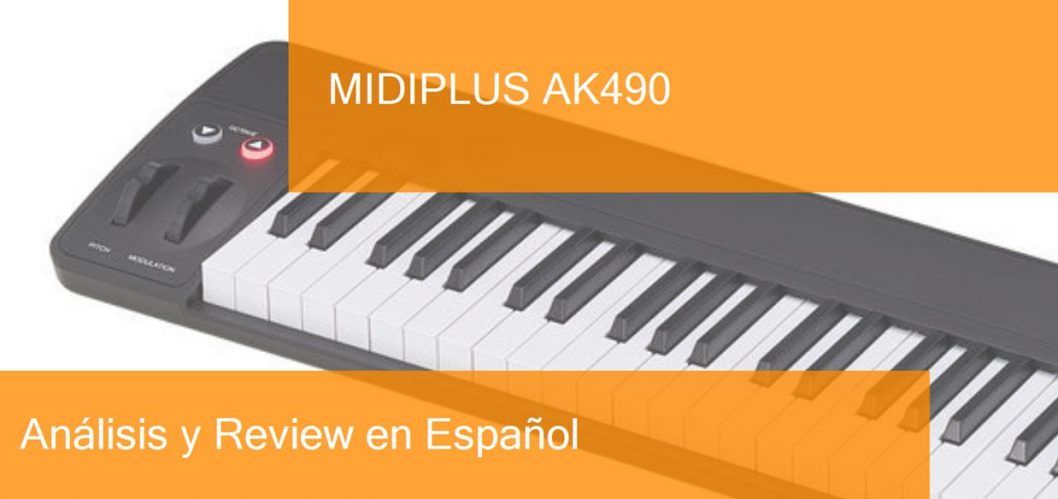
Review MIDI keyboard Midiplus AK490. Where to buy it?
I’ll tell you how this post is built. First I list the features of the Midiplus AK490 keyboard. Then you have a video or two, purchase links and useful comments from other users and then you have one of the most useful parts; comparison tables with similar keyboards so you can compare.
- 49 Velocity-sensitive keys
- Pitch fold and modulation wheel
- Octave selector button
- 6.3 mm Jack input for sustain pedal (The most important pedal of a piano or keyboard is the sustain pedal and is used to keep the note playing even if you stop pressing the key.) (maybe not included)
- Powered via USB or batteries (6 x AA batteries)
- Plug & Enjoy for Mac and PC
- USB-B port
- midi (MIDI allows you to do such wonderful things as connect the keyboard to the computer, record a soundtrack and with certain programs pass with a click what you have played to musical notes in a score. MIDI tracks store information from musical notes) USB output
- MIDI keyboard production
- Dimensions: 830 x 255 x 70 mm
- body weight: 3.2 kg

Now that we’ve seen the features of this keyboard Midiplus AK490 watch these related videos to learn more.
Post you may be interested in
- Ranking with the best midi keyboards
- My selection of cheap midi keyboards.
- Best MIDI Software to work with.
- MIDI Basic Guide.
- Midi Keyboards by Brand.
Some comments from people who come to the forum about this model:
Comment:
I was in question about the responsivenes with this item as it had been the cheapest choice on Thomann, nonetheless it responds with no lagg at all. It really is incredibly enjoyable and smooth to play! I make use of it with Pianissimo and I’m learning just how to play Piano it is positively addicting about it and! Thank you Midiplus and Thomann! <3 Use with Ableton is easy that can also be super the response is lagg-free completely, once again I am truly astonished by the quality of this product. Also the secrets are hammer-action and truly assimilate a Piano. For such a price-range you will not find an improved hammer-action midikeyboard with 49 keys. This also thing is big – it’s nearly one and a half meter very long.
Midiplus AK490 vs Akai MPK mini Mk2
The keyboard Midiplus AK490is usually 31 € cheaper than Akai MPK mini Mk2, but the difference is so small that this can vary..
And then a video of the keyboard
|
Midiplus AK490 |
Akai MPK mini Mk2 |
|---|---|
|
|
And then a video of the keyboardAkai MPK mini Mk2
If you want to know more about this option, click on the following link to see the Akai MPK mini Mk2 review
Midiplus AK490 vs Akai LPK 25
The keyboard Midiplus AK490 is usually 13 € more expensive than Akai LPK 25, but the difference is so small that this can vary..
And then a video of the keyboard
|
Midiplus AK490 |
Akai LPK 25 |
|---|---|
|
|
And then a video of the keyboardAkai LPK 25
If you want to know more about this option, click on the following link to see the Akai LPK 25 review
Midiplus AK490 vs Swissonic EasyKey 49
The keyboard Midiplus AK490is usually 12 € cheaper than Swissonic EasyKey 49, but the difference is so small that this can vary..
And then a video of the keyboard
|
Midiplus AK490 |
Swissonic EasyKey 49 |
|---|---|
|
|
And then a video of the keyboardSwissonic EasyKey 49
If you want to know more about this option, click on the following link to see the Swissonic EasyKey 49 review
Midiplus AK490 vs Arturia Keystep
The keyboard Midiplus AK490is usually 54 € cheaper than Arturia Keystep.
And then a video of the keyboard
|
Midiplus AK490 |
Arturia Keystep |
|---|---|
|
|
And then a video of the keyboardArturia Keystep
If you want to know more about this option, click on the following link to see the Arturia Keystep review
Where to buy the keyboard Midiplus AK490
Amazon
- Free Shipping and possibility of shipping in one day with Amazon Premium.
- Full Guarantee but they are no experts in music equipment.
- Sometimes better price.
- He’s got worse stock than Thomann.
Thomann
- Free Shipping.
- Full warranty. If you have any problems, they take care of everything.
- 100% reliable payment.
- Leader in trouble-free shipping.
- Usually Best price.
- Best Reputation: They are the leading online store in Europe and have the best catalogue and information.
Also look at these models with a similar price and features:
- Novation Launchkey Mini MK3
- Akai MPK mini Mk2
- Akai MPK miniplay
- Roli Lightpad Block M Studio Ed.
- Arturia MiniLab MKII
- Roli Beatmaker Kit
- Novation Impulse 25
- Akai MPK mini MK2 white
- Alesis V25
- CME Xkey Air 25
- IK Multimedia iRig Keys I/O 25
- Akai APC Keys 25
- Akai LPK 25
- M-Audio Code 25 black
- Native Instruments Komplete Kontrol A25
- Novation Launchkey Mini MK2
- Alesis V mini
- Arturia MicroLab Black
- Akai LPK 25 wireless
- Akai MPK mini Limited Black
- Arturia MiniLab MKII Inverted Edition
- M-Audio Oxygen 25 Mk4
- Korg nanoKEY Studio
- Swissonic EasyKey 25
- Korg nanoKEY 2 black
- Korg nanoKEY 2 Limited Orange
- Korg nanoKEY 2 Limited Blue
- Akai MPK mini MK2 white – AIEP3 Bdl
- Nektar Impact LX25+
- Novation Launchkey 25 MK2
- Alesis Q25
- Akai MPK 225
- Korg microKEY 25
- Miditech Midistart Music 25
- Alesis VI25
- Korg nanoKEY 2 white
- Arturia MicroLab Blue
- Nektar SE25
- Korg microKEY Air 25
- IK Multimedia iRig Keys 25
- Midiplus X2 mini
- Icon iKeyboard 3X
- Keith McMillen K-Board
- CME Xkey 25 silver
- Native Instruments Komplete Kontrol M32
- Alesis V49
- Arturia Keystep Black Edition
- Swissonic EasyKey 49
- Arturia Keystep
- Arturia KeyLab Essential 49
- Nektar Impact LX49+
- M-Audio Code 49 Black
- IK Multimedia iRig Keys 2 Pro
- M-Audio Keystation 49 MK3
- M-Audio Keystation Mini 32 MK3
- Novation Impulse 49
- Nektar Impact GX 49
- Novation Launchkey 49 Mk2
- Native Instruments Komplete Kontrol A49
- M-Audio Oxygen 49 Mk4
- Alesis Q49 Keyboard Controller
- Roland A-300 Pro
- IK Multimedia iRig Keys I/O 49
- Alesis VI49
- Midiplus AK490
- Alesis Vortex Wireless 2
- M-Audio Axiom Air Mini 32
- Alesis Vortex Wireless 2 Red
- IK Multimedia iRig Keys 37 Pro
- Arturia KeyLab Essential 49 BE
- Haken Audio Continuum Half Size
- CME Xkey 37 LE
- IK Multimedia iRig Keys Pro
- Korg microKEY 49 MkII
- IK Multimedia iRig Keys 2
- Miditech Midistart Music 49
- Roland A-49 Black
- Korg microKEY 37 MkII
- Swissonic ControlKey 49
- Roland A-500 PRO
- Nektar SE49
- Korg microKEY Air 37
- Korg microKEY Air 49
- Roland A-49 White
- Nektar Panorama T4
- Miditech Garagekey mini
- Miditech Minicontrol-32
- Midiplus X3 mini
- Miditech i2-Control 37 Black
- Icon iKeyboard 4X
- Miditech i2-mini 32
- Midiplus X4 mini
- Miditech i2-mini 32 Bluetooth
- Icon iKeyboard 5X
- Acorn Masterkey 49
- M-Audio Code 61 Black
- Arturia KeyLab Essential 61
- Nektar Impact GX 61
- M-Audio Keystation 61 MK3
- Alesis V61
- Native Instruments Komplete Kontrol A61
- Swissonic EasyKey 61
- M-Audio Oxygen 61 Mk4
- Roland A-800 Pro
- Korg microKEY Air 61
- GSi DMC-122
- Nektar Impact LX61+
- Alesis VI61
- Novation Launchkey 61 MK2
- Icon iKeyboard 6X
- Acorn Masterkey 61
- Miditech i2-61 Black Edition
- Midiplus X6 mini
- Korg microKEY 61 MkII
- Midiplus X-6 II
- Viscount Physis Piano K5 EX
- M-Audio Keystation 88 MkII
- Kawai VPC1
- Doepfer LMK2+ 88 GH
- Doepfer LMK4+ 88 GH black
- Swissonic ControlKey 88
- Viscount Physis Piano K4 EX
- Doepfer LMK4+ 88 GH grey
- Nektar Impact LX88+
- Haken Audio Continuum Full Size
- Midiplus Stage 88
- Studiologic Numa Concert
- Icon iKeyboard 8X
- Doepfer LMK2+ 88 GH without Case
- Midiplus X-8 II
- Doepfer LMK4+ 88 GH GR without Case
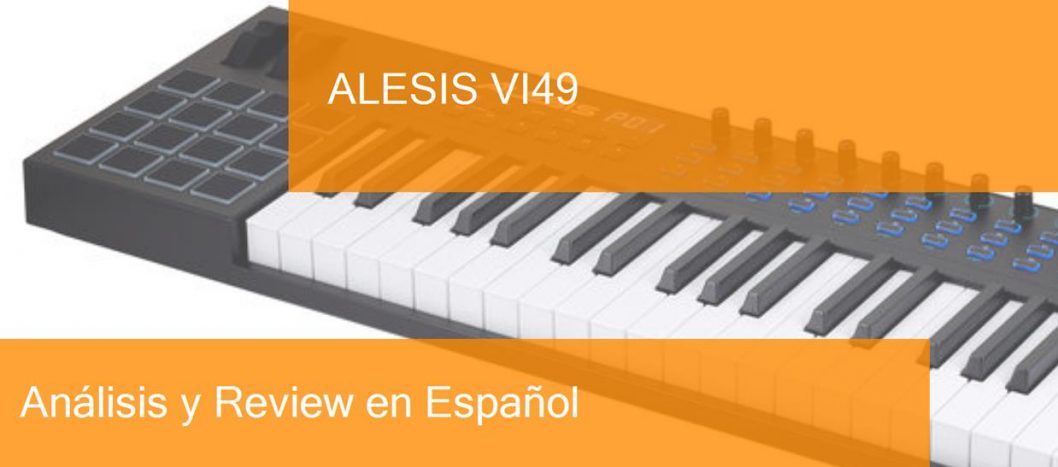
Review MIDI keyboard Alesis VI49. Where to buy it?
Alesis is a company founded in the United States in 1980 that designs and markets electronic musical instruments, digital audio processors, audio mixers, drum amplifiers, digital audio interface amplifiers, recording equipment, drum machines, professional audio and electronic percussion products. I’ll tell you how this post is built. First I list the features of this Alesis VI49 keyboard. Then you have a video or two, purchase links and useful comments from other users and then you have one of the most useful parts; comparison tables with similar keyboards so you can compare.
- 49 semi-built keys with full-size aftertouch with square front
- 16 speed-sensitive trigger pads with RGB backlighting (RedGreenBlue) for rhythm production and clip release
- Interface with 36 buttons and 12 assignable knobs with your music software
- Pitch and modulation wheels provide precise and creative control
- Seamless visual information via LED display and illuminated buttons + knobs
- USB MIDI port and 5-pin MIDI output offer flexible MIDI connectivity
- USB powered
- Plug-and-Play support for Mac and PC
- Includes USB cable, Ableton Live Lite software (download), Xpand! 2 software (download)

It also features 16 speed-sensitive trigger pads with RGB backlighting for rhythm production and clip release, an interface with 36 assignable buttons and 12 assignable knobs with your music software, and pitch bend and modulation wheels that provide precise and creative control.
When connected, it is powered via USB, so no other external power source is needed. 5-pin MIDI output is also integrated. And it’s Plug and Play for Mac and PC.
Finally, we can mention that it includes Ableton Live Lite software (download), Xpand software! 2 software from Air Music Tech (download).
Now that we have seen the features of this Alesis VI49 keyboard watch these related videos to know more.
https://www.youtube.com/watch?v=05vLvrs204M
Posts you may be interested in
- Ranking with the best midi keyboards
- My selection of cheap midi keyboards.
- Best MIDI Software to work with.
- MIDI Basic Guide.
- Midi Keyboards by Brand.
Alesis VI49 vs Alesis V49
The Alesis Vl49 MIDI Keyboard has a price of €185 while the Alesis VI49 has a price of €91/£79/$91. Since the Alesis V49 is a superior model we found a difference of 90 Euro, let’s see its face to face:
- Both offer us 49 keys with sensitivity, but in the Alesis VI49 they are semi-heavy, having better quality and feel when playing the keyboard.
- Both offer speed-sensitive backlit pads (intensity in MIDI language), in the Alesis V49 they are 8, and in the Alesis VI49 they are 16.
- We also have assignable knobs and buttons, in the case of the Alesis V49 it is 4 knobs and 4 buttons, and in the Alesis VI49 it is 36 buttons and 12 knobs.
- Both offer pitch bend and modulation wheels that allow you to change the height of a note while playing.
- Both share visual information through the illuminated knobs and buttons, while the Alesis Vl49 also features an LED display.
- Both can be powered via USB (USB port) and the Alesis VI49 has a 5-pin MIDI output offering flexible MIDI connectivity.
- Both include the Ableton Live Lite software license (download), Xpand! software, and the Alesis VI49 2 software (download).
Let’s put the features of these keyboards in a table so you can compare
|
Alesis VI49 |
Alesis V49 |
|---|---|
|
|
As we can see if there are significant changes in both models, and the price increase is worth it, both for the function of semi-weighted keys, as well as the increase in control devices more that offers us the Alesis VI49, so if the budget gives you, go for it. For its price, the Alesis V49 is not a bad option either.
And here’s a video of the Alesis V49 keyboard
If you want to know more about this option, click on the following link to see the Alesis V49 review.
Alesis VI49 vs Novation Launchkey 49 MK3
The Alesis VI49 MIDI Keyboard is priced at €185 when the Novation Launchkey 49 MK3 is priced at €222/£205/$224. Let’s go to the face-to-face:
- Both offer us 49 keys with sensitivity, but in the Alesis VI49 they are semi-heavy and with a square front, having better quality and feel when playing the keyboard.
- The Alesis VI 49 offers 16 speed-sensitive RGB backlit pads (intensity in MIDI language), we also have 12 knobs and 36 buttons, both assignable and pitch bend and modulation wheels.
- The Novation Launchkey 49 MK 3 offers 16 RGB backlit sensitive pads, 8 assignable faders and a Master fader, buttons for octave up / down, arp / scale / fixed chord, play/stop / record/loop, and so on, plus pitch bend and modulation wheels that allow you to change the height of a note while playing.
- Both share visual information through the illuminated knobs and buttons when the Alesis Vl49 also has an LED display and the Novation Launchkey 49 MK3 has 2 16-digit displays.
- Both can be powered via USB and both have a 5-pin MIDI output offering flexible MIDI connectivity.
- The Alesis includes the Ableton Live Lite software license (download), Xpand! software, and the Alesis MK3 2 software (download) while the Novation includes Ableton Live Lite, Serato Sample LE, AAS Session Bundle, XLN Addictive Keys (1 of 4 virtual keyboards selectable), Klevgrand R0Verb and DAW Cassette, Spitfire Audio LABS-Expressive Strings.
Let’s put the features of these keyboards in a table so you can compare
|
Alesis VI49 |
Novation Launchkey 49 MK3 |
|---|---|
|
|
In this comparison we have two MIDI controllers of different brands and prices, and also with well marked differences. On the one hand the Alesis VI49 that has moderate functions that we have already commented, and on the other hand the Novation Launchkey 49 Mk3 that includes a 49-key keyboard, pads, faders and a great amount of buttons with many functions. Although they are very similar models, the fact that the Novation Launchkey offers faders (which in mixing processes, are very useful) gives it a great advantage, now the Alesis VI49 offers semi-balanced keys which is also an advantage for it. So according to what you need most you will make your choice.
And here is a video of the Novation Launchkey 49 MK3 keyboard
If you want to know more about this option, click on the following link to see the Novation Launchkey 49 MK3 review.
Alesis VI49 vs M-Audio Code 49 Black
The Alesis VI49 MIDI Keyboard is priced at €185 and the M-Audio Code 49 Black is priced at €199, but the difference is so small that this may vary from store to store.
- Both offer 49 keys with sensitivity and aftertouch, but the Alesis VI49 is semi-heavy and has a square front, giving you a better quality and feel when playing the keyboard.
- The Alesis VI 49 offers 16 speed-sensitive RGB backlit pads (intensity in MIDI language), we also have 12 knobs and 36 buttons, both assignable and pitch bend and modulation wheels.
- The M-Audio Code 49 Black offers 4 assignable zones for splits and layers, 1 assignable XY control pad for HID control, 16 fully assignable speed-sensitive trigger pads, 8 assignable knobs, 9 assignable faders, 9 assignable buttons, transport buttons, and pitch bend and modulation wheels.
- Both share visual information via the illuminated knobs and buttons, when the Alesis Vl49 also has an LED display and the M-Audio Code 49 Black has 1 6-digit display.
- Both can be powered via USB and both have a 5-pin MIDI output offering flexible MIDI connectivity. The M-Audio Code 49 Black has an external power input, which is not included.
- The Alesis includes the Ableton Live Lite software license (download), Xpand! software, and the M-Audio Code 49 Black 2 software (download) while the M-Audio includes Ableton Live Lite, Hybrid 3.0 and Loom by Air Music Technology.
Let’s put the features of these keyboards in a table so you can compare
|
Alesis VI49 |
M-Audio Code 49 Black |
|---|---|
|
|
In this comparison we have a pair of MIDI controllers from two different brands and with very similar prices, on the one hand the Alesis VI49 that we have already analyzed before, and the M-Audio Code 49 Black that has a lot of control functions, starting with its 49-key keyboard, going through its XY Control Pad and also the pads, knobs, faders and buttons. It really is a complete controller. If you want a better quality keyboard go for the Alesis VI49 and if you want more control features the M-Audio Code 49 Black is for you.
And here’s a video of the M-Audio Code 49 Black keyboard
If you want to know more about this option, click on the following link to see the M-Audio Code 49 Black review.
Alesis VI49 vs Novation Impulse 49
The Alesis VI49 MIDI Keyboard is priced at €185 when the Novation Impulse 49 is priced at €223/£205/$228. Let’s move on to the face-to-face:
- Both offer us 49 keys with sensitivity and aftertouch, but in the Alesis VI49 they are semi-heavy and have a square front, having better quality and feel when playing the keyboard.
- The Alesis VI 49 offers 16 speed-sensitive RGB backlit pads (intensity in MIDI language), we also have 12 knobs and 36 buttons, both assignable and pitch bend and modulation wheels.
- The Novation Impulse 49 offers 4 assignable zones for splits and layers, 1 assignable XY control pad for HID control, 16 fully assignable speed-sensitive trigger pads, 8 assignable knobs, 9 assignable faders, 9 assignable buttons, transport buttons and pitch bend and modulation wheels.
- Both share visual information through the illuminated knobs and buttons when the Alesis Vl49 also has an LED display and the Novation Impulse 49 has 1 LCD display.
- Both can be powered via USB and both have a 5-pin MIDI output offering flexible MIDI connectivity. The Novation Impulse 49 has a MIDI input and an expression pedal input.
- The Alesis includes the Ableton Live Lite software license (download), Xpand! 2 software (download) while the Novation includes Xcite+ Software Pack, with Ableton Live Lite.
Let’s put the features of these keyboards in a table so you can compare
|
Alesis VI49 |
Novation Impulse 49 |
|---|---|
|
|
In this comparison we have again the Alesis VI49, which we have already analyzed this time against the Novation Impulse 49, which offers 49 semi-weighted keys and with Aftertouch, very similar to those of the Alesis. 8 Pads, 9 Faders, 9 buttons, 8 knobs, 6 transport keys and pitch bend and modulation wheels. Same as the previous comparison, if you want to have a better quality keyboard go for the Alesis VI49 and if you want to have more control functions the Novation Impulse 49 Black is for you.
And here is a video of the Novation Impulse 49 keyboard
If you want to know more about this option, click on the following link to see the Novation Impulse 49 review
Alesis VI49 vs M-Audio Keystation 88 MkII
The Alesis VI49 MIDI Keyboard is priced at €185 while the M-Audio Keystation 88 MkII is priced at €169/£155/$169, but the difference is so small that this may vary from store to store. This is your face-to-face:
- The Alesis VI49 offers 49 keys with sensitivity and aftertouch is semi-heavy and a square front, having better quality and feel when playing the keyboard. The M-Audio Keystation 88 MkII offers 88 full-size speed-sensitive keys
- The Alesis VI 49 offers 16 speed-sensitive RGB backlit pads (intensity in MIDI language), we also have 12 knobs and 36 buttons, both assignable and pitch bend and modulation wheels.
- The M-Audio Keystation 88 Mk II offers transport and directional buttons to operate DAWs and software, Pitch Bend controls, Modulation and Octave controls.
- Both share visual information via illuminated knobs and buttons, while the Alesis Vl49 also features an LED display.
- Both can be powered via USB and both have a 5-pin MIDI output offering flexible MIDI connectivity. The M-Audio Keystation 88 Mk II has a sustain pedal input as well.
- The Alesis includes the Ableton Live Lite software license (download), Xpand! 2 software license (download) while the M-Audio Keystation 88 Mk II includes Ableton Live Lite, including the SONiVOX Eighty-Eight Ensemble plug-in as well.
Let’s put the features of these keyboards in a table so you can compare
|
Alesis VI49 |
M-Audio Keystation 88 MkII |
|---|---|
|
|
In our last comparison we have the Alesis VI49 that we have already analyzed before, and the M-Audio Keystation, which offers a grand piano keyboard of 88 keys, as well as offers transport buttons and pitch bend, modulation and up/down octave controls, it doesn’t have many functions but for the price it has we can’t afford more. In conclusion, if you want more control, the Alesis VI49 is for you, and if you need a keyboard with more range, the M-Audio Keystation 88 MkII will be your choice.
Here is a video of the M-Audio Keystation 88 MkII keyboard
If you want to know more about this option, click on the following link to see the M-Audio Keystation 88 MkII review.
What is the best of these MIDI keyboards if I am a beginner on a budget?
While the answer to this question lies mostly in what specific need you have, for example, if you want to have a keyboard with the widest range of notes possible, or if you want to have as many control functions as possible, or perhaps a mix between the two, that is without leaving behind the different connections and software licenses that most MIDI controllers offer, we will give an objective opinion according to our experience in music production and thus also with the price demanded by the controllers, a kind of value for money.
And the controller that we can mention as the best value for money is the M-Audio Code 49, which for a fair price we have a great number of control functions, which among others, we have: a Control pad XY, trigger pads, encoders, faders, buttons all of them assignable. In addition to transport buttons and other functions make this an excellent MIDI controller for beginners.
Where to buy the Alesis VI49 keyboard
Thomann
- Free Shipping.
- Full warranty. If you have any problems, they take care of everything.
- 100% reliable payment.
- A leader in trouble-free shipping.
- Usually the Best price.
- Best Reputation: They are the leading online store in Europe and have the best catalog and information.
Amazon
- Free Shipping and the possibility of shipping in one day with Amazon Premium.
- Full Guarantee but they are no experts in music equipment.
- Sometimes a better price.
- He’s got worse stock than Thomann.
Also, look at these models with a similar price and features:
- Novation Launchkey Mini MK3
- Akai MPK mini Mk2
- Akai MPK miniplay
- Roli Lightpad Block M Studio Ed.
- Arturia MiniLab MKII
- Roli Beatmaker Kit
- Novation Impulse 25
- Akai MPK mini MK2 white
- Alesis V25
- CME Xkey Air 25
- IK Multimedia iRig Keys I/O 25
- Akai APC Keys 25
- Akai LPK 25
- M-Audio Code 25 black
- Native Instruments Komplete Kontrol A25
- Novation Launchkey Mini MK2
- Alesis V mini
- Arturia MicroLab Black
- Akai LPK 25 wireless
- Akai MPK mini Limited Black
- Arturia MiniLab MKII Inverted Edition
- M-Audio Oxygen 25 Mk4
- Korg nanoKEY Studio
- Swissonic EasyKey 25
- Korg nanoKEY 2 black
- Korg nanoKEY 2 Limited Orange
- Korg nanoKEY 2 Limited Blue
- Akai MPK mini MK2 white – AIEP3 Bdl
- Nektar Impact LX25+
- Novation Launchkey 25 MK2
- Alesis Q25
- Akai MPK 225
- Korg microKEY 25
- Miditech Midistart Music 25
- Alesis VI25
- Korg nanoKEY 2 white
- Arturia MicroLab Blue
- Nektar SE25
- Korg microKEY Air 25
- IK Multimedia iRig Keys 25
- Midiplus X2 mini
- Icon iKeyboard 3X
- Keith McMillen K-Board
- CME Xkey 25 silver
- Native Instruments Komplete Kontrol M32
- Alesis V49
- Arturia Keystep Black Edition
- Swissonic EasyKey 49
- Arturia Keystep
- Arturia KeyLab Essential 49
- Nektar Impact LX49+
- M-Audio Code 49 Black
- IK Multimedia iRig Keys 2 Pro
- M-Audio Keystation 49 MK3
- M-Audio Keystation Mini 32 MK3
- Novation Impulse 49
- Nektar Impact GX 49
- Novation Launchkey 49 Mk2
- Native Instruments Komplete Kontrol A49
- M-Audio Oxygen 49 Mk4
- Alesis Q49 Keyboard Controller
- Roland A-300 Pro
- IK Multimedia iRig Keys I/O 49
- Alesis VI49
- Midiplus AK490
- Alesis Vortex Wireless 2
- M-Audio Axiom Air Mini 32
- Alesis Vortex Wireless 2 Network
- IK Multimedia iRig Keys 37 Pro
- Arturia KeyLab Essential 49 BE
- Haken Audio Continuum Half Size
- CME Xkey 37 LE
- IK Multimedia iRig Keys Pro
- Korg microKEY 49 MkII
- IK Multimedia iRig Keys 2
- Miditech Midistart Music 49
- Roland A-49 Black
- Korg microKEY 37 MkII
- Swissonic ControlKey 49
- Roland A-500 PRO
- Nektar SE49
- Korg microKEY Air 37
- Korg microKEY Air 49
- Roland A-49 White
- Nektar Panorama T4
- Miditech Garagekey mini
- Miditech Minicontrol-32
- Midiplus X3 mini
- Miditech i2-Control 37 Black
- Icon iKeyboard 4X
- Miditech i2-mini 32
- Midiplus X4 mini
- Miditech i2-mini 32 Bluetooth
- Icon iKeyboard 5X
- Acorn Masterkey 49
- M-Audio Code 61 Black
- Arturia KeyLab Essential 61
- Nektar Impact GX 61
- M-Audio Keystation 61 MK3
- Alesis V61
- Native Instruments Komplete Kontrol A61
- Swissonic EasyKey 61
- M-Audio Oxygen 61 Mk4
- Roland A-800 Pro
- Korg microKEY Air 61
- GSi DMC-122
- Nektar Impact LX61+
- Alesis VI61
- Novation Launchkey 61 MK2
- Icon iKeyboard 6X
- Acorn Masterkey 61
- Miditech i2-61 Black Edition
- Midiplus X6 mini
- Korg microKEY 61 MkII
- Midiplus X-6 II
- Viscount Physis Piano K5 EX
- M-Audio Keystation 88 MkII
- Kawai VPC1
- Doepfer LMK2+ 88 GH
- Doepfer LMK4+ 88 GH black
- Swissonic ControlKey 88
- Viscount Physis Piano K4 EX
- Doepfer LMK4+ 88 GH grey
- Nektar Impact LX88+
- Haken Audio Continuum Full Size
- Midiplus Stage 88
- Studiologic Numa Concert
- Icon iKeyboard 8X
- Doepfer LMK2+ 88 GH without Case
- Midiplus X-8 II
- Doepfer LMK4+ 88 GH GR without Case