
- Home
- Author's Archive:

Review MIDI keyboard Haken Audio ContinuuMini. Where to buy it?
I’ll tell you how this post is built. First I list the features of the Haken Audio ContinuuMini keyboard. Then you have a video or two, purchase links and useful comments from other users and then you have one of the most useful parts; comparison tables with similar keyboards so you can compare.
- Polyphonic gliding Sounds (Different sounds of piano and other instruments) dynamically playable by stress plus in horizontal position
- The fingerboard simultaneously processes data regarding the X, Y and Z axes for you to at the most 2 hands
- Integrated noise generation (Eagan Matrix) with 8 voices (Different sounds of piano and other instruments)
- Range: 2 Octaves (2750 cents)
- Supports midi (MIDI allows you to do such wonderful things as connect the keyboard to the computer, record a soundtrack and with certain programs pass with a click what you have played to musical notes in a score. MIDI tracks store information from musical notes), MPE and MPE+
- Output all the way to 8 analog control voltages (CV) feasible via optional Control Voltage Converter
- 3.5 mm Stereo headphone output with 24Bit converter
- 3.5 mm pedal (The most important pedal of a piano or keyboard is the sustain pedal and is used to keep the note playing even if you stop pressing the key.) connection
- Mini-USB port for information transmission and energy supply
- Dimensions (W x D x H): 530 x 60 x 20 mm
- body weight: 250 g

This keyboard usually has a price around 925.00 €
Now that we’ve seen the features of this keyboard Haken Audio ContinuuMini watch these related videos to learn more.
Post you may be interested in
- Ranking with the best midi keyboards
- My selection of cheap midi keyboards.
- Best MIDI Software to work with.
- MIDI Basic Guide.
- Midi Keyboards by Brand.
Haken Audio ContinuuMini vs Roli Seaboard Rise 49
The keyboard Haken Audio ContinuuMiniis usually 74 € cheaper than Roli Seaboard Rise 49.
And then a video of the keyboard
|
Haken Audio ContinuuMini |
Roli Seaboard Rise 49 |
|---|---|
|
|
And then a video of the keyboardRoli Seaboard Rise 49
If you want to know more about this option, click on the following link to see the Roli Seaboard Rise 49 review
Haken Audio ContinuuMini vs Doepfer PK88 GH
The keyboard Haken Audio ContinuuMini is usually 56 € more expensive than Doepfer PK88 GH.
And then a video of the keyboard
|
Haken Audio ContinuuMini |
Doepfer PK88 GH |
|---|---|
|
|
And then a video of the keyboardDoepfer PK88 GH
If you want to know more about this option, click on the following link to see the Doepfer PK88 GH review
Haken Audio ContinuuMini vs Studiologic Numa Stage
The keyboard Haken Audio ContinuuMini is usually 80 € more expensive than Studiologic Numa Stage.
And then a video of the keyboard
|
Haken Audio ContinuuMini |
Studiologic Numa Stage |
|---|---|
|
Connectors
|
And then a video of the keyboardStudiologic Numa Stage
If you want to know more about this option, click on the following link to see the Studiologic Numa Stage review
Haken Audio ContinuuMini vs Keith McMillen K-Board Pro 4
The keyboard Haken Audio ContinuuMini is usually 59 € more expensive than Keith McMillen K-Board Pro 4.
And then a video of the keyboard
|
Haken Audio ContinuuMini |
Keith McMillen K-Board Pro 4 |
|---|---|
|
|
And then a video of the keyboardKeith McMillen K-Board Pro 4
If you want to know more about this option, click on the following link to see the Keith McMillen K-Board Pro 4 review
Where to buy the keyboard Haken Audio ContinuuMini
Thomann
- Free Shipping.
- Full warranty. If you have any problems, they take care of everything.
- 100% reliable payment.
- Leader in trouble-free shipping.
- Usually Best price.
- Best Reputation: They are the leading online store in Europe and have the best catalogue and information.
Amazon
- Free Shipping and possibility of shipping in one day with Amazon Premium.
- Full Guarantee but they are no experts in music equipment.
- Sometimes better price.
- He’s got worse stock than Thomann.
Also look at these models with a similar price and features:
- Roli Seaboard Rise 25
- Roli Seaboard Block Studio Edition
- Roli Songmaker Kit Studio Edition
- Haken Audio ContinuuMini
- Roli Seaboard Rise 49
- Native Instruments Komplete Kontrol S49 MK2
- Arturia KeyLab MkII 49 Black
- Akai MPK 249
- Arturia KeyLab MkII 49 White
- Novation 49SL MKIII
- Korg Triton taktile 49
- Keith McMillen K-Board Pro 4
- Native Instruments Komplete Kontrol S61 MK2
- Novation 61SL MKIII
- Novation Impulse 61
- Arturia KeyLab MkII 61 White
- Arturia KeyLab MkII 61 Black
- Nektar Panorama P6
- Akai MPK 261
- Nektar Panorama T6
- Studiologic SL73 Studio
- Native Instruments Komplete Kontrol S88 MK2
- Studiologic SL88 Studio
- Arturia KeyLab 88 MkII
- M-Audio Hammer 88
- Studiologic SL88 Grand
- Studiologic Numa Stage
- Doepfer PK88 GH
- Doepfer PK88 GH without Case

Review MIDI keyboard Korg nanoKEY 2 black. Where to buy it?
Korg Inc, founded as Keio Electronic Laboratories, is a Japanese multinational corporation that manufactures electronic musical instruments, audio processors and guitar pedals, recording equipment, and electronic tuners. I’ll tell you how this post is built. First I’ll list the features of this Korg nanoKEY 2 black keyboard. Then you have a video or two, purchase links and useful comments from other users and then you have one of the most useful parts; comparison tables with similar keyboards so you can compare.
- Color: Black
- 25-key sensitive keyboard
- 4-speed curves
- Pitch Button (Up/Down)
- Octave-Shift (-4 to +4)
- Modulation button
- Sustain button
- USB-Mini port
- Powered by USB (less than 100 mA)
- Dimensions: 325 x 13 x 83 mm
- Weight: 244 g
- Includes USB cable and software bundle
- Supports Apple iPad from OS 4.2.1
- Requirements: Apple Camera Connection Kit (not included), iPad App must support Core MIDI (KORG does not guarantee compatibility, the possibility of impairment if Apple renews OS and/or launches new models!)

It also offers octave up/down, pitch up/down, sustain and Mod buttons. It has an integrated USB connection and is powered by the same means, i.e. it does not need external power.
It has a lightweight and super portable design fits in a suitcase or even a trouser pocket. It includes a software bundle license.
Now that we have seen the features of this Korg nanoKEY 2 black keyboard look at these related videos to know more.
Posts you may be interested in
- Ranking with the best midi keyboards
- My selection of cheap midi keyboards.
- Best MIDI Software to work with.
- MIDI Basic Guide.
- Midi Keyboards by Brand.
Korg nanoKEY 2 black vs Akai LPK 25
The Korg nanoKEY 2 black MIDI keyboard is priced at €44/£41/$45 and the Akai LPK 25 is priced at €42/£37/$42, but the difference is so small that this may vary from store to store. Let’s go head to head:
- They both offer 25 sensitive mini keys.
- The Korg nanokEY 2 also offers octave up/down, pitch up/down, sustain, and mod buttons. The Akai LPK 25 offers arpeggiator, octave up/down, sustain and tap tempo buttons.
- Both have an integrated USB connection and are USB powered.
- The Korg includes a software bundle license. The Akai includes a software editor for Mac and PC.
Let’s put the features of these keyboards in a table so you can compare
|
Korg nanoKEY 2 black |
Akai LPK 25 |
|---|---|
|
|
Both MIDI controllers are very similar and minimalist, on the one hand, the Korg has the advantage of the up/down pitch buttons that the Akai does not have, and on the other hand, the Akai has the advantage of its arpeggiator and the 4 programmable memory banks. This gives a slight advantage to the LPK 25 Akai.
And here is a video of the LPK 25 Akai keyboard
If you want to know more about this option, click on the following link to see the Akai LPK 25 review
Korg nanoKEY 2 black vs Miditech Midistart Music 25
The Korg nanoKEY 2 black MIDI Keyboard is priced at €44/£41/$45 and the Miditech Midistart Music 25 is priced at €58/£51/$60. Let’s go head to head:
- The Korg offers 25 sensitive mini keys, and the Miditech Midistart Music 25 offers 25 full-size keys with sensitivity.
- The Korg nanokEY 2 also offers octave up/down buttons, pitch up/down, sustain and modulation. The Miditech Midistart Music 25 offers a joystick for pitch bend and modulation, octave up/down buttons, a shift button and an assignable fader.
- Both feature an integrated USB connection, with USB power. The Miditech also integrates a sustain pedal input and MIDI output
- The Korg includes a software bundle license. The Miditech includes the Magix Samplitude SE software.
Let’s put the features of these keyboards in a table so you can compare
|
Korg nanoKEY 2 black |
Miditech Midistart Music 25 |
|---|---|
|
|
In this comparison we have the Miditech Midistart Music 25 as the best controller because it offers a full size 25 key keyboard and certain control functions that benefit the user, only if you are looking for a MIDI controller that fits in your pants pocket, the Korg nanoKey 2 will be your choice.
Here’s a video of the Miditech Midistart Music 25 keyboard
https://www.youtube.com/watch?v=5CVtlM3EB_k&t=1s
If you want to know more about this option, click on the following link to see the Miditech Midistart Music 25 review.
Korg nanoKEY 2 black vs M-Audio Oxygen 49 Mk4
The Korg nanoKEY 2 black MIDI keyboard is priced at €44/£41/$45 when the M-Audio Oxygen 49 Mk4 is priced at €122/£105/$122. Let’s move on to the face-to-face:
- The Korg offers 25 sensitive mini keys, and the M-Audio Oxygen 49 Mk4 offers 49 full-size keys with sensitivity.
- The Korg nanokEY 2 also offers octave up/down buttons, pitch up/down, sustain and modulation. The M-Audio Oxygen 49 Mk4 offers 8 sensitive pads, 8 assignable encoders, 9 freely assignable faders, Transport Button, octave up/down and modulation and pitch bend wheels.
- Both feature an integrated, USB-powered connection. The M-Audio Oxygen 49 Mk4 also features an integrated sustain pedal input and USB connection.
- The Korg includes a software bundle license. The M-Audio Oxygen 49 Mk4 includes Ableton Live Lite (Software) and Sonivox Twist (Software).
Let’s put the features of these keyboards in a table so you can compare
|
Korg nanoKEY 2 black |
M-Audio Oxygen 49 Mk4 |
|---|---|
|
|
In this comparison, we have two somewhat different controllers, on the one hand, the already analyzed Korg nanoKey 2 and on the other the M-Audio Oxygen 49 which offers 49 sensitive keys, 8 sensitive pads, 8 assignable encoders, 9 freely assignable faders, Transport button, octave up/down and modulation and pitch bend wheels.
As we have noted, the Oxygen 49 is a better MIDI controller due to its built-in functions and its keyboard with almost twice as many keys. However, just like the last comparison if you are looking for a MIDI controller that fits in your pocket, the Korg nanoKey 2 will be your choice.
Here is a video of the M-Audio Oxygen 49 Mk4 keyboard
If you want to know more about this option, click on the following link to see the M-Audio Oxygen 49 Mk4 review.
Korg nanoKEY 2 black vs Akai APC Keys 25
The Korg nanoKEY 2 black MIDI Keyboard is priced at €44/£41/$45 and the Akai APC Keys 25 is priced at €72/£64/$73 with a noticeable difference. This is the face-to-face one:
- Both offer 25 sensitive mini keys.
- The Korg nanokEY 2 also offers octave up/down, pitch up/down, sustain and Mod buttons. The Akai APC Keys 25 offers a 5×8 clip launch matrix with RGB lighting for clip status indication, octave and sustain controls, eight assignable faders that Ableton Live recognizes automatically, and transport buttons (stop/pause and play).
- Both feature an integrated USB connection, with USB power.
- The Korg includes a bundle software license. The Akai includes Ableton Live Lite, Hybrid three by AIR Music Tech, SONiVOX Twist Spectral Morphing Synthesizer, Toolroom Records Artist Launch Packages.
Let’s put the features of these keyboards in a table so you can compare
|
Korg nanoKEY 2 black |
Akai APC Keys 25 |
|---|---|
|
|
In our last comparison, we have an interesting face-to-face. On one hand the Korg nanoKey 2 with its functions and features that we have already analyzed before, and on the other hand the Akai APC Keys that because of its functions we can say that it is very compatible with the Ableton Live DAW, so if you work mostly with this DAW, this will be your choice. If on the other hand, you want a MIDI controller compatible with other DAWs alike and incredible portability the Korg nanoKEY 2 will be your choice.
And here is a video of the Akai APC Keys 25
If you want to know more about this option, click on the following link to see the Akai APC Keys 25 review.
Which is the best of these MIDI keyboards if I am a beginner on a low budget?
While the answer to this question lies mostly in what specific need you have, for example, if you want to have a keyboard with the widest range of notes possible, or if you want to have as many control functions as possible, or perhaps a mix between the two, that is without leaving behind the different connections and software licenses that most MIDI controllers offer, we will give an objective opinion according to our experience in music production and thus also with the price demanded by the controllers, a kind of value for money.
In this post we have mostly very cheap MIDI controllers with few functions, however, a very balanced MIDI controller is the Miditech Midistart Music 25, which offers 25 full-size keys (which is excellent for its price), an assignable fader, a joystick for pitch bend and modulation, and octave up/down buttons. We also have a sustain pedal input. It really does offer a lot of features for a fair price. If you get the chance, go for it.
Where to buy the Korg nanoKEY 2 black keyboard
Thomann
- Free Shipping.
- Full warranty. If you have any problems, they take care of everything.
- 100% reliable payment.
- A leader in trouble-free shipping.
- Usually the Best price.
- Best Reputation: They are the leading online store in Europe and have the best catalog and information.
Amazon
- Free Shipping and the possibility of shipping in one day with Amazon Premium.
- Full Guarantee but they are no experts in music equipment.
- Sometimes a better price.
- He’s got worse stock than Thomann.
Also, look at these models with a similar price and features:
- Novation Launchkey Mini MK3
- Akai MPK mini Mk2
- Akai MPK miniplay
- Roli Lightpad Block M Studio Ed.
- Arturia MiniLab MKII
- Roli Beatmaker Kit
- Novation Impulse 25
- Akai MPK mini MK2 white
- Alesis V25
- CME Xkey Air 25
- IK Multimedia iRig Keys I/O 25
- Akai APC Keys 25
- Akai LPK 25
- M-Audio Code 25 black
- Native Instruments Komplete Kontrol A25
- Novation Launchkey Mini MK2
- Alesis V mini
- Arturia MicroLab Black
- Akai LPK 25 wireless
- Akai MPK mini Limited Black
- Arturia MiniLab MKII Inverted Edition
- M-Audio Oxygen 25 Mk4
- Korg nanoKEY Studio
- Swissonic EasyKey 25
- Korg nanoKEY 2 black
- Korg nanoKEY 2 Limited Orange
- Korg nanoKEY 2 Limited Blue
- Akai MPK mini MK2 white – AIEP3 Bdl
- Nektar Impact LX25+
- Novation Launchkey 25 MK2
- Alesis Q25
- Akai MPK 225
- Korg microKEY 25
- Miditech Midistart Music 25
- Alesis VI25
- Korg nanoKEY 2 white
- Arturia MicroLab Blue
- Nektar SE25
- Korg microKEY Air 25
- IK Multimedia iRig Keys 25
- Midiplus X2 mini
- Icon iKeyboard 3X
- Keith McMillen K-Board
- CME Xkey 25 silver
- Native Instruments Komplete Kontrol M32
- Alesis V49
- Arturia Keystep Black Edition
- Swissonic EasyKey 49
- Arturia Keystep
- Arturia KeyLab Essential 49
- Nektar Impact LX49+
- M-Audio Code 49 Black
- IK Multimedia iRig Keys 2 Pro
- M-Audio Keystation 49 MK3
- M-Audio Keystation Mini 32 MK3
- Novation Impulse 49
- Nektar Impact GX 49
- Novation Launchkey 49 Mk2
- Native Instruments Komplete Kontrol A49
- M-Audio Oxygen 49 Mk4
- Alesis Q49 Keyboard Controller
- Roland A-300 Pro
- IK Multimedia iRig Keys I/O 49
- Alesis VI49
- Midiplus AK490
- Alesis Vortex Wireless 2
- M-Audio Axiom Air Mini 32
- Alesis Vortex Wireless 2 Network
- IK Multimedia iRig Keys 37 Pro
- Arturia KeyLab Essential 49 BE
- Haken Audio Continuum Half Size
- CME Xkey 37 LE
- IK Multimedia iRig Keys Pro
- Korg microKEY 49 MkII
- IK Multimedia iRig Keys 2
- Miditech Midistart Music 49
- Roland A-49 Black
- Korg microKEY 37 MkII
- Swissonic ControlKey 49
- Roland A-500 PRO
- Nektar SE49
- Korg microKEY Air 37
- Korg microKEY Air 49
- Roland A-49 White
- Nektar Panorama T4
- Miditech Garagekey mini
- Miditech Minicontrol-32
- Midiplus X3 mini
- Miditech i2-Control 37 Black
- Icon iKeyboard 4X
- Miditech i2-mini 32
- Midiplus X4 mini
- Miditech i2-mini 32 Bluetooth
- Icon iKeyboard 5X
- Acorn Masterkey 49
- M-Audio Code 61 Black
- Arturia KeyLab Essential 61
- Nektar Impact GX 61
- M-Audio Keystation 61 MK3
- Alesis V61
- Native Instruments Komplete Kontrol A61
- Swissonic EasyKey 61
- M-Audio Oxygen 61 Mk4
- Roland A-800 Pro
- Korg microKEY Air 61
- GSi DMC-122
- Nektar Impact LX61+
- Alesis VI61
- Novation Launchkey 61 MK2
- Icon iKeyboard 6X
- Acorn Masterkey 61
- Miditech i2-61 Black Edition
- Midiplus X6 mini
- Korg microKEY 61 MkII
- Midiplus X-6 II
- Viscount Physis Piano K5 EX
- M-Audio Keystation 88 MkII
- Kawai VPC1
- Doepfer LMK2+ 88 GH
- Doepfer LMK4+ 88 GH black
- Swissonic ControlKey 88
- Viscount Physis Piano K4 EX
- Doepfer LMK4+ 88 GH grey
- Nektar Impact LX88+
- Haken Audio Continuum Full Size
- Midiplus Stage 88
- Studiologic Numa Concert
- Icon iKeyboard 8X
- Doepfer LMK2+ 88 GH without Case
- Midiplus X-8 II
- Doepfer LMK4+ 88 GH GR without Case
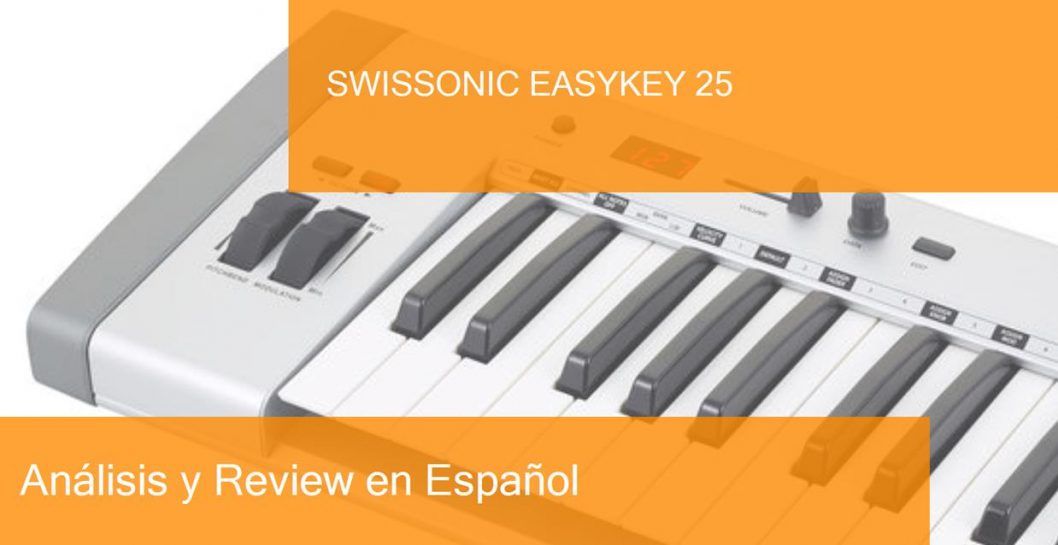
Review MIDI keyboard Swissonic EasyKey 25. Where to buy it?
I’ll tell you how this post is built. First I list the features of the Swissonic EasyKey 25 keyboard. Then you have a video or two, purchase links and useful comments from other users and then you have one of the most useful parts; comparison tables with similar keyboards so you can compare.
- 25 Comprehensive size velocity keys
- Aluminum housing with side panels made of plastic
- pitch bend (Functionality that changes the sound wave of what you play and then returns to its original state) and Modulation wheel
- LED show
- 1 Slider for volume control
- 1 Programmable encoder
- Octave button for the expansion of playing area
- 1 pedal (The most important pedal of a piano or keyboard is the sustain pedal and is used to keep the note playing even if you stop pressing the key.) connector
- 1 midi (MIDI allows you to do such wonderful things as connect the keyboard to the computer, record a soundtrack and with certain programs pass with a click what you have played to musical notes in a score. MIDI tracks store information from musical notes) Out
- USB powered
- Compatible with Windows Vista, XP (as of SP1), Windows 7, Windows 8 and Mac OS X
- Dimensions: (W x D x H): 495 x 210 x 50 mm
- Weight: 2.83 kg
- Including 1 m USB cable and Thomann Studio Starter kit LE (Software bundle with DAW software, computer software synthesizer such as Effekt Plugins)

Now that we’ve seen the features of this keyboard Swissonic EasyKey 25 watch these related videos to learn more.
Post you may be interested in
- Ranking with the best midi keyboards
- My selection of cheap midi keyboards.
- Best MIDI Software to work with.
- MIDI Basic Guide.
- Midi Keyboards by Brand.
Some comments from people who come to the forum about this model:
Comment:
We purchased this as our Bass player was going to be unexpectedly away for a gig. We did not wish to invest hours with a Dep. In this musical organization I perform Sax, but when our Pianist was soloing some help had been desired by her. Initially we had been going to put it through a vocals that is midi, but we discoverd our stage piano gave us use of it’s interior GM voices, therefore utilizing the midi out of the Swissonic we were able to patch into the Bass in the stage piano, which eliminated some wires and power supplies and in addition made the transition from Piano/Bass split to Swissonic Bass and Piano more seamless. (We utilized Piano and Bass split keyboard on the SP) I surely could play Bass with my remaining hand. Exactly how did it go? Great. The machine itself is light, but rested well on a stand. A USB ended up being employed by us plug to power it, plus the midi out socket to the keyboard. The instruction book is quite explicit, yet not really required because the arranged is fairly logical. Occasionaly striking an email did not create a response, we suspect as a result of operator mistake. The arranged out of the package ended up being fine and choosing this system that is right easy. (begins at 0, not 1.) We liked the Aluminium instance which should help with life on your way and all sorts of in most we have been actually satisfied with what we got. The tips are very light in operation which suggested I didn’t get fatigued playing around 40 Bass lines. I spent quite a right time looking for a keyboard with proper midi, not USB, and also this has both. The dimensions that is full also ensure it is easy for me to play without the need to concentrate way too hard. I have big fingers so tiny keys don’t actually work well for me.
What would I choose? Well if I may find one a 25 key with weighted tips, but haven’t had the opportunity to source that so dream on! Oh and a Midi in/through would be nice. I haven’t looked over the software therefore can not comment, we now have a great amount of that in other formats so probably won’t view it.
Delivery, inspite of the efforts associated with the French postal system to postpone it, was as usual from Thomann, fast.
What would I choose? Well if I may find one a 25 key with weighted tips, but haven’t had the opportunity to source that so dream on! Oh and a Midi in/through would be nice. I haven’t looked over the software therefore can not comment, we now have a great amount of that in other formats so probably won’t view it.
Delivery, inspite of the efforts associated with the French postal system to postpone it, was as usual from Thomann, fast.
Comment:
I put it to use to simply play simple lines with digital instruments also to do bass lines with a bass synth module. For this usage is quite perfect, a keyboard that is fine very long sized keys and good action, featured with very basic midi commands. It constantly worked correctly and it is constructed with sturdy materials, so I have absolutely nothing to whine. For the purchase price an excellent product.
Swissonic EasyKey 25 vs Akai MPK mini Mk2
The keyboard Swissonic EasyKey 25is usually 29 € cheaper than Akai MPK mini Mk2, but the difference is so small that this can vary..
And then a video of the keyboard
|
Swissonic EasyKey 25 |
Akai MPK mini Mk2 |
|---|---|
|
|
And then a video of the keyboardAkai MPK mini Mk2
If you want to know more about this option, click on the following link to see the Akai MPK mini Mk2 review
Swissonic EasyKey 25 vs Akai LPK 25
The keyboard Swissonic EasyKey 25 is usually 15 € more expensive than Akai LPK 25, but the difference is so small that this can vary..
And then a video of the keyboard
|
Swissonic EasyKey 25 |
Akai LPK 25 |
|---|---|
|
|
And then a video of the keyboardAkai LPK 25
If you want to know more about this option, click on the following link to see the Akai LPK 25 review
Swissonic EasyKey 25 vs Swissonic EasyKey 49
The keyboard Swissonic EasyKey 25is usually 10 € cheaper than Swissonic EasyKey 49, but the difference is so small that this can vary..
And then a video of the keyboard
|
Swissonic EasyKey 25 |
Swissonic EasyKey 49 |
|---|---|
|
|
And then a video of the keyboardSwissonic EasyKey 49
If you want to know more about this option, click on the following link to see the Swissonic EasyKey 49 review
Swissonic EasyKey 25 vs Arturia Keystep
The keyboard Swissonic EasyKey 25is usually 52 € cheaper than Arturia Keystep.
And then a video of the keyboard
|
Swissonic EasyKey 25 |
Arturia Keystep |
|---|---|
|
|
And then a video of the keyboardArturia Keystep
If you want to know more about this option, click on the following link to see the Arturia Keystep review
Where to buy the keyboard Swissonic EasyKey 25
Thomann
- Free Shipping.
- Full warranty. If you have any problems, they take care of everything.
- 100% reliable payment.
- Leader in trouble-free shipping.
- Usually Best price.
- Best Reputation: They are the leading online store in Europe and have the best catalogue and information.
Amazon
- Free Shipping and possibility of shipping in one day with Amazon Premium.
- Full Guarantee but they are no experts in music equipment.
- Sometimes better price.
- He’s got worse stock than Thomann.
Also look at these models with a similar price and features:
- Novation Launchkey Mini MK3
- Akai MPK mini Mk2
- Akai MPK miniplay
- Roli Lightpad Block M Studio Ed.
- Arturia MiniLab MKII
- Roli Beatmaker Kit
- Novation Impulse 25
- Akai MPK mini MK2 white
- Alesis V25
- CME Xkey Air 25
- IK Multimedia iRig Keys I/O 25
- Akai APC Keys 25
- Akai LPK 25
- M-Audio Code 25 black
- Native Instruments Komplete Kontrol A25
- Novation Launchkey Mini MK2
- Alesis V mini
- Arturia MicroLab Black
- Akai LPK 25 wireless
- Akai MPK mini Limited Black
- Arturia MiniLab MKII Inverted Edition
- M-Audio Oxygen 25 Mk4
- Korg nanoKEY Studio
- Swissonic EasyKey 25
- Korg nanoKEY 2 black
- Korg nanoKEY 2 Limited Orange
- Korg nanoKEY 2 Limited Blue
- Akai MPK mini MK2 white – AIEP3 Bdl
- Nektar Impact LX25+
- Novation Launchkey 25 MK2
- Alesis Q25
- Akai MPK 225
- Korg microKEY 25
- Miditech Midistart Music 25
- Alesis VI25
- Korg nanoKEY 2 white
- Arturia MicroLab Blue
- Nektar SE25
- Korg microKEY Air 25
- IK Multimedia iRig Keys 25
- Midiplus X2 mini
- Icon iKeyboard 3X
- Keith McMillen K-Board
- CME Xkey 25 silver
- Native Instruments Komplete Kontrol M32
- Alesis V49
- Arturia Keystep Black Edition
- Swissonic EasyKey 49
- Arturia Keystep
- Arturia KeyLab Essential 49
- Nektar Impact LX49+
- M-Audio Code 49 Black
- IK Multimedia iRig Keys 2 Pro
- M-Audio Keystation 49 MK3
- M-Audio Keystation Mini 32 MK3
- Novation Impulse 49
- Nektar Impact GX 49
- Novation Launchkey 49 Mk2
- Native Instruments Komplete Kontrol A49
- M-Audio Oxygen 49 Mk4
- Alesis Q49 Keyboard Controller
- Roland A-300 Pro
- IK Multimedia iRig Keys I/O 49
- Alesis VI49
- Midiplus AK490
- Alesis Vortex Wireless 2
- M-Audio Axiom Air Mini 32
- Alesis Vortex Wireless 2 Red
- IK Multimedia iRig Keys 37 Pro
- Arturia KeyLab Essential 49 BE
- Haken Audio Continuum Half Size
- CME Xkey 37 LE
- IK Multimedia iRig Keys Pro
- Korg microKEY 49 MkII
- IK Multimedia iRig Keys 2
- Miditech Midistart Music 49
- Roland A-49 Black
- Korg microKEY 37 MkII
- Swissonic ControlKey 49
- Roland A-500 PRO
- Nektar SE49
- Korg microKEY Air 37
- Korg microKEY Air 49
- Roland A-49 White
- Nektar Panorama T4
- Miditech Garagekey mini
- Miditech Minicontrol-32
- Midiplus X3 mini
- Miditech i2-Control 37 Black
- Icon iKeyboard 4X
- Miditech i2-mini 32
- Midiplus X4 mini
- Miditech i2-mini 32 Bluetooth
- Icon iKeyboard 5X
- Acorn Masterkey 49
- M-Audio Code 61 Black
- Arturia KeyLab Essential 61
- Nektar Impact GX 61
- M-Audio Keystation 61 MK3
- Alesis V61
- Native Instruments Komplete Kontrol A61
- Swissonic EasyKey 61
- M-Audio Oxygen 61 Mk4
- Roland A-800 Pro
- Korg microKEY Air 61
- GSi DMC-122
- Nektar Impact LX61+
- Alesis VI61
- Novation Launchkey 61 MK2
- Icon iKeyboard 6X
- Acorn Masterkey 61
- Miditech i2-61 Black Edition
- Midiplus X6 mini
- Korg microKEY 61 MkII
- Midiplus X-6 II
- Viscount Physis Piano K5 EX
- M-Audio Keystation 88 MkII
- Kawai VPC1
- Doepfer LMK2+ 88 GH
- Doepfer LMK4+ 88 GH black
- Swissonic ControlKey 88
- Viscount Physis Piano K4 EX
- Doepfer LMK4+ 88 GH grey
- Nektar Impact LX88+
- Haken Audio Continuum Full Size
- Midiplus Stage 88
- Studiologic Numa Concert
- Icon iKeyboard 8X
- Doepfer LMK2+ 88 GH without Case
- Midiplus X-8 II
- Doepfer LMK4+ 88 GH GR without Case