
- Home
- Author's Archive:

Review MIDI keyboard Kawai VPC1. Where to buy it?
I’ll tell you how this post is built. First I list the features of the Kawai VPC1 keyboard. Then you have a video or two, purchase links and useful comments from other users and then you have one of the most useful parts; comparison tables with similar keyboards so you can compare.
- 88 Key master keyboard in phase piano design
- 88 wood secrets with RM3 Grand II Hammer Action (The weight of the keys on an acoustic piano that digital pianos try to imitate to match the touch of a real acoustic piano. The keys in the high register are heavier and in the high register less. This is a different concept of sensitivity on the keyboard that serves to regulate the volume of the note. But a hammer action keyboard always has sensitivity on the keys.)
- Key device with 3-way sensor system
- Pressure point simulation and IvoryTouch secrets
- Configurations: Normal, Ivory II, Pianoteq, Galaxy Vintag D, Alicia’s Keys
- Graphic interface
- Any number of touch curves with any number of points
- Touch learn function
- Velocity off set for one key
- midi (MIDI allows you to do such wonderful things as connect the keyboard to the computer, record a soundtrack and with certain programs pass with a click what you have played to musical notes in a score. MIDI tracks store information from musical notes)/USB routing
- MIDI send channel
- totally free pedal (The most important pedal of a piano or keyboard is the sustain pedal and is used to keep the note playing even if you stop pressing the key.) assignment (VPC editor compatible with Windows XP/Vista/7/8) connectors: 3-Way pedal (The most important pedal of a piano or keyboard is the sustain pedal and is used to keep the note playing even if you stop pressing the key.)
- MIDI in/out
- Usb to Host (It’s a more modern MIDI connector. MIDI allows you to do such wonderful things as connect the keyboard to the computer, record a soundtrack and with certain programs pass with a single click what you have played to musical notes in a score. MIDI tracks store note information)
- Power supply via USB (1.0 W) or DC 12 V cord (3.0 W)
- Dimensions (W x D x H): 1380 x 425 x 185 mm
- body weight: 29.5 kg
- Including F-30 triple pedal with half damper function, sheet music stand, energy adaptor and manual

This keyboard usually has a price around 1.29 €
Now that we’ve seen the features of this keyboard Kawai VPC1 watch these related videos to learn more.
Post you may be interested in
- Ranking with the best midi keyboards
- My selection of cheap midi keyboards.
- Best MIDI Software to work with.
- MIDI Basic Guide.
- Midi Keyboards by Brand.
Some comments from people who come to the forum about this model:
Comment:
I purchased the VPC1 for just one specific explanation only: the touch. Exactly the same way as a classical pianist (hobbyist) I actually need a thing that is close enough to an actual piano as you are able to actually play the instrument. Hammering a plastic synth most likely simply harms your method. I’ve been playing that is delighted practicing classical piano for two years now with my VPC1.
Pros:
– The touch. Possibly the most readily useful you will get (until Kawai pops up with improved version) and probably one of the only keyboards which comes even near to being ideal for practicing serious piano repertoire.
– price-feature-ratio. No "fancy extra features". Though significantly costly, you’re only paying for the secrets along with the product that’s what you should be interested in anyhow.
Cons:
– Weight. It weights a great deal and a isn’t really an alternative if you have to bring your personal intrument to gigs.
– Lack of (midi) features. There’s only the energy key along with a computer and a software tool anyhow, I might have anticipated even some buttons to manage the software instruments (why be satisfied with imitating regular piano experience whenever you could have more?) as you need certainly to connect it. Some simple buttons would not even have harmed the "classical look".
– The curved top surface. This actually annoys me personally since I like hoard sheet music and other material on grand pianos etc. and the area that is curved stops this. Now you just need to find another solution for the laptop and extra stuff.
Conclusion: For pianists who actually care for the touch just. You can get an inexpensive synth for one other material anyway.
Comment:
it was the keyboard ( instrument with Pianoteq 4) I are waiting for!. When playing top of the secrets there clearly was ‘just’ enough room so as to not hit the trunk, this requires a technique that is good perhaps not ‘an problem!?! ( Mozart and Beethoven fingering here). The main element s being surface( are good while the fat, stability and rate are ‘there’!!! The 3 sensors allow a ‘no anxiety ornament and trill situation’ for the perfectionist. That is my new ‘instrument’. Thankyou Thomann as well as your team! ONE ON …AND the keyboard is certainly going strong without any failure to any of this secrets at all 12 months. After my review that is first above have settled straight down and can become more balanced here. You can find small niggles that lots of uses have actually stated, the curve top is something that is worked around using bigger plastic risers as an example, and also the music rack is best changing with a floor stand, the rack, whether or not it absolutely was made better is too low for sight reading anyhow. But back into the keyboard, and also this pertains to each comparable products(inc digital piano) the action does not be lighter when using the sustain pedal as on an acoustic, obvious point but take note it WONT do that on this(or any)master keyboard if you utilize the pedal as a comfort to make playing easier. With that mind the action would be stated by me is of average fat. Overall a very good product.
Kawai VPC1 vs Akai MPK mini Mk2
The keyboard Kawai VPC1is usually 87 € cheaper than Akai MPK mini Mk2.
And then a video of the keyboard
|
Kawai VPC1 |
Akai MPK mini Mk2 |
|---|---|
|
|
And then a video of the keyboardAkai MPK mini Mk2
If you want to know more about this option, click on the following link to see the Akai MPK mini Mk2 review
Kawai VPC1 vs Akai LPK 25
The keyboard Kawai VPC1is usually 43 € cheaper than Akai LPK 25, but the difference is so small that this can vary..
And then a video of the keyboard
|
Kawai VPC1 |
Akai LPK 25 |
|---|---|
|
|
And then a video of the keyboardAkai LPK 25
If you want to know more about this option, click on the following link to see the Akai LPK 25 review
Kawai VPC1 vs Swissonic EasyKey 49
The keyboard Kawai VPC1is usually 68 € cheaper than Swissonic EasyKey 49.
And then a video of the keyboard
|
Kawai VPC1 |
Swissonic EasyKey 49 |
|---|---|
|
|
And then a video of the keyboardSwissonic EasyKey 49
If you want to know more about this option, click on the following link to see the Swissonic EasyKey 49 review
Kawai VPC1 vs Alesis Q49 Keyboard Controller
The keyboard Kawai VPC1is usually 65 € cheaper than Alesis Q49 Keyboard Controller.
And then a video of the keyboard
|
Kawai VPC1 |
Alesis Q49 Keyboard Controller |
|---|---|
|
|
And then a video of the keyboardAlesis Q49 Keyboard Controller
If you want to know more about this option, click on the following link to see the Alesis Q49 Keyboard Controller review
Where to buy the keyboard Kawai VPC1
Thomann
- Free Shipping.
- Full warranty. If you have any problems, they take care of everything.
- 100% reliable payment.
- Leader in trouble-free shipping.
- Usually Best price.
- Best Reputation: They are the leading online store in Europe and have the best catalogue and information.
Amazon
- Free Shipping and possibility of shipping in one day with Amazon Premium.
- Full Guarantee but they are no experts in music equipment.
- Sometimes better price.
- He’s got worse stock than Thomann.
Also look at these models with a similar price and features:
- Novation Launchkey Mini MK3
- Akai MPK mini Mk2
- Akai MPK miniplay
- Roli Lightpad Block M Studio Ed.
- Arturia MiniLab MKII
- Roli Beatmaker Kit
- Novation Impulse 25
- Akai MPK mini MK2 white
- Alesis V25
- CME Xkey Air 25
- IK Multimedia iRig Keys I/O 25
- Akai APC Keys 25
- Akai LPK 25
- M-Audio Code 25 black
- Native Instruments Komplete Kontrol A25
- Novation Launchkey Mini MK2
- Alesis V mini
- Arturia MicroLab Black
- Akai LPK 25 wireless
- Akai MPK mini Limited Black
- Arturia MiniLab MKII Inverted Edition
- M-Audio Oxygen 25 Mk4
- Korg nanoKEY Studio
- Swissonic EasyKey 25
- Korg nanoKEY 2 black
- Korg nanoKEY 2 Limited Orange
- Korg nanoKEY 2 Limited Blue
- Akai MPK mini MK2 white – AIEP3 Bdl
- Nektar Impact LX25+
- Novation Launchkey 25 MK2
- Alesis Q25
- Akai MPK 225
- Korg microKEY 25
- Miditech Midistart Music 25
- Alesis VI25
- Korg nanoKEY 2 white
- Arturia MicroLab Blue
- Nektar SE25
- Korg microKEY Air 25
- IK Multimedia iRig Keys 25
- Midiplus X2 mini
- Icon iKeyboard 3X
- Keith McMillen K-Board
- CME Xkey 25 silver
- Native Instruments Komplete Kontrol M32
- Alesis V49
- Arturia Keystep Black Edition
- Swissonic EasyKey 49
- Arturia Keystep
- Arturia KeyLab Essential 49
- Nektar Impact LX49+
- M-Audio Code 49 Black
- IK Multimedia iRig Keys 2 Pro
- M-Audio Keystation 49 MK3
- M-Audio Keystation Mini 32 MK3
- Novation Impulse 49
- Nektar Impact GX 49
- Novation Launchkey 49 Mk2
- Native Instruments Komplete Kontrol A49
- M-Audio Oxygen 49 Mk4
- Alesis Q49 Keyboard Controller
- Roland A-300 Pro
- IK Multimedia iRig Keys I/O 49
- Alesis VI49
- Midiplus AK490
- Alesis Vortex Wireless 2
- M-Audio Axiom Air Mini 32
- Alesis Vortex Wireless 2 Red
- IK Multimedia iRig Keys 37 Pro
- Arturia KeyLab Essential 49 BE
- Haken Audio Continuum Half Size
- CME Xkey 37 LE
- IK Multimedia iRig Keys Pro
- Korg microKEY 49 MkII
- IK Multimedia iRig Keys 2
- Miditech Midistart Music 49
- Roland A-49 Black
- Korg microKEY 37 MkII
- Swissonic ControlKey 49
- Roland A-500 PRO
- Nektar SE49
- Korg microKEY Air 37
- Korg microKEY Air 49
- Roland A-49 White
- Nektar Panorama T4
- Miditech Garagekey mini
- Miditech Minicontrol-32
- Midiplus X3 mini
- Miditech i2-Control 37 Black
- Icon iKeyboard 4X
- Miditech i2-mini 32
- Midiplus X4 mini
- Miditech i2-mini 32 Bluetooth
- Icon iKeyboard 5X
- Acorn Masterkey 49
- M-Audio Code 61 Black
- Arturia KeyLab Essential 61
- Nektar Impact GX 61
- M-Audio Keystation 61 MK3
- Alesis V61
- Native Instruments Komplete Kontrol A61
- Swissonic EasyKey 61
- M-Audio Oxygen 61 Mk4
- Roland A-800 Pro
- Korg microKEY Air 61
- GSi DMC-122
- Nektar Impact LX61+
- Alesis VI61
- Novation Launchkey 61 MK2
- Icon iKeyboard 6X
- Acorn Masterkey 61
- Miditech i2-61 Black Edition
- Midiplus X6 mini
- Korg microKEY 61 MkII
- Midiplus X-6 II
- Viscount Physis Piano K5 EX
- M-Audio Keystation 88 MkII
- Kawai VPC1
- Doepfer LMK2+ 88 GH
- Doepfer LMK4+ 88 GH black
- Swissonic ControlKey 88
- Viscount Physis Piano K4 EX
- Doepfer LMK4+ 88 GH grey
- Nektar Impact LX88+
- Haken Audio Continuum Full Size
- Midiplus Stage 88
- Studiologic Numa Concert
- Icon iKeyboard 8X
- Doepfer LMK2+ 88 GH without Case
- Midiplus X-8 II
- Doepfer LMK4+ 88 GH GR without Case
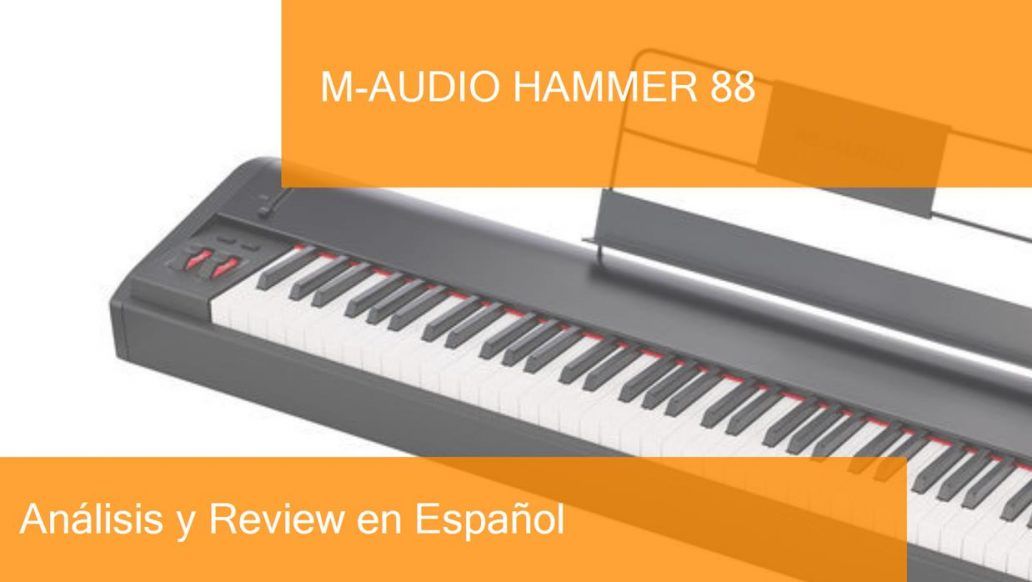
Review M-Audio Hammer 88 MIDI keyboard. Where to buy it?
M-Audio is a business unit of inMusic Brands that designs and markets digital audio and MIDI interfaces, keyboards and MIDI controllers, synthesizers, speakers, studio monitors, digital DJ systems, microphones, and music software. I’ll tell you how this post is built. First I will list the features of this M-Audio Hammer 88 keyboard. Then you have a video or two, shopping links, and useful reviews from other users and then you have one of the most useful parts; comparison charts with similar keyboards so you can compare.
- Keyboard controller with weighted hammer action
- 88 keys
- USB-MIDI connection, Plug & Play compatible on Mac or PC
- MIDI output for connection to external MIDI peripherals
- Pitch-Bend and modulation wheels
- Volume Fader and Up/Down Buttons
- Keyboard zone assignment for split and layer functions and chord function with 1 finger (4 voices)
- Easy parameter editing via the included Hammer 88 editor
- Compatible with iOS with Apple iPad Camera Connection Kit connector (available separately)
- Includes licenses for the following software packages: AIR “Mini Grand” Acoustic Grand Piano, AIR “Velvet” Vintage Electric Piano, AIR “DB-33” Tonewheel Organ Simulator and SONiVOX “Eighty-Eight Ensemble” Authentic Piano Instrument
- Ableton Live Lite
- Includes 3-month license for Skoove for online piano lessons
- Includes score support
- Powered by USB port or external power supply (not included)
- Dimensions: 1420 x 300 x 130 mm
- Weight: 17.5 kg
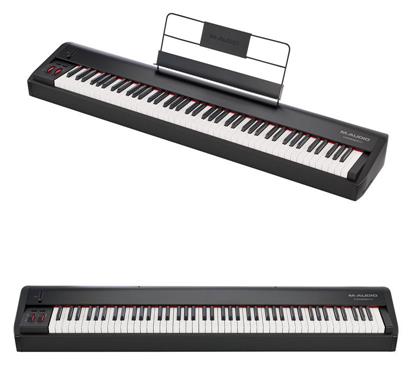
It also offers Pitch-Bend and modulation wheels and volume fader and Up/Down buttons, being a somewhat minimalist MIDI controller in functions, as we can’t find anything about pads, knobs, buttons and other control functions.
It is conceived as a simulation of a real acoustic piano and has assignment zones for Split and Layer functions and 1-finger chord function (4 voices). It also offers easy parameter editing via the included Hammer 88 editor. Also included are the licenses for AIR “Mini Grand” Acoustic Grand Piano, AIR “Velvet” Vintage Electric Piano, AIR “DB-33” Tonewheel Organ Simulator, and SONiVOX “Eighty-Eight Ensemble” Authentic Piano Instrument and Ableton Live Lite.
It has a USB-MIDI connection, sustain, expression and footswitch inputs is Mac and PC compatible, and offers a MIDI output.
Now that we’ve seen the features of this M-Audio Hammer 88 keyboard, check out these related videos to learn more.
Posts you may be interested in
- Ranking with the best midi keyboards
- My selection of cheap midi keyboards.
- Best MIDI Software to work with.
- MIDI Basic Guide.
- Midi Keyboards by Brand.
M-Audio Hammer 88 vs Studiologic SL88 Grand
The M-Audio Hammer 88 MIDI Keyboard is priced at €422/£366/$419 and the Studiologic SL88 Grand is priced at €769/£699/$785. Let’s go face-to-face:
- Both offer 88 keys with hammer mechanics, in the case of the Studiologic SL88 Grand, it is a TP40 Wood with Aftertouch (FATAR Brand) keyboard with wooden core keys and ivory touch.
- The M-Audio Hammer 88 also offers Pitch-Bend and modulation wheels, and volume fader and Up/Down buttons. When the Studiologic SL88 Grand offers a 6-way control joystick, 3 assignable buttons, 4 programmable zones, 4 programmable pedal connections and 3 programmable joystick controllers.
- In connections, the M-Audio Hammer 88 has USB-MIDI connection, MIDI output, sustain pedal input, expression, and footswitch and is powered via USB although it also has an input for an external power supply, which is not included. The Studiologic SL88 Grand offers a USB-MIDI connection and also includes a 9V DC 1A power supply (not USB powered) and a VFP1/10 sustain pedal.
- The M-Audio Hammer 88 includes licenses for the following software packages: AIR “Mini Grand” Acoustic Grand Piano, AIR “Velvet” Vintage Electric Piano, AIR “DB-33” Tonewheel Organ Simulator, and SONiVOX “Eighty-Eight Ensemble” Authentic Piano Instrument and Ableton Live Lite. The Studiologic SL88 Grand includes a collection of virtual instruments (once the hardware is registered).
Let’s put the features of these keyboards in a table so you can compare
|
M-Audio Hammer 88 |
Studiologic SL88 Grand |
|---|---|
|
|
In this interesting comparison, we can notice that both are good MIDI controllers, the M-Audio Hammer 88 which is a somewhat minimalist MIDI controller that its main function is on its 7-octave keyboard. And the Studiologic SL88 Grand that has many and more functions than its competition, apart from the great quality of the keyboard it has, also offers joystick, knobs and assignable zones that will allow greater control of the DAW we are using. The M-Audio is an excellent choice for its price range, but the Studiologic SL88 Grand outperforms it in many features.
Here’s a video of the Studiologic SL88 Grand keyboard
If you want to know more about this option, click on the following link to see the Studiologic SL88 Studio review
M-Audio Hammer 88 vs Kawai VPC1
The M-Audio Hammer 88 MIDI Keyboard is priced at €422/£366/$419 and the Kawai VPC1 is priced at €1,268/£1,168/$1,295. Let’s see the face-to-face:
- Both offer 88 keys with hammer mechanics, in case the Kawai VPC1 has an RM3 Grand II (Kawai’s own) hammer action, with 3 sensors and let-off simulation and ivory key surface. It has a really wonderful keyboard.
- The M-Audio Hammer 88 also offers Pitch-Bend and modulation wheels, and volume fader and Up/Down buttons. When the Kawai VPC1 offers a graphical interface where you can choose certain settings. It also has the following features: An unlimited number of Touch Curves, Touch Learn function, Velocity Off Set for each key, and more.
- When connected, the M-Audio Hammer 88 has a USB-MIDI connection, MIDI output, sustain pedal input, expression and footswitch input, and is powered via USB, but also has an input for an external power supply, which is not included. The Kawai VPC1 offers USB-MIDI connection, USB-Host, free pedal assignment, MIDI input and output, connections for triple footswitches and can be powered via USB or the included power supply.
- The M-Audio Hammer 88 includes licenses for the following software packages: AIR “Mini Grand” Acoustic Grand Piano, AIR “Velvet” Vintage Electric Piano, AIR “DB-33” Tonewheel Organ Simulator and SONiVOX “Eighty-Eight Ensemble” Authentic Piano Instrument and Ableton Live Lite.
Let’s put the features of these keyboards in a table so you can compare
|
M-Audio Hammer 88 |
Kawai VPC1 |
|---|---|
|
|
As we have seen since the introduction of this comparison we see that the controllers have a great difference in price, the M-Audio Hammer 88 that we have already analyzed before at almost a third of the price of the Kawai VPC1 which is a MIDI controller with a great quality keyboard, typical of the Kawai brand, with all the functions already analyzed before, without a doubt this is the best MIDI controller in the comparison.
And here is a video of the Kawai VPC1 keyboard
If you want to know more about this option, click on the following link to see the Kawai VPC1 review.
M-Audio Hammer 88 vs Roland A-88 MKII
The M-Audio Hammer 88 MIDI Keyboard is priced at €422/£366/$419 and the Roland A-88 MKII is priced at €959/£859/$949. Let’s move on to the face-to-face:
- Both offer 88 hammer-action keys, in the case of the Roland A-88 MKII keys they offer PHA-4 Standard technology with an ivory touch.
- The M-Audio Hammer 88 also offers Pitch-Bend and modulation wheels, and volume fader and Up/Down buttons. When the Roland A-88 MKII offers a joystick for Pitch/Modulation function, +/- buttons for octave selection and keyboard sensitivity adjustment, 8 Pads and rotary controllers with RGB lighting for MIDI hardware and software control.
- When connected, the M-Audio Hammer 88 has a USB-MIDI connection, MIDI output, sustain pedal input, expression pedal input, and footswitch input, and is powered via USB, but also has an input for an external power supply, which is not included. The Roland A-88 MKII offers USB-MIDI connection, MIDI input and output, input for a sustain pedal and 2 connections for an expression pedal. It can also be powered via USB-C or an external transformer.
- The M-Audio Hammer 88 includes licenses for the following software packages: AIR “Mini Grand” Acoustic Grand Piano, AIR “Velvet” Vintage Electric Piano, AIR “DB-33” Tonewheel Organ Simulator and SONiVOX “Eighty-Eight Ensemble” Authentic Piano Instrument and Ableton Live Lite.
Let’s put the features of these keyboards in a table so you can compare
|
M-Audio Hammer 88 |
Roland A-88 MKII |
|---|---|
|
|
In this comparison, we have an interesting face to face, with the M-Audio Hammer 88 that we have already analyzed a few times in this post. And the Roland A-88 MKII which is a high-quality MIDI keyboard and also has more functions like a joystick, up and down octave buttons, and 8 pads with RGB backlighting. If you have the budget go for the Roland A-88 MKII, if not the M-Audio Hammer 88 is not a bad choice.
And here’s a video of the Roland A-88 MKII
https://www.youtube.com/watch?v=USFvGCHt5PY
M-Audio Hammer 88 vs Native Instruments Komplete Kontrol S88 MK2
The M-Audio Hammer 88 MIDI Keyboard is priced at €422/£366/$419 and the Native Instruments Komplete Kontrol S88 MK2 is priced at €945/£866/$955. With a difference of 486 euros between them.
- Both offer 88 hammer-action keys, the keyboard of the Native Instruments Komplete Kontrol S88 MK2 is a high-quality Fatar brand.
- The M-Audio Hammer 88 also offers Pitch-Bend and modulation wheels, and volume fader and Up/Down buttons. When the Native Instruments Komplete Kontrol S88 MK2 offers pitch bend and modulation wheels and a touch strip for expression control, a 4D (4-dimensional) pushbutton encoder and pre-mapped control for KOMPLETE instruments and other instruments from major manufacturers. Other functions offered are Preset navigation based on labels, an RGB (RedGreenBlue) light guide above each key that indicates different functions, a ‘Smart Play’ that allows you to consult the scales and modes of the light guide, and others.
- When connected, the M-Audio Hammer 88 has a USB-MIDI connection, MIDI output, sustain pedal input, expression pedal input, and footswitch input, and is powered via USB, but also has an input for an external power supply, which is not included. While the Native Instruments Komplete Kontrol S88 MK2 offers USB-MIDI connection, MIDI input and output, and input for two assignable pedals. It also has a power supply input that is included.
- The M-Audio Hammer 88 includes licenses for the following software packages: AIR “Mini Grand” Acoustic Grand Piano, AIR “Velvet” Vintage Electric Piano, AIR “DB-33” Tonewheel Organ Simulator, and SONiVOX “Eighty-Eight Ensemble” Authentic Piano Instrument and Ableton Live Lite. The Native Instruments Komplete Kontrol S88 MK2 includes the KOMPLETE SELECT sample library package.
Let’s put the features of these keyboards in a table so you can compare
|
M-Audio Hammer 88 |
Native Instruments Komplete Kontrol S88 K12 |
|---|---|
|
|
In the current comparison, if we find a big difference, the M-Audio Hammer 88 looks like a very minimalist MIDI controller keyboard compared to the Native Instruments Komplete Kontrol S88 MK2 that after its 88-key Fatar brand keyboard, which is already a great quality, also offers many features and compatibility with the most popular DAWs, really in a very complete MIDI controller, if you have the budget this is the choice.
And here is a video of the Native Instruments Komplete Kontrol S88 K12 keyboard
M-Audio Hammer 88 vs Akai MPK 261
The M-Audio Hammer 88 MIDI Keyboard is priced at €422/£366/$419 and the Akai MPK 261 is priced at €385/£339/$393, but the difference is so small that this may vary depending on the shop where we ask. We have two MIDI controllers with very different functions, let’s go face to face:
- The M-Audio Hammer 88 offers 88 hammer-action keys, while the Akai MPK 261 offers 61 semi-weighted keys.
- The M-Audio Hammer 88 also offers Pitch-Bend and Modulation wheels, and volume fader and Up/Down buttons. The Akai MPK 261 offers 16 MPC (Midi Production Center) pads with RGB (RedGreenBlue) backlighting, 4 x 4 pad banks, 8 control knobs, 8 assignable faders, and 8 backlit switches. Also included are integrated transport (rec, play, pause, stop, etc.) and parameter controls, and Pitch bend, modulation and octave controls for dynamic performances.
- When connected, the M-Audio Hammer 88 has a USB-MIDI connection, MIDI output, sustain pedal input, expression and footswitch input, and is powered via USB, but also has an input for an external power supply, which is not included. While the Akai MPK 261 offers USB-MIDI connection, and input for two pedals: expression and sustain. It is powered via USB.
- The M-Audio Hammer 88 includes licenses for the following software packages: AIR “Mini Grand” Acoustic Grand Piano, AIR “Velvet” Vintage Electric Piano, AIR “DB-33” Tonewheel Organ Simulator and SONiVOX “Eighty-Eight Ensemble” Authentic Piano Instrument and Ableton Live Lite. The Akai MPK 261 includes the licenses for Ableton Live Lite, Hybrid 3 by AIR Music Tech, SONiVOX Twist 2.0 and Akai Pro MPC Essentials.
Let’s put the features of these keyboards in a table so you can compare
|
M-Audio Hammer 88 |
Akai MPK 261 |
|---|---|
|
|
In our last comparison, we have two MIDI controllers with different functions and features, on the one hand, the M-Audio Hammer 88 has a more minimalist model where it includes a MIDI keyboard with counterbalanced hammer mechanics, pitch bend and modulation wheels and a volume fader. On the other hand, the Akai MPK 261 offers many more features of a MIDI controller such as pads, knobs, faders and switches and a 61-key keyboard. So depending on your needs you will choose the best one.
And here is a video of the Akai MPK 261
If you want to know more about this option, click on the following link to see the Akai MPK 261 review.
Where to buy the M-Audio Hammer 88 keyboard
Amazon
- Free Shipping and the possibility of shipping in one day with Amazon Premium.
- Full Guarantee but they are no experts in music equipment.
- Sometimes a better price.
- He’s got worse stock than Thomann.
Thomann
- Free Shipping.
- Full warranty. If you have any problems, they take care of everything.
- 100% reliable payment.
- A leader in trouble-free shipping.
- Usually the Best price.
- Best Reputation: They are the leading online store in Europe and have the best catalog and information.
[create_boton_thomann link=”https://www.thomann.co.uk/m_audio_hammer_88.htm”]
Also, look at these models with a similar price and features:
- Roli Seaboard Rise 25
- Roli Seaboard Block Studio Edition
- Roli Songmaker Kit Studio Edition
- Haken Audio ContinuuMini
- Roli Seaboard Rise 49
- Native Instruments Komplete Kontrol S49 MK2
- Arturia KeyLab MkII 49 Black
- Akai MPK 249
- Arturia KeyLab MkII 49 White
- Novation 49SL MKIII
- Korg Triton taktile 49
- Keith McMillen K-Board Pro 4
- Native Instruments Komplete Kontrol S61 MK2
- Novation 61SL MKIII
- Novation Impulse 61
- Arturia KeyLab MkII 61 White
- Arturia KeyLab MkII 61 Black
- Nektar Panorama P6
- Akai MPK 261
- Nektar Panorama T6
- Studiologic SL73 Studio
- Native Instruments Komplete Kontrol S88 MK2
- Studiologic SL88 Studio
- Arturia KeyLab 88 MkII
- M-Audio Hammer 88
- Studiologic SL88 Grand
- Studiologic Numa Stage
- Doepfer PK88 GH
- Doepfer PK88 GH without Case
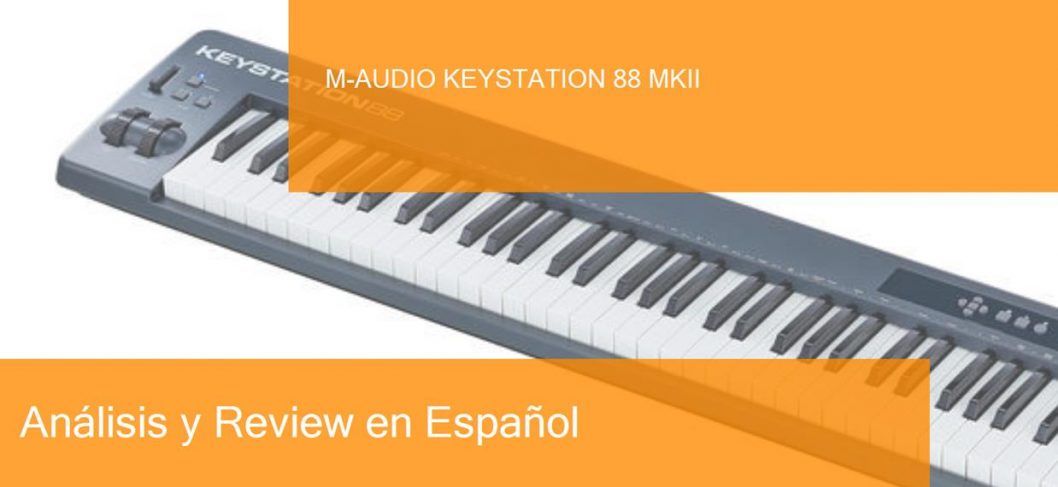
Review M-Audio Keystation 88 MkII MIDI keyboard. Where to buy it?
M-Audio is a business unit of inMusic Brands that designs and markets digital audio and MIDI interfaces, keyboards and MIDI controllers, synthesizers, speakers, studio monitors, digital DJ systems, microphones and music software. I’ll tell you how this post is built. First I will list the features of this M-Audio Keystation 88 MkII keyboard. Then you have a video or two, purchase links and useful comments from other users and then you have one of the most useful parts; comparison tables with similar keyboards so you can compare.
- 88 full-size speed-sensitive keys
- USB MIDI connection for playing virtual instruments, controlling recording software and more
- Transport and directional buttons to operate with DAWs and software
- Pitch Bend, Modulation and Octave Controls
- USB powered
- Supports Plug-and-Play connectivity with Mac and PC
- Lightweight design
- IOS support using the Apple iPad Camera Connection Kit (sold separately)
- Includes Ableton Live Lite, a powerful software sequencer for music creation and live performance
- Includes the SONiVOX Eighty-Eight Ensemble plug-in, a virtual piano instrument that captures a 9-foot Steinway CD327
- USB port
- 1 MIDI port
- 6.3mm Expression Pedal Jack
- Jack for 6.3mm sustain pedal
- Operates via USB or optional power supply
- Approximate dimensions: 1346 x 240 x 100mm
- Weight: 7,30Kg approx.

Function controls include modulation and pitch bend wheels, octave up and down buttons, transport buttons (rec, play, pause, stop, etc) and a volume fader.
In connections, we have a sustain pedal input, an expression input, none is included. And it’s USB powered, plus it has an external power supply, which is also not included. It has a MIDI output.
The M-Audio Keystation 88 MKII includes Ableton Live Lite and the SONiVOX Eighty-Eight Ensemble plug-in, a virtual piano instrument that captures a 9-foot Steinway CD327 piano.
Now that we’ve seen the features of this M-Audio Keystation 88 MkII keyboard, watch these related videos to learn more.
Posts you may be interested in
- Ranking with the best midi keyboards
- My selection of cheap midi keyboards.
- Best MIDI Software to work with.
- MIDI Basic Guide.
- Midi Keyboards by Brand.
M-Audio Keystation 88 MkII vs Arturia KeyLab Essential 88
The M-Audio Keystation 88 MkII MIDI keyboard is priced at €205/£177/$203 when the Arturia KeyLab Essential 88 is priced at €349/£311/$345. Let’s go head-to-head:
- Both offer 88 full-size keys with sensitivity.
- In function controls, the M-Audio Keystation 88 MKII offers modulation and pitch bend wheels, octave buttons, transport buttons and a volume fader. When the Arturia KeyLab Essential 88 offers more functions, such as: 8 sensitive, assignable and aftertouch pads, 9 assignable knobs, 9 assignable faders, 13 assignable buttons, transport buttons, and modulation and pitch bend wheels. In addition, there is an encoder that can be pressed and assigned.
- The M-Audio Keystation 88 MK3 features an integrated sustain and expression pedal input, an external power input, MIDI output, and a USB connection. The Arturia KeyLab Essential 88 features a USB connection, a sustain pedal input, MIDI output, and external power input (not included).
- Finally, the M-Audio Keystation 88 MKII includes Ableton Live Lite and the SONiVOX Eighty-Eight Ensemble plug-in, a virtual piano instrument that captures a 9-foot Steinway CD327 piano. And the Arturia KeyLab Essential 88 includes the Arturia Analog Lab 3 license, Ableton Live Lite license and Model D Piano UVI license.
Let’s put the features of these keyboards in a table so you can compare
|
M-Audio Keystation 88 MkII |
Arturia KeyLab Essential 88 |
|---|---|
|
|
In our first comparison, we found two controllers with similarities and differences. On the one hand, the M-Audio Keystation 88 MKII is a MIDI keyboard with 88 keys with somewhat minimalist functions, only found modulation and pitch bend wheels, up and down octave buttons, transport buttons (rec, play, pause, stop, etc) and a fader for volume. On the other hand, the Arturia KeyLab Essential 88 offers 8 sensitive, assignable pads with aftertouch, 9 assignable knobs, 9 assignable faders, 13 assignable buttons, transport buttons and modulation and pitch bend wheels. In addition, there is a push-button and assignable encoder.
If you want a MIDI controller that uses only the keyboard as such, the M-Audio Keystation 88 MKII is your choice. If you want a MIDI controller that, along with the 88-key keyboard, also requires more control features such as pads, knobs, faders and buttons, the Arturia KeyLab Essential 88 will be your choice. Both are good for what they offer and cost.
And here’s a video of the Arturia KeyLab Essential 88
M-Audio Keystation 88 MkII vs M-Audio Hammer 88
The M-Audio Keystation 88 MkII MIDI keyboard is priced at €205/£177/$203 while the M-Audio Hammer 88 is priced at €422/£366/$419. Let’s go head to head:
- Both offer 88 full-size keys with sensitivity. The keyboard of the M-Audio Hammer 88 has a counterbalanced hammer action, giving you a great quality keyboard compared to the Keystation.
- In function controls, both offer modulation and pitch bend wheels, octave buttons, transport buttons and a volume fader. The M-Audio Hammer 88 offers keyboard zone assignment for split and layer functions and 1-finger chord function.
- In terms of connections, the M-Audio Keystation 88 MK3 features an integrated sustain and expression pedal input, an external power input, MIDI output, and a USB connection. The M-Audio Hammer 88 features a USB connection, a sustain pedal input, an expression pedal input, and an input for a second footswitch, a MIDI output, and an external power input (not included).
- Finally, the M-Audio Keystation 88 MKII includes Ableton Live Lite and the SONiVOX Eighty-Eight Ensemble plug-in, a virtual piano instrument that captures a 9-foot Steinway CD327 piano. And the M-Audio Hammer 88 includes licenses for the following software packages: AIR “Mini Grand” Acoustic Grand Piano, AIR “Velvet” Vintage Electric Piano, AIR “DB-33” Tonewheel Organ Simulator and SONiVOX “Eighty-Eight Ensemble” Authentic Piano Instrument, Ableton Live Lite license and a 3-month Skoove license for online piano lessons.
Let’s put the features of these keyboards in a table so you can compare
|
M-Audio Keystation 88 MkII |
M-Audio Hammer 88 |
|---|---|
|
|
Here is an interesting comparison with two MIDI controllers from the same brand, M-Audio, and both with 88 keys. The main difference between the two is that the Hammer 88 has a weighted hammer action, which greatly increases the quality and price of the controller. If you are a pianist who is not used to or is very uncomfortable playing without the counterweight on the keys, or simply want to learn piano, it will surely be your choice. If you don’t need the counterweight, the Keystation 88 will be fine for you.
Here’s a video of the M-Audio Hammer 88 keyboard
If you want to know more about this option, click on the following link to see the M-Audio Hammer 88 review.
M-Audio Keystation 88 MkII vs Novation Impulse 49
The M-Audio Keystation 88 MkII MIDI Keyboard is priced at €205/£177/$203 while the Novation Impulse 49 is priced at €223/£205/$228, with a difference of £70 between them. We will also have your face to face:
- The M-Audio Keystation 88 MKII offers 88 keys with sensitivity and square fronts. The Novation Impulse 49 offers 49 semi-weighted keys with sensitivity and aftertouch.
- In function controls, the M-Audio Keystation 88 MKII offers modulation and pitch bend wheels, octave buttons, transport buttons and a volume fader. When the Novation Impulse 49 offers 8 backlit pads, 9 assignable faders, 8 assignable knobs, 6 transport keys, octave up/down, and pitch bend and modulation wheels.
- In terms of connections, the M-Audio Keystation 88 MKII features a sustain pedal input, an expression pedal input, an external power input, MIDI output, and a USB connection. The Novation Impulse 49 features a USB connection, sustain and expression pedal inputs, and MIDI input and output.
- Finally, the M-Audio Keystation 88 MKII includes Ableton Live Lite and the SONiVOX Eighty-Eight Ensemble plug-in, a virtual piano instrument that captures a 9-foot Steinway CD327 piano. And the Novation Impulse 49 includes Xcite+ Software Pack licenses, with Ableton Live Lite.
Let’s put the features of these keyboards in a table so you can compare
|
M-Audio Keystation 88 MkII |
Novation Impulse 49 |
|---|---|
|
|
In this comparison we find the M-Audio Keystation 88 MKII that we have already analyzed before, and so does the Novation Impulse 49 with 49 semi-balanced keys, 8 pads, 9 faders, 9 buttons, 8 knobs, 6 transport keys and modulation and pitch bend wheels. Where we can clearly see big differences between both MIDI controllers. The M-Audio is for users who only need the 88-key keyboard, while the Novation is for those who settle for a 4-octave keyboard and need more control features like the ones mentioned above, which allow for more precise control in the DAW to be used.
And here is a video of the Novation Impulse 49 keyboard
If you want to know more about this option, click on the following link to see the Novation Impulse 49 review.
M-Audio Keystation 88 MkII vs M-Audio Oxygen 61 Mk4
The M-Audio Keystation 88 MkII MIDI keyboard is priced at €205/£177/$203 when the M-Audio Oxygen 61 Mk4 is priced at €155/£133/$154, but the difference is so small that this may vary. Let’s move on to the face-to-face:
- The M-Audio Keystation 88 MKII offers 88 keys with sensitivity and square fronts. The M-Audio Oxygen 61 Mk4 offers 61 keys with sensitivity.
- In function controls, the M-Audio Keystation 88 MKII offers modulation and pitch bend wheels, octave buttons, transport buttons and a volume fader. When the M-Audio Oxygen 61 Mk4 offers 8 pads, 9 assignable faders, 8 assignable knobs, transport keys, octaves up/down, and pitch bend and modulation wheels.
- In connections, we find that the M-Audio Keystation 88 MKII integrates a sustain pedal input, an expression pedal input, an external power input, MIDI output and a USB connection. The M-Audio Oxygen 61 Mk4 has a built-in USB connection and a sustain pedal input.
- Finally, the M-Audio Keystation 88 MKII includes Ableton Live Lite and the SONiVOX Eighty-Eight Ensemble plug-in, a virtual piano instrument that captures a 9-foot Steinway CD327 piano. And the M-Audio Oxygen 61 Mk4 includes SONiVOX Twist (Software), Ableton Live Lite (Software) licenses.
Let’s put the features of these keyboards in a table so you can compare
|
M-Audio Keystation 88 MkII |
M-Audio Oxygen 61 Mk4 |
|---|---|
|
|
In this comparison we find a very similar case to the previous one, on the one hand we have the M-Audio Keystation 88 MKII with its respective functions, and on the other hand we have the M-Audio Oxygen 61 MK4 with 61 sensitive keys, 8 pads, 9 assignable faders, 8 assignable knobs, transport keys, octaves up/down, and pitch bend and modulation wheels. The M-Audio Keystation 88 MKII is for users who only need the 88-key keyboard, while the M-Audio Oxygen 61 MK4 is for those who settle for a 5-octave keyboard, and need more control features like those mentioned above, which allow for more precise control in the DAW to be used.
Here is a video of the M-Audio Oxygen 61 Mk4 keyboard
If you want to know more about this option, click on the following link to see the M-Audio Oxygen 61 Mk4 review.
M-Audio Keystation 88 MkII vs Arturia KeyLab Essential 61
The M-Audio Keystation 88 MkII MIDI keyboard is priced at €205/£177/$203 while the Arturia KeyLab Essential 61 is priced at €239/£215/$239. The face-to-face is:
- The M-Audio Keystation 88 MKII offers 88 keys with sensitivity and square fronts. The Arturia KeyLab Essential 61 offers 61 keys with sensitivity.
- In function controls, the M-Audio Keystation 88 MKII offers modulation and pitch bend wheels, octave buttons, transport buttons and a volume fader. When the Arturia KeyLab Essential 61 offers 1 pushable encoder, 8 sensitive pads, 9 assignable knobs, transport keys, octave up/down, and pitch bend and modulation wheels.
- In connections, we find that the M-Audio Keystation 88 MKII integrates a sustain pedal input, an expression pedal input, an external power input, MIDI output and a USB connection. The Arturia KeyLab Essential 61 has an integrated USB connection, a sustain pedal input, an external power supply input, and a MIDI output.
- Finally, the M-Audio Keystation 88 MKII includes Ableton Live Lite and the SONiVOX Eighty-Eight Ensemble plug-in, a virtual piano instrument that captures a 9-foot Steinway CD327 piano. And the Arturia KeyLab Essential 61 includes Arturia Analog Lab 2 software, Ableton Live Lite and UVI Grand Piano.
Let’s put the features of these keyboards in a table so you can compare
|
M-Audio Keystation 88 MkII |
Arturia KeyLab Essential 61 |
|---|---|
|
|
Again, we find a very similar case to the last two comparisons, on the one hand, the M-Audio Keystation 88 MKII with its functions and on the other hand the Arturia KeyLab Essential 61 with 61 sensitive keys, 1 pressable encoder, 8 sensitive pads, 9 assignable knobs, transport keys, octaves up/down, and pitch bend and modulation wheels. The M-Audio Keystation 88 MKII is for users who only need the 88-key keyboard, while the Arturia KeyLab Essential 61 is for those who settle for a 5-octave keyboard and need more control features like the ones mentioned above, which allow for more precise control in the DAW to be used.
And here is a video of the Arturia KeyLab Essential 61
If you want to know more about this option, click on the following link to see the Arturia KeyLab Essential 61 review.
Which is the best of these MIDI keyboards if I am a beginner on a low budget?
While the answer to this question lies mostly in what specific need you have, for example, if you want to have a keyboard with the widest possible note range, or if you want to have as many control functions as possible, or perhaps a mix between the two, that is without leaving behind the different connections and software licenses that most MIDI controllers offer, we will give an objective opinion according to our experience in music production and thus also with the price that the controllers demand, a kind of value for money.
In this post, we find certain 88-key controllers, and other controllers of no more than 460 And as the best 88-key controller we can mention the M-Audio Keystation 88 MKII which also offers modulation and pitch bend wheels, octave buttons, transport buttons and a volume fader. Plus pedal connections and licenses to get the most out of the controller in question. If you get the chance, go for it.
Where to buy the M-Audio Keystation 88 MkII
Amazon
- Free Shipping and the possibility of shipping in one day with Amazon Premium.
- Full Guarantee but they are no experts in music equipment.
- Sometimes a better price.
- He’s got worse stock than Thomann.
Thomann
- Free Shipping.
- Full warranty. If you have any problems, they take care of everything.
- 100% reliable payment.
- A leader in trouble-free shipping.
- Usually the Best price.
- Best Reputation: They are the leading online store in Europe and have the best catalog and information.
Also, look at these models with a similar price and features:
- Novation Launchkey Mini MK3
- Akai MPK mini Mk2
- Akai MPK miniplay
- Roli Lightpad Block M Studio Ed.
- Arturia MiniLab MKII
- Roli Beatmaker Kit
- Novation Impulse 25
- Akai MPK mini MK2 white
- Alesis V25
- CME Xkey Air 25
- IK Multimedia iRig Keys I/O 25
- Akai APC Keys 25
- Akai LPK 25
- M-Audio Code 25 black
- Native Instruments Komplete Kontrol A25
- Novation Launchkey Mini MK2
- Alesis V mini
- Arturia MicroLab Black
- Akai LPK 25 wireless
- Akai MPK mini Limited Black
- Arturia MiniLab MKII Inverted Edition
- M-Audio Oxygen 25 Mk4
- Korg nanoKEY Studio
- Swissonic EasyKey 25
- Korg nanoKEY 2 black
- Korg nanoKEY 2 Limited Orange
- Korg nanoKEY 2 Limited Blue
- Akai MPK mini MK2 white – AIEP3 Bdl
- Nektar Impact LX25+
- Novation Launchkey 25 MK2
- Alesis Q25
- Akai MPK 225
- Korg microKEY 25
- Miditech Midistart Music 25
- Alesis VI25
- Korg nanoKEY 2 white
- Arturia MicroLab Blue
- Nektar SE25
- Korg microKEY Air 25
- IK Multimedia iRig Keys 25
- Midiplus X2 mini
- Icon iKeyboard 3X
- Keith McMillen K-Board
- CME Xkey 25 silver
- Native Instruments Komplete Kontrol M32
- Alesis V49
- Arturia Keystep Black Edition
- Swissonic EasyKey 49
- Arturia Keystep
- Arturia KeyLab Essential 49
- Nektar Impact LX49+
- M-Audio Code 49 Black
- IK Multimedia iRig Keys 2 Pro
- M-Audio Keystation 49 MK3
- M-Audio Keystation Mini 32 MK3
- Novation Impulse 49
- Nektar Impact GX 49
- Novation Launchkey 49 Mk2
- Native Instruments Komplete Kontrol A49
- M-Audio Oxygen 49 Mk4
- Alesis Q49 Keyboard Controller
- Roland A-300 Pro
- IK Multimedia iRig Keys I/O 49
- Alesis VI49
- Midiplus AK490
- Alesis Vortex Wireless 2
- M-Audio Axiom Air Mini 32
- Alesis Vortex Wireless 2 Network
- IK Multimedia iRig Keys 37 Pro
- Arturia KeyLab Essential 49 BE
- Haken Audio Continuum Half Size
- CME Xkey 37 LE
- IK Multimedia iRig Keys Pro
- Korg microKEY 49 MkII
- IK Multimedia iRig Keys 2
- Miditech Midistart Music 49
- Roland A-49 Black
- Korg microKEY 37 MkII
- Swissonic ControlKey 49
- Roland A-500 PRO
- Nektar SE49
- Korg microKEY Air 37
- Korg microKEY Air 49
- Roland A-49 White
- Nektar Panorama T4
- Miditech Garagekey mini
- Miditech Minicontrol-32
- Midiplus X3 mini
- Miditech i2-Control 37 Black
- Icon iKeyboard 4X
- Miditech i2-mini 32
- Midiplus X4 mini
- Miditech i2-mini 32 Bluetooth
- Icon iKeyboard 5X
- Acorn Masterkey 49
- M-Audio Code 61 Black
- Arturia KeyLab Essential 61
- Nektar Impact GX 61
- M-Audio Keystation 61 MK3
- Alesis V61
- Native Instruments Komplete Kontrol A61
- Swissonic EasyKey 61
- M-Audio Oxygen 61 Mk4
- Roland A-800 Pro
- Korg microKEY Air 61
- GSi DMC-122
- Nektar Impact LX61+
- Alesis VI61
- Novation Launchkey 61 MK2
- Icon iKeyboard 6X
- Acorn Masterkey 61
- Miditech i2-61 Black Edition
- Midiplus X6 mini
- Korg microKEY 61 MkII
- Midiplus X-6 II
- Viscount Physis Piano K5 EX
- M-Audio Keystation 88 MkII
- Kawai VPC1
- Doepfer LMK2+ 88 GH
- Doepfer LMK4+ 88 GH black
- Swissonic ControlKey 88
- Viscount Physis Piano K4 EX
- Doepfer LMK4+ 88 GH grey
- Nektar Impact LX88+
- Haken Audio Continuum Full Size
- Midiplus Stage 88
- Studiologic Numa Concert
- Icon iKeyboard 8X
- Doepfer LMK2+ 88 GH without Case
- Midiplus X-8 II
- Doepfer LMK4+ 88 GH GR without Case