
- Home
- Author's Archive:
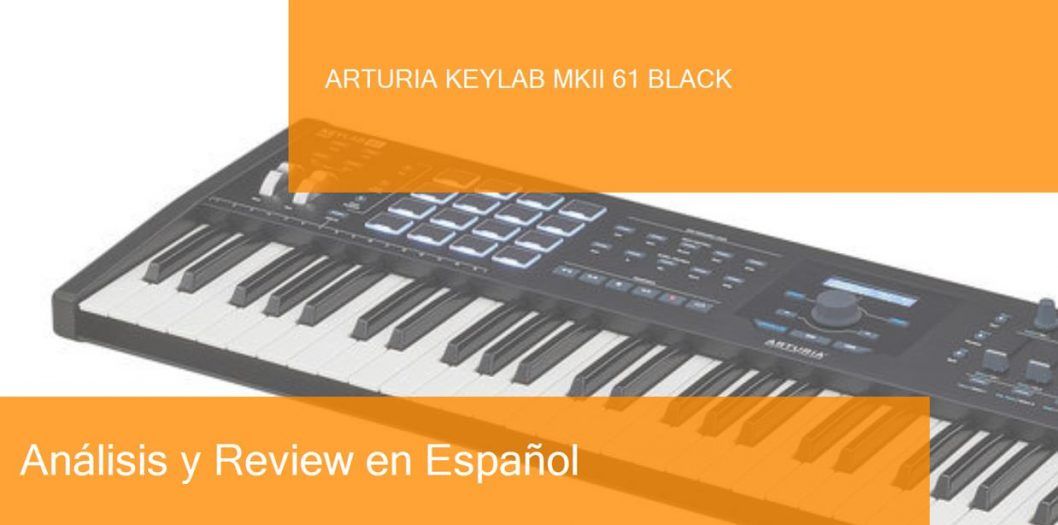
Review MIDI keyboard Arturia KeyLab MkII 61 Black. Where to buy it?
I’ll tell you how this post is built. First I list the features of the Arturia KeyLab MkII 61 Black keyboard. Then you have a video or two, purchase links and useful comments from other users and then you have one of the most useful parts; comparison tables with similar keyboards so you can compare.
- 61 Velocity sensitive keys with aftertouch
- 16 Colour illuminated performance pads
- 9 Faders
- 9 Rotating control knob
- LC-Display
- Category work
- Pitch and Modulation wheel
- Chord and Transpose work
- Transport buttons
- 5 Expression Control inputs
- 4 CV Outputs
- 1 CV input
- midi (MIDI allows you to do such wonderful things as connect the keyboard to the computer, record a soundtrack and with certain programs pass with a click what you have played to musical notes in a score. MIDI tracks store information from musical notes) input and output
- USB port
- Input for external power
- Aluminium housing
- System requirements: Windows 7 or MAC OS 10.8 or later on, 4 GB RAM, 2 GHz Central Processing Unit, 7 GB free hard drive space for complete installation of the included software, DVD drive, net connection
- Dimensions (W x D x H): 875 x 297 x 53 mm
- Weight: 7 kg
- Colour: Ebony
- Includes Analog Lab software with over 6500 Sounds (Different sounds of piano and other instruments), Piano V and Ableton Live Lite
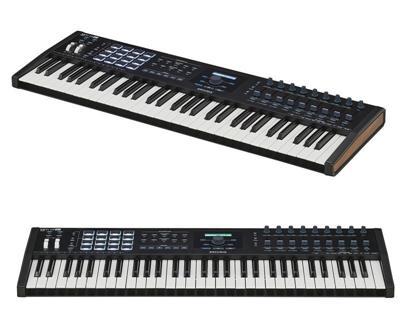
This keyboard usually has a price around 483.00 €
Now that we’ve seen the features of this keyboard Arturia KeyLab MkII 61 Black watch these related videos to learn more.
Post you may be interested in
- Ranking with the best midi keyboards
- My selection of cheap midi keyboards.
- Best MIDI Software to work with.
- MIDI Basic Guide.
- Midi Keyboards by Brand.
Some comments from people who come to the forum about this model:
Comment:
it had been the missing ring of a small synth modules string and I’m positively delighted of it. It features modification that is total a huge amount of pads, tips, faders and encoders you can designate to every midi message you want. Oahu is the just midi controller of CV outputs to its range (pitch, gate and 2 modulation, which I now use with my old MS10 expanding the keyboard and modulating the cutoff regularity with a pedal) CV in and 5 assignable pedals inputs (expression or switches). The secrets are pretty light but extremely playable and of a size that is good. I don’t utilize it for managing my DAWs yet (that is simple by using the right mask for the control buttons), but with the Arturia’s Analog Lab software and all Arturia’s virtual instruments it’s matching perfectly, giving you a really fast control of presets and parameters.
I bought the version that is black colored is quite elegant. Every component is firm and with a smooth and believe is solid touch. Excellent tool.
I bought the version that is black colored is quite elegant. Every component is firm and with a smooth and believe is solid touch. Excellent tool.
Arturia KeyLab MkII 61 Black vs Studiologic SL88 Studio
The keyboard Arturia KeyLab MkII 61 Black is usually 95 € more expensive than Studiologic SL88 Studio.
And then a video of the keyboard
|
Arturia KeyLab MkII 61 Black |
Studiologic SL88 Studio |
|---|---|
|
|
And then a video of the keyboardStudiologic SL88 Studio
If you want to know more about this option, click on the following link to see the Studiologic SL88 Studio review
Arturia KeyLab MkII 61 Black vs Roli Seaboard Rise 25
The keyboard Arturia KeyLab MkII 61 Blackis usually 66 € cheaper than Roli Seaboard Rise 25.
And then a video of the keyboard
|
Arturia KeyLab MkII 61 Black |
Roli Seaboard Rise 25 |
|---|---|
|
Technical data:
System requirements:
|
And then a video of the keyboardRoli Seaboard Rise 25
If you want to know more about this option, click on the following link to see the Roli Seaboard Rise 25 review
Arturia KeyLab MkII 61 Black vs Native Instruments Komplete Kontrol S49 MK2
The keyboard Arturia KeyLab MkII 61 Black is usually 4 € more expensive than Native Instruments Komplete Kontrol S49 MK2, but the difference is so small that this can vary..
And then a video of the keyboard
|
Arturia KeyLab MkII 61 Black |
Native Instruments Komplete Kontrol S49 MK2 |
|---|---|
|
|
And then a video of the keyboardNative Instruments Komplete Kontrol S49 MK2
If you want to know more about this option, click on the following link to see the Native Instruments Komplete Kontrol S49 MK2 review
Arturia KeyLab MkII 61 Black vs Nektar Panorama P6
The keyboard Arturia KeyLab MkII 61 Black is usually 54 € more expensive than Nektar Panorama P6.
And then a video of the keyboard
|
Arturia KeyLab MkII 61 Black |
Nektar Panorama P6 |
|---|---|
|
|
And then a video of the keyboardNektar Panorama P6
If you want to know more about this option, click on the following link to see the Nektar Panorama P6 review
Where to buy the keyboard Arturia KeyLab MkII 61 Black
Thomann
- Free Shipping.
- Full warranty. If you have any problems, they take care of everything.
- 100% reliable payment.
- Leader in trouble-free shipping.
- Usually Best price.
- Best Reputation: They are the leading online store in Europe and have the best catalogue and information.
Amazon
- Free Shipping and possibility of shipping in one day with Amazon Premium.
- Full Guarantee but they are no experts in music equipment.
- Sometimes better price.
- He’s got worse stock than Thomann.
Also look at these models with a similar price and features:
- Roli Seaboard Rise 25
- Roli Seaboard Block Studio Edition
- Roli Songmaker Kit Studio Edition
- Haken Audio ContinuuMini
- Roli Seaboard Rise 49
- Native Instruments Komplete Kontrol S49 MK2
- Arturia KeyLab MkII 49 Black
- Akai MPK 249
- Arturia KeyLab MkII 49 White
- Novation 49SL MKIII
- Korg Triton taktile 49
- Keith McMillen K-Board Pro 4
- Native Instruments Komplete Kontrol S61 MK2
- Novation 61SL MKIII
- Novation Impulse 61
- Arturia KeyLab MkII 61 White
- Arturia KeyLab MkII 61 Black
- Nektar Panorama P6
- Akai MPK 261
- Nektar Panorama T6
- Studiologic SL73 Studio
- Native Instruments Komplete Kontrol S88 MK2
- Studiologic SL88 Studio
- Arturia KeyLab 88 MkII
- M-Audio Hammer 88
- Studiologic SL88 Grand
- Studiologic Numa Stage
- Doepfer PK88 GH
- Doepfer PK88 GH without Case
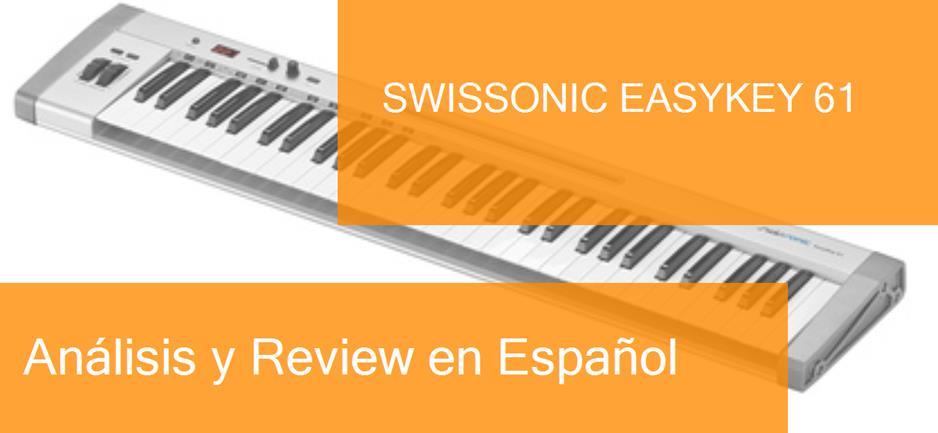
Review MIDI keyboard Swissonic EasyKey 61. Where to buy it?
I’ll tell you how this post is built. First I list the features of the Swissonic EasyKey 61 keyboard. Then you have a video or two, purchase links and useful comments from other users and then you have one of the most useful parts; comparison tables with similar keyboards so you can compare.
- 61 Comprehensive size velocity keys
- Aluminum housing with part panels made from plastic
- Pitch fold and modulation wheel
- LED Show
- 1 Slider for volume control
- 1 Programmable encoder
- Octave key for the expansion regarding the ambitus
- 1 pedal (The most important pedal of a piano or keyboard is the sustain pedal and is used to keep the note playing even if you stop pressing the key.) connector
- 1 midi (MIDI allows you to do such wonderful things as connect the keyboard to the computer, record a soundtrack and with certain programs pass with a click what you have played to musical notes in a score. MIDI tracks store information from musical notes) out
- USB powered
- Compatible with Windows Vista, XP (at the time of SP1), Windows 7, Windows 8 and Mac OS X
- Dimensions (W x H x D): 980 x 210 x 68 mm
- body weight: 5.74 kg
- Incl. 1 m USB cable and Thomann Studio Starter Kit LE (software package with DAW software, software synthesizers and effects plug-ins)
Now that we’ve seen the features of this keyboard Swissonic EasyKey 61 watch these related videos to learn more.
Post you may be interested in
- Ranking with the best midi keyboards
- My selection of cheap midi keyboards.
- Best MIDI Software to work with.
- MIDI Basic Guide.
- Midi Keyboards by Brand.
Some comments from people who come to the forum about this model:
Comment:
I’m an amateur musician, so I knew forehand that I ended up being buying an entry level Midi Keyboard corresponding to my abilities and spending plan.
I use Swissonic exceptionally for the past 2 months
I’m trying to learn tips through this controller as well as for this purpose seems fine..Well built and accurate with regards to sensitiveness in playing.
But I think it does not have of features to your belated mapping abilities that almost all DAW’s offer nowadays.
I utilized to play with a budget mini keyboard having additionally 8 pads and 8 knobs. Although the mini keyboard lacked of quality and finally died, was undoubtedly alot more responsive to all of the DAW’s parameters.
I guess you simply can not have it all because of this amount of money!!
Comment:
I don’t expect much with this keyboard because of its price. My Roland midi died and I have been cost by it three times this cost 7 years ago.
To my shock and pleasure this is every bit as effective as my Roland for velocity sensitiveness and general feel. It really works completely with Reaper on my 7 yr old windows pentium 2 laptop with no latency, it works completely with my old midi devices such as for example my Roland JP 8080.
I know like my last keyboard it doesn’t have many knobs or features but the suits me fine as I won’t be gigging with this particular.
It is a tremendously solidly build keyboard gives me personally the confidence that it will last quite a long time. Interestingly good for an excellent cost.
Swissonic EasyKey 61 vs Akai MPK mini Mk2
The keyboard Swissonic EasyKey 61 is usually 11 € more expensive than Akai MPK mini Mk2, but the difference is so small that this can vary..
And then a video of the keyboard
|
Swissonic EasyKey 61 |
Akai MPK mini Mk2 |
|---|---|
|
|
And then a video of the keyboardAkai MPK mini Mk2
If you want to know more about this option, click on the following link to see the Akai MPK mini Mk2 review
Swissonic EasyKey 61 vs Akai LPK 25
The keyboard Swissonic EasyKey 61 is usually 55 € more expensive than Akai LPK 25.
And then a video of the keyboard
|
Swissonic EasyKey 61 |
Akai LPK 25 |
|---|---|
|
|
And then a video of the keyboardAkai LPK 25
If you want to know more about this option, click on the following link to see the Akai LPK 25 review
Swissonic EasyKey 61 vs Swissonic EasyKey 49
The keyboard Swissonic EasyKey 61 is usually 30 € more expensive than Swissonic EasyKey 49, but the difference is so small that this can vary..
And then a video of the keyboard
|
Swissonic EasyKey 61 |
Swissonic EasyKey 49 |
|---|---|
|
|
And then a video of the keyboardSwissonic EasyKey 49
If you want to know more about this option, click on the following link to see the Swissonic EasyKey 49 review
Swissonic EasyKey 61 vs Arturia Keystep
The keyboard Swissonic EasyKey 61is usually 12 € cheaper than Arturia Keystep, but the difference is so small that this can vary..
And then a video of the keyboard
|
Swissonic EasyKey 61 |
Arturia Keystep |
|---|---|
|
|
And then a video of the keyboardArturia Keystep
If you want to know more about this option, click on the following link to see the Arturia Keystep review
Where to buy the keyboard Swissonic EasyKey 61
Thomann
- Free Shipping.
- Full warranty. If you have any problems, they take care of everything.
- 100% reliable payment.
- Leader in trouble-free shipping.
- Usually Best price.
- Best Reputation: They are the leading online store in Europe and have the best catalogue and information.
Amazon
- Free Shipping and possibility of shipping in one day with Amazon Premium.
- Full Guarantee but they are no experts in music equipment.
- Sometimes better price.
- He’s got worse stock than Thomann.
Also look at these models with a similar price and features:
- Novation Launchkey Mini MK3
- Akai MPK mini Mk2
- Akai MPK miniplay
- Roli Lightpad Block M Studio Ed.
- Arturia MiniLab MKII
- Roli Beatmaker Kit
- Novation Impulse 25
- Akai MPK mini MK2 white
- Alesis V25
- CME Xkey Air 25
- IK Multimedia iRig Keys I/O 25
- Akai APC Keys 25
- Akai LPK 25
- M-Audio Code 25 black
- Native Instruments Komplete Kontrol A25
- Novation Launchkey Mini MK2
- Alesis V mini
- Arturia MicroLab Black
- Akai LPK 25 wireless
- Akai MPK mini Limited Black
- Arturia MiniLab MKII Inverted Edition
- M-Audio Oxygen 25 Mk4
- Korg nanoKEY Studio
- Swissonic EasyKey 25
- Korg nanoKEY 2 black
- Korg nanoKEY 2 Limited Orange
- Korg nanoKEY 2 Limited Blue
- Akai MPK mini MK2 white – AIEP3 Bdl
- Nektar Impact LX25+
- Novation Launchkey 25 MK2
- Alesis Q25
- Akai MPK 225
- Korg microKEY 25
- Miditech Midistart Music 25
- Alesis VI25
- Korg nanoKEY 2 white
- Arturia MicroLab Blue
- Nektar SE25
- Korg microKEY Air 25
- IK Multimedia iRig Keys 25
- Midiplus X2 mini
- Icon iKeyboard 3X
- Keith McMillen K-Board
- CME Xkey 25 silver
- Native Instruments Komplete Kontrol M32
- Alesis V49
- Arturia Keystep Black Edition
- Swissonic EasyKey 49
- Arturia Keystep
- Arturia KeyLab Essential 49
- Nektar Impact LX49+
- M-Audio Code 49 Black
- IK Multimedia iRig Keys 2 Pro
- M-Audio Keystation 49 MK3
- M-Audio Keystation Mini 32 MK3
- Novation Impulse 49
- Nektar Impact GX 49
- Novation Launchkey 49 Mk2
- Native Instruments Komplete Kontrol A49
- M-Audio Oxygen 49 Mk4
- Alesis Q49 Keyboard Controller
- Roland A-300 Pro
- IK Multimedia iRig Keys I/O 49
- Alesis VI49
- Midiplus AK490
- Alesis Vortex Wireless 2
- M-Audio Axiom Air Mini 32
- Alesis Vortex Wireless 2 Red
- IK Multimedia iRig Keys 37 Pro
- Arturia KeyLab Essential 49 BE
- Haken Audio Continuum Half Size
- CME Xkey 37 LE
- IK Multimedia iRig Keys Pro
- Korg microKEY 49 MkII
- IK Multimedia iRig Keys 2
- Miditech Midistart Music 49
- Roland A-49 Black
- Korg microKEY 37 MkII
- Swissonic ControlKey 49
- Roland A-500 PRO
- Nektar SE49
- Korg microKEY Air 37
- Korg microKEY Air 49
- Roland A-49 White
- Nektar Panorama T4
- Miditech Garagekey mini
- Miditech Minicontrol-32
- Midiplus X3 mini
- Miditech i2-Control 37 Black
- Icon iKeyboard 4X
- Miditech i2-mini 32
- Midiplus X4 mini
- Miditech i2-mini 32 Bluetooth
- Icon iKeyboard 5X
- Acorn Masterkey 49
- M-Audio Code 61 Black
- Arturia KeyLab Essential 61
- Nektar Impact GX 61
- M-Audio Keystation 61 MK3
- Alesis V61
- Native Instruments Komplete Kontrol A61
- Swissonic EasyKey 61
- M-Audio Oxygen 61 Mk4
- Roland A-800 Pro
- Korg microKEY Air 61
- GSi DMC-122
- Nektar Impact LX61+
- Alesis VI61
- Novation Launchkey 61 MK2
- Icon iKeyboard 6X
- Acorn Masterkey 61
- Miditech i2-61 Black Edition
- Midiplus X6 mini
- Korg microKEY 61 MkII
- Midiplus X-6 II
- Viscount Physis Piano K5 EX
- M-Audio Keystation 88 MkII
- Kawai VPC1
- Doepfer LMK2+ 88 GH
- Doepfer LMK4+ 88 GH black
- Swissonic ControlKey 88
- Viscount Physis Piano K4 EX
- Doepfer LMK4+ 88 GH grey
- Nektar Impact LX88+
- Haken Audio Continuum Full Size
- Midiplus Stage 88
- Studiologic Numa Concert
- Icon iKeyboard 8X
- Doepfer LMK2+ 88 GH without Case
- Midiplus X-8 II
- Doepfer LMK4+ 88 GH GR without Case
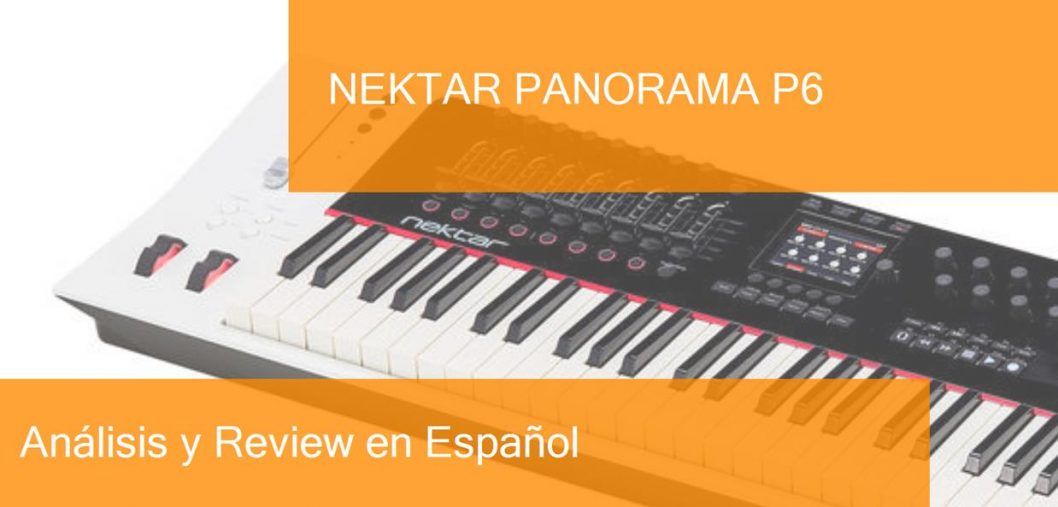
Review MIDI keyboard Nektar Panorama P6. Where to buy it?
Nektar Technology’s MIDI controllers offer unrivaled remote control for your music software and are packed with powerful features. They bridge the gap between software and hardware with Nektar DAW control for most major DAWs and performance tools that help you create music more intuitively. I’ll tell you how this post is built. First I will list the features of this Nektar Panorama P6 keyboard. Then you have a video or two, purchase links and useful comments from other users and then you have one of the most useful parts; tables of comparisons with similar keyboards so you can compare.
- 61 sensitive weighted keys and Aftertouch
- Pitch and modulation wheels
- High-resolution TFT screen and 3.5″
- 16 rotary controllers
- 9 Fader of 45mm
- 1 ALPS Motorfader 100mm
- 10 configurable LED switches
- 28 freely configurable switches
- 12 speed and pulse sensitive pads
- 4 LED mode switches
- Sustain and expression pedal connections
- USB port (computer) + USB Micro B (Motorfader power)
- Powerful link to all conventional DAWs including Cubase, Nuendo, Reason, Studio One and Logic Pro X
- Dimensions: 990 x 330 x 101 mm
- Weight: 7.71kg

This MIDI keyboard usually costs around €444 and offers a keyboard with 61 weighted keys and aftertouch, which will allow you to play and compose different musical ideas, with a high-quality keyboard and a good touch.
As with other control functions it offers 16 assignable knobs, 9 assignable 45mm faders, 1 100mm ALPS Motorfader (mechanical fader), 10 configurable LED switches, 28 freely configurable switches, 12 speed and keystroke sensitive pads, and pitch bend and modulation wheels.
The Nektar Panorama P6 integrates a MIDI output, a USB connection, and two pedal inputs (expression and sustain).
Now that we have seen the features of this Nektar Panorama P6 keyboard look at these related videos to find out more.
Posts you may be interested in
- Ranking with the best midi keyboards
- My selection of cheap midi keyboards.
- Best MIDI Software to work with.
- MIDI Basic Guide.
- Midi Keyboards by Brand.
Nektar Panorama P6 vs Nektar Impact GX 49
The Nektar Panorama P6 MIDI Keyboard is priced at €444 while the Nektar Impact GX 49 is priced at €79/£73/$80, with a large difference of £365. Let’s move on to the face-to-face:
- The Nektar Panorama P6 offers 61 sensitive counterbalanced keys and Aftertouch. The Nektar Impact GX 49 provides 49 ‘full size’ speed-sensitive keys with ‘synth-action’.
- The Nektar Panorama P6 offers 16 assignable knobs, 9 assignable 45mm faders, 1 100mm ALPS Motorfader (mechanical fader), 10 configurable LED switches, 28 freely configurable switches, 12 speed and pulse sensitive pads, and pitch bend and modulation wheels. The Nektar Impact GX 49 offers transport buttons, octave up/down and transposition buttons, a volume control, and pitch bend and modulation wheels.
- The Nektar Panorama P6 integrates a MIDI output, a USB connection, and two pedal inputs (expression and sustain). And the Nektar Impact GX 49 integrates a sustain pedal input and USB connection.
Let’s put the features of these keyboards in a table so you can compare
|
Nektar Panorama P6 |
Nektar Impact GX 49 |
|---|---|
|
|
In our first comparison, we have two Nektar brand MIDI controllers, on the one hand, the Panorama p6 which offers 61 sensitive counterbalanced keys and Aftertouch, 16 assignable knobs, 9 assignable 45mm faders, 1 100mm ALPS Motorfader (mechanical fader), 10 configurable LED switches, 28 freely configurable switches, 12 speed and keystroke sensitive pads, and pitch bend and modulation wheels. The Nektar Impact GX 49 also offers 49 ‘full size’ speed-sensitive keys with ‘synth-action’, transport buttons, up/down an octave and transpose buttons, a volume knob, and pitch bend and modulation wheels.
This is an unfair comparison because the Nektar Impact GX 49 MIDI controller is priced much lower than its competitor the Nektar Panorama p6. The advantages of the Nektar Panorama p6 are its counterbalanced keyboard and mechanical fader which is far superior to its competition, so the Nektar Panorama p6 is undoubtedly the best choice. However, if your budget is limited the Nektar Impact GX 49 is a good choice for its low price.
And here’s a video of the Nektar Impact GX 49
If you want to know more about this option, click on the following link to see the Nektar Impact GX 49 review.
Nektar Panorama P6 vs Native Instruments Komplete Kontrol A25
The Nektar Panorama P6 MIDI Keyboard is priced at €444 when the Native Instruments Komplete Kontrol A25 is priced at €135/£125/$137. Let’s go head to head:
- The Nektar Panorama P6 provides 61 sensitive counterbalanced keys and Aftertouch. The Native Instruments Komplete Kontrol A25 provides 25 semi-weighted keys.
- The Nektar Panorama P6 offers 16 assignable knobs, 9 assignable 45mm faders, 1 100mm ALPS Motorfader (mechanical fader), 10 configurable LED switches, 28 freely configurable switches, 12 speed and keystroke sensitive pads, and pitch bend and modulation wheels. The Native Instruments Komplete Kontrol A25 offers 1 4D push encoder, 8 assignable knobs, transport buttons (rec, play, pause), octave up/down buttons and other functions. In addition to pitch bend and modulation wheels.
- The Nektar Panorama P6 integrates a MIDI output, a USB connection, and two pedal inputs (expression and sustain). And the Native Instruments Kompletete Kontrol A25 integrates a sustain pedal input and USB connection.
- The Native Instruments Komplete Kontrol A25 includes the licenses for The Gentleman, Monark, Scarbee Mark I, Reaktor Prism, Reaktor Blocks Wired, Reaktor 6 Player, Kontakt 6 Player, Guitar Rig 5 Player, Komplete Kontrol Software, Maschine Essential.
Let’s put the features of these keyboards in a table so you can compare
|
Nektar Panorama P6 |
Native Instruments Komplete Kontrol A25 |
|---|---|
|
|
In this comparison, we have on the one hand the Nektar Panorama P6 with its functions and features that we already know, and on the other hand, we have the Native Instruments Komplete Kontrol A25 that offers 25 semi-balanced keys, 1 4D push encoder, 8 assignable knobs, transport buttons (rec, play, pause), up/down octave buttons and other functions. Plus pitch bend and modulation wheels.
Again we comment that as an advantage of the Nektar Panorama P6 its counterbalanced keyboard and a mechanical fader that are of great quality, having a great touch in both. And as an advantage of the Native Instruments Komplete Kontrol A25 we can count on its great number of licenses that it offers, which for beginners are very appreciated. If you have the budget and want a quality MIDI controller go for the Nektar Panorama P6, if you want a more compact and economical controller the Native Instruments Komplete Kontrol A25 will be a good choice.
And here is a video of the Native Instruments Komplete Kontrol A25 keyboard
If you want to know more about this option, click on the following link to see the Native Instruments Komplete Kontrol A25 review.
Nektar Panorama P6 vs Arturia KeyLab 88 MkII
The Nektar Panorama P6 MIDI Keyboard is priced at €444 and the Arturia KeyLab 88 MkII is priced at €875/£789/$866. We will see your face to face:
- The Nektar Panorama P6 provides 61 sensitive counterbalanced keys and Aftertouch. And the Arturia KeyLab 88 MKII provides a Fatar plywood keyboard, with hammer action (Fatar — TP100LR) of 88 keys, with sensitivity and aftertouch.
- The Nektar Panorama P6 offers 16 assignable knobs, 9 assignable 45mm faders, 1 100mm ALPS Motorfader (mechanical fader), 10 configurable LED switches, 28 freely configurable switches, 12 speed and touch-sensitive pads, and pitch bend and modulation wheels. And the Arturia KeyLab 88 MKII offers 16 illuminated pads with chord memory function, 9 assignable faders, 9 assignable knobs, transport buttons (rec, play, pause, stop, etc.), a center knob to choose different functions, modulation and pitch bend wheels.
- The Nektar Panorama P6 integrates a MIDI output, a USB connection, and two pedal inputs (expression and sustain). The Arturia KeyLab 88 MkII integrates CV outputs (pitch out, gate out, Mod 1 and Mod 2), MIDI input and output, inputs for expression, sustain and 3 auxiliary pedals, CV input, external power supply input and USB connection.
- The Native Instruments Komplete Kontrol A25 includes the licenses for The Gentleman, Monark, Scarbee Mark I, Reaktor Prism, Reaktor Blocks Wired, Reaktor 6 Player, Kontakt 6 Player, Guitar Rig 5 Player, Komplete Kontrol Software, Maschine Essential. The Arturia includes the Analog Lab 4 software licenses with 6000 synthesizer sounds, Ableton Live Lite, Arturia Wurli V, Arturia VOX Continental V and Arturia Piano V.
Let’s put the features of these keyboards in a table so you can compare
|
Nektar Panorama P6 |
Arturia KeyLab 88 MkII |
|---|---|
|
|
In this battle of the titans, we have in one corner the Nektar Panorama P6 which has its functions and features that we have already analyzed, and in the other corner, we have the Arturia KeyLab 88 MkII which offers a plywood Fatar keyboard, with a hammer action (Fatar — TP100LR) of 88 keys, with sensitivity and aftertouch, as well as 16 illuminated pads with chord memory function, 9 assignable faders, 9 assignable knobs, transport buttons (rec, play, pause, stop, etc), a central knob to choose different functions, modulation wheels and pitch bend.
Although the Nektar Panorama P6 is a good MIDI controller thanks to its weighted keyboard, and its control functions, including its mechanical 100mm fader. The Arturia KeyLab 88 MkII outperforms it thanks to its high-quality Fatar keyboard, its control functions, and its connections that can only be found on high-end MIDI controllers, of course, it’s also almost twice as expensive, but it’s completely worth the effort to go for the best. Even if you don’t want to invest that much in a controller, the Nektar Panorama P6 is a great choice.
And here’s a video of the Arturia KeyLab 88 MkII
If you want to know more about this option, click on the following link to see the Arturia KeyLab 88 MkII review.
Nektar Panorama P6 vs Akai MPK 225
The Nektar Panorama P6 MIDI Keyboard is priced at €444, while the Akai MPK 225 is priced at €239/£215/$248. Let’s go head to head:
- The Nektar Panorama P6 provides 61 sensitive counterbalanced keys and Aftertouch. and the Akai MPK 225 provides 25 semi-weighted keys.
- The Nektar Panorama P6 offers 16 assignable knobs, 9 assignable 45mm faders, 1 100mm ALPS Motorfader (mechanical fader), 10 configurable LED switches, 28 freely configurable switches, 12 speed and pulse sensitive pads, and pitch bend and modulation wheels. And the Akai MPK 225 offers 8 MPC (MIDI Production Center) pads with RGB lighting, 8 assignable controllers and 4 assignable keys, 5 transport buttons (rec, play, pause, etc), movement buttons and other functions, as well as pitch bend and modulation wheels.
- The Nektar Panorama P6 integrates a MIDI output, a USB connection, and two pedal inputs (expression and sustain). The Akai MPK 225 integrates a MIDI input and output, a USB connection, an external power supply input and two inputs for pedals (expression and sustain).
- The Native Instruments Komplete Kontrol A25 includes the licenses for The Gentleman, Monark, Scarbee Mark I, Reaktor Prism, Reaktor Blocks Wired, Reaktor 6 Player, Kontakt 6 Player, Guitar Rig 5 Player, Komplete Kontrol Software, Maschine Essential. The Akai MPK 225 includes the Ableton Live Lite, SONiVOX Twist 2.0 and Akai Pro MPC Essentials software licenses.
Let’s put the features of these keyboards in a table so you can compare
|
Nektar Panorama P6 |
Akai MPK 225 |
|---|---|
|
|
In this comparison we have on the one hand the Nektar Panorama P6 that we have already analyzed before, and on the other hand we have the Akai MPK 225 that offers 25 semi-weighted keys, 8 MPC Pads (MIDI Production Center) with RGB lighting, 8 assignable controllers and 4 assignable keys as well, 5 transport buttons (rec, play, pause, etc), movement buttons and other functions, as well as pitch bend and modulation wheels.
As an advantage of the Nektar Panorama P6 we continue to comment on its counterbalanced keys and mechanical fader which for mixing purposes is really useful. And as an advantage of the Akai MPK 255 we can say that it is a more compact and lighter controller and still does not lose the functions of a quality controller, it has semi-balanced keys and certain control functions, however the Nektar Panorama P6 continues to be a better controller.
And here’s a video of the Akai MPK 225 keyboard
If you want to know more about this option, click on the following link to see the Akai MPK 225 review.
Nektar Panorama P6 vs Novation Impulse 25
The Nektar Panorama P6 MIDI Keyboard is priced at €444 and the Novation Impulse 25 is priced at £165, with a difference of €165/£149/$168. Let’s move on to the face-to-face:
- The Nektar Panorama P6 offers 61 sensitive counterbalanced keys and Aftertouch. and the Novation Impulse 25 offers 25 semi-counterbalanced keys and Aftertouch.
- The Nektar Panorama P6 offers 16 assignable knobs, 9 assignable 45mm faders, 1 100mm ALPS Motorfader (mechanical fader), 10 configurable LED switches, 28 freely configurable switches, 12 speed and pulse sensitive pads, and pitch bend and modulation wheels. And the Novation Impulse 25 offers 8 backlit Drum Pads, 1 55mm Fader, 8 assignable controllers, and modulation-pitch wheels.
- Both feature a MIDI output, a USB connection, and two pedal inputs (expression and sustain).
- The Native Instruments Komplete Kontrol A25 includes the licenses for The Gentleman, Monark, Scarbee Mark I, Reaktor Prism, Reaktor Blocks Wired, Reaktor 6 Player, Kontakt 6 Player, Guitar Rig 5 Player, Komplete Kontrol Software, Maschine Essential. Novation Impulse 25 includes the Xcite+ Software Pack, Ableton Live Lite licenses.
Let’s put the features of these keyboards in a table so you can compare
|
Nektar Panorama P6 |
Novation Impulse 25 |
|---|---|
|
|
In our last comparison, we have the Nektar Panorama P6 which we have already analyzed before, and also the Novation Impulse 25 which offers us 25 semi-heavy keys and Aftertouch, 8 backlit Drum-Pads, 1 55mm Fader, 8 assignable controllers, and modulation-pitch wheels.
As an advantage of the Nektar Panorama P6 we can always comment its counterbalanced keyboard and its control functions, and as an advantage of the Novation Impulse 25 we can mention that it is a compact MIDI controller with good control functions. The Nektar Panorama P6 is the best, however, the Novation Impulse 25 is a good choice for its price.
And here is a video of the Novation Impulse 25 keyboard
If you want to know more about this option, click on the following link to see the Novation Impulse 25 review.
Which is the best of these MIDI keyboards if I am a beginner on a low budget?
While the answer to this question lies mostly in what specific need you have, for example, if you want to have a keyboard with the widest range of notes possible, or if you want to have as many control functions as possible, or perhaps a mix between the two, that is without leaving behind the different connections and software licenses that most MIDI controllers offer, we will give an objective opinion according to our experience in music production and thus also with the price demanded by the controllers, a kind of value for money.
In this post we have a group of MIDI controllers with a very big price range and therefore with different features and control functions, but we can comment that the most suitable for a beginner in music production is the Native Instruments Komplete Control A25 that offers 25 full size keys with sensitivity, plus also 8 touch-sensitive encoders and a 4D pushbutton shrink, in addition to its sustain pedal input and its large number of licenses and effects typical of Native Instruments. If you have the opportunity to purchase it, go for it.
Where to buy the Nektar Panorama P6 keyboard
Amazon
- Free Shipping and the possibility of shipping in one day with Amazon Premium.
- Full Guarantee but they are no experts in music equipment.
- Sometimes a better price.
- He’s got worse stock than Thomann.
Thomann
- Free Shipping.
- Full warranty. If you have any problems, they take care of everything.
- 100% reliable payment.
- A leader in trouble-free shipping.
- Usually the Best price.
- Best Reputation: They are the leading online store in Europe and have the best catalog and information.
Also, look at these models with a similar price and features:
- Roli Seaboard Rise 25
- Roli Seaboard Block Studio Edition
- Roli Songmaker Kit Studio Edition
- Haken Audio ContinuuMini
- Roli Seaboard Rise 49
- Native Instruments Komplete Kontrol S49 MK2
- Arturia KeyLab MkII 49 Black
- Akai MPK 249
- Arturia KeyLab MkII 49 White
- Novation 49SL MKIII
- Korg Triton taktile 49
- Keith McMillen K-Board Pro 4
- Native Instruments Komplete Kontrol S61 MK2
- Novation 61SL MKIII
- Novation Impulse 61
- Arturia KeyLab MkII 61 White
- Arturia KeyLab MkII 61 Black
- Nektar Panorama P6
- Akai MPK 261
- Nektar Panorama T6
- Studiologic SL73 Studio
- Native Instruments Komplete Kontrol S88 MK2
- Studiologic SL88 Studio
- Arturia KeyLab 88 MkII
- M-Audio Hammer 88
- Studiologic SL88 Grand
- Studiologic Numa Stage
- Doepfer PK88 GH
- Doepfer PK88 GH without Case