- Home
- Author's Archive:

Digital Piano Alesis Recital Pro Full Review. Is it a good one?
Digital Piano Alesis Recital Pro. Complete Review. Is it a good one?
Alesis, is an American company that designs and markets electronic musical instruments, digital audio processors, audio mixers, drum amplifiers, digital audio interface amplifiers, recording equipment, drum machines, professional audio and electronic percussion products. In this article we will see a mid-range piano, the Alesis Recital Pro, and then compare it with other very popular pianos. This is a model that costs around €355/$ 379/£314 for example. Let’s go through its features:
- 88 hammer-action keys, weighted (Weight that the keys of an acoustic piano have and that digital pianos try to imitate to equal the touch of the piano. The keys in the high register are heavier and in the high register less. This is different from the sensitivity on the keyboard which serves to regulate the volume of the note. But a weighted keyboard always has sensitivity in the keys) and adjustable velocity dynamics. It has keys with touch sensitivity.
- 12 sounds (different piano sounds and other instruments) of high quality incorporated with dual function and layers: Acoustic piano, acoustic piano (bright), electric piano, vibraphone, organ, church organ, harpsichord, harpsichord, synthesizer, strings, acoustic bass, double bass.
- Recording function to be able to record songs and work quickly.
- Metronome (Basic study element to study and practice the tempo of a piece of music) with the following range: 30 – 280 bpm.
- 126 notes of polyphony (Number of notes that can be played at once. This includes accompaniments that also consume notes. So if you play on top of an accompaniment more notes will be accumulated).
- Effects: Modulation, reverb, chorus.
- USB midi output (MIDI allows you to do such wonderful things as connect your keyboard to your computer, record a sound track, and with certain programs click through what you’ve played to musical notes on a score. MIDI tracks store the information of the musical notes).
- 6.3mm sustain jack input (The sustain pedal on a piano or keyboard is used to keep the note playing even if you stop pressing the key). The pedal is not included.
- 3 jack outputs of 6.3mm (2 master and 1 headphone).
- USB apart from MIDI.
- Quite powerful speakers: 2 x 20W and 2 x 10W bass speakers.
- It works with batteries or power supply (12V DC / 2A).
- Includes the adapter and lectern
- dimensions 1305 x 350 x 145mm (W x D x H).
- A light weight of 11.8kg.
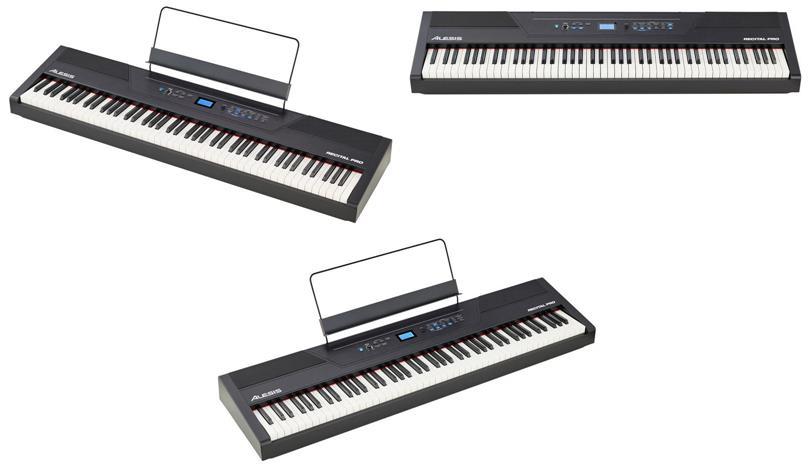
Now that we’ve looked the the characteristics, one function this piano lacks is that it doesn’t come with a sustain pedal as we said before, but it is important to emphasize this.
It is a piano with very powerful speakers, line output to play in large concerts and can run on batteries so it is a very well thought out piano to play outdoors without needing extra amplification. And all this at a very good price.
Now that we have listed and described the features of this keyboard there is no better way than to take a look at the following two videos I have selected where they tell us more about the Alesis Recital Pro and you can hear how its different sounds sound.
Now let’s compare the Alesis Recital Pro with its more common alternatives. Also, at the end of the post you will find a section with the best purchase possibilities for this keyboard. But you can go directly to that part of the post by pressing the next button.
Related post you can be interested in
- Ranking with the best digital pianos
- My selection of cheap musical keyboards.
- Basic concepts you need to know about digital pianos.
- The best resources to learn to play the piano by yourself.
Alesis Recital Pro vs Casio CDP S 100
This comparison is very interesting because they are two pianos that cost almost the same. The Alesis can be about 20 euros more expensive and both are designed to be very transportable.
I like the quality of the sounds of the Casio better and it is a piano designed to be lighter and take much less space. This can be important for several people.
The disadvantage of the Casio compared to the Alesis Recital Pro is that its speakers are less powerful, so for playing on the street the Alesis may be a better choice.
The quality of the materials used by Casio is more reliable. That’s true even though the Alesis brand has been stepping up to the plate with this model.
The polyphony of the Alesis is better, but the polyphony of the Casio CDP S100 is also sufficient to play most of the music that is available, and I really like the weighted keyboard of the Casio better.
On the other hand, the Casio comes with a sustain pedal and the Alesis does not.
In conclusion, I prefer the Casio CDP S100 to the fact that you will not be playing much in the street and want more power. Then the Alesis may be a better choice although the low weight of the Casio CDP S100 and its small dimensions make it a very valid option.
Another advantage of the Casio CDP S100 is that it supports battery operation
Here I show you a chart where all the technical characteristics of both models are shown:
|
Alesis Recital Pro |
Casio CDP-S100 |
|---|---|
|
|
And now a video of the Casio CDP S100 by a reader of the blog and surely gives you more information:
If you want to know more about this model, don’t miss our review of the Casio CDP-S100.
Alesis Recital Pro vs Yamaha P-45
The Alesis Recital Pro keyboard is usually about £115 cheaper than the Yamaha P-45, which usually ranges around €425/$499/£389. The Yamaha P45 is better in quality to the Alesis Recital and is a better choice if you want to learn piano and have a little more money. The Yamaha P45 is by far the best selling piano in its price range:
- Both keyboards could be considered digital pianos as they have 88 weighted keys, which is a fundamental feature of any professional piano keyboard or a good piano learning experience.
- The Yamaha P-45 features GHS technology, which scales the weighted piano keyboard into three sections for the lowest, middle and highest sounds, thus simulating the weight of the keys on a non portable piano.
- The Alesis Recital Pro presents a diversity of 12 sounds in front of the Yamaha P-45, which has 10 sounds. The sounds of Yamaha pianos also simulate these sounds from AWM (Advanced Wave Memory) technology and are of higher quality although they are less.
- The Alesis Recital Pro allows you to record your own songs or themes, which you can use as an accompaniment for future performances. This is an advantage of the Alesis.
- One of the strengths of the Alesis piano is its capacity for polyphony, 126 notes, as opposed to the Yamaha piano which only has 64 but the sounds are better sampled on the Yamaha P45.
- Both have a layering function.
- Reverb and Chorus functions in both models.
- In contrast, the Alexis Recital Pro has a modulation function. Modulation is the harmonic process by which the composer changes the tonality in the course of the piece.
- Both have USB MIDI, a feature that makes it essential to be able to connect it to our computer to record compositions in digital format and, with specialized software, be able to take out the scores. The Alesis has an extra USB connection that allows it to be connected to other devices such as an USB memory.
- One of the main strengths of the Alesis are the master-jack outlets they have. These connections allow them to be connected to powerful amplifying equipment, as the sound signal they carry is more powerful, and in most cases, of higher quality. At this point the Yamaha P-45 does not have this feature and only serves to listen to itself while you are studying and practicing alone, or accompanied by an instrument that is not very amplified.
- Both have headphone outputs to be able to study and practice without disturbing anyone: 6.3 mm jack output in the case of Alesis and minijack in the case of Yamaha
- The Alesis features the most powerful speakers, with one 20W for bass sounds and two additional 10W speakers. The Yamaha features a pair of speakers with 6W of power each. In both cases, this is enough power to play in rehearsal rooms with the accompaniment of an instrument without amplification. In this case, the Yamaha P-45 does not have an output for connection to an amplification system.
- A very positive point about both pianos is that they include a music stand to place our tablet or our scores.
- Both are lightweight pianos, with little difference (11.8kg for the Alesis and 11.5kg for the Yamaha). This makes them relatively easy to transport, as it is in a keyboard backpack of their dimensions. But nothing like the Casio CDP S100 in this respect.
- The special features of the Yamaha P-45 include its Master EQ, the IAC control for sound improvement, and the Duo mode that allows the piano to be converted into two keyboards so that two different people can play, for example a teacher and a student.
Although it has less polyphony factors such as the best weighted keys. The IAC and the quality of the sound sampling make the Yamaha P45 a much better real piano experience. While it is true that the Alesis is very good for playing on the street because of the power of its speakers (although of worse quality than those of the Yamaha)
The Alesis Recital Pro presents itself as a competitive piano for beginners and has all the advantages of connectivity offered by MIDI or its jack-master connectors for amplification. The price difference is also less than that of the Yamaha, which is a very considerable factor.
The Yamaha P-45 is characterized by the quality of its keyboards, and the touch that they offer. Also the quality of the Yamaha manufacturer and its prestige as one of the great piano manufacturers of history, are a guarantee of confidence. One of its strengths when considering your purchase, especially if you are a beginner, is the quality and guarantee of its materials.
Below I show you a chart where you can find all the technical characteristics of both models:
|
Alesis Recital Pro |
Yamaha P-45 |
|---|---|
|
|
And now a video of the Yamaha P-45:
If you want to know more about this model don’t miss our review of the Yamaha P-45.
Alesis Recital Pro vs Thomann SP-5600
The Alesis Recital Pro piano is usually about 55 euros cheaper than the Thomann SP-5600 (its price is about €369/£333). As we can see, the Alesis is still the most competitive on the market both in terms of price, and the features it provides accordingly. But the Thomann is not a negligible alternative, if you can’t afford the Yamaha P45 and you’re not going to move the keyboard much because of the batteries, the Thomann SP 5600 is a very important option.
The Thomann Sp-5600 offers:
- 88-key weighted keyboard like the Alesis, although the latter offers adjustable speed dynamics.
- 600 different sounds! This is a brutal variety, but we can’t disregard the ones offered by the Alesis, because their quality is also very good.
- 120 pre-recorded or demo songs.
- 230 styles, and 10 of them are configurable.
- More notes of polyphony: 128 notes against 126 for the Alesis.
- Duo mode: you can play with another person or with your piano teacher, and follow their hands and become a great pianist. And it incorporates two headphone or headset outputs so that you can listen to both.
- Reverb and Chorus effects. It also features Layer and Split functions. All these functions can be found in the two portable piano models.
- Master EQ equalizer. This feature is not found in the Alesis Recital Pro piano.
- DSP sound effects. The DSP is a processor that optimizes the speed of digital signal processing and allows almost instantaneous signal generation, making the sound emulation with respect to a mechanical piano of incredible quality.
- Sustain pedal and music stand. The Alesis Recita Pro does not have a built-in pedal.
- USB MIDI: essential for recording your songs on MIDI tracks as well as transcribing or composing your own songs in score from the piano. The only thing against it is that it doesn’t have an additional USB like the Alesis Recital Pro does.
- Mic IN: if the pianist is also a singer, you can connect the mic to the same piano and the voice comes out with the sound of the instrument.
- Weight and dimensions: a weight of almost 14 kg and dimensions of 1365 x 366 x 137mm (W x D x H) It is less portable and takes up more space than the Alesis Recital Pro, which weighs 11.8 kg and has dimensions of 1305 x 350 x 145mm.
In conclusion, the Thomann Sp-5600 model offers in many ways greater performance than the Alesis, especially in polyphonic notes, styles and demo songs. It also offers technical advantages such as the Master EQ and DSP sound effects. Also the possibility of connecting a microphone is an advantage if you are also a singer and composer. The Alesis does have as a different feature that’s the presence of an additional USB connector to that of the MIDI, which is not present in any of the other models I have discussed in this review.
Below I show you a chart where all the technical features of both models are listed:
|
Alesis Recital Pro |
Thomann SP-5600 |
|---|---|
|
|
And now a video of the Thomann SP-5600, so you can see how it sounds:
If you want to know more about this model don’t miss our review of the Thomann SP-5600
We can conclude that the Alesis Recital Pro portable piano is the most balanced in performance, especially considering the functionalities and connectivity with a PC for music composition and production that it offers. Especially if you are starting out in the world of pianos and have a budget to spend between 350 or 500 euros.
Where to buy Alesis Recital Pro
Amazon
- Free Shipping and possibility of shipping in one day with Amazon Premium.
- Full Guarantee but they are no experts in music equipment.
- Sometimes better price.
- He’s got worse stock than Thomann.
Thomann
- Best option at Europe.
- Free Shipping.
- Full warranty. If you have any problems, they take care of everything.
- 100% reliable payment.
- Leader in trouble-free shipping.
- Usually Best price.
- Best Reputation: They are the leading online store in Europe and have the best catalogue and information.
Check below related models with similar price and features:
- Thomann SP 5600
- Yamaha YDP 143
- Roland FP 30
- Yamaha YDP 163
- Yamaha YDP S52
- Hemingway DP 201 MKII
- Casio PX S1000
- Casio CDP S100
- Thomann DP 33
- Casio PX S3000
- Casio PX 870
- Yamaha YDP S54
- Yamaha YDP 144
- Korg B1
- Casio PX 360
- Casio PX 770
- Korg LP 380
- Korg C1 Air
- Casio CDP S350
- Thomann DP 32
- Yamaha YDP S34
- Korg LP 180
- Yamaha PSR EW410
- Korg PA 600
- Casio CT X5000
- Yamaha DGX 660
- Korg EK 50
- Yamaha PSR S670
- Yamaha PSR S775
- Roland 5
- Casio CT X3000
- Yamaha PSR A350
- Casio WK 7600
- Casio WK 6600
- Yamaha P45
- Yamaha P125
- Kawai ES 110
- Alesis Recital Pro
- Kurzweil SPS4 8
- Roland FP 10
- Korg D1
- Studiologic Numa Compact 2
- Korg SP 280
- Yamaha P121
- Studiologic Numa Compact 2x
- Roland GO PIANO 88
- Studiologic Numa Stage
Piano Digital Casio CDP S100 Review Complete. A good choice?
I had been waiting for the release of the Casio CDP 135 for a long time instead of its predecessor the Casio CDP 130 which was the cheapest weighted piano you could find.
For some reason, the Casio CDP 135 has not been launched in the same price range (about 300 euros) and the Casio CDP S100 has been released in Europe to compete with the Yamaha P-45. It’s a shame because the Casio PX 160 used to cost the same and it’s a wonder. Buy it if you still see it around. If you live in America check also for the new Casio CDP 135
Casio CDP S100 vs Casio CDP 130
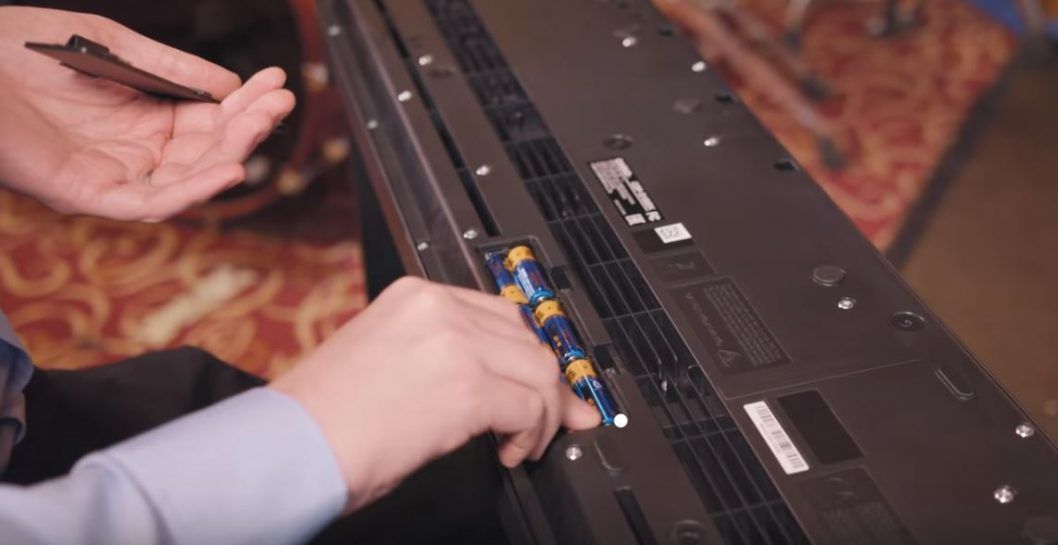
It must be said that the Casio CDP S100 is a good digital piano. And he’s got something very new. It is intended for transportation and playing outdoors. This makes him an article to consider. It weighs only 10.5 kg and is 30% smaller than its predecessor the Casio CDP 130. It also supports batteries. In this video below, he tells you what’s new.
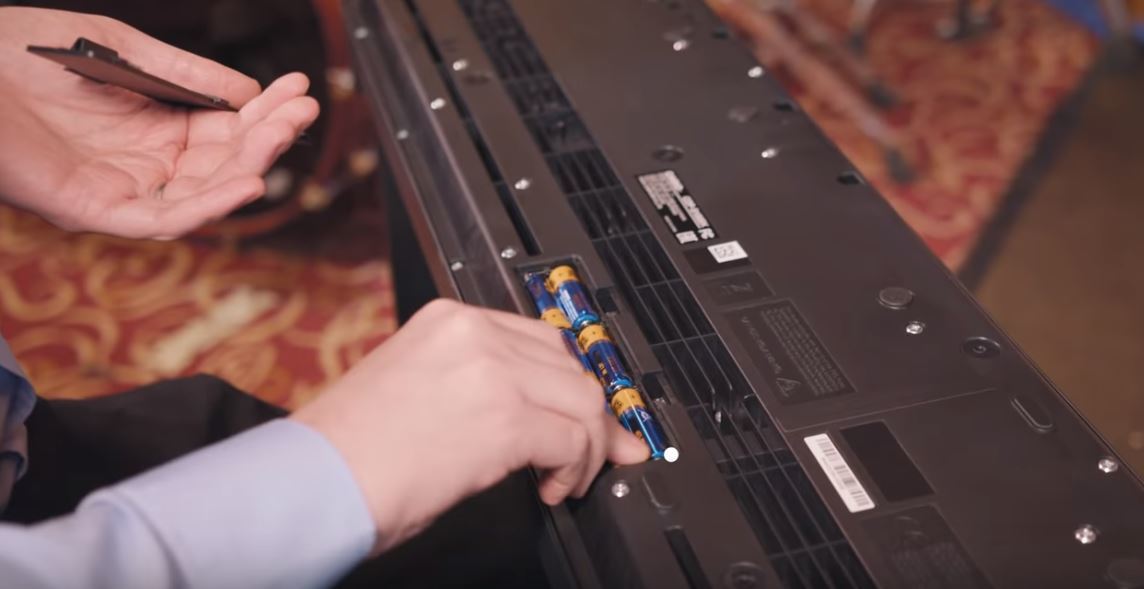
External small batteries
Also, it has:
- New and more modern counterbalance system (the keys are weighted so that the touch is like that of an acoustic piano)
- New touch less than imitates ivory on black keys.
- The sounds have a higher quality sampling. You can see it in the following video from minute 1:50
- It has an app to control the parameters of the piano. Very useful
- Very powerful 8W speakers
Sound
He’s got 10 piano sounds. Classic piano and some electric ones. It has a reverb and chorus effect to modify your sounds and give them more effective.
Its sound is quite acceptable and it’s perfectly good to start with. It has a correct sampling and competes with the Yamaha P45 in sound quality.
It has a polyphony of 64 notes which are the notes that can sound at the same time. Including accompaniments.
Connections
It has a USB MIDI to connect it to the computer and input for sustain pedal that is included.
It also comes with a sound input so you can connect a player and play over it. It’s very well thought out to move as we said before.
And of course a headphone jack.
Extra Functions
It has a layering function so you can play over other sounds. A very typical mix is usually piano + strings. So while you’re playing you have a stringed instrument accompaniment.
Of course, he does:
- Transposer
- Reverb
- Chorus
- Metronome
- 2 demo songs
- USB to Host Connection
- Dimensions: 1322 x 232 x 99 mm (W x D x H) – Much smaller than other pianos in its range.
Casio CDP S100 vs Yamaha P45
Here’s the big fight.
- The Casio CDP S100 has the same polyphony as the Yamaha P45.
- It weighs a kilogram less and is smaller. The speakers are more powerful.
- Comes with App to manage the keyboard and the Yamaha p45 not.
The truth is that Casio has done big damage to Yamaha with this new model. Although I like the GHS feel of the Yamaha, the portability of the Casio certainly makes me prefer it.
Casio CDP S100 vs Roland FP 30
In this case, there is no comparison. The Roland Fp 30 wins in all aspects but costs about 90 euros more.
Whether we compare the Casio CDP S100 vs Yamaha P125 or vs Kawai ES 110 or vs Roland FP 30 the comparison does not make sense because there is a price difference of around 100 euros. These pianos have more sounds, more polyphony, etc.
Is important that you have a look at my Best Digital Pianos Selection.
You have to think more about comparing the Yamaha P45 as a direct rival. In this, as we have said before, Casio wins if the objective is portability.
Casio CDP S100 vs Casio PX 160
The Casio PX 160 was a great piano for a budget similar to that of the CDP S100. If you find it in white color very cheap I recommend it because it has better polyphony but for now, the new flagship is the Casio CDP S100
Conclusion
If you are looking for a portable piano this is the best value for money by far.
Where to buy the Casio CDP S100?
Of course one of the best options is your country Amazon website, here the direct link. If you live in Europe check as well the Thomann Website
Amazon
- Free Shipping and the possibility of shipping in one day with Amazon Premium.
- Full Guarantee but they are no experts in music equipment.
- Usually better price.
Below check the Thomann link:
Shipping America with Thomann
Buy in America in a Safe Way and with all the Reliability given by the Germans of Thomann
If you are anywhere in America you can also benefit from Thomann’s guarantees. It is quite possible that you have purchased items in the USA or China but the Thomann store ships worldwide, and does so with leading companies such as DHL.
The prices of the items are cheaper and without VAT. You also have a full three year warranty and the certainty of your 30 day money back (you can return it without explanation and they will bear the shipping costs of the return).
In addition the delivery times are very reasonable. Normally 7 to 14 working days.
You will see that even adding the shipping costs + product price without VAT + customs if you inspect the article the final price is cheaper than elsewhere in your country.
Of course it is much cheaper than buying USA and the deal is much better.
If you are not inspected in customs you will get even cheaper. These customs costs have to consult each in their country. But still it is profitable and with all the reliability and know-how of the largest online musical instruments store in Europe and one of the world’s largest.