
- Home
- Author's Archive:

Digital Piano Casio CTK 1500 Full Review. Is it a good choice?
Casio Digital Piano CTK 1500 Review Complete: It is a good choice?
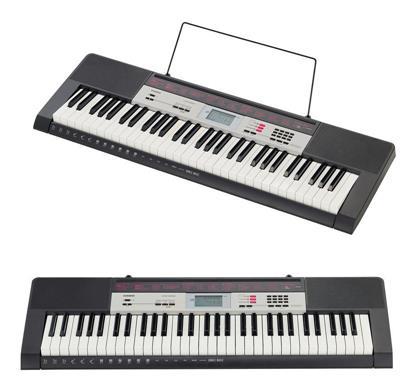
Casio Computer Co., Ltd. is an electronics manufacturer founded in 1946 and based in Tokyo, Japan. Now we will look at their CTK 1500 keyboard which is an excellent choice for beginners, and people who are learning to play the keyboard. It is the predecessor of the Casio CTK 1550 that we will compare later.
We’re talking about a keyboard that comes to cost about €95. Its price is usually under €100.
It’s a very competitively priced keyboard but it lacks the sensitivity on the keyboard to do dynamics, the midi and a sustaining pedal input. There are keyboards for little more money than if they bring all those things that I consider vital in a keyboard as you will see in the comparison.
It must also be said that the new Casio CTK 1550 has come out, which is basically the same as you will see in the comparisons.
Just go with the features of this popular keyboard due to its low price:
Features
- Musical keyboard with 61 keys.
- 32 notes of polyphony (number of notes that can be played at the same time). This includes the accompaniments that also consume notes. So if you play on top of an accompaniment more notes will be accumulated)
- 120 sounds. (Different sounds of piano and other instruments)
- Dance Music effects aimed at making electronic music.
- 50 Preset songs. (pre-recorded)
- 70 Preset types of rhythms. (Accompanying rhythms that adapt to what you are playing. There are bossa nova rhythms, etc. Sometimes they are also known as accompaniment styles) (to play over)
- Learning system: Left hand, right hand, both hands. (although not very useful actually)
- Transposition function (Transposition allows you to move the note spectrum of a keyboard. This is to be able to play with transposing instruments. It is not an easy concept but it is made to facilitate the writing of an orchestration for instruments with very different bass and treble registers)
- LC display to improve usability.
- Combined line and headphone output to plug it into a mixer.
- 2 x 2 W speaker system.
- Possibility of operation also with batteries.
- Very handy size (W x D x H): 946 x 307 x 92 mm.
- A very light weight of 3.3 kg (it’s one of the best you have).
- It has no MIDI-USB connection, which would allow a connection to the computer to be used as a MIDI controller in some music production program.
- It does not include a power supply, which has to be of the type AD-E95100.
Sound
Now that we have listed and described the features of this keyboard, there’s no better way than to take a look at the following video where they tell us more about the Casio CTK-1500 and you can hear how its different sounds sound.
You will surely be interested…
- See this section for possible discounts and offers
- Ranking with the best value for money digital pianos
- The cheapest keyboards to get started
- Learn piano for free
Now let’s compare the Casio CTK-1500 with its more common alternatives. At the end of the post you will also find a section with the best purchase options for this keyboard. But you can go directly to that part of the post by pressing the next button.
Related post you can be interested in
- Ranking with the best digital pianos
- My selection of cheap musical keyboards.
- Basic concepts you need to know about digital pianos.
- The best resources to learn to play the piano by yourself.
- The best Casio Digital Pianos.
Casio CTK-1500 vs. Casio CTK-1550
We will put the characteristics of each of these pianos in 2 different columns to make it easier to see the differences, although being from such a close series it has the same specifications, with the difference that the letters on the front panel are now in blue and the CTK 1500 is currently a discontinued model. Both have the same price and it does not make sense to buy the 1500 when the 1550 is on the market.
|
Casio CTK-1500 |
Casio CTK-1550 |
|---|---|
|
|
And now a video of the Casio CTK-1550 where we can hear how it sounds:
Casio CTK-1500 vs. Casio CTK-2500
We will put the characteristics of each of these pianos in 2 different columns to make it easier to see the differences:
- Both keyboards, due to their brand and series, are very similar. There is a slight difference of 30 ? between both and we will see if they are really worth it. The Casio CTK 1500 being an entry-level model has a value of €95, while the CTK 2500 going up a bit to the value of €120.
- Both keyboards have 61 keys that have no sensitivity.
- The CTK 1500, has 120 integrated sounds, including keyboards, guitars, trumpets, etc. and are very electronic sounds, while the 2500 has the same sound quality but in a wider variety, reaching 400.
- In the 1500 we find 50 preset songs, and in the 2500 we have 60. Also speaking of rhythm presets, the 1500 offers 70, while the 2500 gives us 100.
- Other relevant differences are that the CTK 1500 does not include a metronome, while the CTK 2500 does. Finally, the CTK 1500 does not have a sustain pedal input, whereas the CTK 2500 does.
The other features are very similar: both have a learning system, LC screen, same speakers and weight.
The main differences that justify this price difference are:
|
Casio CTK-1500 |
Casio CTK-2500 |
|---|---|
|
|
And now a video of the Casio CTK-2500 where we can hear what it sounds like:
Casio CTK-1500 vs Casio CTK-3500 (the new one is the Casio CT S300)
First of all, we would like to say that the new version of this keyboard is the Casio CT S300, but the comparison we make applies to both:
The price of the CTK 1500 is €95, and the CTK 3500 is €150, being almost double the value of the first one we will check if the price increase is equivalent to what it offers. Although I already advance you that it is worth it because it brings what I consider essential in a keyboard that is sensitivity in the keys, MIDI and sustain pedal input at a very good price.
- Both keyboards have 61 keys, however the CTK 3500 has touch sensitivity, that is, if you press a key hard, it will sound higher, while if you play a note gently it will sound lower.
- The CTK 1500 has 32 notes of polyphony, the CTK 2500 provides 48. Polyphony means the number of notes that can be played at the same time.
- The CTK 1500 offers 120 sounds, while the CTK 3500 offers 400 sounds.
- Both include pre-recorded songs in demo form, the CTK 1500 has 50, while the CTK 3500 gives 60. Speaking of preset rhythms, the CTK 1500 offers 70, and the CTK 3500 includes 100.
- Both have a learning system, which indicates where to play with the right or left hand.
- One relevant difference is that the CTK 3500 has a USB-MIDI connection, which means that it can be used as a MIDI controller in music production programs, a feature that is missing from the CTK 1500.
- The CTK 3500 also features: metronome, Pitch Bend (wheel for changing the pitch of a note), sustain pedal input, and also includes the power adapter. Things not included in the CTK 1500.
We will put the characteristics of each of these pianos in 2 different columns to make it easier to see the differences:
|
Casio CTK-1500 |
Casio CTK-3500 |
|---|---|
|
|
And now a video of the Casio CTK-3500 for you to hear what it sounds like:
If you want to know more about this model, don’t miss our review of the Casio CTK-3500
Casio CTK-1500 vs Yamaha PSR F51
First we will talk about its price. The Casio CTK 1500 has a value of €95, while the Yamaha PSR F51 has a value ranging from €100 to €120/$150 depending on the store. This means that we have an increase of 30 Euros more. Let’s find out if it’s worth this increase in price.
- Both are 61-key keyboards and have 32 polyphonic notes, remember that polyphony refers to the number of notes that can be played at the same time.
- In both keyboards we find 120 sounds, at the end of this comparison there is a video where the sounds of the Yamaha PSR F51 are shown, noticing that being of different brands, their sounds also change.
- In the preset songs we find that the CTK 1500 has 50, and the Yamaha PSR F51 has 30, in the accompaniment preset rhythms the Casio has 70 and the Yamaha includes 114.
- Both have a learning system, the Casio with different hands (right and left) and the Yamaha, a Duo system, in which it allows two people to play the keyboard at the same time.
- One difference is that the Casio has 2W speakers, while the Yamaha has 2.5W speakers. Slightly more powerful.
- In the measurements, we have the Casio with (W, D, H) 946 x 307 x 92 mm with a weight of 3.3kg and the Yamaha with 990 x 380 x 160 mm and its weight is 3.4kg.
- Finally, the Casio does not include the power pedal, unlike the Yamaha, which does.
We will put the characteristics of each of these pianos in 2 different columns to make it easier to see the differences, which are quite competitive:
|
Casio CTK-1500 |
Yamaha PSR F51 |
|---|---|
|
|
Here is a video of the Yamaha PSR F51:
And if you want more information you can visit our review of the Yamaha PSR F51
Casio CTK-1500 vs Startone MK-300
Now we will have a versus with the Casio CTK 1500, which we have already mentioned has a value of €95 and the Startone MK-300 with a price of €115/£102.
- Both keyboards have 61 keys, however on the Startone we find that they have sensitivity, i.e. if we play with more or less force, the note volume will increase or decrease proportionally.
- In the Casio we have 32 polyphonic notes and in the Startone 64. Remembering that polyphony, is the amount of notes that can sound at the same time.
- The Casio has 120 sounds, with 70 rhythms to accompany, while the Startone has 390 sounds and 110 rhythms/styles to accompany.
- The Casio has 50 preset songs, and the Startone has 110 songs.
- The Startone’s highlights are: 4 track recording, Metronome, Pitch Bend wheel, and sustain pedal input. Of which the Casio CTK 1500 does not have.
- The Casio has 2W speakers, while the Startone offers 10W speakers.
- Finally, the Startone, which includes the power adapter, has a MIDI USB connection, which can be connected to a computer to use it as a MIDI controller. Where the Casio makes these features more expensive.
We will put the features of each of these pianos in 2 different columns to make it easier to see the differences:
|
Casio CTK-1500 |
Startone MK-300 |
|---|---|
|
|
And now a video of the Startone MK-300
If you want to know more about this model don’t miss our review of the Startone MK-300
Where to buy Casio CTK 1500
Amazon
- Free Shipping and possibility of shipping in one day with Amazon Premium.
- Full Guarantee but they are no experts in music equipment.
- Sometimes better price.
- He’s got worse stock than Thomann.
Thomann
- Free Shipping.
- Full warranty. If you have any problems, they take care of everything.
- 100% reliable payment.
- Leader in trouble-free shipping.
- Usually Best price.
- Best Reputation: They are the leading online store in Europe and have the best catalogue and information.
Check below related models with similar price and features:
- Thomann DP 26
- Thomann SP 320
- Yamaha NP 32 Piaggero
- Korg Tiny Piano
- Startone MK 300
- Startone MK 200
- Yamaha PSR E463
- Yamaha PSR E363
- Startone MKR 61
- Roland GO KEYS
- Casio SA 46
- Casio SA 47
- Casio CTK 240
- Casio CT X700
- Yamaha EZ 220
- Yamaha PSR E263
- Yamaha PSR EW300
- Casio LK 280
- Casio SA 76
- Casio CTK 3500
- Casio LK 265
- Casio LK 136
- Casio CTK 1500
- Casio SA 77
- Yamaha sonogenic SHS 500
- Casio SA 78
- Casio CTK 2500
- Yamaha YPT 260
- Roland GO PIANO
- Midiplus Stage 88
Did you like this post? > > > [/one_half_first]
Digital Piano Casio CTK 240 Full Review. Is it a good piano?
Casio Digital Piano CTK-240 Review Complete – Is it a Great Choice?
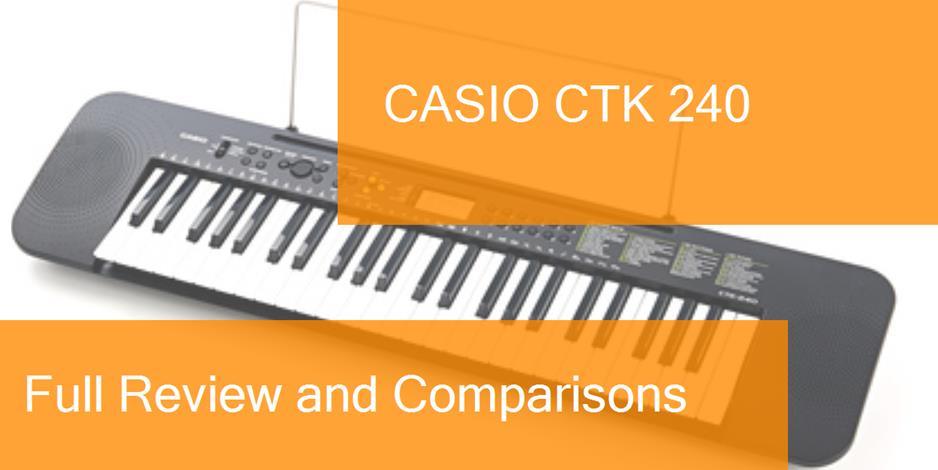
Casio Computer Co., Ltd. is an electronics manufacturer founded in 1946 and based in Tokyo, Japan. Now let’s take a look at the Casio CTK – 240, a beginner’s keyboard, and at a very affordable price €73/$70/£66, one of the lowest on the keyboard market (we could find it for about 80 Euro at the time of reviewing this article). It offers the following features:
- 49 keys without sensitivity or weighted keys.
- 12 notes of polyphony (Number of notes that can be played at the same time. This includes accompaniments that also consume notes. So if you play on top of an accompaniment, more notes will be accumulated).
- 100 sounds (Different sounds of piano and other instruments).
- 100 styles (accompaniment styles that adapt to the chords we are playing. For example they will put a bass and a drum kit that will adapt and synchronize with the notes we are playing on the keyboard).
- 50 pre-recorded internal songs.
- LCD display improves usability and makes it easier to operate.
- 2 not very powerful speakers of 1.6W.
- Works only with batteries. We will need to have a very good rechargeable battery and a battery charger suitable for these.
- A very light weight of 2.8kg.
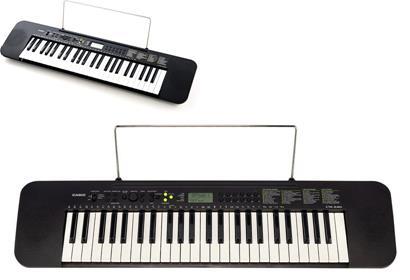
It is offered as one of the cheapest keyboards from one of the most well known and respected manufacturers. It is a basic one, and it would only be recommended if you don’t want to spend a lot of money on a first hand instrument and want to try it out.
Now that we have listed and described the features of this keyboard, there’s no better way to do so than to take a look at the following video where they tell us more about the Casio CTK-240 and you can hear how its different sounds sound.
Related post you can be interested in
- Ranking with the best digital pianos
- My selection of cheap musical keyboards.
- Basic concepts you need to know about digital pianos.
- The best resources to learn to play the piano by yourself.
- The best Casio Digital Pianos.
It has no sustain pedal possibility. This is a drawback, since this type of pedals are necessary so that the notes can continue to play after their key is pressed, and provide musical and sound continuity to our performances.
Now let’s compare the Casio CTK-240 with its more common alternatives. At the end of the post you will also find a section with the best purchase options for this keyboard. But you can go directly to that part of the post by pressing the next button.
Casio CTK-240 vs Startone MK-200
We will compare the Casio CTK- with a similarly priced model, the Startone MK-200. The price difference can be about 17 Euro but it is so small that it can change. The price you can find the Startone MK-200 starts at about €89/£79.
We are talking about keyboards similar in price, but very different in features. We will highlight the most important ones:
- The number of keys on the Startone MK-200 is greater: 61. They also have touch sensitivity, which allows the volume of the notes played on each key to be adjusted to the force of the touch. This feature is not found on the Casio keyboard.
- Greater repertoire of sounds and musical styles: 320 sounds and 110 styles offered by the Startono MK-200 compared to 100 sounds and 100 songs offered by the Casio CTK-240. This greater variety allows greater musical experimentation.
- The Casio offers fewer notes for polyphony: 12 notes compared to 32 notes for the Startone. This is important, as it greatly limits the number of notes that can be played on the keyboard at the same time.
- The Startone offers 100 demo or pre-recorded songs to accompany with your keyboard, while the Casio only offers half.
- The Startone offers dual mode that allows the keyboard to combine two sounds that sound at once to create a more complete one, for example piano with a string instrument sound. And split mode, which allows you to play two or more instrument sounds on one keyboard, but have different keys and keyboard sections to play. There are also no similar features on the Casio CTK-200.
- Keyboard division mode: Allows the keyboard to be divided into two equal keyboards with half of the keys, so that it can be played by two people at the same time, like a teacher and student.
- The Startone includes a metronome while the Casio does not. This is important, as it is a function that serves to control the musical rhythm of your performances, especially during learning.
- The Casio’s speakers are 1.6W, a low power that only allows the piano to be heard in a small room without much noise. The Startone has 3W speakers, a power that allows a much better hearing of the keyboard.
- The Casio CTK-240 is only battery operated, while the Startone MK-200 also offers a connector for electrical power. This means that the keyboard does not have to rely solely on batteries.
- The Startone is the only one of both keyboards that offers headphone output, which allows you to hear only yourself play, and a MIDI connection, which is used to connect to the computer and work with software for learning, composing and producing music, and/or to take out the scores of your songs.
- The weight of the Casio CTK-240 is the best feature (it weighs 2.3Kg) compared to the Startone MK-200n, which weighs 4.5kg. Still, the weight of the Startone is light enough for a keyboard of its characteristics.
- The Startone includes a sustain pedal input, but not the pedal.
With all these features, the Startone MK-200 is offered as a more powerful keyboard than the Casio CTK-240 and a very small price difference (less than €20).
The Casio CTK-240 can be offered as an entry-level keyboard for a person who wants to start playing a keyboard instrument, or wants to try out the experience, and not leave himself a large sum of money for it. However, if you want a keyboard with more advanced capabilities, such as a MIDI connection or a sustaining pedal, we recommend the Startone MK-200. For that 20 euros, the amount of features it comes with is very good.
It must be said that the Yamaha brand is more reliable than Startone in terms of reliability. And by that I mean that the components will last you a little longer. So if you find a price difference of more than 20 euros and you just want to experience the Yamaha can the best cheap option.
We will put the characteristics of each of these pianos in 2 different columns to make it easier to see the differences:
|
Casio CTK-240 |
Startone MK-200 |
|---|---|
|
|
There is no video of the Startone MK 200 but its sound engine is practically the same as the Startone MK 300 (that you will find in the next comparison) so we leave you with this video where you can listen to a very famous song with strings accompaniment:
If you want to know more about this model do not miss our review of the Startone MK-200.
Casio CTK-240 vs Startone MK-300
The differences that we can observe between the Casio CTK-240 and the Startone MK-300 are the same as the case of the Startone MK-200, but allowing better performance and quality and it’s around €115/£102. The Startone MK-300 is the superior model to the MK-200 and offers some additional features:
- Pitch Bend Wheel: Functionality that changes the sound wave of what you play and then returns to its original state.
- 10W speakers: Enough power to be accompanied by an instrument that requires little or no amplification, such as a guitar. But not others, like a drum set.
- Improved style and sound quality.
The price of the Startone MK-300 can be found from €115/£102 (price at review sheet of this article) and differs from the Casio CTK-240 by about €40. If your budget is not tight, we recommend that you opt for this model or the MK-200.
We will put the characteristics of each of these pianos in 2 different columns to make it easier to see the differences:
|
Casio CTK-240 |
Startone MK-300 |
|---|---|
|
|
And now a video of the Startone MK-300 to hear how it sounds
If you want to know more about this model don’t miss our Startone MK-300 review
Casio CTK-240 vs Casio CTK-1550 (formerly Casio CTK 1500)
In this comparison we will talk about two Casio model keyboards. The price of this keyboard is about €90 which means a difference of about €15 with the CTK-240 that is around €73/$70/£66. We are going to highlight the main differences of both keyboards:
- The CTK-1500 offers more keys, 61 compared to CTK-240 which has 49 keys. This is important, because the more keys, the more compositions we can play on one keyboard.
- The Casio CTK-1500 offers more polyphonic notes, 32 notes, compared to only 12 notes on the CTK-240.
- More sounds in the CTK-1500 (120 sounds versus 100 sounds in the CTK-240).
- Slightly more powerful speakers: 2W in the CTK-1550 and 1.6W in the CTK-240.
- Exclusive to the CTK-1500 is the transducer function, and the combined line and headphone output: this enables the CTK-1500 to be connected to a mixing console.
- Both are lightweight keyboards: 2.8 kg for the CTK-240 and 3.3 kg for the CTK-1550.
- Bad power options: The CTK-240 is only battery operated and the CTK-1550 does not have a power supply, which must be purchased separately.
- The CTK-1500 offers a powerful range of dance sounds.
We will put the characteristics of each of these pianos in 2 different columns to make it easier to see the differences:
|
Casio CTK-240 |
Casio CTK-1500 |
|---|---|
|
|
And now a video of the Casio CTK-1550 that has the same sounds:
If you want to know more about this model don’t miss our review of the Casio CTK-1500
The Casio CTK-1500 offers a wider range of styles and rhythms than the Casio CTK-240, especially dance rhythms. If you are looking for a keyboard with this feature, this may be a suitable model. If your budget is tight and you have enough of the basic features, the CTK-240 may be sufficient.
However, they are keyboards that lack keyboard sensitivity and MIDI connection. If you are looking for a keyboard that is more like playing a piano (like the keys have sensitivity) or you can connect it to the computer with MIDI and specialized software to learn to play the piano, compose and produce your music or get your song scores, we recommend that you consider one of the Startone keyboards, the MK-200 or MK-300, or the Yamaha PSR-E363 that we will discuss in the last comparison.
If you can put in a little more money. The Yamaha PSR E363 below is by far the most recommended:
Casio CTK-240 vs Yamaha PSR E363
In this comparison we will compare the Casio CTK-240 with a Yamaha keyboard, the PSR-E363, which can be found at a first hand price of about €198/$400 (PKS, Professional Kit Stand)/£180. The price difference is the most substantial among the pairs of keyboards we have analyzed, as it is over 100 Euro. Although the price difference is the highest so far, the Yamaha PSR-E363 is one of the most recommended (or lower-middle-market) keyboards sold for value. This Yamaha can be found many times for 150 euro , although now in Coronavirus time there are usually no offers and it is usually in the 160/ 180 euro range
While the Casio CTK-240 is a recommended instrument as a first keyboard for beginners and if you don’t want to spend a lot of money at first. The Yamaha PSR-E363 is offered as a great digital keyboard for learning for a couple of years and as an auxiliary keyboard that can accompany you for a long time.
We can highlight the following differences between the Yamaha PSR-E363 and the casio CTK-240
- The largest number of keys. The PSR-E363 has 61 keys, which means that more songs can be played than the CTK-240, which only has 49 keys. And the Yamaha PSR E363 has remarkable key sensitivity for its price.
- The Casio CTK-240 offers only 12 notes of polyphony, while the Yamaha PSR-E363 has 48 notes.
- The Yamaha PSR-E363 offers a wider repertoire of sounds, styles and songs. The Yamaha has 574 sounds, 165 styles and 154 demo or pre-recorded songs. While the Casio CTK-240 offers 100 songs, 100 styles and 50 demo or pre-recorded songs.
- Similar speaker power: The Casio CTK-240 has 1.6W speakers, while the Yamaha has 2.5W. In both cases, it’s just enough power for listening to your keyboard in a closed room.
- The Yamaha PSR-E363 can be connected to mains power and batteries. The Casio TK can only be operated with batteries.
- The Casio CTK-240 is a very portable keyboard weighing 2.8 kg and measuring 914 x 237 x 75 mm (W x D x H). The Yamaha is offered as heavier (4.6kg) and bulkier (dimensions 945 x 368 x 118mm). These physical differences are understandable, as the Yamaha is a keyboard with a larger number of keys and offers more features that translate into more electronics.
As exclusive to the Yamaha PSR-E363:
- Touch-sensitive keyboard as mentioned above. This is important for playing with nuances.
- It features Reverb and Chorus effects, a Master EQ equalization system, and the ability to perform arpeggios (musical phrases or sequences that can be played and played easily by pressing a key).
- It has an internal metronome and transposition (it allows you to move a whole sequence of notes to another pitch or frequency).
- Duo function: Allows the keyboard to become two different keyboards, so it can be played by two people at once, like a teacher and a student. A very useful function if you are a beginner or are just starting to play a keyboard. It is very similar to the keyboard partitioning feature of the Startone MK-200 and MK-300 keyboards.
- Sustain pedal input, we remember, this is important, as this pedal allows the notes we play to continue to sound for a while after they are played.
- It includes a music stand to support a tablet or your scores.
- Auxiliary mini-jack input to connect a microphone, an instrument or any electronic device to the keyboard so that it can play its audio through the keyboard as an accompaniment.
- USB MIDI: this connector will allow us to record in MIDI by connecting them from the keyboard to the computer. This way we can do such wonderful things as being able to record our songs on MIDI-compatible tracks or get our scores out with specialized software.
- Headset output. It allows you to listen to yourself while playing the keyboard, without disturbing anyone.
We are going to put the characteristics of each of these pianos in 2 different columns so that it is easier to see the differences and you can see that the PSR E-363 is not really a typical keyboard as such but it has interesting options.
|
Casio CTK-240 |
Yamaha PSR E363 |
|---|---|
|
|
And now a video of the Yamaha PSR-E363
If you want to know more about this model don’t miss our review of the Yamaha PSR-E363
In conclusion, the Casio CTK-240 is offered as a very basic keyboard, which can be useful for those who want a keyboard for learning to play with minimal functions. It is advantageous in terms of its low price and its weight, which is very light.
On the other hand, it doesn’t have some features that are very useful in electronic keyboards that we can see in the Startone and Yamaha models: sustain pedal input, headset output, MIDI connection and including lectern.
Where to buy Casio CTK 240
Amazon
- Free Shipping and possibility of shipping in one day with Amazon Premium.
- Full Guarantee but they are no experts in music equipment.
- Sometimes better price.
- He’s got worse stock than Thomann.
Thomann
- Free Shipping.
- Full warranty. If you have any problems, they take care of everything.
- 100% reliable payment.
- Leader in trouble-free shipping.
- Usually Best price.
- Best Reputation: They are the leading online store in Europe and have the best catalogue and information.
Check below related models with similar price and features:
- Thomann DP 26
- Thomann SP 320
- Yamaha NP 32 Piaggero
- Korg Tiny Piano
- Startone MK 300
- Startone MK 200
- Yamaha PSR E463
- Yamaha PSR E363
- Startone MKR 61
- Roland GO KEYS
- Casio SA 46
- Casio SA 47
- Casio CTK 240
- Casio CT X700
- Yamaha EZ 220
- Yamaha PSR E263
- Yamaha PSR EW300
- Casio LK 280
- Casio SA 76
- Casio CTK 3500
- Casio LK 265
- Casio LK 136
- Casio CTK 1500
- Casio SA 77
- Yamaha Sonogenic SHS 500
- Casio SA 78
- Casio CTK 2500
- Yamaha YPT 260
- Roland GO PIANO
- Midiplus Stage 88

Digital Piano Casio CDP S350 Full Review. Is it a good keyboard?
Digital Piano Casio CDP S350 Full Review. Is it a good choice?
A digital piano that surpasses in many ways other previous models and is the best options for professionals, with more than 64 polyphonic voices as well as 700 sounds, 200 rhythms and 300 musical presets, the Casio CDP S350 is one of the digital pianos that competes and has an advantage in the market, today we will review the characteristics of it. It costs around €488/
- 88 weighted Keys with scaled Hammer Action (The weight of the keys on an acoustic piano that digital pianos try to imitate to match the touch of a real acoustic piano. The keys in the high register are heavier and in the high register less. This is a different concept of sensitivity on the keyboard that serves to regulate the volume of the note. But a hammer action keyboard always has sensitivity on the keys.)
- 64 Voice polyphony (Number of notes that can sound at once. This includes songs that sound at once. So if you play over an accompaniment sound, more notes will accumulate.)
- 700 Sounds (Different sounds of piano and other instruments), 200 Rhythms, 10 User Rhythms, 310 Music Presets
- 32 Slots Registration memory
- Split (Split the keyboard into two different instruments) function
- Layer function
- Apps to manage the piano(Chordana Play for Piano)
- Metronome (Element of basic study to study and practice the tempo of a piece of music.)
- Transposer (Transposition allows you to move the note spectrum of a keyboard. This allows you to play with transposing instruments. It is not an easy concept but it is made to facilitate the writing of an orchestration for instruments with very different bass and treble registers.)
- reverb (Reverberation effect which is a reflection effect of the sound) and Chorus effects
- pitch bend (Functionality that changes the sound wave of what you play and then returns to its original state) wheel
- LCD screen
- Power saving mode
- Usb to Host (It’s a more modern MIDI connector. MIDI allows you to do such wonderful things as connect the keyboard to the computer, record a soundtrack and with certain programs pass with a single click what you have played to musical notes in a score. MIDI tracks store note information)
- USB to device
- Headphone output
- Line-in audio input
- pedal (The most important pedal of a piano or keyboard is the sustain pedal and is used to keep the note playing even if you stop pressing the key.) connection
- 2 Loud-speaker of 8 Watt
- Dimensions (W x D x H): 1322 x 232 x 99 mm and a weight of 10.9 kg
- SP-3 pedal included
- Power supply included (battery operation possible)

Now that we’ve listed and described the features of this digital piano there’s no better than taking a look at the following video where they tell us more about the Casio CDP S350 and you can hear the different sounds of this piano.
Related post you can be interested in
- Ranking with the best digital pianos
- My selection of cheap musical keyboards.
- Basic concepts you need to know about digital pianos.
- The best resources to learn to play the piano by yourself.
- The best Casio Digital Pianos.
Now let’s compare the Casio CDP S350 with its more common alternatives. Also at the end of the post you will find a section with the best shopping possibilities for this digital piano. But you can go directly to that part of the post by pressing the following button.
Casio CDP S350 vs Casio PX 360
A more focused model for studio pianists is the PX 360 which has among all its features a DSP function and more polyphonic voices, but the Casio CDP S350 model has many more functions such as many more sounds and rhythms for a considerably lower price.
The digital piano Casio CDP S350 is usually about 250 € cheaper than Casio PX 360.
Let’s put the features of each of these pianos in 2 different columns to make it easier to see the differences
|
Casio CDP S350 |
Casio PX 360 |
|---|---|
|
|
And below a video of the Casio PX 360
If you want to know more about this model do not miss our Casio PX 360 review
Casio CDP S350 vs Korg B1
Comparing it with the Korg B1 we find that the Korg has some deficiencies like not carrying MIDI as well as a limitation on the effects it brings, however the Casio CDP S350 innovates in several of these matters bringing 64 polyphonic voices as well as more than 700 sounds, 200 rhythms and 300 presets of music.
The digital piano Casio CDP S350 is usually about 230 € more expensive than Korg B1.
Let’s put the features of each of these pianos in 2 different columns to make it easier to see the differences
|
Casio CDP S350 |
Korg B1 |
|---|---|
|
|
And below a video of the Korg B1
If you want to know more about this model do not miss our Korg B1 review
Casio CDP S350 vs Korg SP 280
A more modern model than the latter, the Korg SP 280 has more polyphonic voices and also several levels of sensitivity compared to the Casio CDP S350 which has many more registers of sounds as well as rhythms, having also functions such as a power saving mode and a layer function.
The digital piano Casio CDP S350 is usually about 34 € more expensive than Korg SP 280 (it costs around €584/$699/£539), but with so little price difference this can vary.
Let’s put the features of each of these pianos in 2 different columns to make it easier to see the differences
|
Casio CDP S350 |
Korg SP 280 |
|---|---|
|
|
And below a video of the Korg SP 280
If you want to know more about this model do not miss our Korg SP 280 review
Casio CDP S350 vs Roland FP 30
Comparing the Casio CDP S350 with the Roland FP 30 we find that both have almost the same functions with the exception that the Casio model surpasses the Roland having more than 700 voices as well as more than 200 rhythms, the Roland on the other hand stands out for having a Playback system via MIDI that is perfect for live performances.
The digital piano Casio CDP S350 is usually about 34 € more expensive than Roland FP 30 (it costs around €625/$729/£566), but with so little price difference this can vary.
Let’s put the features of each of these pianos in 2 different columns to make it easier to see the differences
|
Casio CDP S350 |
Roland FP 30 |
|---|---|
|
|
And below a video of the Roland FP 30
https://www.youtube.com/watch?v=62_LCDLQsU4
If you want to know more about this model do not miss our Roland FP 30 review
Where to buy Casio CDP S350
Thomann
- Free Shipping.
- Full warranty. If you have any problems, they take care of everything.
- 100% reliable payment.
- Leader in trouble-free shipping.
- Usually Best price.
- Best Reputation: They are the leading online store in Europe and have the best catalogue and information.
Amazon
- Free Shipping and possibility of shipping in one day with Amazon Premium.
- Full Guarantee but they are no experts in music equipment.
- Sometimes better price.
- He’s got worse stock than Thomann.
Check below related models with similar price and features:
- Thomann SP 5600
- Yamaha YDP 143
- Roland FP 30
- Yamaha YDP 163
- Yamaha YDP S52
- Hemingway DP 201 MKII
- Casio PX S1000
- Thomann DP 33
- Casio PX S3000
- Casio PX 870
- Yamaha YDP S54
- Yamaha YDP 144
- Korg B1
- Casio CDP S100
- Casio PX 360
- Casio PX 770
- Korg LP 380
- Korg C1 Air
- Casio CDP S350
- Thomann DP 32
- Yamaha YDP S34
- Korg LP 180
- Korg PA 600
- Casio CT X5000
- Yamaha DGX 660
- Korg EK 50
- Yamaha PSR S670
- Yamaha PSR S775
- Yamaha PSR EW410
- Roland 5
- Casio CT X3000
- Yamaha PSR A350
- Casio WK 7600
- Casio WK 6600
- Yamaha P45
- Yamaha P125
- Kawai ES 110
- Alesis Recital Pro
- Kurzweil SPS4 8
- Roland FP 10
- Korg D1
- Studiologic Numa Compact 2
- Korg SP 280
- Yamaha P121
- Studiologic Numa Compact 2x
- Roland GO PIANO 88
- Studiologic Numa Stage