
- Home
- Author's Archive:
Digital Pianos Kawai CN27 Review. A Good Choice?
Review Kawai CN27: Where to Buy and Opinion
The Kawai CN27 is a digital piano at an affordable price with great features such as hammer action keys, high-quality piano sounds from Kawai libraries, Bluetooth connectivity, and sleek design.
The Kawai brand is currently making a name for itself in the digital piano market by presenting interesting models in affordable and accessible ranges, but also large high-end models with incredible performance, in addition to its fairly renowned acoustic pianos in which it already amasses a great experience of almost 100 years.
Where to buy it CN 29?Notice that new model Kawai CN 29 has come to live. So i update “where to buy” links to the new one. They are almost the same. So everything you read in this post is valid. Have the look to my review of the new Kawai CN 29 here
The mechanism of the Kawai CN27

I’m sure you’ll be interested in…
- Ranking with the best digital pianos in quality-price ratio
- The cheapest musical keyboards for beginners
- Learn piano by yourself and for free
Kawai’s CN line of pianos features hammer action keys, emulating the keys of an acoustic piano.
This mechanism is called “Responsive Hammer III” and is the most recent action technology launched by the Kawai brand in search of the most faithful possible emulation of acoustic piano keys with plastic keys.
These keys emulate very well the sensation of ivory and each of its 88 keys has a weight to recreate the sensation of playing an acoustic piano very well.
Also, to be more precise in the emulation the keys are graduated according to their height, the lower ones being much heavier, and as they go up, they start to become lighter, this seeks to emulate the acoustic pianos, where the hammers of the lower notes are longer and become shorter as the notes go up.
It also has two loudspeakers of 12 centimeters with a power of 20W each. More than enough to rehearse and play in a medium-sized restaurant.
The sound of the Kawai CN27
This digital piano features 19 sounds including several acoustic piano sounds, meticulously sampled in stereo from Shigeru Kawai SK-EX and Kawai EX pianos, concert pianos of the brand’s highest range today.
These piano sounds have emulation in the resonance of the damper pedal and in the resonance of the strings.
It also has electronic pianos, organs, strings, choirs, and pads in its list of sounds.
In this digital piano, it is possible to make use of the Dual function that allows putting a different sound in two sections of the keyboard, in addition, the function “Four Hands” or four hands, that allows dividing in keyboard in 2 independent sections of 44 keys, very useful so that the teachers and students can play at the time.
It has 6 types of reverb and effect to enhance the brightness of the sound.
Kawai CN27 Learn Mode
This piano has a system of lessons with studies by Czerny, Burgmüller, and Beyer, as well as a collection of songs from the book “Alfred’s Basic Piano”. (These books are sold separately)
Thanks to the system that includes this piano, each hand can be practiced separately, the metronome can also be graduated to practice at the necessary speed and finally, the lesson can be recorded for self-evaluation.
The Bluetooth connectivity of the Kawai CN27
In addition to the traditional USB and MIDI ports, the Kawai CN27 allows through Bluetooth, the connection with supported devices.
Once related to a smartphone, a tablet, or a computer, the possibilities in this instrument expand, with a range of educational applications, live performance, or score writing.
The Kawai Virtual Technician control application is available for free download and provides an intuitive way to learn and adjust various features of this piano from a touch interface, without the need for additional cables or adapters.
Kawai CN 29 vs Kawai CN 27
They are almost the same. Al least in the mean features. Just some improvements in apps and a better let-off effect on the keyboard. Anyway, the new model is at the same price. So no doubt what to buy
Kawai CN27 vs Kawai KPD110
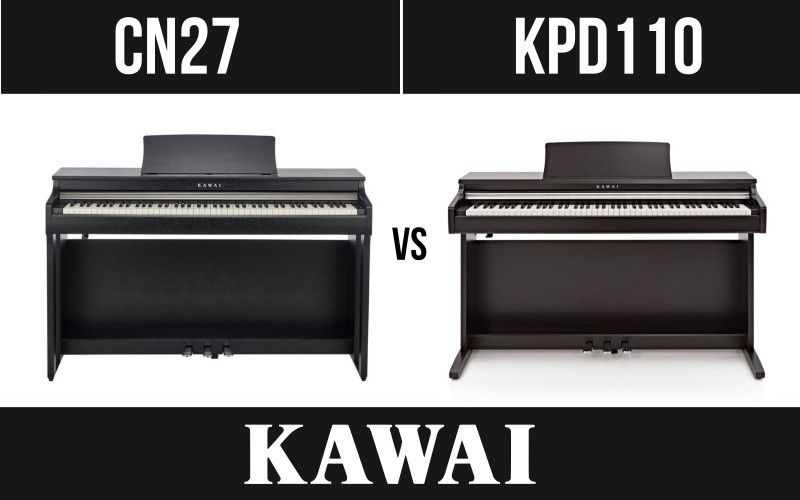
While the Kawai CN line refers to high-quality digital pianos, the KPD line belongs to the most economical line of digital pianos of the Kawai brand, therefore, with fewer features.
Both teams share features such as the pedal system, amount of reverb, brightness emulation, loudspeakers, and headphone output.
Their main differences are:
- The keys of the CN27, are of better quality because they have weighted keys in all the keys, more hardness in the lower keys and sensation of ivory in the keys, specifications not available in the keys of the Kawai KPD110.
- While the CN27 features 2 high-quality stereo-sampled pianos, the SX-EX and EX, acoustic pianos from the brand’s highest range, the KPD110 has only the SX-EX.
- The CN27 emulates the 2-factor resonance, the off-pedal resonance, and the string resonance, while the KPD110 has only the off-pedal resonance emulation.
- With the Virtual Technician software, 17 parameters can be controlled on the CN27 and only 13 parameters on the KPD110.
- The CN27 has 19 sounds while the KPD110 has 15 sounds.
Kawai CN27 vs Kawai CN25

The CN27 is the direct successor to the Kawai CN25, improving a few of its functions with quite a few of its specifications intact.
Among its similarities, there is the quality of the keyboard, both teams have the system “Responsive Hammer Action III”, the same amount of sounds, the same reverberations.
Here are some of the improvements presented in this update:
- In the Virtual Technician Software, 17 parameters can be controlled from the CN27 while in the CN25 only 7 parameters can be controlled.
- The CN27 emulates the resonance of acoustic pianos in 2 of its parameters (Resonance of the off pedal and resonance of the strings) while the CN25 does not have this function.
If you want to know more about this digital piano, read our full review of the Kawai CN25.
Kawai CN27 vs Kawai CN37
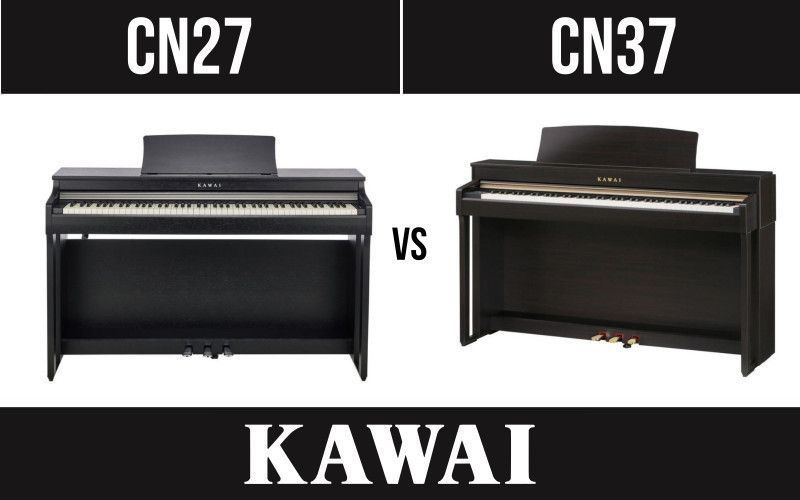
The Kawai CN37 is currently the most complete digital piano in Kawai’s CN line, outperforming the CN27.
çHere are their main differences:
- The CN37 has 352 soundbanks, including drum kits, while the CN27 has only 19 sounds.
- On the CN37 there are 7-speed curves for keystrokes, while on the CN27 there are only 4.
- The polyphony on the CN37 is 256 voices versus 192 voices on the CN27. The CN37 has more bills of exchange and more tuning options than the CN27.
- The CN37 has 100 rhythms, functionality not available on the CN27.
- The CN37 includes more demo and studio songs.
- In the CN37, the Virtual Technician software can control many more parameters than in the CN27.
- While the CN27 has 2 speakers covering all frequency ranges, the CN37 has 2 speakers for low frequencies and 2 speakers for high frequencies.
Kawai CN27 vs Kawai ES8

Kawai’s ES line is the brand’s line of portable digital pianos with a much lower weight than the CN line, for the possibility of being taken to live performances.
Both models have the same type of keys, of the “Responsive Hammer III” technology of the brand, but the ES has some more functionalities, thought for the needs of the concerts. Here are the main differences between these two pianos:
Kawai’s ES line is the brand’s line of portable digital pianos with a much lower weight than the CN line, for the possibility of being taken to live performances.
Both models have the same type of keys, of the “Responsive Hammer III” technology of the brand, but the ES has some more functionalities, thought for the needs of the concerts.
Here are the main differences between these two pianos:
- The ES8 has 34 sounds, including 3 brand acoustic pianos sampled in stereo, the SK-EX, the EX, and the SK-5 while the CN27 has only 19 sounds with 2 brand acoustic pianos sampled in stereo, the SK-EX, and the EX.
- The polyphony of the ES8 is 256 voices while the polyphony on the CN27 is 192 voices. On the ES8 it is possible to adjust reverberation depth and time while on the CN27 it is not possible to adjust these parameters.
- The ES8 has more assignable effects and more tuning adjustments than the CN27.
- The ES8 has 100 rhythms with chord recognition, functionality not available on the CN27.
- The ES8 can play MP3 or WAV audio from a USB stick while the CN27 does not.
- Several lessons are included in the CN27, while in the ES8 no lesson is found.
- The power of the ES8’s drivers is a little lower than that of the CN27, but it has Bass Reflex technology, which reinforces the low frequencies.
- The weight of the ES8 is almost half the weight of the CN27.
CN27 vs Yamaha YDP 143 Arius
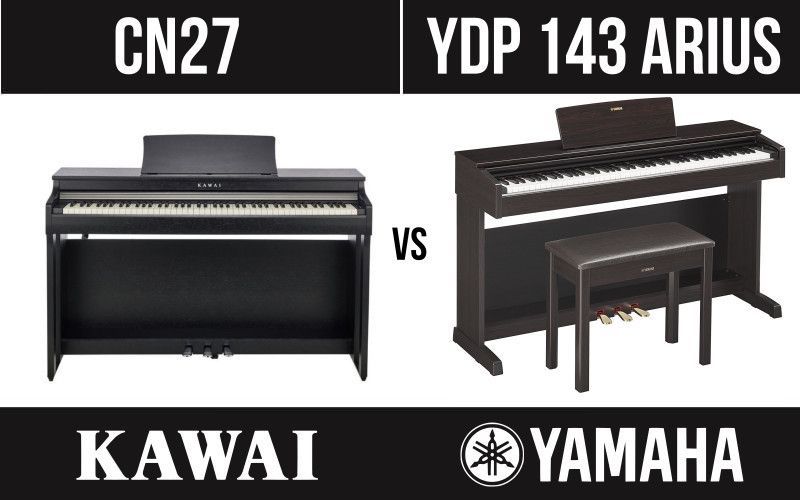
The Yamaha YDP 143 Arius, is a digital piano with much fewer features than the Kawai CN27, therefore, for a much lower price. Here are their main differences:
- The CN27 has “Responsive Hammer III” technology in its keys, with which it manages to emulate the keys of an acoustic piano quite well, while the YDP 143 Arius has keys of good quality, but not at the level of precision of the CN27 in emulation.
- The YDP 143 Arius has 10 sounds while the CN27 has 19 sounds.
- The CN27 has 6 reverberation types while the Yamaha YDP 143 Arius has only 4 reverberation types.
- The YDP 143 Arius emulates the resonance of the off pedal, while the CN27 emulates the resonance of both the off pedal and the strings.
- The power of the YDP 143 Arius speakers is much less than that of the Kawai CN27 speakers.
If you want to know more about this digital piano, read our full review of Yamaha YDP 143 Arius.
Where to buy Kawai CN27?
Of course, Amazon if you are in the US, India or any country, here the direct link:
Thomann
- The best in Europe by far
- Free Shipping
- Full warranty. If you have any problems, they take care of everything.
- A leader in logistics and transport without problems.
- The best price most of the time.
- Best Reputation: They are Europe’s leading online store and have the best catalog and information.
Amazon
- Free Shipping and the possibility of shipping in one day with Amazon Premium.
- Full Guarantee but they are no experts in music equipment.
- Sometimes a better price.
If you are in Europe here a good option:
Conclusions
The Kawai CN27 is an excellent choice for both piano students and teachers, thanks to its sound, the feel of the keys, and its functions of lessons and piano to 4 hands. If you want to know more about this brand, you can read our list of best Kawai pianos. You can also read our list of cheap keyboards and digital pianos and our list of the best keyboards and digital pianos at value for money.
For a similar price you have the following pianos and keyboards:
- YAMAHA YDP-S34 ARIUS
- YAMAHA YDP 163
- YAMAHA YDP 143
- YAMAHA PSR S770
- YAMAHA PSR S670
- YAMAHA PSR E453
- YAMAHA PSR E443
- YAMAHA P45
- YAMAHA P255
- YAMAHA P125
- YAMAHA P-121
- YAMAHA P115
- YAMAHA P105
- YAMAHA DGX 660
- YAMAHA ARIUS YDP 142
- YAMAHA PSR S775
- YAMAHA PSR E463
- YAMAHA P35
- THOMANN SP 5600
- THOMANN DP-33
- THOMANN DP-31
- ROLAND GO KEYS
- ROLAND FP-60
- ROLAND FP 80
- PIANO THOMANN SP 320
- KURZWEIL SPS4-8
- KURZWEIL SP6
- KURZWEIL SP4-8
- KURZWEIL FORTE SE
- KURZWEIL FORTE 8
- KURZWEIL ARTIS 7
- KORG PA-700 ORIENTAL
- KORG PA-700
- KORG PA600
- KORG PA-300
- KORG PA-1000
- KORG HAVIAN 30
- KORG GRANDSTAGE 88
- CASIO PX-870 PRIVIA
- CASIO PX-770 PRIVIA
- CASIO PX-5S PRIVIA PRO
- CASIO PX-560 PRIVIA
- CASIO PX-360 PRIVIA
- CASIO PX 160
- CASIO CT-X800
- CASIO CT-X700
- CASIO CT-X5000
- CASIO CT-X3000
- CASIO CDP 130
- THOMANN DP 26
- ROLAND FP 90
- ROLAND FP 30
- ROLAND FA 06
- ROLAND BK 5
- KORG SP 280
- KORG LP 380
- KORG B1
- KAWAI ES8
- KAWAI ES110
- KAWAI ES100
- KAWAI CN25
- CASIO CDP 230
- CASIO CDP S100
Did you like this article?
>>>>>>>>>
Digital Piano Yamaha PSR S975: Is it a really professional choice?
Yamaha PSR S975 Review: Opinions and Where to Buy It
The Yamaha PSR S975 is a high-end arranger keyboard with an extensive library of high-quality sounds, accompaniment rhythms from multiple musical genres, and advanced functions for live musicians such as vocal harmonizer and emulation of guitar amplifiers on your microphone or guitar input.
Where to Buy this Keyboard?
Two options:
It has 61 keys (5 octaves) with sensitivity, 128 polyphony voices, an LCD screen, and an excellent library of sounds and effects that include some of the sounds and effects of Yamaha’s legendary Tyros5.
A keyboard designed to accompany keyboard players and musicians who play alone and need good accompaniment as well as effects on their voice or guitar.
The Yamaha PSR S975 sound
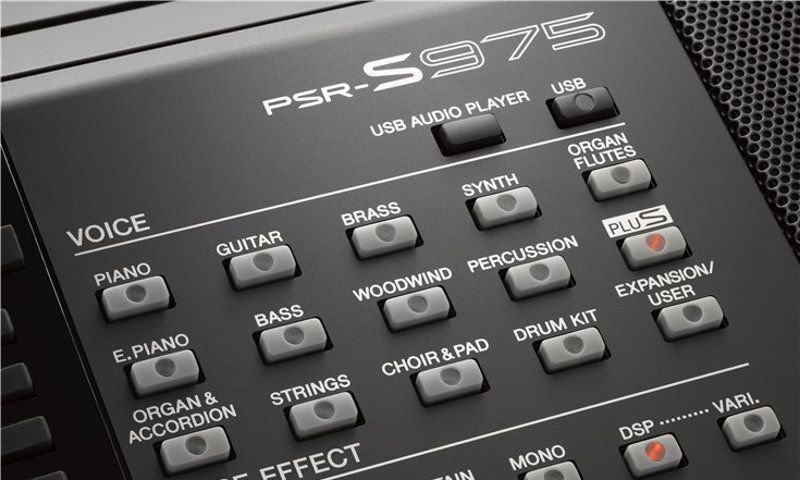
This keyboard’s extensive library includes 1090 main voices, 55 drum kits and 480 XG voices. Among their premium voices are:
- 30 voices from the Mega Voices bookstore.
- 140 voices from the S.Art bookstore!
- 32 voices from the Sweet bookstore!
- 74 voices from the Cool!
- 99 voices from the Live bookstore!
- 30 voices from the Organ Flutes bookstore!
Its extensive effects section features:
- 52 factory reverb banks and 3 user reverb banks.
- 106 factory chorus banks and 3 user chorus banks.
- 322 factory DSP banks with various effects and 10 user DSP banks.
- 5 factory compressions and 5 user compressions.
- 5 factory master equalizations and 2 user master equalizations.
- Harmozinator for voice with 44 factory presets.
- Vocoder with 10 factory presets.
- 60 user settings for Harmonizer or vocoder.
- Real Distortion and Real Reverb effects from the Tyros effects library5.
- Arpeggiator.
- It has 2 speakers of 15W each with a size of 13 cm x 5 cm and external audio input to connect the microphone or guitar and apply the effects included in your library. To control the sound in real-time it has a pitch bend wheel, modulation wheel, and two assignable controls.
I’m sure you’ll be interested in…
- Ranking with the best digital pianos in quality-price ratio
- The cheapest musical keyboards for beginners
- Other Yamaha Digital Piano Reviews
- Learn piano by yourself and for free
It also has USB audio playback with advanced functions such as tempo modification, vocal cancellation, a tone change, and letter display of the MP3 files that include them.
The Rhythms of PSR S975
The Yamaha PSR S975 has 523 accompaniment rhythms, with 40 rhythms from the +Audio bookstore, 431 professional rhythms, 34 session rhythms, 15 DJ rhythms, and 3 free-play rhythms.
Each of these rhythms includes 3 intros, 4 main variations, 4 fills, a break, and 3 finals.
These rhythms include a great variety of rhythms that can also be expanded thanks to the official expansions of the brand that include additional rhythms of multiple musical rhythms countries and cultures.
Yamaha PSR S975 vs Korg PA1000
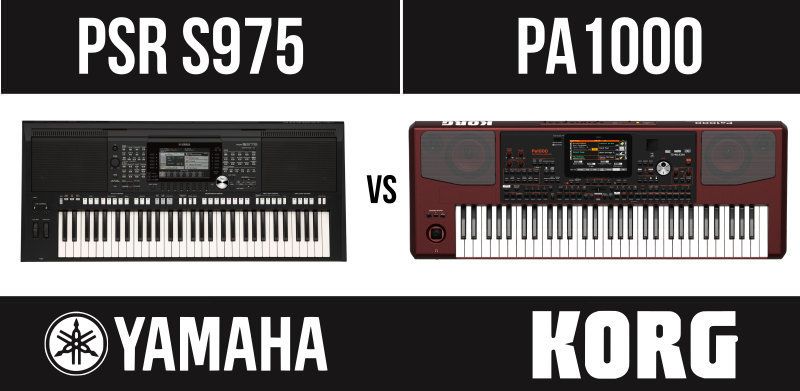
The Korg PA1000 is a high-end Arranger/Workstation with very similar features to the PSR S975, with a very similar price and with differences that we will see next.
- The Korg PA1000 features more sounds, this one has 1750 high-quality sounds versus the 1625 sounds of the Yamaha PSR S975.
- The Yamaha PSR S975 has more rhythms, it has 523 accompaniment rhythms versus the 430 accompaniment rhythms of the Korg PA1000.
- The Korg PA1000 has a touch screen, functionality not available on the PSR S975.
- The Korg PA1000 has KAOSS FX effects from the legendary Kaoscilator effects processor, while the
- Yamaha PSR S975 has effects from the great Tyros5.
- The Korg PA000 has an internal storage memory of 960 Mb and a USB and SD memory reader while the PSR S975 has approximate internal storage of 768 Mb and has only a USB reader.
- The amplification system is much better on the Korg PA1000, thanks to its 2 33 Wlavocs versus the 2 15 W speakers on the Yamaha PSR S975.
Yamaha PSR S975 vs Yamaha PSR S775
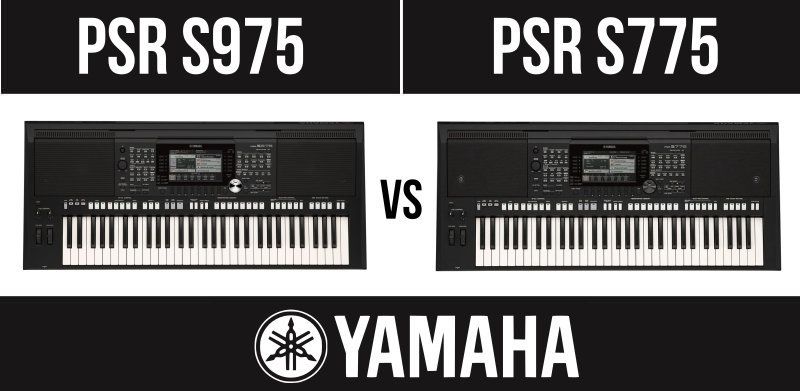
Although both teams belong to the same Yamaha line, the PSR S975 has more features than the Yamaha PSR S775. These two keyboards share features such as USB audio playback with advanced features, the same speakers, the same amount of controls, and its LED display. Here is a list of their main differences:
- The PSR S975 has a much larger sound library with 1090 main sounds and 55 drum kits versus the 930 main sounds and 50 drum kits of the Yamaha PSR S775. Both share the same amount of sounds from the XG library (480).
- The Yamaha PSR S975 also has more sounds from the Tyros5 libraries with higher sampling quality.
- The expansion memory in the PSR S975 is approximately 768 Mb versus approximately 280 Mb in the PSR S775.
- The PSR S975 features effects coming directly from the Tyros5, the Real Distortion, and the Real Reverb, in addition to more effects than the PSR S775.
- The PSR S975 also has specialized functions for voice, vocal harmonize, and vocoder, features not available in the PSR S775.
- The PSR S975 has 523 rhythms versus the 430 rhythms of the PSR S775.
You can learn more about this keyboard in our full review of the Yamaha PSR S775.
Yamaha PSR S975 vs Yamaha Tyros 5
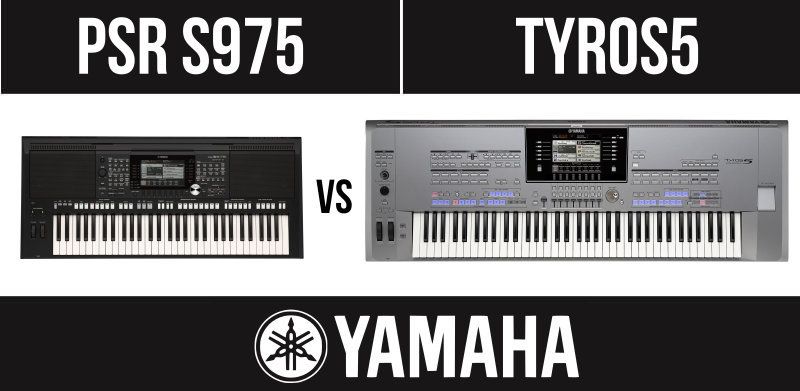
The Yamaha Tyros5 is a top-of-the-range workstation that has been discontinued for a few years, but received multiple accolades from the critics at the time, being a fairly powerful team for its time with high-quality samples, which are still used in equipment line PSR S975.
Although in principle when seeing the numbers, the quantity of sounds in these two types of equipment is not very different, it is necessary to bear in mind that the sounds of the Tyros5 are in their majority of greater quality with a more specialized sampling level and dedicated libraries.
In its effects section, they are very similar, although the Tyros5 wins the battle again with 2 DSP sections each with 322 factory presets while the PSR S975 has only one DSP.
Both feature dedicated voice effects such as vocal harmonizer and vocoder.
The number of rhythms is not very different, 539 in Tyros5 versus 523 in PSR S975.
In internal memory, there is a big difference because the Tyros5 has an internal hard disk of 500 Gb versus the internal storage of approximately 768 Mb of the PSR S975.
Yamaha PSR S975 vs Yamaha PSR S970
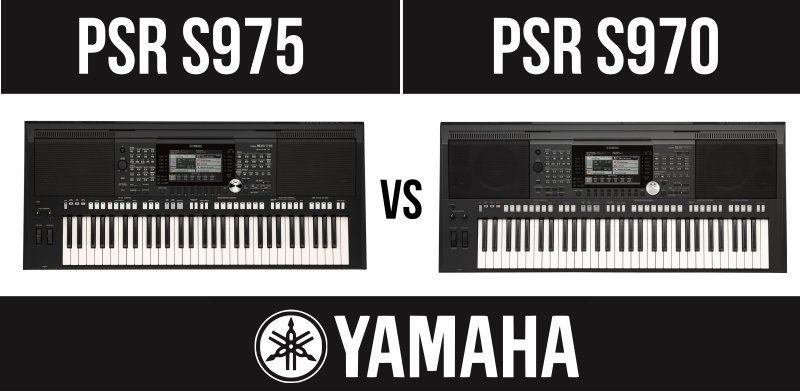
The PSR S975 is a direct enhancement to the Yamaha PSR S970, expanding its functionalities.
Both teams share features such as a microphone or guitar input, Real Reverb and Real Distortion effects from the Tyros5, its controls, the same number of effects, the power of its speakers, vocal effects such as the vocal harmonizer and vocoder, and its advanced USB Audio playback functions.
Here are some of the improvements:
- The PSR S975 has 1625 sounds versus 989 sounds of the PSR S975.
- The PSR S975 incorporates 523 accompaniment rhythms versus the 450 accompaniment rhythms of the PSR S970.
- The PSR S975 has more premium voices than the PSR S970.
- The PSR S975 has an expandable memory of approximately 768 Mb while the PSR S970 does not have expansion memory.
You can learn more about this keyboard in our full review of the Yamaha PSR S970.
Where to Buy Yamaha PSR S975
If you live outside Europe you have to check Amazon and if you live in Europe have a look as well to Thomann.
Conclusions
The Yamaha PSR S975 is currently the high-end Arranger/Workstation keyboard in the brand’s PSR S line, with premium sounds and effects from the acclaimed Tyros5 library and extensive functionalities for accompanying live musicians in their presentations, only surpassed as an arranger in the brand by the powerful Yamaha Genos.
Learn more about this line in our article on Yamaha’s PSR line.
If you are thinking of buying a new keyboard, you can read our list of cheap keyboards and electronic pianos and you can also find our list of the best keyboards and electronic pianos that are most convenient in terms of price/quality ratio.
For a similar price you have the following pianos and keyboards:
- yamaha PSR-A3000
- yamaha PSR S975
- yamaha PSR S970
- yamaha P-515
- yamaha MX61
- yamaha Montage 8
- yamaha Genos
- yamaha CP40 Stage
- yamaha CP4
- yamaha CP300
- yamaha CP1
- yamaha CLP 685
- Waldorf Zarenbourg
- Studiologic Numa Stage
- Studiologic Numa Concert
- Studiologic Numa Compact 2x
- Studiologic Numa Compact 2
- roland RD 2000
- roland Kiyola KF-10
- Nord Piano 3
- korg SV1 88
- korg SV1 73
- Crumar Seven
- Clavia Nord Stage 3 HP76
- Clavia Nord Stage 3 compact
- Clavia Nord Piano 4
- Clavia Nord Electro 6D 73
- Clavia Nord Electro 6D 61
- Clavia Nord Electro 6
- roland TB-3
- roland System-1
- Nord Stage 3
Did you like this article?
>>>>>>
Digital Piano Yamaha PSR S775 Full Review. Is it a good keyboard?
Yamaha PSR S775 Review: Reviews and Where to Buy It
The Yamaha PSR S775 is a portable workstation with ample rhythms, a good library of sounds and features designed to accompany keyboardists and other live musicians.
This keyboard has 5 octaves (61 keys), a 128-voice polyphony, an LCD screen, a very wide sound bank that includes sounds of quite quality and accompaniment rhythms that cover many musical genres.
A perfect keyboard for keyboard players who need to play solo or with few musicians, who need good accompaniment and sound libraries covering many musical genres and instruments of all kinds.
The sound of the Yamaha PSR S775
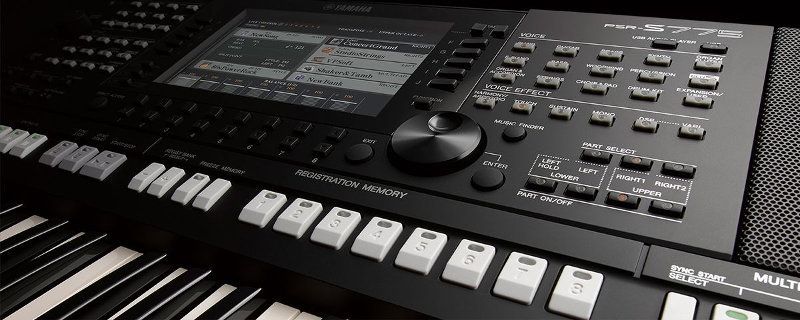
This keyboard has an extensive library of 930 sounds, 50 drum kits and 480 additional voices from the XG library.
What is the best place to buy this keyboard?
Two good options:
Among his voices, he has some voices that come directly from the legendary Tyros5. Among their voices are found:
- 76 voices from the bookstore S.Art!
- 23 voices from the Mega Voices bookstore.
- 28 voices from the Sweet bookstore!
- 64 voices from Cool!
- 81 voices from the Live bookstore!
- 20 voices from the Organ Flutes bookstore!
Its effects section is also very wide and is constituted by:
- 52 factory reverb banks and 3 user reverb banks.
- 106 factory chorus banks and 3 user chorus banks.
- 295 factory DSP banks with various effects and 10 user DSP banks.
- 5 factory compressions and 5 user compressions.
- 5 factory master equalizations and 2 user master equalizations.
- It also has arpeggiator and effects for microphone or guitar input.
It has two speakers of 15W each with a size of 13 cm x 5 cm and an audio input to connect the microphone or guitar and apply the effects included in the PSR S775. Very powerful even for playing alone with that volume in a restaurant.
USB audio playback features advanced features such as tempo change, vocal cancellation, pitch change, and display of the lyrics of the MP3 files that include them.
Finally, it has two programmable controls, a bend wheel, a modulation wheel, and 2 inputs for assignable pedals, all this to modify in real-time the sounds to taste.
Los Ritmos del Yamaha PSR S775
I’m sure you’ll be interested in…
- Ranking with the best digital pianos in quality-price ratio
- The cheapest musical keyboards for beginners
- Other Yamaha Digital Piano Reviews
- Learn piano by yourself and for free
The Yamaha PSR S775 includes an extensive library of 433 accompaniment rhythms, with 387 professional rhythms, 30 session rhythms, 15 DJ styles, and one freely reproducible.
These rhythms include 3 intros, 4 main variations, 4 fills, 1 break, and 3 finals.
These rhythms cover a large number of musical genres and thanks to Yamaha’s official expansions, it is possible to add many more specific rhythms, such as European rhythms, Latin rhythms, orchestral rhythms, world music, and expansions dedicated to specific countries such as Mexico, Brazil, Indonesia, India, China, Italy, Spain and more.
Yamaha PSR S775 vs Yamaha PSR S770
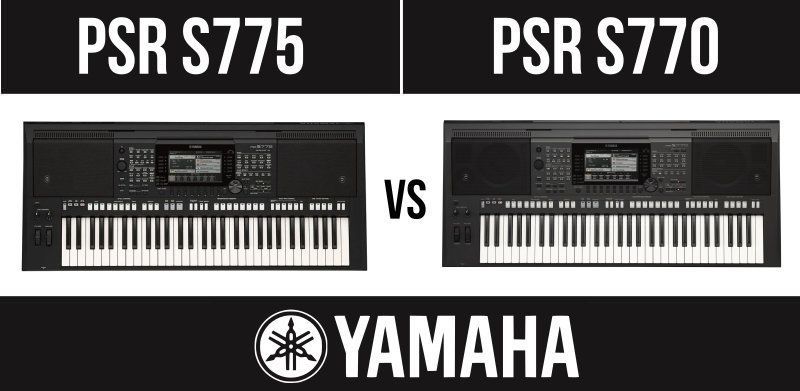
The PSR S775 is a direct improvement on the PSR S770 so many of its features are similar as the same amount of effects, same controls, input for microphone or guitar, and USB audio playback functionalities, basically, the improvements that include the PSR S775 over the PSR S770 are:
- More sounds, the PSR S775 has 930 sounds, 50 drum kits, and 480 voices XG, while the PSR S770 has 830 sounds, 36 drum kits, and 480 voices XG.
- More rhythms, the PSR S775 has 433 rhythms versus the 360 rhythms included in the PSR S770.
You can also read our full review of the Yamaha PSR S770.
Yamaha PSR S775 vs Yamaha PSR S670
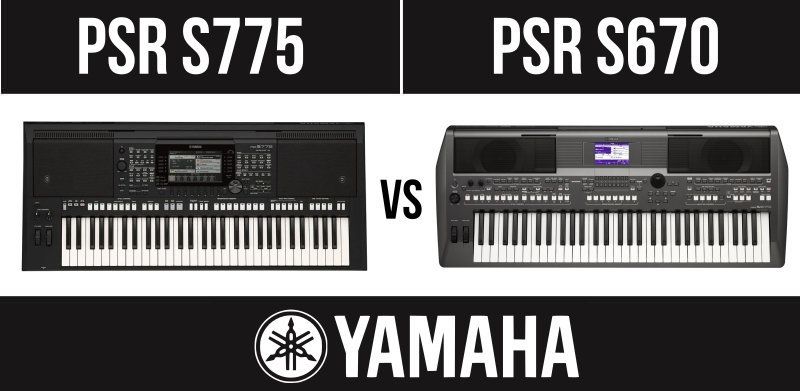
The Yamaha PSR S670 is a team with less performance than the PSR S775, here are their main differences:
- The 4.3-inch screen on the PSR S670 is much smaller than on the PSR S775 which has a 7-inch screen, plus the screen on the PSR S670 is monochrome while the screen on the PSR S775 is color.
- The amount of sounds is very different in the 2 teams, the PSR S670 has 416 sounds, 34 drum kits, and 480 voices XG while the PSR S775 has 930 sounds, 50 drum kits, and 480 voices XG, also take into account, the PSR S775 has more premium voices. In the effects section, you can also see a difference because the PSR S670 has fewer effects than the PSR S775.
- There is also a big difference in rhythms, as the PSR S775 has 430 rhythms versus the 230 rhythms of the PSR S670.
- The PSR S670 does not have a microphone or guitar input to which effects can be assigned, functionality that if it is in the PSR S775.
You can also read our full review of the Yamaha PSR S670. The Yamaha PSR S can be a very interesting option for the price as it also brings professional features. Much more than in the PSR E series. So it is always good to take a look at its review and look at its current price in the reference stores we recommend you.
Yamaha PSR S775 vs Korg PA700
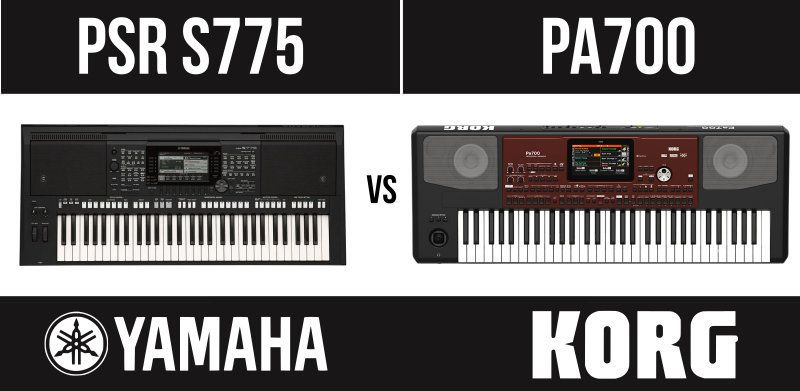
Although these two teams are from different manufacturers so their sounds and rhythms are quite different, we will show here their main advantages and differences between that two teams separated by a difference of about 80 euros, being the Korg PA700 the highest priced team:
- The Korg PA700 has a touch screen, functionality not available on the PSR S775. As for its sound library, the Korg PA700 wins the battle with about 1,700 factory sounds and 106 drum kits versus the Yamaha PSR S775 with its 1,410 sounds (930 main sounds and 480 voices XG) and 50 drum kits.
- In terms of rhythms, the Yamaha PSR S775 is ahead with 433 rhythms versus 370 rhythms of the Korg PA700.
- The Korg PA700 features KAOSS FX functionality inspired by Korg’s legendary Kaossilator effects processor, functionality not available on the PSR S775.
- The Korg PA700 has 960 Mb of internal storage, while the PSR S775 has approximate storage of 280 Mb, in addition, the Korg PA700 has an SD memory reader.
- As for Speakers, the Korg PA700 has 2 speakers of 25W of power versus the 2 Speakers with 15W of power of the Yamaha PSR S775.
Yamaha PSR S775 vs Yamaha PSR S975
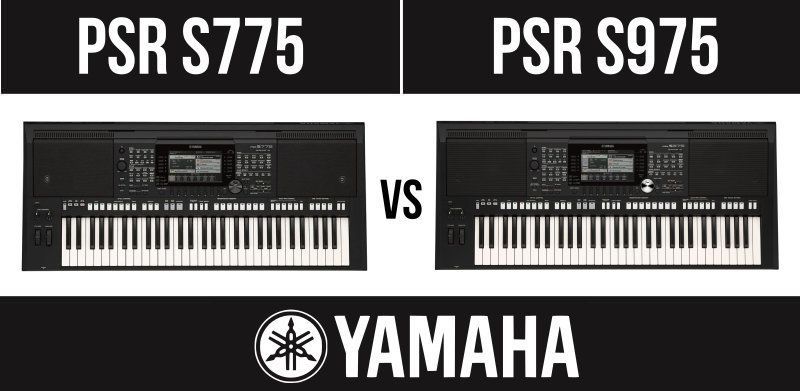
The Yamaha PSR S975 is currently the most powerful workstation in Yamaha’s PSR-S range, second only to Yamaha Genos.
Both devices share functionalities such as USB audio playback, the same controls, speakers with the same power, and a similar screen; here we will list their main differences:
- The Yamaha PSR S975 has the most sounds, 1090 main sounds, 55 drum kits, and 480 sounds from the XG library versus 930 main sounds, 50 drum kits, and 480 sounds from the XG library of the Yamaha PSR S775.
- The Yamaha PSR S975 also has more premium sounds from the Tyros5 libraries. The expansion memory in the PSR S975 is approximately 768 Mb versus approximately 280 Mb in the PSR S775.
- The PSR S975 has Real Distortion and Real Reverb effects from the Tyros5 effects library, as well as more effects than the PSR S775.
- The PSR S975 also features voice harmonizer and vocoder functions, features not available on the PSR S775.
In terms of rhythms, PSR S975 has 523 rhythms versus 433 rhythms of PSR S775.
Where to buy Yamaha PSR S775?
As we say at the beginning of this post. Below I link you the best options to buy it worldwide:
Conclusions
The Yamaha PSR S775 is definitive equipment for pianists and keyboardists who need accompaniment for their solo or accompanied shows, who are looking for a lot of sounds from all kinds of musical instruments and a lot of musical rhythms. If you are thinking of buying a new keyboard, you can read our list of cheap keyboards and electronic pianos and you can also find our list of the best keyboards and electronic pianos that are most convenient in terms of price/quality ratio. On the other hand, you may also like these posts:
For a similar price you have the following pianos and keyboards:
- YAMAHA YDP-S34 ARIUS
- YAMAHA YDP 163
- YAMAHA YDP 143
- YAMAHA PSR S770
- YAMAHA PSR S670
- YAMAHA PSR E453
- YAMAHA PSR E443
- YAMAHA P45
- YAMAHA P255
- YAMAHA P125
- YAMAHA P-121
- YAMAHA P115
- YAMAHA P105
- YAMAHA DGX 660
- YAMAHA ARIUS YDP 142
- YAMAHA PSR S775
- YAMAHA PSR E463
- YAMAHA P35
- THOMANN SP 5600
- THOMANN DP-33
- THOMANN DP-31
- ROLAND GO KEYS
- ROLAND FP-60
- ROLAND FP 80
- PIANO THOMANN SP 320
- KURZWEIL SPS4-8
- KURZWEIL SP6
- KURZWEIL SP4-8
- KURZWEIL FORTE SE
- KURZWEIL FORTE 8
- KURZWEIL ARTIS 7
- KORG PA-700 ORIENTAL
- KORG PA-700
- KORG PA600
- KORG PA-300
- KORG PA-1000
- KORG HAVIAN 30
- KORG GRANDSTAGE 88
- CASIO PX-870 PRIVIA
- CASIO PX-770 PRIVIA
- CASIO PX-5S PRIVIA PRO
- CASIO PX-560 PRIVIA
- CASIO PX-360 PRIVIA
- CASIO PX 160
- CASIO CT-X800
- CASIO CT-X700
- CASIO CT-X5000
- CASIO CT-X3000
- CASIO CDP 130
- THOMANN DP 26
- ROLAND FP 90
- ROLAND FP 30
- ROLAND FA 06
- ROLAND BK 5
- KORG SP 280
- KORG LP 380
- KORG B1
- KAWAI ES8
- KAWAI ES110
- KAWAI ES100
- KAWAI CN27
- KAWAI CN25
- CASIO CDP 230
- CASIO CDP S100
Did you like this article?
>>>>>>>>>>