
- Home
- Author's Archive:

Digital Piano Casio LK 136 Full Review. Is it a good choice?
Digital Piano Casio LK 136 Full Review. Is it a good choice?
Casio LK 136 Main Features
- 61 keys with lights
- 32 notes polyphony (Number of notes that can sound at once. This includes songs that sound at once. So if you play over an accompaniment sound, more notes will accumulate.)
- 120 Sounds (Different sounds of piano and other instruments)
- 100 presets demo songs
- Dance music effects
- 70types of Rhythms (Accompanying rhythms that adapt to what you play. There are bossa nova rhythms, etc. Sometimes also known as accompaniment styles) Preset
- pitch bend (Functionality that changes the sound wave of what you play and then returns to its original state) wheel
- Common Effects: reverb (Reverberation effect which is a reflection effect of the sound), Chorus
- Piano Learn mode
- Transposition function
- Metronome (Element of basic study to study and practice the tempo of a piece of music.)
- LCD screen
- Auto power-off function (energy saving)
- headphone output
- pedal (The most important pedal of a piano or keyboard is the sustain pedal and is used to keep the note playing even if you stop pressing the key.) connection
- Has NOT midi (MIDI allows you to do such wonderful things as connect the keyboard to the computer, record a soundtrack and with certain programs pass with a click what you have played to musical notes in a score. MIDI tracks store information from musical notes)
- Sustain pedal connection
- Two 2 W speakers system (not very powerfull)
- Dimensions 946 x 307 x 92 mm
- Weight: 3,5 Kg
- Optional External power supply and can work with bateries also
Now that we’ve listed and described the features of this digital piano there’s no better than taking a look at the following video where they tell us more about the Casio LK 136 and you can hear the different sounds of this piano.
Related post you can be interested in
- Ranking with the best digital pianos
- My selection of cheap musical keyboards.
- Basic concepts you need to know about digital pianos.
- The best resources to learn to play the piano by yourself.
- The best Casio Digital Pianos.
Now let’s compare the Casio LK 136 with its more common alternatives. Also at the end of the post you will find a section with the best shopping possibilities for this digital piano. But you can go directly to that part of the post by pressing the following button.
Casio LK 136 vs Casio CTK 1500
The digital piano Casio LK 136 is usually about 39 € more expensive than Casio CTK 1500, but with so little price difference this can vary.
The most important features of the Casio CTK-1500 keyboard !
- With a well-designed 61-key layout, ideal for young musicians , the Casio CTK-1500 is the perfect keyboard for beginners to hone their skills and learn excellent techniques.
- Its easy-to-use controls and interface can help you navigate through the various functions with ease.
- With features like the 100-song bank , dance music mode and much more, enjoy playing the keyboard in a fun way.
- The CTK-1500 is ideal for tomorrow’s musicians. It is packed with features that help beginners learn to play and enjoy creating their own music.
- The new Dance Music mode , exclusive to Casio keyboards, allows you to become a DJ and create incredible dance floors.
5 advantages that will make you decide on the Casio CTK-1500 keyboard!
- Easy learning .
- Ideal for every beginner who wants to enter the world of piano.
- Polyphony of 32 different voices .
- Includes deactivation function of the right or left part of the keyboard , to practice lessons.
- In addition to 120 sounds and 70 rhythms , the keyboard also has 100 songs with which you can learn to play.
And below a video of the Casio CTK 1500
If you want to know more about this model do not miss our Casio CTK 1500 review
Casio LK 136 vs Casio LK 280
If you’re looking for your first digital keyboard and a virtual teacher that’s available 24/7, then the LK-280 model from Casio will certainly be the best choice to make.
Launched in 2011, this 61-key digital piano from the Japanese manufacturer has basically everything you need to start learning piano and music, from Lighted Keys to the integrated Step-Up Lesson System, and ships for the extremely competitive price of $199.
Key features of the Casio LK 280
- 61 speed sensitive light keys
- 400 tones
- Automatic accompaniment with 100 rhythms
- Wide selection of finished songs
- Step-Up learning system
- Audio input to connect external audio sources
- microphone input
The Casio LK-280 combines powerful educational functions, 61 touch-sensitive keys, and dance music mode. These features will always keep you interested as well as help you to learn the piano in a more engaging and enjoyable way.
And below a video of the Casio LK 280
If you want to know more about this model do not miss our Casio LK 280 review
Casio LK 136 vs Casio CTK 3500
Casio brand is famous for producing high-quality instrument at a very reasonable price. The Casio CTK-3500 is one of them that comes with an affordable price.
The price is around $100 and the keyboard is equipped with many useful features and functions you would associate with more expensive models, including various sounds, step-up lesson system, and Dance music mode, etc.
Casio CTK-3500 is an easy-to-operate portable keyboard with 61 touch-sensitive keys. It’s a solid option for beginners and kids to enjoy the fun of the music world and learn piano skills.
If you’re looking a keyboard for learning and entertainment, Casio CTK-3500 is well worth considering.
Conclusion
Casio CTK-3500 is a 61-key portable keyboard with touch-sensitive keys. It’s a solid option for beginners and kids to have fun and learn on. It’s loaded with lots of useful features and functions in a compact keyboard. Importantly, the low price is really appealing.
And below a video of the Casio CTK 3500
If you want to know more about this model do not miss our Casio CTK 3500 review
Casio LK 136 vs Casio LK 265
The Casio LK-265 luminous keyboard guarantees an optimal start for all beginners in the use of the keyboard. A large selection of finished songs are already stored in the instrument, which can be easily rehearsed by means of 61 dynamic keys . You will be supported by the Step-Up learning system .
If you’re looking for a keyboard for learning on and having fun, you won’t go wrong with Casio LK-265.
Conclusion
Casio LK-265 is a 61-key touch-sensitive keyboard with light-up keys for learning. It’s specially designed for entry-level adult players and kid players to learn on. This keyboard can give them something that let them get interested and inspired to continue developing their music skills.
And below a video of the Casio LK 265
If you want to know more about this model do not miss our Casio LK 265 review
Where to buy Casio LK 136
Thomann
- Free Shipping.
- Full warranty. If you have any problems, they take care of everything.
- 100% reliable payment.
- Leader in trouble-free shipping.
- Usually Best price.
- Best Reputation: They are the leading online store in Europe and have the best catalogue and information.
Amazon
- Free Shipping and possibility of shipping in one day with Amazon Premium.
- Full Guarantee but they are no experts in music equipment.
- Sometimes better price.
- He’s got worse stock than Thomann.
Check below related models with similar price and features:
- Thomann DP 26
- Thomann SP 320
- Yamaha NP 32 Piaggero
- Korg Tiny Piano
- Startone MK 300
- Startone MK 200
- Yamaha PSR E463
- Yamaha PSR E363
- Startone MKR 61
- Roland GO KEYS
- Casio SA 46
- Casio SA 47
- Casio CTK 240
- Casio CT X700
- Yamaha EZ 220
- Yamaha PSR E263
- Yamaha PSR EW300
- Casio LK 280
- Casio SA 76
- Casio CTK 3500
- Casio LK 265
- Casio LK 136
- Casio CTK 1500
- Casio SA 77
- Yamaha sonogenic SHS 500
- Casio SA 78
- Casio CTK 2500
- Yamaha YPT 260
- Roland GO PIANO
- Midiplus Stage 88

Digital Piano Casio CT X5000 Full Review Is it a good purchase?
Digital Piano Casio CT X5000 Full Review Is it a good purchase?
Casio is a Japanese company that produces various electronic products, including digital keyboards. One of these is the Casio CT-X5000, a keyboard for beginners and intermediate players that has many great features to get you started. With a price of €365/$520/£333 it is a keyboard with many possibilities and many sounds:
- 61 keys with configurable touch sensitivity
- 64 notes of polyphony (Number of notes that can be played at once. This includes accompaniments that also consume notes. So if you play on top of an accompaniment more notes will be accumulated)
- Sound generator with AiX engine
- 800 sounds (Different sounds of piano and other instruments)
- 30 pre-installed songs
- 235 types of rhythms (Rhythms of accompaniment that adapt to what you are playing. There are bossa nova rhythms, etc. Sometimes they are also known as accompaniment styles) Accompaniment preset, not bad this number of possibilities
- Pitch-Bend Wheel
- Four-phrase pads to improve usability
- brings the following basic effects: reverb (Reverb effect), Chorus
- Harmony
- DSP (Digital Signal Processing) effects. These are digital effects that modify the sound of the keyboard)
- 100 types of Arpeggios (The Arpeggio function allows you to play an entire passage of notes by pressing just one key. Many come pre-recorded and some keyboards allow you to create them)
- One-Touch presets for fast switching between functions
- Transposition (Transposition allows you to move the note spectrum of a keyboard. This is to be able to play with transposing instruments. It is not an easy concept but it is made to facilitate the writing of an orchestration for instruments with very different bass and treble registers)
- LC display for improved usability
- Auto shut-off function (energy saving)
- Combined headset/line connection
- Pedal connection
- Usb to Host Connector (This is a more modern MIDI connector. MIDI allows you to do such wonderful things as connect your keyboard to your computer, record a sound track, and with certain programs pass what you have played to musical notes on a score with a single click. MIDI tracks store the information of the notes)
- USB to Device Connector
- Recorder who understands MIDI
- It has a connection for a sustain pedal (The sustain pedal of a piano or keyboard serves to keep the note playing even if you stop pressing the key)
- 2 very powerful 15W speakers
- A very portable weight of 7 kg (it can even be carried in a meter)
- Includes power supply but WARNING: does not support batteries, which are sometimes not clear

As you can see we have a keyboard with good features: a great amount of sounds reaching 800, 64 polyphonic notes that is not bad to start playing the keyboard (for sure with time you will need more and you will want to jump to another level), we have 235 different rhythms (with different musical genres) that serve as accompaniment, a Pitch Bend wheel and another important function are the 100 types of arpeggios that it offers, to compose or interpret diversity of compositions.
Related post you can be interested in
- Ranking with the best digital pianos
- My selection of cheap musical keyboards.
- Basic concepts you need to know about digital pianos.
- The best resources to learn to play the piano by yourself.
- The best Casio Digital Pianos.
Let’s continue to do a comparison to the Casio CT X5000 with its more common alternatives. Also at the end of the post you will find a section with the best shopping possibilities for this digital piano. But you can go directly to that part of the post by pressing the following button.
Casio CT-X5000 vs Yamaha PSR-E463
First let’s compare these two digital keyboards our Casio CT-X5000 with a price of €365/$520/£333 and the Yamaha PSR -E463 which is currently priced at €285/$350/£259, making a difference of 80 euro between the two. We will put them face to face in order to verify their differences and similarities:
- Both keyboards have 61 touch-sensitive keys, which means that when we play the keys loudly they’ll sound louder, and while we play less loudly, they sound quieter.
- When it comes to sounds, the Casio CT-X5000 has 800 sounds with 64 polyphonic notes, while the Yamaha PSR-E463 has 758 sounds with 48 polyphonic voices. Polyphony is the maximum number of notes that can be played at the same time.
- Both the Casio CT-X5000 and the Yamaha PSR-E463 have 235 different kinds of rhythms. That’s not bad for the level of keyboards we have. In addition to a pitch bend wheel that allows you to change the pitch (height) of the sound when playing.
- Both keyboards have effects like: Chorus, Harmony, Reverb and Master EQ. They have functions of: Transposition, Metronome, and Arpeggios where the Casio has 100 types, and the Yamaha has 150 types.
- In speakers, the Casio CT-X5000 has 2 very powerful 15W speakers, while the Yamaha PSR-E463 has a 2 x 6W speaker system. The Casio’s speakers are twice as powerful.
- Both keyboards have very similar connections, mixed headphone/line output, sustain pedal connection, USB inputs and outputs, which can be connected to standard USB sticks, and can also be connected to a computer with a music composition and production program.
- The Casio CT-X5000 has a very portable weight of 7 kg and dimensions of: 948 mm x 384 mm x 116 mm (Width, Depth and Height), while the Yamaha PSR-E463 has a weight of 6.6 kg and dimensions of 946 x 404 x 139 mm (Width, Depth and Height).
- The Casio CT-X5000 cannot be powered by batteries, the Yamaha can.
Here’s a video of the Yamaha keyboard sound engine, the AWN Dynamic Stereo Sampling:
We found good options for digital keyboards, with their advantages and disadvantages. The Casio has slight advantages over the Yamaha. A greater amount of sound, a more powerful speaker system, the downside is that it can’t run on batteries if you want to play it on the street or in a place that doesn’t have power nearby. However, for the price, the Yamaha is still a good option.
We will put the characteristics of each of these pianos in 2 different columns to make it easier to see the differences:
|
Casio CT-X5000 |
Yamaha PSR-E463 |
|---|---|
|
|
And now a video of the Yamaha PSR-E463:
If you want to know more about this model don’t miss our review of the Yamaha PSR-E463.
Casio CT-X5000 vs Yamaha PSR-EW410
First let’s compare these two digital keyboards our Casio CT-X5000 with a price of €365/$520/£333 and the Yamaha PSR-EW410 which is currently priced at €385/$470/£349, getting to a difference of 20 Euro between the two. With such a short difference, it is most likely that they can have the same features, or maybe not, we will see.
- Let’s start by comparing the keys, the Casio CT-X5000 has 61 keys with touch sensitivity and 64-note polyphony, and the Yamaha PSR-EW410 has 76 keys with touch sensitivity and 64-note polyphony.
- Both have 235 styles/rhythms that serve for accompaniment, both have the Pitch Bend wheel (which serves to change the pitch of the notes that are played), and effects such as: Reverb, Chorus and Delay. Transposition, Metronome and Arpeggio functions where the Casio has 100 types, and the Yamaha has 150 types.
- In speakers, the Casio CT-X5000 has 2 very powerful 15W speakers, while the Yamaha PSR-E463 has a 2 x 12W speaker system. The Casio speakers are twice as powerful.
- Both keyboards have very similar connections, mixed headphone/line output, sustain pedal connection, USB inputs and outputs, which can be connected to standard USB sticks, and can also be connected to a computer with a music composition and production program.
- The Casio CT-X5000 has a very portable weight of 7 kg and dimensions of: 948 mm x 384 mm x 116 mm (Width, Depth and Height), while the Yamaha PSR-EW410 has a weight of 8.4 kg and dimensions of 1179 x 138 x 413 mm (Width, Depth and Height).
- The Casio CT-X5000 cannot be operated with batteries, when the Yamaha does allow this option.
A notable difference from the Yamaha PSR-E2410 and a feature that makes it stand out are its 2 Direct Controllers, also called spin regulators that filter and adjust the sound like on an analog synthesizer, plus its Tone Inflection wheel adjusts the tone of the sound making voices like Guitar, Sax or Trumpet sound real. Excellent input from Yamaha.
We will put the characteristics of each of these pianos in 2 different columns to make it easier to see the differences:
|
Casio CT-X5000 |
Yamaha PSR-EW410 |
|---|---|
|
|
And now a video of the Yamaha PSR-EW410
If you want to know more about this model don’t miss our review of the Yamaha PSR-EW410.
Casio CT-X5000 vs Korg EK-50
Now we will continue with our comparisons, in this section we will have the Casio CT-X5000 that as we have already mentioned has a price of €365/$520/£333, along with a keyboard brand Korg, the model EK50 that currently has a value of €294/$450/£272, which give a difference of 69 euros. Let’s see your face to face:
- Both keyboards have 61 touch-sensitive keys, so you can start studying the piano and playing compositions with musical dynamics.
- In terms of sounds we see a remarkable difference, 800 sounds has the Casio CT-X5000 with 64 notes of polyphony and 235 rhythms / musical styles, when the Korg EK50 has 702 sounds with 64 voices polyphony and 280 rhythms / musical styles.
- Both keyboards have effects such as: Chorus, Harmony, Reverb and Master EQ. They have functions of: Transposition, Metronome, and Arpeggios where the Casio has 100 types, but in the Korg we don’t have the option of Arpeggios.
- In speakers, the Casio CT-X5000 has 2 very powerful 15W speakers, while the Korg EK-50 has a 2 x 10W speaker system.
- Both keyboards have very similar connections, mixed headphone/line output, sustain pedal connection, USB inputs and outputs, which can be connected to standard USB sticks, and can also be connected to a computer with a music composition and production program. In addition to a pitch bend wheel that allows you to change the pitch (height) of the sound when playing.
- The Casio CT-X5000 has a very portable weight of 7 kg and dimensions of: 948 mm x 384 mm x 116 mm (Width, Depth and Height), when the Korg EK-50 has a weight of 7.5 kg and dimensions 994 x 392 x 132 mm (Width, Depth and Height).
- The Casio CT-X5000 cannot be operated with batteries, the Korg can.
A relevant difference to the Korg EK50 is that it has an upgradeable operating system, which gives the instrument a somewhat longer life so that it can be used with new operating systems.
We will put the characteristics of each of these pianos in 2 different columns to make it easier to see the differences:
|
Casio CT-X5000 |
Korg EK-50 |
|---|---|
|
|
And now a video of the Korg EK50
If you want to know more about this model don’t miss our review of the Korg EK50.
Casio CT-X5000 vs Yamaha PSR-S670
Now we will continue with our comparisons, in this section we will have the Casio CT-X5000 that as we have already mentioned has a price of €365/$520/£333, along with a Yamaha PSR-S670 keyboard that currently has a value of €598/£545, giving a difference of almost 240 euros. Big price difference, we will see if there is also a big difference between its functions and features:
- Both keyboards have 61 touch-sensitive keys, so we can start studying piano, and playing compositions with musical dynamics.
- The Casio CT-X5000 has 800 different sounds with 64 notes of polyphony and 235 rhythms/musical styles, while the Yamaha PSR-S670 has a total of 930 sounds with 64 notes of polyphony and 230 rhythms/musical styles.
- Both keyboards have effects such as: Chorus, Harmony, Reverb and Master EQ. They have functions of: Transposition, Metronome, and Arpeggios where the Casio has 100 types, and in the Yamaha we also find the option but it’s not as worked on as in other models.
- In speakers, both have 2 very powerful 15W speakers.
- Both keyboards have very similar connections, mixed headphone/line output, sustain pedal connection, USB inputs and outputs, which can be connected to standard USB sticks, and can also be connected to a computer with a music composition and production program. In addition to a pitch bend wheel that allows you to change the pitch (height) of the sound when playing and on the Yamaha modulation wheel.
- The Casio CT-X5000 has a very portable weight of 7 kg and dimensions of: 948 mm x 384 mm x 116 mm (Width, Depth and Height), when the Yamaha PSR-S670 has a weight of 8.1 kg and dimensions 1004 x 410 x 137mm (Width, Depth and Height).
- The Casio CT-X5000 cannot be operated with batteries, the Yamaha does have this option.
The Yamaha PSR-S670 surprises with both the quantity and quality of its mostly electric piano sounds, which have been sampled in high definition and quality. Below is a sample video so that you can hear the different sounds and have your own opinion of them.
We will put the characteristics of each of these pianos in 2 different columns to make it easier to see the differences:
|
Casio CT-X5000 |
Yamaha PSR-S670 |
|---|---|
|
|
And now a video of the Yamaha PSR-S670:
If you want to know more about this model don’t miss our review of the Yamaha PSR – S670.
Where to buy Casio CT X5000
Thomann
- Free Shipping.
- Full warranty. If you have any problems, they take care of everything.
- 100% reliable payment.
- Leader in trouble-free shipping.
- Usually Best price.
- Best Reputation: They are the leading online store in Europe and have the best catalogue and information.
Amazon
- Free Shipping and possibility of shipping in one day with Amazon Premium.
- Full Guarantee but they are no experts in music equipment.
- Sometimes better price.
- He’s got worse stock than Thomann.
Check below related models with similar price and features:
- Thomann SP 5600
- Yamaha YDP 143
- Roland FP 30
- Yamaha YDP 163
- Yamaha YDP S52
- Hemingway DP 201 MKII
- Casio PX S1000
- Thomann DP 33
- Casio PX S3000
- Casio PX 870
- Yamaha YDP S54
- Yamaha YDP 144
- Korg B1
- Casio CDP S100
- Casio PX 360
- Casio PX 770
- Korg LP 380
- Korg C1 Air
- Casio CDP S350
- Thomann DP 32
- Yamaha YDP S34
- Korg LP 180
- Korg PA 600
- Casio CT X5000
- Yamaha DGX 660
- Korg EK 50
- Yamaha PSR S670
- Yamaha PSR S775
- Yamaha PSR EW410
- Roland 5
- Casio CT X3000
- Yamaha PSR A350
- Casio WK 7600
- Casio WK 6600
- Yamaha P45
- Yamaha P125
- Kawai ES 110
- Alesis Recital Pro
- Kurzweil SPS4 8
- Roland FP 10
- Korg D1
- Studiologic Numa Compact 2
- Korg SP 280
- Yamaha P121
- Studiologic Numa Compact 2x
- Roland GO PIANO 88
- Studiologic Numa Stage

Digital Piano Casio CT X700 Full Review Is it a good choice?
Casio Digital Piano CT-X700 Review Complete. Is it a good choice?
Casio Computer Co., Ltd. is an electronics manufacturer founded in 1946 and based in Tokyo, Japan. Today we examine an interesting keyboard that deserves several comparisons below. It is usually around 200 euros and has some improvements compared to the super famous Casio CTK 3500 that make it a very interesting option, its price is €209/$174/£189, let’s see its specs:
- 61 Sensitive keys (You can adjust the volume of the note depending on how you press it. And it’s different from the weighted keys that is the weight of the keys on a piano) to the touch.
- 48 notes of polyphony (Number of notes that can be played at the same time. This includes accompaniments that also consume notes. So if you play on top of an accompaniment more notes will be accumulated)
- Sound source with AiX technology.
- 600 sounds (Different sounds of piano and other instruments).
- 160 songs already incorporated.
- 195 types of rhythms (accompaniment rhythms that adapt to what you are playing. There are bossa nova rhythms, etc. Sometimes they are also known as accompaniment styles).
- Various types of effects: Reverb, Chorus, Harmony, 100 types of Arpeggio (The Arpeggio function allows you to play an entire passage of notes by pressing just one key. Many come pre-recorded and some keyboards allow you to create them)
- Configurations that can be changed at the press of a button.
- LCD screen.
- Transposition (Transposition allows you to move the note spectrum of a keyboard. This allows you to play with transposing instruments. It is not an easy concept but it is made to facilitate the writing of an orchestration for instruments with very different bass and treble registers)
- Headphone jack and line output. (great line output for plugging into large amplification equipment)
- USB to host. (USB MIDI)
- Midi recorder (MIDI allows you to do such wonderful things as connecting the keyboard to the computer, recording a sound track and with certain programs to pass with a click what you have played to musical notes on a score. MIDI tracks store the information of the musical notes).
- Connection for sustain pedal (this pedal is important to keep the note in time sounding after you stop pressing it)
- Two 2.5W speakers (for home rehearsal)
- It works with batteries and comes with a power supply.
- It has the following dimensions in mm 948 x 350 x 109 and weighs 4.3 kg.
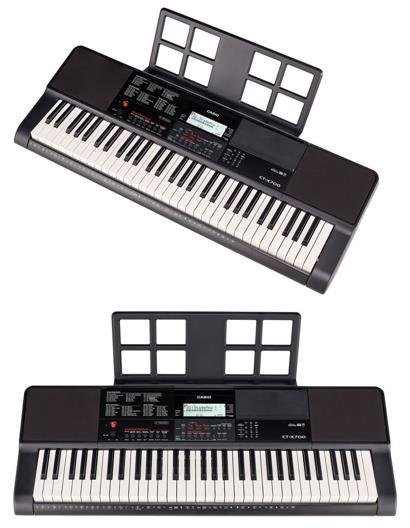
Now that we’ve listed and described the features of this keyboard, there’s no better way than to take a look at the following video where they tell us more about the Casio CT-X700 and you can hear how its different sounds sound.
Related post you can be interested in
- Ranking with the best digital pianos
- My selection of cheap musical keyboards.
- Basic concepts you need to know about digital pianos.
- The best resources to learn to play the piano by yourself.
- The best Casio Digital Pianos.
Now let’s compare the Casio CT X700 with its more common alternatives. Also at the end of the post you will find a section with the best shopping possibilities for this digital piano. But you can go directly to that part of the post by pressing the following button.
Casio CT-X700 vs Casio CT-X800
In this section we will discuss two very similar keyboards from Casio’s CT-X series of keyboards. The price difference is very small, about 25 Euros (at the time of reviewing this article the CT-X700, the first hand price could be found for about €209/$174/£189 and the CT-X800 for about €229/£209)
Both feature the same sound characteristics, polyphony notes, rhythm types, one-touch settings, speakers, etc
The differences that separate them are minimal, but we go on to describe them:
- Pitch Bend Wheel: Functionality that changes the sound wave of what you play and then returns to its original state.
- Additional USB connection that allows you to record and load your songs from a pen drive.
We are going to put the characteristics of each of these pianos in 2 different columns to make it easier for the similar ones:
|
Casio CT-X700 |
Casio CT-X800 |
|---|---|
|
|
Here’s a video explaining the performance features of the Casio CT-X800, such as the layer function, split function and the one-button preset function:
https://www.youtube.com/watch?v=rX3QQ7kRxfQ
If the differences don’t make up for it, the Casio CT-X700 is well suited as a starter or beginner’s keyboard
Casio CT-X700 vs Yamaha PSR-E363
In this comparison we will buy Casio and Yamaha keyboards oriented as low-end keyboards and for beginner students or people who want to start playing a piano.
The price difference between both keyboards is small about €10, and this difference can change. The Yamaha PSR-E363 is a bit cheaper, it can be found first hand for about €198/$400 (PKS)/£180 and the Casio CT-X700 for about €209/$174/£189 (prices at time of review of article).
Among its similarities The AiX technology sound source:
- Both are 61-key keyboards with touch-sensitivity. This means that the more forcefully a key is pressed, the more note is produced.
- Same notes of polyphony, 48 notes.
- They have controls and functions for metronome, transposition and arpeggios.
- They feature Reverb and Chorus effects.
- Both have a USB to Host connection for recording MIDI pans by connecting them to a PC or other devices.
- They have inputs for the Sustain Pedal.
- Both have headphone outputs.
- 2.5W speakers. This power is only for listening at home.
- They have a power supply to connect them to the electrical current and can be equipped with batteries.
- They have the possibility of saving settings.
- They include support or lectern for scores.
Enter your differences we can stand out:
- Different repertoires and number of sounds, pre-recorded songs or demo and rhythm types or styles. In the Casio we can find some more in each case:
- Sounds: In the Casio CT-X700 we can find 600 different sounds and the Yamaha PSR-E363 we have 574 sounds.
- Songs: In the CT-X700 we can find 160 pre-recorded songs and the PSR-E363 154 demo songs.
- Styles or rhythms: In the case of the Casio CT-X700 we can find 195 different rhythms and in the Yamaha PSR-E363,165 different styles.
- The Yamaha offers to record up to 5 user songs (which you can create and record yourself). This is not possible with the Casio.
- Duo function of the Yamaha PSR-E363: Allows the keyboard to become two different keyboards, so that it can be played by two people at once, like a teacher and a student. A very useful function if you are a beginner or are just starting to play a keyboard.
- The PSR-E363 offers a Master EQ system.
- Similar weight and dimensions:
- Casio CTK-800: Weight 4.3 kilos and dimensions (width x depth x height) 948 x 350 x 109 mm.
- Yamaha PSR-E363: Weight of 4.6 kgy and dimensions (width x depth x height) of 945 x 368 x 118 mm.
- The Yamaha PSR-E363 offers a mini-jack auxiliary input, which allows a microphone, instrument or playback device to be connected to it, and a song to be played over the keyboard and played on its speakers. In addition, the Casio CT-X700 offers a line output for connection to a powerful amplifier system. This can make the difference if you want to take it to a concert.
It has to be said that the Yamaha is the best-selling one in its category.
|
Casio CT-X700 |
Yamaha PSR-E363 |
|---|---|
|
|
And now a video of the Yamaha PSR-E363:
If you want to know more about this model do not miss our review of the Yamaha PSR-E363
Casio CT-X700 vs Casio CTK-3500
The Casio CTK-3500 is similar to the Yamaha PSR 363 in terms of performance but is usually even cheaper than the PSR 363 making it a highly recommended option. I do like the sounds of the Yamaha better, though.
Let’s summarize your similar features:
- Both are 61-key touch-sensitive keyboards.
- They feature 48 notes of polyphony.
- MIDI connection via USB to Host,
- Incorporate transposition and metronome
- They feature sustain pedal input.
- They come with their own power supplies and can be powered by batteries.
Let’s highlight your main differences:
- This is a more basic model than the CT-X700 and offers less variety of sounds, songs and rhythms than the CTK-3500, but includes a variety of modern rhythms such as Hall, Dance and Virtual Room.
- The Casio CT-X700 features an arpeggiator or arpeggios, while the Casio CTK-3500 does not.
- The CTX 700 has a line output and the Casio CTK 3500 has a less powerful output. I don’t consider it a line output although you can connect it to a small normal amplifier without any problem.
- Present Pitch Bend wheel on the CTK-3500. It is not available on the CT-X700 but on its brother Ct-X800.
- Slightly more powerful speakers on the CT-X700 (2.5W) compared to the 2W speakers of the CTK-3500.
- The CT-X700 is offered as a heavier piano (4.3 kg) than the CTK-3500 (3.4 kg).
- The Casio CTK 3500 as well as the Yamaha PSR E363 has no line output and the CT-X700 has line output.
|
Casio CT-X700 |
Casio CTK-3500 |
|---|---|
|
|
And now a video of the Casio CTK-3500:
If you want to know more about this model don’t miss our review of the Casio CTK-3500.
Casio CT-X700 vs Startone MK-300
The Casio CT-X700 and the Startone MK-300 are two keyboards with 61 touch-sensitive keys but with a significant price difference as the Startone can be up to 120 euros cheaper. The Startone can be found at a first hand price of about €115/£102 (at the time of the article’s revision). In some cases, the Casio is superior to the Startone and vice versa, so we will now describe in detail its most important features:
- The CT-X700 offers 48 notes of polyphony and the Startone MK-300 offers 64 notes. This is important to note because it allows more notes to be played from the keyboard and accompaniment simultaneously
- The Casio CT-X700 offers a larger range of 600 sounds and the Startone MK-300 390 sounds. Apart from the difference in quantity, the Casio offers a higher quality of these. This also applies to demo or pre-recorded rhythms and songs.
- Both feature Reverb and Chorus effects, and Dual and Split modes.
- They feature metronome and transposition.
- They offer recording and MIDI connection through USB to Host ports.
- They have a headphone output.
- They have input for sustain pedal.
- They work with batteries and power supply (including power supply).
- Similar weights and dimensions.
- Duo mode or keyboard partition (similar to the Yamaha PSR-E363) and Pitch Bend wheel on the Startone.
- The Startone MK-300 has more powerful speakers, with a power of 10W (enough to accompany another instrument like a guitar, without much amplification). The Casio CT-X700 only has 2.5W speakers.
- The Casio has line output and the Startone does not
The quality of materials is better in the Casio CT-X700 although the Startone is very competitive in terms of functionality.
We will put the characteristics of each of these pianos in 2 different columns to make it easier to see the differences:
|
Casio CT-X700 |
Startone MK-300 |
|---|---|
|
|
Now a video of the Startone MK-300
The Casio CT-X700 is offered as an entry-level keyboard with good quality sounds, effects and rhythms, as well as a MIDI connection so that it can be recorded in MIDI and is not too heavy.
The Startone MK- 300 is quite good, even if it doesn’t have the above features in the same quantity and quality. Furthermore, it is a keyboard with a MIDI connection (which is a bargain for its price), very economical and offers the Duo mode (very suitable if you are a beginner student and want to accompany yourself by playing with your teacher).
If your budget is very tight, and you don’t want to spend more than 120 Euro on a keyboard, the Startone is a good choice. If you are looking for more sound quality or better technical quality, any of the other alternatives above is good.
If you want to know more about this model don’t miss our review of the Startone MK-300
Where to buy Casio CT X700
Amazon
- Free Shipping and possibility of shipping in one day with Amazon Premium.
- Full Guarantee but they are no experts in music equipment.
- Sometimes better price.
Thomann
- Best option at Europe
- Free Shipping.
- Full warranty. If you have any problems, they take care of everything.
- 100% reliable payment.
- Leader in trouble-free shipping.
- Usually Best price.
- Best Reputation: They are the leading online store in Europe and have the best catalogue and information.
Check below related models with similar price and features:
- Thomann DP 26
- Thomann SP 320
- Yamaha NP 32 Piaggero
- Korg Tiny Piano
- Startone MK 300
- Startone MK 200
- Yamaha PSR E463
- Yamaha PSR E363
- Startone MKR 61
- Roland GO KEYS
- Casio SA 46
- Casio SA 47
- Casio CTK 240
- Casio CT X700
- Yamaha EZ 220
- Yamaha PSR E263
- Yamaha PSR EW300
- Casio LK 280
- Casio SA 76
- Casio CTK 3500
- Casio LK 265
- Casio LK 136
- Casio CTK 1500
- Casio SA 77
- Yamaha Sonogenic SHS 500
- Casio SA 78
- Casio CTK 2500
- Yamaha YPT 260
- Roland GO PIANO
- Midiplus Stage 88