
- Home
- Author's Archive:

Digital Piano Korg PA 1000 Full Review. Is it a good choice?
Korg PA 1000 Review Complete Digital Piano. Is it a good choice?
Korg Inc. is a Japanese multinational corporation that manufactures electronic musical instruments, audio processors and guitar pedals, recording equipment, and electronic tuners. Their PA1000 is a professional keyboard that costs around €1800/$2199/£1,666 and offers us a very interesting functions without exceeding 2000 euros. Let’s go over the features but don’t miss the comparisons, that’s where all the good information is to know which one suits you.
- 61 semi-weighted keys (Weight of the keys of an acoustic piano, which digital pianos try to imitate to match the touch of the piano. The keys in the high register are heavier and in the high register less heavy. This is different from the sensitivity on the keyboard which serves to regulate the volume of the note. But a weighted keyboard always has sensitivity in the keys) with touch sensitivity and aftertouch effect
- 128 notes of polyphony (Number of notes that can be played at once. This includes accompaniments that also consume notes. So if you play over an accompaniment more notes will be accumulated)
- Filters with resonance effect
- For each sound you have a 3-band equalizer
- DNC(Defined Nuance Control)
- More than 1,750 sounds (various piano and other instrument sounds)
- GM/XG sound packs
- 107 battery kits
- More than 430 styles (accompaniment styles that adapt to the chords we are playing. For example, they will put a bass and a drum kit that will adapt and synchronize with the notes we are playing on the keyboard)
- Comes with digital handle organ
- 300 MB of PCM user memory
- 148 types of master effects
- Compatible with MP3 and MP3 G formats
- Highly visible TFT screen
- DSP (Digital Signal Processing) effects. These are digital effects that modify the sound of the keyboard)an>
- Support sequencer with 16 tracks
- 4 configurable pads
- Memory expansion slot with Micro-SD
- Recorder in MP3 format
- Metronome (Basic study element to study and practice the tempo of a piece of music)
- Transposition (Transposition allows you to move the note spectrum of a keyboard. This is to be able to play with transposing instruments. It is not an easy concept but it is made to facilitate the writing of an orchestration for instruments with very different bass and treble registers)
- LOOP function and for sample creation
- 960MB internal memory
- Helmet Jack
- Video output in RCA format
- Midi input and output (MIDI allows you to do such wonderful things as connect your keyboard to your computer, record a sound track, and with certain programs click through what you’ve played to musical notes on a score. MIDI tracks store the information of the musical notes)
- USB MIDI
- USB 2.0 for USB memories
- Input for a sustain pedal (The sustain pedal of a piano or keyboard is used to keep the note playing even if you stop pressing the key)
- Input for programmable pedal
- 2 very powerful 33W speakers
- 2 line outputs for the live
- A super light weight of 10.75kg and dimensions of 1,030 x 378.3 x 133mm (width x depth x height)
- Includes network cable and stand
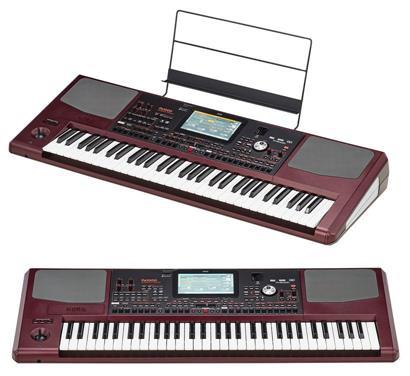
This keyboard brings many sounds but it is also a tool to create sounds, equalize and master them. For each sound you have three frequency bands that can be equalized so you can adjust the parameters of each sound.
It also has a high quality color screen with an interface similar to the found on cheaper models such as the Korg PA 600.
It also has many corrective filters for the adjustment of sound frequencies, which makes this keyboard a real music production workstation.
We can save our sounds and create samples and loops for live play.
It has a voice processor to make us second voices if you plug in a voice microphone with some very interesting filters. It also has a guitar processor.
With this keyboard you can mix, create your own styles. It has a memory for user sounds that you create yourself and you can modify the parameters of the sound wave very thoroughly.
In this new model you can create a style from a MIDI song with the information of the musical notes.
Another good function is that you can regulate the intensity of the LEDs on each button. That’s nice when you’re playing in a gig and you can highlight certain functions.
You have fully configurable buttons for when you start setting up your splits and your sounds created in a way that greatly improves the usability of the piano.
I really like the lyrics function on the screen so you can remember the lyrics of the songs and it also has a score function. It also has a songbook with a very wide repertoire. Although you can load as many scores as you want.
We’re talking about a keyboard that acts as a DAW (Digital Audio Workstation). It allows you to record in any format you want and create all the mixes you need. They have a very powerful 16-track sequencer.
As far as connections are concerned, as we have been talking about before, we can plug in a guitar and a microphone and process their signals at the levels we want. We can master them, put filters and effects and equalize them as we want because this keyboard is a real music production workstation (well, there are things that are better done in the studio but here you can also). It has line output to plug into any sound system and MIDI and USB ports as you have seen before in the features. It’s impossible that you need more. I like that it has a USB pendrive port on the front for easy access and more discreet.
I invite you to watch the following video in Spanish where they speak very well of all these features. Then watch the second video to hear sound samples because in the first one it talks about the features.
Related post you can be interested in:
- Ranking with the best digital pianos
- My selection of cheap musical keyboards.
- Basic concepts you need to know about digital pianos.
- The best resources to learn to play the piano by yourself.
Now let’s compare the Korg PA-1000 with its more common alternatives. Also at the end of the post you will find a section with the best purchase possibilities for this keyboard. But you can go directly to that part of the post by pressing the next button.
Korg PA-1000 vs Korg PA-700
We will now compare the Korg PA-1000 priced at €1800/$2199/£1,666 and the PA 700 priced at €1079/$1500/£999. The PA 700 includes some of the functions that the PA 1000 brings, although in some ways it is not as complete as the Korg PA-1000.
The main differences that justify this price difference are the following:
- The Korg PA 1000 has much more power in its speakers. And they doesn’t get a boomy sound when you turn it up to its fullest with what it can do for you even on a battery.
- Many more sounds, styles, filters, etc. So you’re paying for variety.
- Synthesis engine similar to PA 1000 but with less sounds, 1700 exactly, and also brings less memory for users 256 MB. It has the same functions as the PA 1000 for exporting sounds.
- The semi-weighted keyboard is very good for more comfortable playing.
- More memory for recording your creations.
It is basically the same but enhanced in the same aspects. I really like the semi-balanced functions. The decision has to be made according to the budget. But if you are going to play many hours at a professional level and you like to use your keyboards to the maximum this option is a marvel.
Otherwise the quality of the native sounds of the Korg PA 700 and Korg PA 1000 seem to be of equal qualities.
See the characteristics of them in this two charts:
|
Korg PA-1000 |
Korg PA-700 |
|---|---|
|
|
If you want to know more about this model don’t miss our review of the Korg PA-700.
Korg PA-1000 vs Yamaha PSR-S975
The Korg PA 1000 is priced at €1800/$2199/£1,666 and the Yamaha PSR S975 which is usually around €1400/$1600/£1200. The Korg PA 1000 digital piano is a high-end arranger/workstation with very similar features to the PSR S975 and with a very similar price.
Let’s see the differences:
- The Korg PA 1000 has more sounds, it has 1750 high quality sounds compared to the 1625 sounds of the Yamaha PSR S975
- In terms of sounds, the Yamaha PSR S975 wins the versus, because it has 523 accompaniment beats against 430 accompaniment beats from Korg PA 1000.
- The Korg PA 1000 has a touch screen, which is a feature not available on the Yamaha PSR S975
- The Korg PA 1000 has a 960 Mb internal memory and a USB/SD card reader, while the PSR S975 comes with a 768 Mb internal memory and only a USB reader.
- The amplification system is much better on the Korg PA 1000, this is for its 2 x 33W speakers compared to the 2 x 15W speakers on the Yamaha PSR S975.
Summarizing we can say that although the PSR S975 brings more beats the Korg PA 1000 gains in storage capacity and again in the quality of the keys with the counterbalance. Although you have to evaluate if you are really going to use all the possibilities of the Korg PA 1000. In this case I would spend more money. If you are not sure, the Korg PA 700 option is more logical.
|
Korg PA-1000 |
Yamaha PSR-S975 |
|---|---|
|
|
And now a video comparison between them:
If you want to know more about this model don’t miss our review of the Yamaha PSR-S975.
It must be said that although it is more expensive there is also the Yamaha PSR SX-900 to beat the Korg PA 1000 in sales.
Korg PA 1000 vs Yamaha PSR SX-900
The Korg PA 1000 basically still wins because even though they cost the same. At around €1800/$2199/£1,666 the Korg PA 1000 has a semi-weighted keyboard and much more powerful speakers. I don’t understand why Yamaha didn’t give semi-weighted keys in this model.
I find the Yamaha’s Vocal Harmony microphone function very powerful. A good function that allows you to do many creative ideas if you sing. Otherwise at the same price I will keep the Korg PA 700 but here are the features of the new PSR SX-900
|
Korg PA-1000 |
Yamaha PSR SX-900 |
|---|---|
|
|
Here is a video of the Yamaha SX 900:
Korg PA-1000 vs Yamaha PSR S775
It’s interesting to know differences but the Yamaha PSR S775 should really be compared to the Korg PA 700 for the amount of sound and performance because it’s much cheaper. Although in many countries Yamaha is giving preference to the Yamaha PSR S775 which costs about €1100/$1400/£855 and is a very interesting instrument:
Here are some important differences between them so you can see that it doesn’t make much sense to compare them (but as they ask me to do it)
- The korg PA 1000 has a touch screen, functionality not available on the PSR S775.
- As for its sound library, the Korg PA 1000 wins the versus with about 1750 factory sounds and 107 drum kits versus the Yamaha PSR S775 with its 1410 sounds (930 main sounds 480 voices XG) and 50 drum kits
- In terms of beats, the Yamaha PSR S775 is slightly ahead with 433 beats versus 430 beats of the Korg PA 1000
- The Korg PA 1000 features the KAOSS FX functionality inspired by Korg’s legendary Kaossilator effect processor, this functionality is not available on the PSR S775.
- The Korg PA 1000 has 960 Mb of internal storage, while the PSR S775 has approximately 280 Mb of storage, plus the Korg PA 1000 has a USB and SD reader.
- As for the speakers, the Korg Pa 1000 has 2 speakers of 33W of power compared to the 2 speakers of 15W of power of the Yamaha PSR S775
Now let’s go to the new Yamaha PSR SX-700 which is similar to the PSR 775 but you may find it in more countries. Let’s go with a video of the Yamaha PSR 775
https://www.youtube.com/watch?v=IxO7ZyGE6bc
If you are interested in knowing more, we invite you to see our review of the Yamaha PSR s775.
Korg PA-1000 vs Yamaha PSR SX-700
A very interesting new keyboard that competes more with the Kork PA 700 so the comparison is similar. There is a difference of about 700 because the PSR SX 700 is about €1200/$1500/£955
Like the SX – 900 the SX 700 has many functions in all DJ and electronic music although the Korg PA 1000 has also greatly enhanced those features since its old version the PA 900
If you want a lot of DJ functionality and your budget is limited to €1200/$1500/£955 this is a great option. And that’s why I wanted to tell you about it in this article. In many countries you may not find the PSR S775, but you can find this model. They are almost equivalent and the intention is the same.
If you want it all and also keys with a better touch similar to the piano and our powerful speakers, the Korg PA 100 is the right choice.
|
Korg PA-1000 |
Yamaha PSR SX-700 |
|---|---|
|
|
Here is a video of the Yamaha SX 700:
Where to buy Korg PA 1000
Amazon
- Free Shipping and possibility of shipping in one day with Amazon Premium.
- Full Guarantee but they are not experts in music equipment.
- Sometimes better price.
Thomann
- Best option to buy it at Europe
- Free Shipping.
- Full warranty. If you have any problems, they take care of everything.
- 100% reliable payment.
- Leader in trouble-free shipping.
- Usually Best price.
- Best Reputation: They are the leading online store in Europe and have the best catalogue and information.
Check below related models with similar price and features:
- Roland FP 60
- Yamaha P515
- Yamaha YDP 164
- Roland FP 90
- Korg G1 Air
- Casio PX 560
- Roland Kiyola KF 10
- Korg PA 1000
- Korg PA 700 Oriental
- Yamaha PSR S975
- Korg Havian 30
- Korg PA 700
- Kurzweil SP6
- Digital Clavia Nord Electro 6D 73
- Piano Clavia Nord Electro 6D 61
- Clavia Nord Stage 3 88
- Korg SV1 73
- Kurzweil Forte 8
- Clavia Nord Stage 3 HP76
- Roland RD 2000
- Kurzweil Artis 7
- Clavia Nord Piano 4
- Clavia Nord Stage 3 compact
- Crumar Seven
- Clavia Nord Electro 6
- Korg Grandstage 73
- Dexibell Live Stage S9
- Dexibell Vivo Stage S1
- Korg SV1 88
- Korg Grandstage 88
- Kurzweil Forte SE
- Yamaha CP88
- Roland VR 730
- Studiologic Numa Concert
- Yamaha CP73
- Dexibell Vivo Stage S7
- Yamaha CP300
- Yamaha CP1
- Clavia Nord Grand
- Viscount Physis Piano K4 EX
- Viscount Physis Piano K5 EX
- Dexibell Vivo Portable P7
- Kurzweil Artis
- Dexibell Vivo Portable P3
- Dexibell Vivo Stage S3
Did you like this post? > > > [/one_half_first]
Digital Piano Korg PA 700 Oriental Full Review. Is it a good keyboard?
Korg PA-700 Oriental Review Complete Digital Piano. Is it a good choice?
Korg is a Japanese company that makes electronic musical instruments and electric guitar implements. This time we will analyze one of their most exotic and different digital keyboards the Korg PA700, with a price of €1.329/$1700/£1,222. It is a keyboard oriented to oriental music that we were very eager to examine. It is considered a very interesting and even professional option, its features are:
- 61 touch-sensitive keys
- 128 notes of polyphony (Number of notes that can be played at once. This includes accompaniments that also consume notes. So if you play over an accompaniment more notes will be accumulated)
- Enhanced Definition Synthesis-eXpanded
- Defined Nuance Control also known as DNC
- 1700 sounds (different piano sounds and other instruments) with 512 user-configurable sounds and 256 drum kits. The Oriental Edition contains sounds (Different piano sounds and other instruments) from the Oriental music world and is what differentiates it from the conventional PA700
- 360 styles (Accompanying styles that adapt to the chords we are playing. For example they will put a bass and drums that will adapt and synchronize with the notes we are playing on the keyboard)
- 960MB internal storage memory
- 128 MB compressed user memory
- Compatible with MP3 and MP3+G formats
- 2 guitar modes
- TFT touch screen with good visibility
- 16-track booster sequencer
- Display with letter visibility
- Micro-SD card slot
- USB midi connection (MIDI allows you to do such wonderful things as connect your keyboard to your computer, record a sound track and with certain programs click through what you’ve played to musical notes on a score. MIDI tracks store the information of the musical notes)
- Line input and output for live
- USB MIDI
- MIDI input and output
- USB stick. It has the capacity to record on a pendrive
- Input for sustain pedal (The sustain pedal of a piano or keyboard is used to keep the note playing even if you stop pressing the key)
- Configurable pedal input
- 2 very powerful 25W speakers
- A weight of 9.9 kg and dimensions of 1030 x 378.3 x 132mm (width x height x depth)
- Includes stand and power cord

We found an arrangement keyboard, with excellent functions and features. With an extensive amount of sounds reaching 1700 and also a large number of styles or rhythms for accompaniment that are 360. With the sensitivity functions, USB MIDI function and sustain pedal input we have a complete musical instrument to practice and play live.
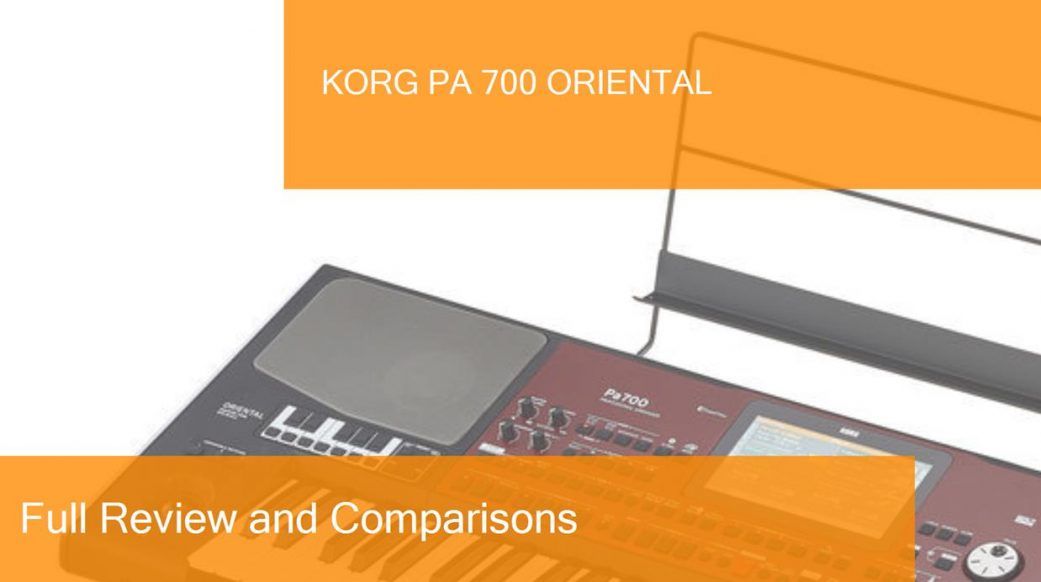
The ORIENTAL version of the Korg Pa700 contains all the functionality of the standard Pa700 and adds a mini keyboard on the left side, which can be used to customize the quarter-tone scale and quickly access the scale presets. In addition to the standard content, Pa700 ORIENTAL also contains sounds and styles that are specific to Middle Eastern music genres. Ouds, bouzuks, kanouns, various percussion instruments and many more sounds are accompanied by dozens of extra Styles that are suitable for traditional and modern music.
Related post you can be interested in
- Ranking with the best digital pianos
- My selection of cheap musical keyboards.
- Basic concepts you need to know about digital pianos.
- The best resources to learn to play the piano by yourself.
Now let’s compare the Korg PA 700 Oriental with its more common alternatives. Also at the end of the post you will find a section with the best shopping possibilities for this digital piano. But you can go directly to that part of the post by pressing the following button.
Korg PA-700 Oriental vs Korg PA-1000
First we will have a comparison between the two Korg array keyboards the PA700 Oriental, which as we have already mentioned has a price of €1.329/$1700/£1,222 and its big brother the PA 1000 which has a price of €1.799/$2200/£1,666 with a big difference of £470. We will see their differences and similarities in the following face-to-face:
- Both keyboards have 61 touch-sensitive keys. In the case of the Korg PA1000 the keys are semi-weighted and have an AfterTouch effect. Firstly sensitivity is the function of being able to create dynamics in the performances, i.e. when we play a key with force it sounds higher than when we play a note with less force which will sound lower. Weighted Keyboard, is the weight that the keys of a real acoustic piano have, in the low range it has more weight while in the high range the keys are much lighter. Aftertouch is a common detection system on keyboards that generates a type of MIDI control information. Using this information, you can alter the sound of a synthesizer or other MIDI device by holding down notes. This function will generate MIDI velocity information based on how hard you press the keys.
- The PA 700 offers 1700 sounds with 512 user-configured sounds from the Eastern music world. The PA 1000 offers more than 1750 sounds and equally 512 user-configured sounds. Both keyboards have 128 notes of polyphony, remember that polyphony is the highest number of notes that can be played at the same time in a device.
- In terms of styles, the PA 700 provides 360 accompaniment styles in line with the Oriental version that it is. While the PA 700 gives 430 accompaniment styles.
- Both devices have an internal memory of 960 MB, the PA 700 has 128 MB of user tablets and the PA 1000 has 300 MB of user tablets.
- Both keyboards have DNC, Defined Nuance Control to reproduce subtle nuances and articulations of acoustic instruments creating very real and rich expression simulations in real time.
- Both keyboards have a 16-track sequencer support, guitar and microphone inputs, micro SD card slot, USB MIDI connection to connect to a computer for use as a MIDI controller in a production or music composition program, and two pedal inputs, Sustain and the other configurable.
- The advantages of the Korg PA1000 are: A three-band equalizer for each sound, 148 types of master effects, a loop function to create samples and 4 pads to configure them.
- The Korg PA700 has two powerful 25W speakers. And the Korg PA1000 has two very powerful 33W speakers.
- In terms of weight and dimensions, the Korg PA700 is 9.9 kg and measures 1030 × 378.3 x 132 mm (W x H x D). The Korg PA1000 is 10.75 kg and measures 1030 × 378.3 × 133 mm (W x H x D)
As we can see, there are two good keyboards for arrangements, where logically the PA1000 has many advantages which are: semi-weighted keys, After Touch effect, a greater number of sounds and styles for accompaniment. In addition to other functions that are not found in the PA700, however, for the price the Korg PA700 is a good option.
We will put the characteristics of each of these pianos in 2 different columns to make it easier to see the differences:
|
Korg PA-700 Oriental |
Korg PA-1000 |
|---|---|
|
|
I’m leaving you a video of the Korg PA 1000:
If you want to know more about this model don’t miss our review of the Korg PA-1000.
Korg PA-700 Oriental vs Yamaha PSR-a3000
Now we will buy two keyboards for arrangements, the Korg PA-700 Oriental which as we have already mentioned has a price of €1.329/$1700/£1,222 compared to the Yamaha PSR-a3000 which has a price of €1.499/$1500/£1,379, where there is a small difference of £170. Let’s analyze their similarities and differences by looking at them face to face:
- Both keyboards have 61 touch-sensitive keys. Sensitivity is the function of being able to create dynamics in performances, i.e. when you play a key with force it sounds louder than when you play a note with less force which will sound lower.
- The PA 700 offers 1700 sounds with 512 user-configurable sounds from the world of oriental music. The Yamaha PSR-a3000 has about 2000 sounds (107 oriental Super Articulation voices). Both keyboards have 128 polyphonic notes, remember that polyphony is the highest number of notes that can be played at the same time in one instrument.
- In terms of styles, the Korg provides 360 styles for accompaniment according to the Oriental version that it is. While the Yamaha gives 400 accompaniment styles.
- The Korg PA700 features a 16-track support sequencer, guitar and microphone inputs, a micro SD card slot, and two pedal inputs, one sustain and the other configurable, plus built-in effects.
- The Yamaha features: a programmable joystick pro for greater dynamics, arpeggio function, One Touch Setting 4 by style, Multi Pads, many built-in effects and Sustain and other pedal input configurations, plus many built-in effects as well.
- Both keyboards are equipped with: USB MIDI The one that allows a connection to a computer to be used as a MIDI controller in a music composition or production program.
And USB to device, which allows the insertion of USB flash drives for audio or MIDI storage. - The Korg PA700 has two powerful 25W speakers. And the Yamaha PSR-a3000 has two very powerful 15 W speakers.
- In terms of weight and dimensions, the Korg PA700 is 9.9 kg and measures 1030 × 378.3 x 132 mm (W x H x D). The Yamaha PSR-a3000 weighs 11.2 kg and measures 1002 × 437 x 148 mm (W x H x D)
How we can see both keyboards for arrangements are very good, however if there are relevant differences also between them. The Korg PA 700 has the following highlights: Its microphone or guitar input with specialized effects for them, a micro SD card slot (which allows you to record audio or MIDI files) and DNC, Defined Nuance Control to reproduce subtle nuances and articulations of acoustic instruments creating very real and rich expression simulations in real time, as well as more powerful speakers. While the Yamaha PSR-a 3000 offers the following features that make it stand out: a greater number of voices/sounds, a greater number of rhythms for accompaniments, a programmable joystick, arpeggio function and the One Touch Setting function, which is an option for switching styles at the touch of a button. Depending on your needs, you are sure to make the best choice.
We’re going to put the characteristics of each of these pianos in 2 different columns to make it easier to see the differences:
|
Korg PA-700 East |
Yamaha PSR-a3000 |
|---|---|
|
|
Korg PA-700 Oriental vs Yamaha PSR-S775
Finally we are going to buy these following keyboards: the corre sees to 700 oriental that as we have commented before has a price of €1.329/$1700/£1,222 and the Yamaha PSR-S775 that has an approximate price of £1299, being of a very similar price with only £30 of difference, we will analyze therefore its differences and similarities:
- The Korg PA700 has a touch screen, functionality not available on the PSR S775.
- In terms of its sound library, the Korg PA700 wins the battle with about 1700 factory sounds and 106 drum kits versus the Yamaha PSR S775 with its 1410 sounds (930 main sounds and 480 XG voices) and 50 drum kits.
- In terms of beats, the Yamaha PSR S775 leads with 433 beats versus the 370 beats of the Korg PA700
- The Korg PA700 features KAOSS FX functionality inspired by Korg’s legendary Kaossilator effects processor, functionality not available on the PSR S775.
- The Korg PA700 has 960 Mb of internal storage, while the PSR S775 has approximately 280 Mb of storage, plus the Korg PA700 has an SD memory reader.
- As for speakers, the Korg PA700 has 2 speakers of 25W power versus the 2 speakers with 15W power of the Yamaha PSR S775.
As we can see both keyboards for arrays are very good, however if there are relevant differences also between them. The Korg PA 700 has the following highlights: Its microphone or guitar input with specialized effects for them, a micro SD card slot (which allows you to record audio or MIDI files) and DNC, Defined Nuance Control to reproduce subtle nuances and articulations of acoustic instruments creating very real and rich in real time expression, plus more powerful speakers. While the Yamaha PSR-S 775 has a head start on its rhythm numbers, it also has a guitar or microphone input that if you play one of these instruments or do it with other people comes in handy.
We will put the characteristics of each of these pianos in 2 different columns to make it easier to see the differences:
|
Korg PA-700 Oriental |
Yamaha PSR-S775 |
|---|---|
|
|
|
An extensive video of the Yamaha PSR-S775:
If you are interested in knowing more, we invite you to see our Review of the Yamaha PSR-S775.
Where to buy Korg PA 700 Oriental
Amazon
- Free Shipping and possibility of shipping in one day with Amazon Premium.
- Full Guarantee but they are no experts in music equipment.
- Sometimes better price.
- He’s got worse stock than Thomann.
Thomann
- Free Shipping.
- Full warranty. If you have any problems, they take care of everything.
- 100% reliable payment.
- Leader in trouble-free shipping.
- Usually Best price.
- Best Reputation: They are the leading online store in Europe and have the best catalogue and information.
Check below related models with similar price and features:
- Roland FP 60
- Yamaha P515
- Yamaha YDP 164
- Roland FP 90
- Korg G1 Air
- Casio PX 560
- Roland Kiyola KF 10
- Korg PA 1000
- Korg PA 700 Oriental
- Yamaha PSR S975
- Korg Havian 30
- Korg PA 700
- Kawai EN 8
- Kawai MP 11
- Kawai MP 7
- Clavia Nord Electro 6D 61
- Clavia Nord Stage 3 88
- Kurzweil SP6
- Korg SV1 73
- Kurzweil Forte 8
- Clavia Nord Electro 6D 73
- Clavia Nord Stage 3 HP76
- Roland RD 2000
- Kurzweil Artis 7
- Clavia Nord Piano 4
- Clavia Nord Stage 3 compact
- Crumar Seven
- Clavia Nord Electro 6
- Korg Grandstage 73
- Dexibell Vivo Stage S9
- Dexibell Vivo Stage S1
- Korg SV1 88
- Korg Grandstage 88
- Kurzweil Forte SE
- Yamaha CP88
- Roland VR 730
- Studiologic Numa Concert
- Yamaha CP73
- Dexibell Vivo Stage S7
- Yamaha CP300
- Yamaha CP1
- Clavia Nord Grand
- Viscount Physis Piano K4 EX
- Viscount Physis Piano K5 EX
- Dexibell Vivo Portable P7
- Kurzweil Artis
- Dexibell Vivo Portable P3
- Dexibell Vivo Stage S3
Did you like this post? > > > [/one_half_first]
Digital Piano Korg PA 700 Full Review. Is it a good choice?
Complete Review Digital Piano Korg PA 700. It is a good choice?
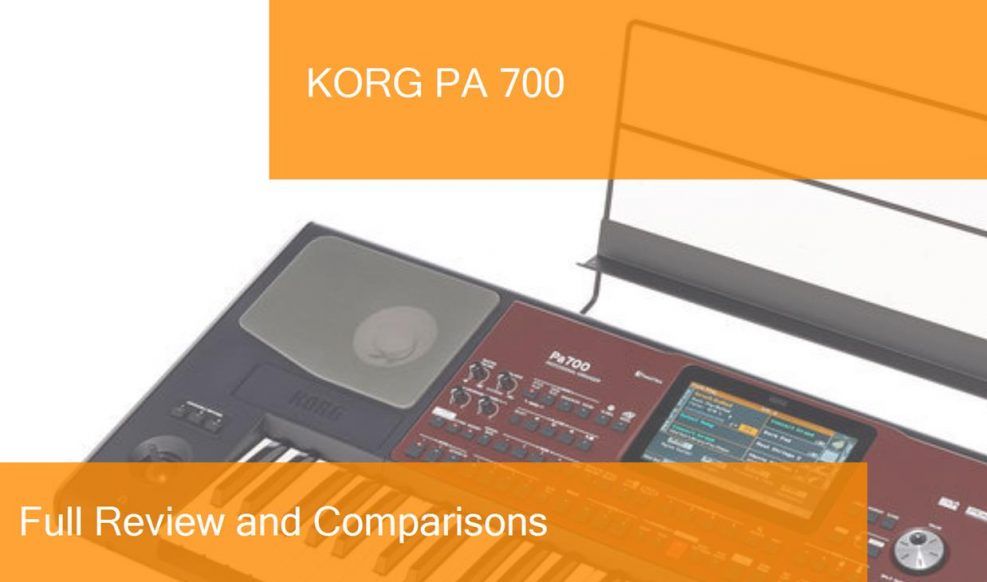
Korg is a Japanese company of electronic musical instruments and guitar tuners. This piano is presented as an upper-middle range piano and focused on professional use and can be used as a keyboard for live performances. It offers great features such as keyboard, great connectivity possibilities with other devices, storage and recording of your own songs ,and diversity in many styles and sounds (highlighting the available drum sets), of great quality.
It offers all the features of a professional keyboard at a very competitive price. We can find it around €1.079/$1700/£999.
These keyboards allow you to create sounds, equalize them and then store them in memory. That is, they allow us to create our own user sounds and then use them. They are mixer keyboards,
It has touch-sensitive keys for dynamic and nuanced playing. Although it would be nice if it had some kind of weighted keys. This makes it a little less popular than the Korg PA 1000 than if it has it (we compare it below). Although the Korg PAS 700 is a good professional keyboard at a competitive price.
Let’s take a look at this powerful keyboard by Korg:
- 61 keys with touch sensitivity not weighted.
- 128 notes of polyphony (Number of notes that can be played at the same time. This includes accompaniments that also consume notes. So if you play over an accompaniment more notes will be accumulated).
- Enhanced Definition Synthesis-eXpanded technology.
- Defined Nuance Control also known as DNC.
- 1700 sounds (various piano and other instrument sounds) with 512 user-configurable sounds and 256 drum kits.
- 360 styles (Accompanying styles that adapt to the chords we are playing. For example they will put a bass and a drum kit that will adapt and synchronize with the notes we are playing on the keyboard).
- Internal storage memory of 960MB.
- 128 MB compressed user memory.
- Compatible with MP3 and MP3+G formats
- 2 guitar modes.
- TFT touch screen with good visibility.
- 16-track booster sequencer.
- Display with lyrics visibility.
- Micro-SD card slot.
- USB midi connection (MIDI allows you to do such wonderful things as connecting the keyboard to the computer, recording a sound track and with certain programs to pass with a click what you have played to musical notes on a score. MIDI tracks store the information of the musical notes).
- Line input and output for the live broadcast.
- USB MIDI.
- MIDI input and output.
- USB pendrive. It has recording capacity on pendrive.
- Input for sustain pedal (The sustain pedal of a piano or keyboard is used to keep the note playing even if you stop pressing the key).
- Configurable pedal input.
- 2 very powerful 25W speakers.
- A weight of 9.9 kg and dimensions of 1030 x 378.3 x 132mm (width x height x depth).
- Includes lectern and power cord.

The first video explains all its features:
Related post you can be interested in
- Ranking with the best digital pianos
- My selection of cheap musical keyboards.
- Basic concepts you need to know about digital pianos.
- The best resources to learn to play the piano by yourself.
- The best Kawai Digital Pianos.
Now let’s compare the Korg PA 700 with its more common alternatives. Also at the end of the post you will find a section with the best shopping possibilities for this digital piano. But you can go directly to that part of the post by pressing the following button.
Korg PA-700 vs Korg PA-1000
In this analysis we will compare two sister models, the Korg PA-700 with its big brother the Korg PA-1000. The difference between both models can be appreciated, being this one more than €700 (the Korg PA-1000 you can find it from €1.799/$2199/£1,666). The Korg PA -1000 includes most of the features of the PA-700, with some extras, the most important one for me is that it has semi-weighted keys to make it easier for you to play as it has some resistance.
- 61 semi-weighted keys with aftertouch effect (allows the note to sound longer) It makes this keyboard more like a piano than its lower model, the Korg PA-700, which are only touch-sensitive keys.
- Filters with resonance effect.
- 3-band equalizer for each sound.
- It allows more than 1750 sounds while the Korg PA-700 is only 1700.
- 430 different styles versus 360 styles offered by the Korg PA-700.
- 33W speakers vs. 25w offered by the speakers of the PA-700. The Korg PA 1000 speakers are extremely powerful.
- Video output in RCA format.
- Little weight difference(the Korg Pa-1000 weighs 10,75kg and the Korg PA-700 about 9,9kg). Both models are presented as lightweight keyboards for their features and range.
In its similarities, we can highlight:
- 128-note polyphony capacity.
- DNC (Defined Nuance Control), sound and style selection system on Korg keyboards.
- 360 MB storage memory for system songs such as those recorded by the musician.
- TFT screen with high visibility.
- MIDI input and output.
- USB to Host to connect to MIDI with the computer and additional USB to be able to record and to load your songs from a Pen drive.
- Possibility to expand the memory through a micro-SD.
- Sustain pedal input. They do not incorporate the pedal.
- Includes the network cable and the lectern.
- Play and support MP3 audio files.
- Virtually the same dimensions.
- Output for headphones.
- Line output for big concerts.
- Joystick as Pitch Bend control.
We are going to put the characteristics of each of these pianos in 2 different columns to make it easier to see the differences:
|
Korg PA-700 |
Korg PA-1000 |
|---|---|
|
|
The Korg PA-1000 may be more interesting than the PA-700 if you need a keyboard more like a piano in terms of sensitivity, effect and weighted keys, or if you want a keyboard with more variety of styles or songs for music composition or production. However, if your budget is tight, the Korg PA-700 is a very competitive professional keyboard.
And now a video of the Korg PA-1000:
If you want to know more about this model, which is also a best seller, don’t miss our review of the Korg PA-1000.
Korg PA-700 vs Yamaha PSR SX700 (replaces Yamaha PSR S775)
With a price that is also around €1.045/$1500/£955 the new Yamaha PSR SX700 is the direct competitor of the Korg PA-700 and costs almost the same.
This Yamaha model is also a professional mixer keyboard with similar features to the Korg PA 700 but to help you get your bearings we can highlight the following aspects:
- The Korg PA 700 has more variety of sounds.
- I like the keyboard and its sensitivity a little bit better than the Yamaha
- The Korg PA 700 has more memory for your creations
- If you make dance music the Yamaha PSR has more interesting sound libraries for it and assignable controls more designed for live playing (DJ needs to say it like that, the real time controls)
- The Korg PA 700’s speakers are far more powerful.
- Neither comes with a sustain pedal.
It’s not easy to choose between one although in this case I think I’ll take more the Korg PA 700 just in this range of the 1000 euros. Of course the Korg Pa 700 sells more and the Korg PA 1000 sells more than the PA700 and the Yamaha PSR SX700
|
Korg PA-700 |
Yamaha PSR SX700 |
|---|---|
|
|
And now a video review in of the Yamaha PSR SX 700:
If you want to know more about this model have a look at our review of the Yamaha PSR S775 because the idea is the same.
Korg PA-700 vs Korg PA 600
If your budget doesn’t reach 1000 euros the perfect option for a mixer keyboard is the Korg PA 700 because many times you can find them for €788/$1150/£725 or less and they share almost the same features but a reduced format.
Obviously they won’t have the same ones but the Korg PA 600 has the most important thing for that price. Lots of quality sounds, decent user storage, and everything you need in connectivity to play live like a pro.
If you can’t spend the 200 euros more than the Korg PA 700 the differences are:
- 1700 sounds from the Korg PA 700 versus 950 sounds from the PA600
- The Korg PA 700 is much lighter with a weight of 9.9 kg compared to 11 kg
- 25W speakers versus 15W on the Korg PA 600. It’s quite a difference and the truth is that with that power and portability the Korg Pa 700 can be moved to many places without the need for extra amplification.
Otherwise they are almost the same. They have all the connectivity you need, the same on-screen features (with lettering and touch functionality) and use the same software.
We will put the features of each of these pianos in 2 different columns to make it easier to see the differences:
|
Korg PA-700 |
Korg PA 600 |
|---|---|
|
|
If you want to know more about this model don’t miss our review of the Korg PA 600
Here is a video review of this model:
In short, we are talking about medium or high range keyboards, with MIDI connection via USB, at least. This is a very important factor, since it allows such wonderful things as connecting it to your computer, so you can record songs on MIDI tracks, get the scores or produce your music with the right software.
Where to buy Korg PA 700
Amazon
- Free Shipping and possibility of shipping in one day with Amazon Premium.
- Full Guarantee but they are no experts in music equipment.
- Sometimes better price.
Thomann
- Best option at Europe
- Free Shipping.
- Full warranty. If you have any problems, they take care of everything.
- 100% reliable payment.
- Leader in trouble-free shipping.
- Usually Best price.
- Best Reputation: They are the leading online store in Europe and have the best catalogue and information.
Check below related models with similar price and features:
- Roland FP 60
- Kawai MP 7
- Yamaha P515
- Yamaha YDP 164
- Roland FP 90
- Korg G1 Air
- Casio PX 560
- Roland Kiyola KF 10
- Korg PA 1000
- Korg PA 700 Oriental
- Yamaha PSR S975
- Korg Havian 30
- Korg PA 700
- Kawai MP 11
- Clavia Nord Electro 6D 61
- Clavia Nord Stage 3 88
- Kurzweil SP6
- Korg SV1 73
- Kawai EN 8
- Kurzweil Forte 8
- Clavia Nord Electro 6D 73
- Clavia Nord Stage 3 HP76
- Roland RD 2000
- Kurzweil Artis 7
- Clavia Nord Piano 4
- Clavia Nord Stage 3 compact
- Crumar Seven
- Clavia Nord Electro 6
- Korg Grandstage 73
- Dexibell Vivo Stage S9
- Dexibell Vivo Stage S1
- Korg SV1 88
- Korg Grandstage 88
- Kurzweil Forte SE
- Yamaha CP88
- Roland VR 730
- Studiologic Numa Concert
- Yamaha CP73
- Dexibell Vivo Stage S7
- Yamaha CP300
- Yamaha CP1
- Clavia Nord Grand
- Viscount Physis Piano K4 EX
- Viscount Physis Piano K5 EX
- Dexibell Vivo Portable P7
- Kurzweil Artis
- Dexibell Vivo Portable P3
- Dexibell Vivo Stage S3