
- Home
- Author's Archive:

Digital Piano Casio SA 46 Full Review. Is it a good choice?
Casio Digital Piano SA 46 Review Complete Is it a good choice?
Casio has always had a catalogue of miniature keyboards, which can serve as a gift for a child with a musical aptitude or for a person who has the desire to start learning to play the keyboard on a very limited budget, as they are worth around €38/$44/£35.
The Casio SA- 46 can be a fun keyboard that can be useful in certain cases and here we show you its main features:
- 32 mini keys without sensitivity levels
- 8 notes of polyphony (Number of notes that can be played at once. This includes the accompaniments that also consume notes. So if you play over an accompaniment more notes will be accumulated)
- 100 sounds (Different sounds of piano and other instruments)
- 50 styles (Accompanying styles that adapt to the chords we are playing. For example they will put a bass and a drum kit that will adapt and synchronize with the notes we are playing on the keyboard)
- 10 themes to practice
- 5 pads to create rhythms (accompaniment rhythms that adapt to what you are playing. There are bossa nova rhythms, etc. Sometimes they are also known as accompaniment styles)
- lC display
- Two very low power 0.5 W speakers, it’s almost a toy
- Headphone output
- It only weighs 1 KG
- Powered by batteries or a transformer not included, the Casio AD-E95100 adapter is ideal for children
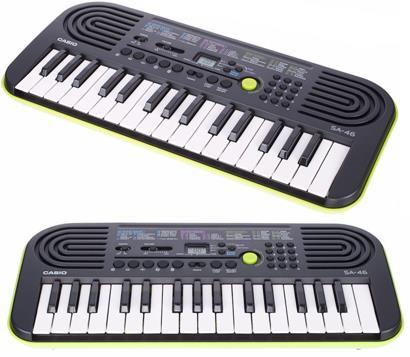
You have to have that for a beginner this keyboard is very short. With such a small polyphony you can’t play with accompaniments and you lack sensitivity in the keys. So the note you play at the same volume always sounds. On the other hand, it doesn’t have MIDI or input for a sustain pedal either. Which are necessary elements to learn piano at a minimum level. I invite you to see the piano selections you will see in this blog to look at other keyboards that do have those extras and cost a little more than 100 euros.
I have selected a couple of videos for you to listen to their sounds and the possibilities they offer. Keep in mind that what you pay for, of course… Then the comparisons below
Related post you can be interested in
- Ranking with the best digital pianos
- My selection of cheap musical keyboards.
- Basic concepts you need to know about digital pianos.
- The best resources to learn to play the piano by yourself.
- The best Casio Digital Pianos.
Now let’s compare the Casio SA 46 with its more common alternatives. Also at the end of the post you will find a section with the best purchasing options for this keyboard. But you can go directly to that part of the post by pressing the next button.
Casio SA 46 vs Casio SA 47
Actually both Casios 46 and 47, are almost identical. Since both have the same value €38/$44/£35, and have very similar characteristics that you will surely find later. One notable difference is that the base of the SA 46 is green, and the Casio SA 47 is black like the rest of the body.
We will put the characteristics of each of these pianos in 2 different columns to make it easier to see the differences:
|
Casio SA 46 |
Casio SA 47 |
|---|---|
|
|
A video where you see the physical differences between them:
It’s good for kids over 6-8 years old…
If you want to know more about this model do not miss our review of the Casio SA 47.
Casio SA 46 vs Casio SA 76
Now we will have the comparison between these two Casios the SA 46 that as we have commented its value is of €38/$44/£35 and the SA 76 that its value is of €57/$54/£52, let us verify if the difference justifies thanks to the characteristics that it offers us.
- The SA 46 has 32 mini keys (for children/persons with small hands) and the SA 76 has 44 mini keys, none of which are sensitive to touch. This means that even if you press hard or softly the keys will sound the same.
- Both have: 8 notes of polyphony, which means that up to 8 notes can be played at the same time. Both have 100 different sounds, 50 styles/rhythms to accompany, 10 songs to practice and 5 Drum-pads to play rhythms or percussions.
- The SA 46 has 0.5W speakers, which are not very powerful. The SA 76 has 0.8W speakers which are a bit more powerful than the SA46.
- The weight of the SA 46 is only 1 kg and the SA 76 is 1.4 kg.
- A notable difference is that the base of the SA 46 is green and the SA 76 is orange.
We will put the characteristics of each of these pianos in 2 different columns to make it easier to see the differences:
|
Casio SA 46 |
Casio SA 76 |
|---|---|
|
|
Here’s a video of the Casio SA 76:
If you want to know more about this model don’t miss our review of the Casio SA 76
Casio SA 46 vs Casio SA 77
Now we will have the comparison between these two Casios the SA 46 that as we have commented its value is of €38/$44/£35, and the SA 77 that its value is of €57/$54/£52, let us verify if the difference justifies thanks to the characteristics that it offers us.
- The SA 46 has 32 mini keys (for children/persons with small hands) and the SA 77 has 44 mini keys, none of which are sensitive to touch. This means that even if you press hard or softly the keys will sound the same.
- Both have: 8 notes of polyphony, which means that up to 8 notes can be played at the same time. Both have 100 different sounds, 50 styles/rhythms to accompany, 10 themes to practice and 5 Drum-pads to play rhythms or percussions.
- The SA 46 has 0.5W speakers, which are not very powerful. The SA 77 has 0.8W speakers which are a little more powerful than the SA 46.
- The weight of the SA 46 is only 1 kg and the SA 77 is 1.4 kg.
- A notable difference is that the base of the SA 46 is green and the SA 77 is black.
We will put the characteristics of each of these pianos in 2 different columns to make it easier to see the differences:
|
Casio SA 46 |
Casio SA 77 |
|---|---|
|
|
Now a video of the Casio SA 77
If you want to know more about this model don’t miss our review of the Casio SA 77
Casio SA 46 vs Casio SA 78
Now we will have the comparison between these two Casios the SA 46 that as we have commented its value is of €38/$44/£35,38 euros and the SA 78 that its value is of €57/$54/£52, let us verify if the difference justifies thanks to the characteristics that it offers us.
- The SA 46 has 32 mini keys (for children/persons with small hands) and the SA 78 has 44 mini keys, none of which are sensitive to touch. This means that even if you press hard or softly the keys will sound the same.
- Both have: 8 notes of polyphony, which means that up to 8 notes can be played at the same time. Both have 100 different sounds, 50 styles/rhythms to accompany, 10 themes to practice and 5 Drum-pads to play rhythms or percussions.
- The SA 46 has 0.5W speakers, which are not very powerful. The SA 78 has 0.8W speakers which are a little more powerful than those of the SA 46.
- The weight of the HS 46 is only 1 kg and the HS 78 is 1.4 kg.
- A notable difference is that the base of the SA 46 is green and that of the SA 78 is red.
We will put the characteristics of each of these pianos in 2 different columns to make it easier to see the differences:
|
Casio SA 46 |
Casio SA 78 |
|---|---|
|
|
Here is a video showing an unboxing and small review of the Casio SA 78:
If you want to know more about this model don’t miss our review of the Casio SA 78
Where to buy Casio SA 46
Amazon
- Free Shipping and possibility of shipping in one day with Amazon Premium.
- Full Guarantee but they are no experts in music equipment.
- Sometimes better price.
- He’s got worse stock than Thomann.
Thomann
- Free Shipping.
- Full warranty. If you have any problems, they take care of everything.
- 100% reliable payment.
- Leader in trouble-free shipping.
- Usually Best price.
- Best Reputation: They are the leading online store in Europe and have the best catalogue and information.
Check below related models with similar price and features:
- Thomann DP 26
- Thomann SP 320
- Yamaha NP 32 Piaggero
- Korg Tiny Piano
- Startone MK 300
- Startone MK 200
- Yamaha PSR E463
- Yamaha PSR E363
- Startone MKR 61
- Roland GO KEYS
- Casio SA 46
- Casio SA 47
- Casio CTK 240
- Casio CT X700
- Yamaha EZ 220
- Yamaha PSR E263
- Yamaha PSR EW300
- Casio LK 280
- Casio SA 76
- Casio CTK 3500
- Casio LK 265
- Casio LK 136
- Casio CTK 1500
- Casio SA 77
- Yamaha Sonogenic SHS 500
- Casio SA 78
- Casio CTK 2500
- Yamaha YPT 260
- Roland GO PIANO
- Midiplus Stage 88

Digital Piano Casio PX S3000 Full Review Is it a good keyboard?
Digital Piano Casio PX S3000 Full Review Is it a good keyboard?
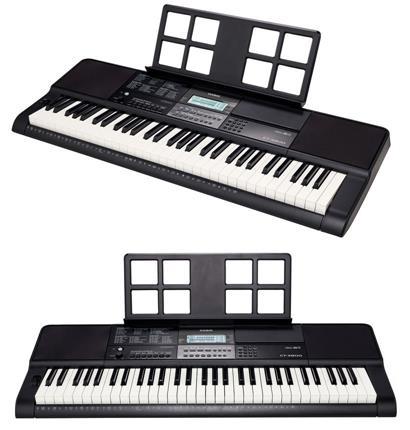
Casio Computer Co., Ltd. is an electronics manufacturer founded in 1946 and based in Tokyo, Japan. Let’s go with a very interesting portable digital piano that has recently come on the market. A weighted keyboard that is also designed to be able to take it anywhere and even play on the street. It’s also great as a concert keyboard for less than 1000 euros (€825/$850/£755). Let’s list its features first:
- 88 ivory/ebony synthetic Smart Scaled Hammer Action keys To imitate the touch of a real acoustic piano
- 700 high quality sounds. In this set you have everything you need.
- 200 rhythms and accompaniments with a great variety
- Audio and midi recorder (records directly to MIDI in your memory)
- Polyphony of 192 voices which is the number of notes sounding at once. With this polyphony you can play any work and you will not have limitations
- Partition and layer function to split the keyboard into two different instruments or to play on top of each other
- chorus
- Brilliance
- DSP (Digital Signal Processing (DSP) effects.) Effects to modify the audio signal
- pitch bend- Also modifies the sound wave to your liking by affecting its equalization
- 60 songs
- Transposition
- Metronome
- Bluetooth audio
- 2 headphone connections
- Sustain pedal input. Basic as a resource of expressiveness in any piano. It also has an input for another expression pedal and supports a triple pedalboard in case we play very advanced scores.
- USB to host. This is actually a USB MIDI connector so you can operate this keyboard as a MIDI controller with music editing programs
- USB to device
- Mono R/L line output. Output with more power than headphones so you can connect to very powerful amplification equipment. Ideal for concerts.
- System of 2 speakers of 8W. Enough power to play outdoors without amplification if you are on a street with good acoustics.
- Possibility to use it with batteries. This is great and the great flexibility to this keyboard so you can take it wherever you want
- Dimensions: 1322 x 232 x 102 mm (width x depth x height)
- Weight: 11.4 kg. Very good weight because this type of keyboard usually weighs about 14 kg
- Includes SP-3 foot pedal, power supply (AD-A12150LW) and score holder
Look at these videos that will surely interest you and in which you can hear the different sounds it has and its quality
Related post you can be interested in
- Ranking with the best digital pianos
- My selection of cheap musical keyboards.
- Basic concepts you need to know about digital pianos.
- The best resources to learn to play the piano by yourself.
- The best Casio Digital Pianos.
Now let’s compare the Casio PX S3000 with its more common alternatives. Also at the end of the post you will find a section with the best shopping possibilities for this digital piano. But you can go directly to that part of the post by pressing the following button.
Casio PX-S3000 Privia vs Roland FP30
First we will have the comparison between the Casio PX-S 3000 keyboard with a price of €825/$850/£755 and the Roland FP 30 which has a price of €619/$700/£555. Having a difference of almost £200 between both, we will analyze their differences and similarities in the following face-to-face:
- Both keyboards have 88 weighted and sensitive keys with hammer action and synthetic ivory touch. The Casio also features synthetic ebony on its black keys and the Roland with leakage. Let’s remember that weighted keyboard is the weight that the keys of a real acoustic piano have, in the low range they have their heaviest notes while in the high range their keys are lighter. And sensitivity refers to the fact that we can interpret dynamics with the keyboard, that is, when we press a key with force it sounds louder than others we press with less force.
- The Casio offers 700 different sounds and 200 rhythms for accompaniment with a polyphony of 192 things maximum. The Roland has 35 sounds, eight standard rhythms and 128 voices of maximum polyphony. Polyphony is the maximum number of notes that can be played simultaneously on one computer.
- Both keyboards have modes such as integer, split, also has the function of metronome, and recorder.
- Some functions of the Calcium are: it has pitch bend wheel, chorus and brilliance effects, Bluetooth audio that allows to connect to an amplification system without cables.
- Some functions of the Roland are: dual whole keyboard and dual piano mode, USB playback of audio files, a recorder of that SMF for ideas.
- Both digital pianos have the USB MIDI function that allows them to be connected to a computer to make MIDI controllers and work in a music composition or production program.
- The Casio offers two connections for All Headphones, and mono R and L line outputs in addition to an 8 W two-speaker system. The Roland offers a mixed connection for output and headphones AND a two-speaker 11 W system.
- The Casio measures 1322 x 232 x 102 mm (W x D x H) and weighs 11.4 kg, while the Roland measures 1300 x 284 x 150 mm (W x D x H) and weighs 14.1 kg.
We found two good digital keyboards that serve two different functions, the Casio is designed to make an arrangement keyboard for its amount of sounds and rhythms also for its effects and line output. On the other hand the Roland is thought to be a digital piano more concentrated on the study of the piano itself and its learning technique, taking into account its amount of sounds and its leakage effect, making a closer experience to a real acoustic piano.
Let’s put the features of these pianos in a table so you can compare
|
Casio PX-S3000 Privia |
Roland FP30 |
|---|---|
|
|
And here is a review of the Roland FP30 digital piano:
If you are interested in knowing more, we invite you to see our Review of the Roland FP 30.
Casio PX-S3000 Privia vs Yamaha P125
Now let’s compare the Casio PX-S3000 keyboard with a price of €825/$850/£755 and the Yamaha 125 with a price of €566/$650/£518 that has been a best seller since it came out. With a difference of almost €300 between them, we’ll look at their similarities and differences in the following head-to-head:
- Both keyboards have 88 weighted and sensitive keys but the Casio with hammer action and ivory and synthetic ebony touch on its black keys. Let’s remember that weighted keyboard is the weight that the keys of a real acoustic piano have, in the low range they have their heavier notes while in the high range their keys are lighter. And sensitivity refers to the fact that we can interpret dynamics with the keyboard, that is to say that when we press a key with force it sounds louder than others that we press with less force.
- The Casio offers 700 different sounds and 200 rhythms for accompaniment with a polyphony of 192 things maximum. The Roland has 35 sounds, eight standard rhythms and 128 voices of maximum polyphony. Polyphony is the maximum number of notes that can be played simultaneously on one computer.
- Both keyboards have modes such as integer, split, metronome and recorder.
- Some functions of the Calcium are: it has pitch bend wheel, chorus and brilliance effects, Bluetooth audio that allows to connect to an amplification system without cables.
- Some functions of the Yamaha are: Effects such as: Four type reverb, IAC, Damper, Sound Boost, Sustain and Triple Pedal inputs, plus option for half pedal.
- Both digital pianos have a USB MIDI function that allows them to be connected to a computer to make MIDI controllers and work in a music composition or production program.
- Both offer two headphone connections, and mono R and L line outputs.
- The Casio has an 8W 2-speaker system, while the Yamaha has a 7W 2-speaker system.
- The Casio has dimensions of 1322 x 232 x 102 mm (width x depth x height) and a weight of 11.4 kg, while the Yamaha has dimensions of 1320 mm x 166 mm x 295mm (width x depth x height) and a weight of 11.8Kg.
Just like the last comparison we found two good ones and in the digital ones they have different functions the Casio as we already mentioned is more usually used as an arrangement keyboard for its sounds and accompaniment rhythms, the Yamaha looks more like a digital piano closer to a real acoustic piano. Thanks to its triple pedal input, it is a must for the professional piano studio.
Let’s put the features of these pianos on a chart so you can compare
|
Casio PX-S3000 Privia |
Yamaha P125 |
|---|---|
|
|
And here’s a video of the Yamaha p125 digital piano:
If you are interested in learning more about the Yamaha P 125 we invite you to view our Review of the Yamaha P 125.
Casio PX-S3000 Privia vs Yamaha DGX-660 B
The Casio PX-S3000 Privia Keyboard is typically 97 Euros more expensive than the Yamaha DGX-660 B. You may have noticed the BK refers to the color. Having said that, let’s compare two very interesting proposals as stage pianos with many sounds.
Although the Yamaha DGX 660 is a good digital piano with good counterbalance the Casio has advantages that can perfectly justify the price difference:
- The Casio PX S3000 weighs less and, because it is battery-powered, offers greater portability for playing even on the street
- The Casio has many more sounds. While it is true that both offer a good variety.
- One advantage of the Yamaha is that it has a microphone input so that its audio signal is output through the speakers to the piano
- The Casio’s speakers are more powerful
- The Casio is less deep and much lighter. It weighs half as much.
It must be said that the Yamaha is a good piano that also supports triple pedal and its sounds are of high quality. I don’t think the Casio has a better sound.
If you just need a digital piano with a lot of sound variety, a good counterbalance and that can be moved by car then the Yamaha DGX may be the perfect choice. But if you are going to move around a lot, play in very big places (the Yamaha has no exit from the line) the Casio PX S3000 is more worthwhile without hesitation.
Let’s put the features of these pianos on a table so you can compare
|
Casio PX-S3000 Privia |
Yamaha DGX-660 |
|---|---|
|
|
And here is a video of the Yamaha DGX-660 digital piano:
If you want to know more about this option, click on the following link to see the Yamaha DGX-660 digital piano
Casio PX-S3000 BK Privia vs Yamaha YDP-S34 B Arius
The Casio PX-S3000 BK Privia Keyboard is usually 40 euros more expensive than the Yamaha YDP-S34 B Arius, but the difference is so small that this can vary. It costs around €792/£722.
In this case let’s compare the Casio with a Yamaha which is a digital piano intended to imitate an acoustic piano. Please note that the Yamaha YDP is not designed to be transported even though it weighs much less than a real acoustic piano.
In common we can say that:
- Both have 88 keys and a good quality counterbalance
- They both have good polyphony
- They have recording and USB MIDI output for connection to the computer
- Both have or can have a triple pedalboard (optional on the Casio, purchased separately)
Taking this into account we can say that both are good for studying but it is true that YDP S34 has more stability and this makes it more comfortable to practice. Anyway we can buy the full Casio support but it already increases the price a lot.
The Casio is unbeatable if you are thinking of a digital piano with lots of sound and very portable. The YDP S34 is like an acoustic piano but has the advantage that it takes up very little space. The advantage of the YDP S34 over the Yamaha YDP 144 is just that. It’s beautiful, it’s stable, and it’s small yet still looks like a real piano. The Yamaha YDP 144 takes up more space, but it has some features that make the piano experience much more real.
It must also be said that the sounds of the Yamaha YDP 34 are few but very good recorded in the memory and of great quality.
Let’s put the characteristics of these pianos on a table so you can compare
|
Casio PX-S3000 BK Privia |
Yamaha YDP-S34 B Arius |
|---|---|
|
|
Let’s go with a video review to hear how it sounds.
If you want to know more about this option click on the following link to see the Yamaha YDP-S34 Arius digital piano
Casio PX-S3000 BK Privia vs Kawai CN-17 B
The Casio PX-S3000 BK Privia Keyboard is usually 42 Euros cheaper than the Kawai CN-17 , but the difference is so small that this may vary.
In this case many of the things we have said in the previous one can be considered in the same way in this digital piano with a stand that tries to imitate a wall piano.
I want to tell you about it because the Kawai are very famous for their touch, although I like the sound of the Yamaha a little more.
As I said before if you want portability the Casio is the best option without hesitation but if you want a piano to study and you find the Kawai CN 17 cheaper than the S34 case I recommend you more the Kawai. For the following reasons:
- It has 5 more sounds
- You can record more sounds
- Duo mode for playing with the teacher
The advantage of the smaller S34.
But let’s go back to the Casio PX. I actually like the quality of the keyboard better in the Kawai. Even if it’s cheaper than the Casio, but, well, in terms of portability, the Casio is a real wonder and I think it’s a very balanced keyboard in terms of price and features.
Let’s put the characteristics of these pianos on a chart so you can compare
|
Casio PX-S3000 BK Privia |
Kawai CN-17 B |
|---|---|
|
|
And here’s a video of the Kawai CN-17 digital piano
Where to buy Casio PX S3000
Amazon
- Free Shipping and possibility of shipping in one day with Amazon Premium.
- Full Guarantee but they are no experts in music equipment.
- Sometimes better price.
- He’s got worse stock than Thomann.
Thomann
- Free Shipping.
- Full warranty. If you have any problems, they take care of everything.
- 100% reliable payment.
- Leader in trouble-free shipping.
- Usually Best price.
- Best Reputation: They are the leading online store in Europe and have the best catalogue and information.
Check below related models with similar price and features:
- Thomann SP 5600
- Yamaha YDP 143
- Roland FP 30
- Yamaha YDP 163
- Yamaha YDP S52
- Hemingway DP 201 MKII
- Casio PX S1000
- Thomann DP 33
- Casio PX S3000
- Casio PX 870
- Yamaha YDP S54
- Yamaha YDP 144
- Korg B1
- Casio CDP S100
- Casio PX 360
- Casio PX 770
- Korg LP 380
- Korg C1 Air
- Casio CDP S350
- Thomann DP 32
- Yamaha YDP S34
- Korg LP 180
- Korg PA 600
- Casio CT X5000
- Yamaha DGX 660
- Korg EK 50
- Yamaha PSR S670
- Yamaha PSR S775
- Yamaha PSR EW410
- Roland 5
- Casio CT X3000
- Yamaha PSR A350
- Casio WK 7600
- Casio WK 6600
- Yamaha P45
- Yamaha P125
- Kawai ES 110
- Alesis Recital Pro
- Kurzweil SPS4 8
- Roland FP 10
- Korg D1
- Studiologic Numa Compact 2
- Korg SP 280
- Yamaha P121
- Studiologic Numa Compact 2x
- Roland GO PIANO 88
- Studiologic Numa Stage

Digital Piano Casio PX S1000 Full Review. Is it a good purchase?
Digital Piano Casio PX S1000 Full Review. Is it a good choice?
Casio Computer Co., Ltd. is a Japanese multinational consumer electronics and commercial electronics manufacturing company headquartered in Tokyo, Japan. Its products include calculators, mobile phones, digital cameras, electronic musical instruments, and analogue and digital watches. Now we are going to review the Casio PX S1000 (It costs around €529/$650/£479 an electronic piano with the following specs:
- 88 Keys with scaled Hammer Action (The weight of the keys on an acoustic piano that digital pianos try to imitate to match the touch of a real acoustic piano. The keys in the high register are heavier and in the high register less. This is a different concept of sensitivity on the keyboard that serves to regulate the volume of the note. But a hammer action keyboard always has sensitivity on the keys.) keyboard (Smart Scaled Hammer Action (The weight of the keys on an acoustic piano that digital pianos try to imitate to match the touch of a real acoustic piano. The keys in the high register are heavier and in the high register less. This is a different concept of sensitivity on the keyboard that serves to regulate the volume of the note. But a hammer action keyboard always has sensitivity on the keys.) Keyboard)
- 18 piano Sounds (Different sounds of piano and other instruments)
- 192 Voice polyphony (Number of notes that can sound at once. This includes songs that sound at once. So if you play over an accompaniment sound, more notes will accumulate.)
- Hammer and Damper resonance
- Split (Split the keyboard into two different instruments) and layer function
- chorus (Effect of touching in places similar to a church or cathedral)
- DSP (Digital Signal Processing (DSP) effects. These are digital effects that modify the sound of the keyboard.)
- Brilliance
- 60 Internal exercises
- Transposer (Transposition allows you to move the note spectrum of a keyboard. This allows you to play with transposing instruments. It is not an easy concept but it is made to facilitate the writing of an orchestration for instruments with very different bass and treble registers.)
- Metronome (Element of basic study to study and practice the tempo of a piece of music.)
- Bluetooth audio
- Connections: 2x Headphones, sustain pedal (The most important pedal of a piano or keyboard is the sustain pedal and is used to keep the note playing even if you stop pressing the key.), USB MIDI, line-out R/L mono
- 2x 8 W speakers
- Battery operation posible (good to play on the street)
- Dimensions (W x D x H): 1322 x 232 x 102 mm
- Weight: 11,2 kg
- Includes sustain pedal, power supply and music holder

Now that we’ve listed and described the features of this digital piano there’s no better than taking a look at the following videos where they tell us more about the Casio PX S1000 and you can hear the different sounds of this piano.
Related post you can be interested in
- Ranking with the best digital pianos
- My selection of cheap musical keyboards.
- Basic concepts you need to know about digital pianos.
- The best resources to learn to play the piano by yourself.
- The best Casio Digital Pianos.
Now let’s compare the Casio PX S1000 with its more common alternatives. Also at the end of the post you will find a section with the best shopping possibilities for this digital piano. But you can go directly to that part of the post by pressing the following button.
Casio PX S1000 vs Casio PX S3000
The Casio PX S3000 is the next level of the Casio PX S1000, it has some more functions than its predecesor and it’s better in some aspects, you should check their differences and similarities to make the best choice.
The digital piano Casio PX S1000 is usually about 263 € cheaper than Casio PX S3000.
Let’s put the features of each of these pianos in 2 different columns to make it easier to see the differences
|
Casio PX S1000 |
Casio PX S3000 |
|---|---|
|
|
And below a video of the Casio PX S3000
If you want to know more about this model do not miss our Casio PX S3000 review.
Casio PX S1000 vs Roland FP 30
Now we are going to make the comparison between this two models. The digital piano Casio PX S1000 is usually about 70 € more expensive than Roland FP 30.
Let’s put the features of each of these pianos in 2 different columns to make it easier to see the differences
|
Casio PX S1000 |
Roland FP 30 |
|---|---|
|
|
And below a video of the Roland FP 30
https://www.youtube.com/watch?v=62_LCDLQsU4
If you want to know more about this model do not miss our Roland FP 30 review
Casio PX S1000 vs Yamaha P125
The digital piano Casio PX S1000 is usually about 46 € more expensive than Yamaha P125, but with so little price difference this can vary.
Let’s put the features of each of these pianos in 2 different columns to make it easier to see the differences
|
Casio PX S1000 |
Yamaha P125 |
|---|---|
|
|
And below a video of the Yamaha P125
If you want to know more about this model do not miss our Yamaha P125 review
Casio PX S1000 vs Yamaha P45
The digital piano Casio PX S1000 is usually about 236 € more expensive than Yamaha P45.
Let’s put the features of each of these pianos in 2 different columns to make it easier to see the differences
|
Casio PX S1000 |
Yamaha P45 |
|---|---|
|
|
And below a video of the Yamaha P45
If you want to know more about this model do not miss our Yamaha P45 review
Where to buy Casio PX S1000
Amazon
- Free Shipping and possibility of shipping in one day with Amazon Premium.
- Full Guarantee but they are no experts in music equipment.
- Sometimes better price.
- He’s got worse stock than Thomann.
Thomann
- Free Shipping.
- Full warranty. If you have any problems, they take care of everything.
- 100% reliable payment.
- Leader in trouble-free shipping.
- Usually Best price.
- Best Reputation: They are the leading online store in Europe and have the best catalogue and information.
Check below related models with similar price and features:
- Thomann SP 5600
- Yamaha YDP 143
- Roland FP 30
- Yamaha YDP 163
- Yamaha YDP S52
- Hemingway DP 201 MKII
- Casio PX S1000
- Thomann DP 33
- Casio PX S3000
- Casio PX 870
- Yamaha YDP S54
- Yamaha YDP 144
- Korg B1
- Casio CDP S100
- Casio PX 360
- Casio PX 770
- Korg LP 380
- Korg C1 Air
- Casio CDP S350
- Thomann DP 32
- Yamaha YDP S34
- Korg LP 180
- Korg PA 600
- Casio CT X5000
- Yamaha DGX 660
- Korg EK 50
- Yamaha PSR S670
- Yamaha PSR S775
- Yamaha PSR EW410
- Roland 5
- Casio CT X3000
- Yamaha PSR A350
- Casio WK 7600
- Casio WK 6600
- Yamaha P45
- Yamaha P125
- Kawai ES 110
- Alesis Recital Pro
- Kurzweil SPS4 8
- Roland FP 10
- Korg D1
- Studiologic Numa Compact 2
- Korg SP 280
- Yamaha P121
- Studiologic Numa Compact 2x
- Roland GO PIANO 88
- Studiologic Numa Stage