
- Home
- Author's Archive:

Digital Piano Clavia Nord Electro 6 Full Review. Is it a good one?
Digital Piano Clavia Nord Electro 6 Full Review. Is it a good choice?
- 73 Keys with Nord Hammer Action (The weight of the keys on an acoustic piano that digital pianos try to imitate to match the touch of a real acoustic piano. The keys in the high register are heavier and in the high register less. This is a different concept of sensitivity on the keyboard that serves to regulate the volume of the note. But a hammer action keyboard always has sensitivity on the keys.) Portable
- Advanced Split (Split the keyboard into two different instruments)ting and layering
- Piano with Synth functions
- 6 Split points with LED display
- 1 GB Memory for Nord Piano Library
- 512 MB Memory for Nord Sample Library
- North C2D B3 Tone Wheel simulation
- Principal Pipe Organ model
- B3 Tone Wheel bass
- Transposer (Transposition allows you to move the note spectrum of a keyboard. This allows you to play with transposing instruments. It is not an easy concept but it is made to facilitate the writing of an orchestration for instruments with very different bass and treble registers.)
- Leslie 122 Simulation of the North C2D
- Extended polyphony (Number of notes that can sound at once. This includes songs that sound at once. So if you play over an accompaniment sound, more notes will accumulate.), enought to play everything
- Program selection with set-list function
- Organise mode for rearranging programs and samples
- Seamless transitions function. Professional transitions
- Quick access to two-manual setups with the Dual (Dual mode allows you to combine two sounds to create a more complete sound. Typical combination of piano + sound of string instruments)-organ mode
- 9 LED pull bar
- Holder for optionally available Half-Moon switch from Nord
- All effects are in stereo
- Tube Overdrive simulation
- Vibe effect
- reverb (Reverberation effect which is a reflection effect of the sound) and delay effects separated
- 2x Line-Out jack (L/R)
- Monitor input mini stereo jack
- Headphone output
- Input for control and sustain pedal (The most important pedal of a piano or keyboard is the sustain pedal and is used to keep the note playing even if you stop pressing the key.) (not included)
- Input for Rotary Speaker Pedal
- midi (MIDI allows you to do such wonderful things as connect the keyboard to the computer, record a soundtrack and with certain programs pass with a click what you have played to musical notes in a score. MIDI tracks store information from musical notes) In/Out
- Usb to Host (It’s a more modern MIDI connector. MIDI allows you to do such wonderful things as connect the keyboard to the computer, record a soundtrack and with certain programs pass with a single click what you have played to musical notes in a score. MIDI tracks store note information)
- Dimensions: 1074 x 344 x 121 mm
- A good weight of: 11,4 kg
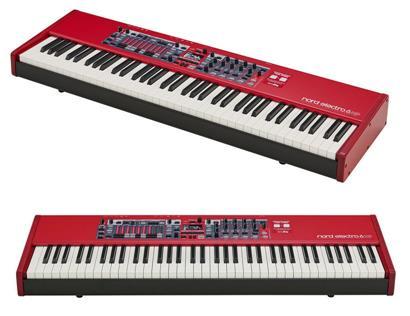
Now that we’ve listed and described the features of this digital piano there’s no better than taking a look at the following videos where they tell us more about the Clavia Nord Electro 6 and you can hear the different sounds of this piano.
https://www.youtube.com/watch?v=qk3R1MgnHTg
Related post you can be interested in
- Ranking with the best digital pianos
- My selection of cheap musical keyboards.
- Basic concepts you need to know about digital pianos.
- The best resources to learn to play the piano by yourself.
Now let’s compare the Clavia Nord Electro 6 with its more common alternatives. Also at the end of the post you will find a section with the best shopping possibilities for this digital piano. But you can go directly to that part of the post by pressing the following button.
Clavia Nord Electro 6 vs Korg SV1 73
The digital piano Clavia Nord Electro 6 is usually about 800 € more expensive than Korg SV1 73.
Let’s put the features of each of these pianos in 2 different columns to make it easier to see the differences
|
Clavia Nord Electro 6 |
Korg SV1 73 |
|---|---|
|
|
And below a video of the Korg SV1 73
If you want to know more about this model do not miss our Korg SV1 73 review
Clavia Nord Electro 6 vs Korg Grandstage 73
The digital piano Clavia Nord Electro 6 is usually about 250 € more expensive than Korg Grandstage 73.
Let’s put the features of each of these pianos in 2 different columns to make it easier to see the differences
|
Clavia Nord Electro 6 |
Korg Grandstage 73 |
|---|---|
|
|
And below a video of the Korg Grandstage 73
If you want to know more about this model do not miss our Korg Grandstage 73 review
Clavia Nord Electro 6 vs Roland VR 730
The digital piano Clavia Nord Electro 6 is usually about 960 € more expensive than Roland VR 730.
Let’s put the features of each of these pianos in 2 different columns to make it easier to see the differences
|
Clavia Nord Electro 6 |
Roland VR 730 |
|---|---|
|
|
And below a video of the Roland VR 730
Clavia Nord Electro 6 vs Kawai MP 11
The digital piano Clavia Nord Electro 6 is usually about 50 € cheaper than Kawai MP 11.
Let’s put the features of each of these pianos in 2 different columns to make it easier to see the differences
|
Clavia Nord Electro 6 |
Kawai MP 11 |
|---|---|
|
|
And below a video of the Kawai MP 11
If you want to know more about this model do not miss our Kawai MP 11 review
Where to buy Clavia Nord Electro 6
Amazon
- Free Shipping and possibility of shipping in one day with Amazon Premium.
- Full Guarantee but they are no experts in music equipment.
- Sometimes better price.
- He’s got worse stock than Thomann.
Thomann
- Free Shipping.
- Full warranty. If you have any problems, they take care of everything.
- 100% reliable payment.
- Leader in trouble-free shipping.
- Usually Best price.
- Best Reputation: They are the leading online store in Europe and have the best catalogue and information.
- Roland FP 60
- Yamaha P515
- Yamaha YDP 164
- Roland FP 90
- Korg G1 Air
- Casio PX 560
- Roland Kiyola KF 10
- Korg PA 1000
- Korg PA 700 Oriental
- Yamaha PSR S975
- Korg Havian 30
- Korg PA 700
- Kawai ES 8
- Kawai MP 11
- Kawai MP 7
- Clavia Nord Electro 6D 61
- Clavia Nord Stage 3 88
- Kurzweil SP6
- Korg SV1 73
- Kurzweil Forte 8
- Clavia Nord Electro 6D 73
- Clavia Nord Stage 3 HP76
- Roland RD 2000
- Kurzweil Artis 7
- Clavia Nord Piano 4
- Clavia Nord Stage 3 compact
- Crumar Seven
- Clavia Nord Electro 6
- Korg Grandstage 73
- Dexibell Vivo Stage S9
- Dexibell Vivo Stage S1
- Korg SV1 88
- Korg Grandstage 88
- Kurzweil Forte SE
- Yamaha CP88
- Roland VR 730
- Studiologic Numa Concert
- Yamaha CP73
- Dexibell Vivo Stage S7
- Yamaha CP300
- Yamaha CP1
- Clavia Nord Grand
- Viscount Physis Piano K4 EX
- Viscount Physis Piano K5 EX
- Dexibell Vivo Portable P7
- Kurzweil Artis
- Dexibell Vivo Portable P3
- Dexibell Vivo Stage S3
Did you like this post? > > > >

Digital Piano Casio WK 7600 Full Review. Is it a good purchase?
Digital Piano Casio WK 7600 Full Review. Is it a good choice?
Casio is on the top of the keyboard sellings. It can be an excellent option for beginners and advanced. Is it a good choice for you? See this review to find out.
- 76 keys with velocity sensitivity (You can adjust the volume of the note depending on how you press it. And it’s different from the weighted hammer action, which is the weight of the keys on a piano.)
- 68 notes polyphony (Number of notes that can sound at once. This includes songs that sound at once. So if you play over an accompaniment sound, more notes will accumulate.)
- 820 Sounds (Different sounds of piano and other instruments)
- 260 Styles (To clarify, this are accompanying styles that adapt to the chords we are playing. For example they will put a bass and a drum set that will adapt and synchronize with the notes we are playing on the keyboard.)
- 100 DSP (Digital Signal Processing (DSP) effects. These are digital effects that modify the sound of the keyboard.) Effects
- Rhythm Editor
- Pitch bend (Functionality that changes the sound wave of what you play and then returns to its original state)
- 96 memory slots
- Audio recording
- Common Effects: reverb (Reverberation effect which is a reflection effect of the sound), Chorus
- 100 Presets One-Touch
- 16 parts Split mode (Split the keyboard into two different instruments)
- Transposer (Transposition allows you to move the note spectrum of a keyboard. This allows you to play with transposing instruments. It is not an easy concept but it is made to facilitate the writing of an orchestration for instruments with very different bass and treble registers.)
- Metronome (Element of basic study to study and practice the tempo of a piece of music.)
- LCD screen
- Combined headphone/line connection (jack)
- Sustain pedal (The most important pedal of a piano or keyboard is the sustain pedal and is used to keep the note playing even if you stop pressing the key.) connection
- Audio IN (mini-jack estéreo)
- Usb to Host (It’s a more modern MIDI connector. MIDI allows you to do such wonderful things as connect the keyboard to the computer, record a soundtrack and with certain programs pass with a single click what you have played to musical notes in a score. MIDI tracks store note information)
- Sustain pedal connection
- SD and SDHC port
- 2 x 7 W speakers system (not very powerfull)
- Dimensions 1161 x 385 x 147 mm
- Weight: 7,2 kg
- External power supply included
- Can work with bateries
- Music holder
Now that we’ve listed and described the features of this digital piano there’s no better than taking a look at the following video where they tell us more about the Casio WK 7600 and you can hear the different sounds of this piano.
Related post you can be interested in
- Ranking with the best digital pianos
- My selection of cheap musical keyboards.
- Basic concepts you need to know about digital pianos.
- The best resources to learn to play the piano by yourself.
- The best Casio Digital Pianos.
Now let’s compare the Casio WK 7600 with its more common alternatives. Also at the end of the post you will find a section with the best shopping possibilities for this digital piano. But you can go directly to that part of the post by pressing the following button.
Casio WK 7600 vs Yamaha PSR EW410
The digital piano Casio WK 7600 is usually about 26 € more expensive than Yamaha PSR EW410, but with so little price difference features can vary.
We begin the comparison with both models, which have 76 keys with velocity sensitivity.
Continuing, the Casio WK 7600 has 68 polyphony notes, 820 sounds, 260 styles, 100 DSP effect. On the other side, it has rhythm editor, pitch bend whee, l96 memory slots, transposer and metronome.
Additionally, it has audio recording, common effects: Reverb, Chorus, 100 One-Touch Presets, and 16 Split mode parts.
This keyboard has also sustain pedal connection, LCD screen and a 2 x 7W speaker system (not very powerful). It also comes with accessories such as a sheet holder and an external power supply included (it can also work with batteries).
Moreover, let’s compared it to the other model, the Yamaha PSR EW410. This keyboard has 758 sounds, 48-note polyphony, 235 styles, Pitch Bend Wheel, swivel regulators.
Yamaha modelalso counts with reverb, chorus, and DSP effects, 150 arpeggio types, preset master equalizer, dual and split functions.
Additionally, it has pattern function, metronome, transposer, 2 x 12W Loud vocal system and includes an external power supply (PA-300C) and support for scores.
Now, we come to connectivity, where the Casio WK 7600 has a combined headphone/line (jack) connection. It also has sustained pedal connection, audio input (stereo mini-jack), USB to host, SD and SDHC port.
Yamaha PSR EW410 has USB to host, USB to the device, auxiliary audio input; sustain pedal input (sustain pedal not included). Including also, headphone connection, auxiliary audio input (stereo mini jack), outputs: L / L + R, R
The WK 7600 measures 1161 x 385 x 147mm and has a total weight of 7.2kg..
Yamaha PSR measures 1179 x 138 x 413mm and weighs 8.4 kg.
And below a video of the Yamaha PSR EW410
If you want to know more about this model do not miss our Yamaha PSR EW410 review
Casio WK 7600 vs Casio WK 6600
The Casio WK 7600 digital piano usually costs about 62 € more than the Casio WK 6600.
Firstly, these two keyboards have 76 keys with velocity sensitivity and have a system of 2 not very powerful speakers of 6W. In addition, both come with accessories such as an external power supply (both can run on batteries) and score support.
In terms of features and functions, the Casio WK 7600 has a slight advantage. It has 68 polyphonic notes versus 48 polyphonic notes from the Casio WK 6600.
On the other hand, the Casio WK 7600 has around 820 sounds, 260 styles, and 100 DSP effects, while the WK 6600 has 700 sounds 210 styles and 100 DSP effects.
Other features and functionalities of the Casio WK 7600 include a rhythm editor, pitch bend wheel, 96 memory slots. In addition, audio recording, common effects: Reverb, Chorus, 100 Presets One-Touch, 16 parts Split mode, Transposer, Metronome and LCD screen.
Speaking now of the other features of the Casio WK 6600, we have a pitch bend wheel, 32 memory slots, common reverb effects, Choruses, 100 One-Touch Presets, 16 split mode parts, transposer, metronome and LCD screen.
The Casio WK 7600 is superior due to its small additional features.
Finally, the connections of the WK 7600, combined headphones/line connection (jack), sustain pedal connection. It also has audio input (stereo mini-jack), USB to host, sustain pedal connection and SD and SDHC port.
While the WK 6600 has combined headphones/line connection (jack), sustain pedal connection, audio input (stereo mini-jack), USB to host, sustain pedal connection and SD and SDH port.
The Casio WK 7600 measures 1161 x 385 x 147mm and has a total weight of 7.2 kg, while the Casio WK 6600 measures 1161 x 385 x 147mm and has a total weight of 8.3 kg.
And below a video of the Casio WK 6600
If you want to know more about this model do not miss our Casio WK 6600 review.
Casio WK 7600 vs Thomann SP 5600
The digital piano Casio WK 7600 is usually about 52 € more expensive than Thomann SP 5600.
The Casio WK 7600 has a 76-key keyboard with velocity sensitivity, while the Thomann SP 5600 has 88 Weighted hammer action keys. The Casio 7600 has 2 7W speakers, while the Thomann SP 5600 has 2 10W speakers.
Some accessories that the WK 7600 comes with are sheet music support and an external power supply (it can also work with batteries). While the Thomann has are sheet music support, power supply and sustain pedal.
The Thomann SP 5600 features 600 sounds, 230 styles (10 from the user), 120 songs, 128 polyphonic notes, Master EQ (3 different types) and reverb and chorus effects. In addition, it also has arrangements function: start/stop, sync start, introduction/end, A fill, B fill.
Going on, it also has layer mode, split mode, four-hand mode, Sequencer: 5 user songs: melody and accompaniment, duet function, Pitch bend, metronome, transposer.
On the other hand, the Casio WK7600 has 68 polyphonic notes, about 820 sounds, 260 styles, and 100 DSP effects. Among other features and functionalities of the Casio WK 7600, we have a rhythm editor, pitch bend wheel, 96 memory slots.
In addition, audio recording, common effects: Reverb, Chorus, 100 Presets One-Touch, 16 parts Split mode, Transposer, Metronome and LCD screen.
Moving now to the connections that the WK 7600 has been a combined headphones/line connection (jack), sustain pedal connection. It also has audio input (stereo mini-jack), USB to host, sustain pedal connection and SD and SDHC port.
The connections of the Thomann SP 5600 are 2 headsets for duet mode, USB to HOST, AUX audio input/output.
Finally, the Casio WK 7600 measures 1161 x 385 x 147mm and has a total weight of 7.2 Kg. Thomann SP 5600 measures are (W x D x H) 1365 x 366 x 137mm and has a weight of 13.8 kg.
If you want to know more about this model do not miss our Thomann SP 5600 review
Casio WK 7600 vs Yamaha P45
The Casio WK 7600 digital piano is usually about 22 € more expensive than the Yamaha P45. Let’s compare this two models.
Firstly, the Yamaha P45 keyboard features 88 weighted keys on a Graded Hammer Standard (GHS) keyboard and 2 6W speakers. Secondly, we have the Casio WK 7600 with a keyboard of 76 keys with dynamic sensitivity and 2 speakers of 7W.
On the other hand, some of the accessories of the WK 7600 are score support and an external power supply (it can also work with batteries). While the Yamaha P45 comes with sheet music support, sustain pedal, built-in microphone, and power supply.
In its functionality, the Casio WK 7600 has 68 polyphonic notes, 820 sounds, 260 styles, 100 DSP effects, rhythm editor, pitch bend Wheel. It also has an audio recording, common reverb, and chorus effects, 100 One-Touch Presets and 16 Split mode parts.
Including 96 memory slots, transposer, metronome, sustain pedal connection, LCD screen. Finally, it measures 1161 x 385 x 147mm and weighs 7.2 Kg.
Among the features and functions of the Yamaha P45 are the AWM sampling technology, 64 polyphonic voices, 10 sounds, Dual-mode and four hands, reverb and chorus effects, metronome, transposer, IAC, 10 songs. Its total weight is 11.5 Kg and its size is 1326 x 154 x 295mm.
Continuing with the last part, the connections of the Casio WK 7600 are a combined headphone/line (jack) connection, sustain pedal connection. It also has audio input (stereo mini-jack), USB to host, sustain pedal connection and SD and SDHC port.
While the Yamaha P45 has the only USB to HOST connections and 1 stereo headphone output jack.
And below a video of the Yamaha P45
If you want to know more about this model do not miss our Yamaha P45 review
Where to buy Casio WK 7600
Thomann
- Free Shipping.
- Full warranty. If you have any problems, they take care of everything.
- 100% reliable payment.
- Leader in trouble-free shipping.
- Usually Best price.
- Best Reputation: They are the leading online store in Europe and have the best catalogue and information.
Amazon
- Free Shipping and possibility of shipping in one day with Amazon Premium.
- Full Guarantee but they are no experts in music equipment.
- Sometimes better price.
- He’s got worse stock than Thomann.
Check below related models with similar price and features:
- Thomann SP 5600
- Yamaha YDP 143
- Roland FP 30
- Yamaha YDP 163
- Yamaha YDP S52
- Hemingway DP 201 MKII
- Casio CDP S100
- Casio PX S1000
- Thomann DP 33
- Casio PX S3000
- Casio PX 870
- Yamaha YDP S54
- Yamaha YDP 144
- Korg B1
- Casio PX 360
- Casio PX 770
- Korg LP 380
- Korg C1 Air
- Casio CDP S350
- Thomann DP 32
- Yamaha YDP S34
- Korg LP 180
- Korg PA 600
- Yamaha PSR EW410
- Casio CT X5000
- Yamaha DGX 660
- Korg EK 50
- Yamaha PSR S670
- Yamaha PSR S775
- Roland 5
- Casio CT X3000
- Yamaha PSR A350
- Casio WK 7600
- Casio WK 6600
- Yamaha P45
- Yamaha P125
- Kawai ES 110
- Alesis Recital Pro
- Kurzweil SPS4 8
- Roland FP 10
- Korg D1
- Studiologic Numa Compact 2
- Korg SP 280
- Yamaha P121
- Studiologic Numa Compact 2x
- Roland GO PIANO 88
- Studiologic Numa Stage

Digital Piano Casio WK 6600 Full Review. Is it a good keyboard?
Digital Piano Casio WK 6600 Full Review. Is it a good choice?
Casio has taken models of almost all types of existing pianos with very good results in the long run to compete with established companies such as Yamaha or Korg, today I will be reviewing the WK 6600 model which has a specific niche of professionals and combines quite interesting functions such as 100 DSP effects as well as a pitch bend wheel, in this article I will review several of the features of this model.
Features
- 76 keys with velocity sensitivity (You can adjust the volume of the note depending on how you press it. And it’s different from the weighted hammer action, which is the weight of the keys on a piano.)
- 48 notes polyphony (Number of notes that can sound at once. This includes songs that sound at once. So if you play over an accompaniment sound, more notes will accumulate.)
- 700 Sounds (Different sounds of piano and other instruments)
- 210 Styles (Accompanying styles that adapt to the chords we are playing. For example they will put a bass and a drum set that will adapt and synchronize with the notes we are playing on the keyboard.)
- 100 DSP (Digital Signal Processing (DSP) effects. These are digital effects that modify the sound of the keyboard.) Effects
- Rueda de pitch bend (Functionality that changes the sound wave of what you play and then returns to its original state) Wheel
- 32 memory slots
- Common Effects: reverb (Reverberation effect which is a reflection effect of the sound), Chorus
- 100 Presets One-Touch
- 16 parts Split mode (Split the keyboard into two different instruments)
- Transposer (Transposition allows you to move the note spectrum of a keyboard. This allows you to play with transposing instruments. It is not an easy concept but it is made to facilitate the writing of an orchestration for instruments with very different bass and treble registers.)
- Metronome (Element of basic study to study and practice the tempo of a piece of music.)
- LCD screen
- Combined headphone/line connection (jack)
- Sustain pedal (The most important pedal of a piano or keyboard is the sustain pedal and is used to keep the note playing even if you stop pressing the key.) connection
- Audio IN (mini-jack estéreo)
- Usb to Host (It’s a more modern MIDI connector. MIDI allows you to do such wonderful things as connect the keyboard to the computer, record a soundtrack and with certain programs pass with a single click what you have played to musical notes in a score. MIDI tracks store note information)
- Sustain pedal connection
- SD and SDH port
- 2 x 6 W speakers system (not very powerfull)
- Dimensions 1161 x 385 x 147 mm
- Weight: 8,3 kg
- External power supply included and can it works with bateries also
- Music holder
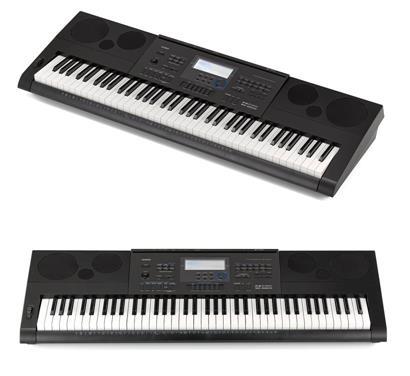
Now that we’ve listed and described the features of this digital piano there’s no better than taking a look at the following video where they tell us more about the Casio WK 6600 and you can hear the different sounds of this piano.
https://www.youtube.com/watch?v=_pgqux527BY
Related post you can be interested in
- Ranking with the best digital pianos
- My selection of cheap musical keyboards.
- Basic concepts you need to know about digital pianos.
- The best resources to learn to play the piano by yourself.
- The best Casio Digital Pianos.
Now let’s compare the Casio WK 6600 with its more common alternatives. Also at the end of the post you will find a section with the best shopping possibilities for this digital piano. But you can go directly to that part of the post by pressing the following button.
Casio WK 6600 vs Yamaha PSR EW410
Casio has almost reached Yamaha in the domain of the digital piano industry and this new Casio model puts a point on Casio’s side, having a versatile piano that surpasses Yamaha’s own brand of pianos, comparing it to the PSR EW410 model we find that Casio has many more DSP effects as well as a wheel that can change the Pitch.
The digital piano Casio WK 6600 is usually about 36 € cheaper than Yamaha PSR EW410, but with so little price difference this can vary.
Let’s put the features of each of these pianos in 2 different columns to make it easier to see the differences
|
Casio WK 6600 |
Yamaha PSR EW410 |
|---|---|
|
|
And below a video of the Yamaha PSR EW410
If you want to know more about this model do not miss our Yamaha PSR EW410 review
Casio WK 6600 vs Casio WK 7600
If we compare it with a somewhat newer model we can see that the Casio WK 7600 we find that this model integrates the function of audio recording as well as a post SD to record, there is also an increase in styles and sounds offered by the piano.
The Casio WK 6600 model has 76 keys with a speed sensitivity plus 48 polyphonic notes, 700 sounds, 200 styles, 100 DSP effects, 32 memory lots, most common effects such as reverb, chorus. 100 presets, an LCD screen, a transposer, metronome, a sustain pedal as well as a direct line to connect the piano via MIDI.
On the other hand the Casio WK 7600 has almost the same features but adding the function of recording audio from the keyboard as well as an SD port to pass the music and play it from the keyboard.
The digital piano Casio WK 6600 is usually about 62 € cheaper than Casio WK 7600.
Let’s put the features of each of these pianos in 2 different columns to make it easier to see the differences
|
Casio WK 6600 |
Casio WK 7600 |
|---|---|
|
|
And below a video of the Casio WK 7600
If you want to know more about this model do not miss our Casio WK 7600 review.
Casio WK 6600 vs Thomann DP 26
The difference between these two keyboards is clear and justifies that the WK 6600 model is more expensive, a greater variety of sounds as well as styles, more than 100 DSP effects that work quite well both in live presentations and in the studio and includes several more features that make it a better keyboard for all users.
The Thomann DP 26 has 88 keys with hammer action function, 20 sounds, 2 demo songs as well as 50 styles, 64 polyphonic voices, LED lights, leyer mode, split mode as well as master EQ effects, reverb, chorus, a song sequencer that can make the melody and also the base chords, 60 presets and a duet function among many other functions.
The digital piano Casio WK 6600 is usually about 54 € more expensive than Thomann DP 26.
Let’s put the features of each of these pianos in 2 different columns to make it easier to see the differences
|
Casio WK 6600 |
Thomann DP 26 |
|---|---|
|
|
And below a video of the Thomann DP 26
If you want to know more about this model do not miss our Thomann DP 26 review
Casio WK 6600 vs Thomann SP 5600
This is another similar case, Casio has combined in perfect harmony the quality of the piano it has presented with its price, making more established pianos for live performances such as the Thomann SP 5600 lack the functionalities that Casio’s WK 6600 has.
The Casio WK 6600 model has 76 keys with a speed sensitivity plus 48 polyphonic notes, 700 sounds, 200 styles, 100 DSP effects, 32 memory lots, most common effects such as reverb, chorus. 100 presets, an LCD screen, a transposer, metronome, a sustain pedal as well as a direct line to connect the piano via MIDI.
The Thomann has 88 keys with hammer action, 600 sounds, a start function that can do both a synchronized start, an end and several fills, it also has 230 styles, 128 polyphonic voices, a layer mode, a four hands mode, reverb effects, master EQ and chorus, duet function, pitch bend as well as a sustain pedal among other features.
The digital piano Casio WK 6600 is usually about 10 € cheaper than Thomann SP 5600, but with so little price difference this can vary.
Let’s put the features of each of these pianos in 2 different columns to make it easier to see the differences
|
Casio WK 6600 |
Thomann SP 5600 |
|---|---|
|
|
And below a video of the Thomann SP 5600
If you want to know more about this model do not miss our Thomann SP 5600 review
Where to buy Casio WK 6600
Thomann
- Free Shipping.
- Full warranty. If you have any problems, they take care of everything.
- 100% reliable payment.
- Leader in trouble-free shipping.
- Usually Best price.
- Best Reputation: They are the leading online store in Europe and have the best catalogue and information.
Amazon
- Free Shipping and possibility of shipping in one day with Amazon Premium.
- Full Guarantee but they are no experts in music equipment.
- Sometimes better price.
- He’s got worse stock than Thomann.
Check below related models with similar price and features:
- Thomann SP 5600
- Yamaha YDP 143
- Roland FP 30
- Yamaha YDP 163
- Yamaha YDP S52
- Hemingway DP 201 MKII
- Casio PX S1000
- Thomann DP 33
- Casio PX S3000
- Casio PX 870
- Yamaha YDP S54
- Yamaha YDP 144
- Korg B1
- Casio CDP S100
- Casio PX 360
- Casio PX 770
- Korg LP 380
- Korg C1 Air
- Casio CDP S350
- Thomann DP 32
- Yamaha YDP S34
- Korg LP 180
- Korg PA 600
- Casio CT X5000
- Yamaha DGX 660
- Korg EK 50
- Yamaha PSR S670
- Yamaha PSR S775
- Yamaha PSR EW410
- Roland 5
- Casio CT X3000
- Yamaha PSR A350
- Casio WK 7600
- Casio WK 6600
- Yamaha P45
- Yamaha P125
- Kawai ES 110
- Alesis Recital Pro
- Kurzweil SPS4 8
- Roland FP 10
- Korg D1
- Studiologic Numa Compact 2
- Korg SP 280
- Yamaha P121
- Studiologic Numa Compact 2x
- Roland GO PIANO 88
- Studiologic Numa Stage