
- Home
- Author's Archive:
Digital Piano Yamaha YDP 143 Full Review. Is it a good choice?
The Yamaha YDP 143 is the new version of the Yamaha Arius YDP 142. It is a digital piano under 800 euros with very good value for the money. It is a piano designed for the classical student who wants to enjoy the advantages of having a digital piano and at the same time wants an apparent piano with a presence similar to that of an upright piano.
Notice that the Yamaha YDP 144 has been launched. The only difference of the Yamaha YDP 143 vs Yamaha YDP 144 is that grand piano sound comes with a better sampling quality (which is really good).

Throughout the article, we will also recommend other cheaper options within the brand Yamaha.
Where to Buy Yamaha YDP 144 Arius? (143 is not sold anymore)
Amazon
- Free Shipping and the possibility of shipping in one day with Amazon Premium.
- Full Guarantee but they are no experts in music equipment
- A leader in fast shipments.
- The price change a lot daily.
- The best option in the USA and worldwide
Thomann
- Free Shipping
- Full warranty. If you have any problems, they take care of everything.
- 100% reliable payment.
- A leader in trouble-free shipping.
- Usually the Best price.
- Best Reputation: They are the leading online store in Europe and have the best catalog and information.
The Yamaha Arius YDP 143 is a complete piano. It has 88 weighted keys that imitate the mechanical system of an acoustic piano. This is very important when learning to play the piano.
The keys on a digital piano should feel the same weight as on an acoustic piano and be sensitive to touch. The louder you press, the louder the sound. The Hammer Action system it has is Yamaha’s GHS (Graded Hammer Standard) a very accomplished system that is in most Yamaha digital pianos in that price range.
Sound
This piano has 10 high-quality sounds. Piano sounds are recorded with the Pure CF Sound Engine technology which is one of Yamaha’s latest patents on sampling. All sounds are recorded from a Yamaha CF grand piano. Among those 10 sounds, you have a real piano, harpsichord, electric piano. All of them with professional quality. We will leave you a video so you can hear what they sound like.
The Yamaha YDP 143 has 192 polyphony notes, which as explained in the video are the notes that can sound at the same time on the piano. If you touch up an accompaniment this also consumes polyphony. With 192 you can play anything.
The Yamaha YDP 143 also comes with 50 presets or accompaniments, so you can play over them and complement your sound. So that you can play the piano while it plays, for example, an orchestral accompaniment of strings. The touch is very achieved and has a very good response time. There is no delay or sound delay of any kind.
On the other hand this piano dumper resonance, Intelligence acoustic control (IAC) to balance bass and treble when playing bass. All these effects try to get you as close as possible to playing an acoustic piano, even mimicking the reverberation of the strings being struck by the hammer.
Connectivity
One of the advantages of portable pianos is their ability to connect to the computer via a USB MIDI connector.
This opens up a world of possibilities for us. Well, we can record what we play in a music production program and then edit it. In addition, those tracks that we record when being MIDI then they can be exported directly to music sheets with programs like CUBASE.
Today MIDI connection is basic. Because then this will allow us to play with our sounds, modify them, and then get the score without doing anything else.
We can also write scores and compose scores while playing with programs like Sibelius. Another utility of the Yamaha YDP Arius 143 is that the keyboard can be divided into 2 smaller pianos so that teacher and student can play on four hands mode. It also has two headphones outputs so that you can study in silence and even give the class in silence.
Triple Pedal
The pedals are a basic element for playing the piano. The most important is the sustain pedal, which allows the note to continue playing even if we stop pressing the key. This consumes polyphony and is a very valuable interpretative resource. The YDP 143 has all three pedals included. So, this is perfect.
Extras
All digital pianos come with metronome and reverb and chorus effects. In this case, you have up to 4 types of reverbs that give enough possibilities of interpretation. With this piano, you can record up to two tracks and then play on them.
Is Yamaha YDP 143 right for me?
It is a digital piano with good quality in relation to the price. Although there are better and better finishes to study classic is valid for many years. At least for the middle and elementary piano learning levels without a problem. In the upper one, it is convenient to combine the study in one of these with a real acoustic piano.
The digital pianos of more quality have a more achieved touch but this model gives for many years. You have to keep in mind that the intention of these pianos is to look like an acoustic piano even though they weigh much less. This one weighs 38 Kg. so it is much more manageable than an upright piano of about 150 Kg.
If you want to open up your possibilities, you should take a look at portable digital pianos. Specifically, you have the Yamaha P115 that offers very similar features at a lower price. And if you want something cheaper portable and with a good touch, take a look at the Kawai ES110.
Yamaha YDP 143 vs Yamaha YDP 142
The improvement is basically in the polyphony that is now 192 notes compared to 128 that the previous model had. A change that users were asking loudly and all for the same price as the YDP 142.
Yamaha YDP 143 vs Yamaha P115 vs Yamaha P125
Both digital pianos offer almost the same features. Even they both have the same polyphony. Although now the Yamaha P125 has come out that has more sounds than the Yamaha P115.
In total now brings 24 piano sounds. But the Yamaha P115 and Yamaha P125 also have line output to plug into any amplification system, which counts as a stage piano and weighs only 12 Kg. We recommend that you take a look at our selection of the best value for money piano keyboards before you decide.
Basically the Yamaha YDP 143 suits you a little better than the Yamaha P125 if portability does not matter to you and you are more oriented to studying classical music at home. Well, it has some nuances that imitate a wall-mounted piano better. As for the Yamaha YPT 142, do not hesitate, is better if buy the 143 (now YDP 144) because it has better polyphony at the same price. The YPT 142 is only suitable for you if you find it very cheaply second-hand.
Here is our complete review of the new Yamaha P125. The truth is that the price has dropped lately and is becoming a great option.
Where to Buy Yamaha YDP 143 Arius
Being a digital piano you can buy it online without worries, as the production has a similar and consistent quality. It is not that like other acoustic instruments, that each one arrives in a different way. Worldwide choose Amazon, still, if you are in Europe Thomann is the best option:
For a similar price you have the following pianos and keyboards:
- yamaha YDP-S34 Arius
- yamaha YDP 163
- yamaha YDP 143
- yamaha PSR S770
- yamaha PSR S670
- yamaha PSR E453
- yamaha PSR E443
- yamaha P45
- yamaha P255
- yamaha P125
- yamaha P-121
- yamaha P115
- yamaha P105
- yamaha DGX 660
- yamaha Arius YDP 142
- yamaha PSR S775
- yamaha PSR E463
- yamaha p35
- Thomann SP 5600
- Thomann DP-33
- Thomann DP-31
- roland Juno DS61
- roland JD XI
- roland Go Keys
- roland FP-60
- roland FP 80
- Piano Thomann SP 320
- Moog Sub Phatty
- Moog Mother 32
- Minimoog Model D
- Kurzweil SPS4-8
- Kurzweil SP6
- Kurzweil SP4-8
- Kurzweil Forte SE
- Kurzweil Forte 8
- Kurzweil Artis 7
- korg PA-700 Oriental
- korg PA-700
- korg PA600
- korg PA-300
- korg PA-1000
- korg Kross
- korg Kronos
- korg Havian 30
- korg Grandstage 88
- casio PX-870 Privia
- casio PX-770 Privia
- casio PX-5S Privia Pro
- casio PX-560 Privia
- casio PX-360 Privia
- casio PX 160
- casio CT-X800
- casio CT-X700
- casio CT-X5000
- casio CT-X3000
- casio Cdp 130
- Thomann DP 26
- roland FP 90
- roland FP 30
- roland FA 06
- roland BK 5
- korg SP 280
- korg Monologue
- korg Minilogue
- korg Microkorg
- korg LP 380
- korg B1
- kawai ES8
- kawai ES110
- kawai ES100
- kawai CN27
- kawai CN25
- casio Cdp 230
- Arturia Microbrute
- Casio CDP S100
Vote if you liked this article 🙂
Digital Piano Yamaha PSR EW410 Review. Is It Worth It?
Yamaha PSR EW410 Review: Opinion and Where to Buy It
The Yamaha PSR EW410 is an excellent choice as an entry-level keyboard, with ample possibilities for playing multiple musical genres, 76 keys (6 octaves), 758 sounds covering quite a few types of musical instruments with a very good quality acoustic piano sound, and 235 types of rhythms from different musical genres.
It has powerful built-in speakers (12 W + 12 W) as well as live and live functions that meet the needs of beginner concert keyboardists.
Where to buy it?This keyboard also features a wide range of Latin American rhythms such as cumbia, bachata, son cubano, joropo, parranda and many more, with Latin users in mind.An excellent choice for keyboardists looking for a keyboard that is suitable for both studio and live use and has a wider 5 octave range.
The sound of the Yamaha PSR EW410

I’m sure you’ll be interested in…
- Ranking with the best digital pianos in quality-price ratio
- The cheapest musical keyboards for beginners
- Other Yamaha Digital Piano Reviews
- Learn piano by yourself and for free
Among its 758 sounds is a wide range of instruments ranging from pianos, organs, synths, winds, strings, drums and more, but the Yamaha PSR EW410 stands out over the PSR-E line for having a higher quality acoustic piano from the Live library! From Yamaha, some of these 758 sounds also come from Yamaha bookstores like Sweet!, Cool! and also have 3 dynamic voices.
The voices on this keyboard could be divided into 237 panel voices, with a more professional sound, 24 drum kits, 40 arpeggios and 457 voices from the XGlite library.The panel sounds are divided like this:
- 10 acoustic pianos.
- 8 electric pianos.
- 15 organs.
- 6 accordions.
- 13 guitars.
- 17 lows.
- 19 string sounds.
- 5 chorus sounds.
- 15 saxophones.
- 10 trumpets.
- 15 metal sounds.
- 9 flutes.
- 28 solo synthesizers.
- 18 pad synthesizers.
- 12 percussions.
- 37 ethnic sounds.
Also thanks to the Quick Sampling system, it is possible to record audio samples to create new sounds according to the needs of the keyboardist.
Its amplification system has a power of 12W and 12W with 12 cm Bass Reflex loudspeakers.
It also has an effects section with 10 effects varied in the DSP, 12 Reverb types, 5 Chorus types, 6 equalization types and 26 harmony types so that different modifications to your voices can be made to your liking.
Also as a very useful functionality for live, can record up to 80 minutes of audio in WAV format and also has external audio input to launch tracks, sequences and so on from an external player.
The Rhythms of the Yamaha PSR EW410
This keyboard comes with 235 rhythms from the factory and also has the ability to play more additional rhythms from a USB memory stick.
Each rhythm has intro, final, fills, self-synchronization, and accompaniment with various instruments according to the chords being played; each rhythm has 4 variations and a “Climax” that make the execution more varied.
Its “Groove creator” feature allows the user to create DJ-style music, with pre-recorded loops and patterns that can be combined to create fun rhythms.
In this video is shown in the demonstration of the PSR E463, but in these two teams the rhythms are exactly the same, therefore, the rhythms shown in this video are also included in the PSR EW410.
Yamaha PSR EW410 vs Yamaha PSR E463

The first comparison we can think of and perhaps the most appropriate, is to compare the PSR EW410 with the PSR E463, and these two teams share almost all the same performance with slight differences where the EW410 wins the battle:
- It has a keyboard with 76 keys (6 octaves) in front of the 61 keyboard of the E463 with more range.
- The acoustic piano sound of the PSR EW410 is of higher quality than that of the PSR E463, the rest of its sounds and rhythms are the same.
- The speakers of the PSR EW410 are much more powerful than those of the PSR E463.
You can read more about this team in our full review of the Yamaha PSR E463.
Yamaha PSR EW410 vs Yamaha PSR EW400
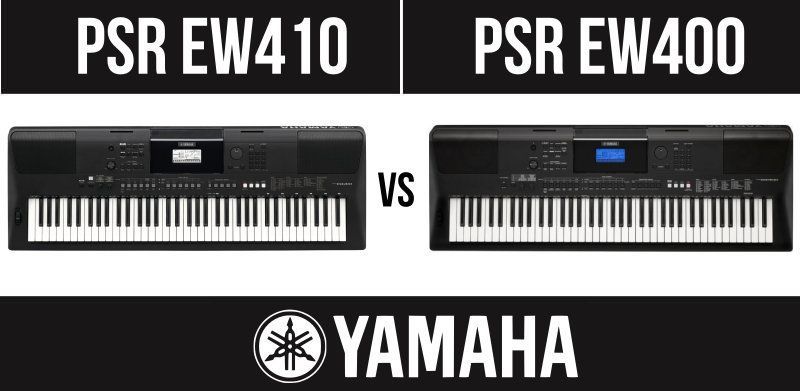
Another of the much needed comparisons when reviewing the Yamaha PSR EW410 is with its predecessor, the PSR EW400, with which it also shares many features among them the same amount of sounds, but exceeds in several respects, being an improvement of this model:
- The PSR EW410 has a higher number of rhythms, 235, versus 220 rhythms in the PSR EW400.
- The PSR EW400 does not have the Groove Creator function, although it does have the “DJ Patterns” function which is very similar.
- The PSR EW400 does not have the Quick Sampling feature that allows you to create new voices from recorded samples.
You can read more about this team in our full review of the Yamaha PSR EW400.
Yamaha PSR EW410 vs Yamaha PSR E363

The Yamaha PSR E363 is a team with less performance than the PSR EW410 (And also for a much lower price)Among its main differences are highlighted:
- The PSR E363 has 5 octaves versus the 6 octaves of the PSR EW410.
- The sound bank of the PSR E363 is much more limited, with 574 sounds versus 758 sounds of the PSR EW410.
- The acoustic piano sound of the PSR EW410 is of much higher quality than that of the PSR E363.
- The PSR E363 also brings much less rhythms, with only 165 rhythms versus the 235 of the PSR EW410.
- The speakers of the EW410 are much more powerful than those of the PSR E363.As for effects, they have the same Reverbs, Chorus and Equalizations, but the PSR E363 doesn’t have the 10 DSP effects of the PSR EW410.
- Finally, the PSR E363 does not have the functions of Groove Creator, Quick Sampling or the possibility to save audio in .WAV format.
You can read more about this team in our full review of the Yamaha PSR E363.
Yamaha PSR EW410 vs Yamaha PSR S670

The PSR-S line is a superior line to Yamaha’s PSR-E line so the PSR S670 will outperform the PSR EW410 in many respects, but bearing in mind that the PSR-EW410 is a 6 octave keyboard while the PSR-S670 is a 5 octave keyboard.
Their main differences are:
- The loudspeakers of the PSR S670 are of greater power, because they have 15W of power, versus 12W of power of the PSR EW410.
- Although the PSR S670 has far fewer voices (416), these voices are superior to the voices of the PSR EW410, as they have higher sample quality, natural reverberations and greater instrument detail.
- The PSR S670 has more effects in its DSP section with 44 factory Reverb settings plus 3 User
- Reverb settings on the PSR S670 versus only 12 factory Reverb settings on the PSR EW410, 71 factory Chorus settings plus 3 user Chorus on the PSR S670 versus 5 types of Chorus on the EW410 and a much more powerful DSP engine with 283 assignable factory effects and 10 user DSP effects on the PSR S670 versus only 10 effects on the EW410.
- On the PSR S670 it is also easier to navigate its functionalities, thanks to a greater number of dedicated controls.
You can read more about this team in our full review of the Yamaha PSR S670.
Where to Buy Yamaha PSR EW410?
Amazon
- Free Shipping and possibility of shipping in one day with Amazon Premium.
- Full Guarantee but they are no experts in music equipment
- Leader in fast shipments.
- Price that change a lot daily.
- The best option in USA and worldwide
Thomann
- Free Shipping
- Full warranty. If you have any problems, they take care of everything.
- 100% reliable payment.
- A leader in trouble-free shipping.
- Usually the Best Price
- Best Reputation: They are the leading online store in Europe and have the best catalog and information.
Conclusions
In short, Yamaha’s PSR EW410 is a great piece of equipment for beginner keyboardists who need a keyboard that accompanies them in their daily studio but can also be used in concert, as well as the great advantage of having 6 octaves, which means a greater range than other keyboards in this range that generally have only 5 octaves.
If you are interested in buying a new keyboard, you can read our complete list of cheap keyboards and our list of the best digital pianos and keyboards in price/quality ratio.You may also be interested:
For a similar price you have the following pianos and keyboards:
- YAMAHA PSR-EW300
- YAMAHA PSR-E263
- YAMAHA PSR-A350
- YAMAHA PSR F51
- YAMAHA PSR F50
- YAMAHA PSR EW400
- YAMAHA PSR E363
- YAMAHA PSR E353
- YAMAHA PSR E253
- YAMAHA NP-32 PIAGGERO
- YAMAHA EZ 220
- YAMAHA PSR EW410
- STARTONE MKR 61
- STARTONE MK-300
- STARTONE MK-200
- KORG TINY PIANO
- CASIO SA78
- CASIO SA 77
- CASIO SA 76
- CASIO SA 47
- CASIO SA 46
- CASIO LK-280
- CASIO LK-265
- CASIO LK-135
- CASIO CTK-2500
- CASIO CTK-240
- CASIO CTK 7200
- CASIO CTK 4400
- CASIO CTK 3500
- CASIO CTK 2200
- CASIO CTK 1500
- YAMAHA NP12
- ROLAND GO PIANO
- CASIO CTK1300
- CASIO CTK 6200
- CASIO CTK 3200
Did you like this article?
>>>>>>
Digital Pianos PSR EW400 Review. Is it a good option?
Yamaha PSR EW400 Analysis and Opinion
It’s not new that Yamaha has always been involved in keyboards for live music and the PSR EW400 is a clear example of that.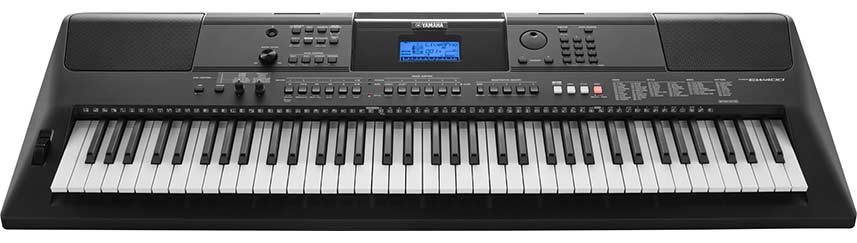
The PSR EW400 ranks as a strong competitor among keyboards under 400€ and with more than 61 keys, as this model has 76 pressure-sensitive keys that will allow you to play virtually any piece.
Yamaha is a brand that has always stood out for its versatility, the Japanese brand usually places a variety of functions on its keyboards allowing them to be used for more than one function, the PSR EW400 is no exception to that rule.
Notice – new Yamaha EW410 vs Yamaha EW400
I’m sure you’ll be interested in…
- Ranking with the best digital pianos in quality-price ratio
- The cheapest musical keyboards for beginners
- Other Yamaha Digital Piano Reviews
- Learn piano by yourself and for free
We added this update to the post. The new version has come out, but it doesn’t bring many changes either. So most of the content of this post is valid for the new EW410. We have also updated the purchase link to Thomann. Here you have the new review of the Yamaha PSR EW410 but we detail the differences also in this post: There are new features aimed at increasing control over your music and the ability to edit in real-time. Very direct oriented:
- The PSR EW410 has a higher number of rhythms, 235, versus 220 rhythms in the PSR EW400.
- The PSR EW400 does not have the Groove Creator function, although it does have the “DJ Patterns” function which is very similar.
- The PSR EW400 does not have the Quick Sampling feature that allows you to create new voices from recorded samples.
- Continue with the post and we’ll tell you about more aspects that both have in common.
Where to buy the Yamaha PSR EW400 or the new EW410?
Amazon
- Free Shipping and the possibility of shipping in one day with Amazon Premium.
- Full Guarantee but they are no experts in music equipment
- A leader in fast shipments.
- The price change a lot daily.
- The best option in USA and worldwide
Thomann
- Free Shipping
- Full warranty. If you have any problems, they take care of everything.
- 100% reliable payment.
- A leader in trouble-free shipping.
- Usually the Best price.
- Best Reputation: They are the leading online store in Europe and have the best catalog and information.
Features
Among the outstanding features of the PSR EW400 are the 76 keys with velocity sensitivity and two speakers of 12w each, the versatility of this keyboard makes it a great choice for virtually any use, however, the main utility is to play live music.
Characteristics
- 76 pressure-sensitive keys (without weighted keys)
- 758 voices, including a live piano voice.
- Sounds of diverse genres to play virtually any type of music
- 48 Notes from polyphony
- Programmable buttons
- DSP Effects
- 1 Tone Turning Wheel
- Creator of rhythms with 25 patterns included (35 in the Yamaha EW410)
- Functions of arpeggios and accompaniments
- Study mode with lessons included
- Internal recording functions
- Music database for accompaniment functions
- Dual and Split function (two voices on the same keyboard)
- MIDI connectivity
- USB connectivity with integration for iPhone and iPad
- Inline in/out input for headphones
- Input for sustain pedal (FC4A)
- The option of use with 6 batteries type D or 11w power adapter.
- L/R Outputs
- 2 12w speakers with bass reflex technology
- Weight 8.6kg
- The Yamaha PSR EW410 brings the features specified above.
The PSR EW400 is a keyboard with a wide variety of functions, focused on playing live music, however, the focus of the Japanese brand also extends to portable keyboards because it allows the possibility of use with batteries type D, making it a great option to take to any party or presentation regardless of location.
Sound
The Yamaha PSR EW400 incorporates 2 12 w speakers with bass reflex technology allowing to have a fairly respectable sound power, variety of voices, and accompaniment functions. The sound quality is good in spite of having only 48 polyphony notes which are the notes that can sound at the same time including accompaniments, etc.
The Sound of the PSR EW400 is shown below:
The following video shows an interpretation of “Hey Jude” on a Yamaha PSR EW400:
As you can see in the videos, the Yamaha PSR EW400 has a fairly respectable sound quality, especially considering that it is a keyboard of less than 400€.
Connectivity
The PSR EW400 has everything you need for connectivity, this Yamaha model has MIDI, USB, L/R input, and port to connect a sustain pedal.


Yamaha was concerned that the PSR EW400 really had the indispensable, even has a system to connect to iOS (iPad and iPhone) via MIDI and/or USB, however, some will miss the Bluetooth connection and the possibility of including a triple footswitch.
Advantages and Disadvantages of the PSR EW400
The advantages of this model are:
76 key touch-sensitive keyboard for less than 400€.
- Versatility
- Sound power
- Portable and can be used with batteries
- Connectivity
- Diversity of functions
The disadvantages of this model are:
- Sound quality (only 48 polyphony notes)
- Keys without weight
- No Bluetooth
- Variety of accessories (there is no triple footswitch for this model)
The PSR EW400 has more advantages than disadvantages, it is necessary to emphasize that this model has 76 keys sensitive to the touch, powerful speakers, and possibility of using with batteries, inside the keyboards for less than 400€ the PSR EW400 offers a quite attractive versatility.
In the disadvantages section, you will find the sound quality, at this point, you have to clarify that it has good sound quality (compared to 48 notes polyphony keyboards), however, the clarity and cleanliness is not compared to models that include a greater number of polyphony notes. Another important disadvantage is the lack of counterweight on the keys, as it can cause conflicts for those who are accustomed to using a piano.
Yamaha PSR EW400 vs PSR E453
The two models of the Japanese brand share a great diversity of functions and characteristics, however, within the main differences are found:
- The size of the PSR EW400 is larger, with 76 sensitive keys, while the PSR E453 has 61 sensitive keys.
- The PSR EW400 has more sound power as it has two 12w speakers, while the PSR E453 has 2 6w speakers.
- The PSR EW400 has an L/R input, while the PSR E453 only has an auxiliary input.
- The PSR EW400 is powered at 16V, while the PSR E453 is powered at 12V.
- The weight of the PSR EW400 is 8.6 Kg and the PSR E453 weighs 2Kg.

The PSR EW400 is a clear winner in this comparison because it has more power and more keys, providing more versatility, basically, the two models of Yamaha have the same functions, the main differences are the number of keys, the sound power, the size and weight of the keyboard.
The PSR E453 is also an excellent alternative for those looking for a good quality keyboard for a lower price if you want to know more about this model you can read our full review of the Yamaha PSR E453.
Yamaha PSR EW400 vs Casio WK7600
Competition between the Casio and Yamaha keyboards has always existed, as there are very similar models in both brands, this situation happens with the Casio WK7600 and the Yamaha PSR EW400. Below are the differences between the two models:
- Both models have 76 keys with sensitivity (without counterweight), however, the Casio WK7600 has 64 polyphony notes against 46 Yamaha notes.
- Both models can be used with batteries, USB input, MIDI, and pedal.
- The Yamaha has 758 voices, while the Casio model has 820 voices.
- The PSR EW400 has a specific mode for connection with iPad and iPhone, while the almost only has MIDI and USB ports.
- The sound power of the PSR EW400 is much higher, as it has two speakers of 12w each, giving a total of 24w, while the Casio WK7600 has two speakers of 7w each (14w). The Casio WK7600 has an SD input for SD card storage expansion (supported capacity 2gb to 32gb).
The comparison between the Yamaha PSR EW400 and the Casio WK7600 is very close, the two models are similar, both models are of great quality and a very good purchase option, however, for a musician who has presentations and can not use an amplifier the PSR EW400 would be a great choice because in terms of sound power is much higher, but if the selection criterion is sound quality the Casio WK7600 is a better option.
Below are two videos to compare the sound of the two brands:
Casio WK7600
Below is the sound of the Yamaha PSR EW400:
Conclusion
The PSR EW400 can be a good choice for those who want to learn piano and can’t afford an 88-key digital piano but want a good-sized alternative, as the 76 keys give you the ability to play almost any piece.
The only disadvantage of this model is the lack of weight on the keys, however, it is practically impossible to find a keyboard of less than 400€ with that feature.
If you’re a musician and you’re looking for a keyboard to go out and use anywhere the PSR EW400 is an excellent choice, as it has two powerful speakers that will help you generate a proper volume of sound, also has the ability to be used with batteries.
The PSR EW400 is an excellent alternative for a beginner pianist or a keyboardist who makes presentations in places where there is no electricity, however, there are other high-quality options, to know them you can enter our selection of the best digital pianos and keyboards of the moment if you are looking for an economical option we recommend you read our selection of cheap keyboards.
Where to Buy Yamaha PSR EW400
It’s always best to buy from an online store that will ship you the correct transport. Besides, buying online can save you a lot of money. You can search for the product at any Yamaha distributor in your area. But if you buy online that for this keyboard is the ideal choice for the leading store in the USA and worldwide is Amazon, in Europe the best is Thomann. Here the direct links:
For a similar price you have the following pianos and keyboards:
- yamaha PSR-EW300
- yamaha PSR-E263
- yamaha PSR-A350
- yamaha PSR F51
- yamaha PSR F50
- yamaha PSR EW400
- yamaha PSR E363
- yamaha PSR E353
- yamaha PSR E253
- yamaha NP-32 Piaggero
- yamaha EZ 220
- yamaha PSR EW410
- Startone MKR 61
- Startone MK-300
- Startone MK-200
- korg Volca FM
- korg Tiny Piano
- casio SA78
- casio SA 77
- casio SA 76
- casio SA 47
- casio SA 46
- casio LK-280
- casio LK-265
- casio LK-135
- casio CTK-2500
- casio CTK-240
- casio CTK 7200
- casio CTK 4400
- casio CTK 3500
- casio CTK 2200
- casio CTK 1500
- yamaha NP12
- roland Go Piano
- casio CTK1300
- casio CTK 6200
- casio CTK 3200
Did you like this article?
>>>>>>>>>>>>>