
- Home
- Author's Archive:
Digital Piano Yamaha PSR E463 Full Review. Is it a good Keyboard?
Yamaha PSR E463 Review: Opinion and Where to Buy It
The Yamaha PSR E463 is an ideal beginner’s keyboard for creating and playing all kinds of music, with 61 keystrokes, 758 sounds covering a wide range of instruments, and 235 rhythms spanning all major music genres.
This keyboard features powerful built-in speakers and several live-ready features that will allow novice keyboardists to have a machine to accompany them at their concerts and meet their primary needs. Yamaha also thought a lot about its Latin American users, since it included rhythms of cumbia, joropo, parranda, vallenato, bachata, son cubano, guajira, among other diverse Latin rhythms.
The sound of the Yamaha PSR E463
I’m sure you’ll be interested in…
- See this section for possible discounts and offers
- Ranking with the best digital pianos in quality-price ratio
- The cheapest musical keyboards for beginners
- Other Yamaha Digital Piano Reviews
- Learn piano by yourself and for free
Among his 758 voice, it has 8 voices from the Sweet! bookstore, 3 from the Cool! bookstore. And 3 from the Dynamic Voices library.237 Panel voices with a more professional sound, 24 drum kits, 40 arpeggio voices, and 457 voices from the XGlite library. The panel sounds are divided like this:
- 10 acoustic pianos.
- 8 electric pianos.
- 15 organs.
- 6 accordions.
- 13 guitars.
- 17 lows.
- 19 string sounds.
- 5 chorus sounds.
- 15 saxophones.
- 10 trumpets.
- 15 metal sounds.
- 9 flutes.
- 28 solo synthesizers.
- 18 pad synthesizers.
- 12 percussions.
- 37 ethnic sounds.
Thanks to its Quick Sampling system, it is also possible to create your own sounds, store them, and use them with all the others…Its amplification system has a power of 6W and 6W with 12 cm Bass Reflex loudspeakers.
It is not bad at all, as it is even good for a small or medium-sized bar. In addition to this, is a keyboard with DSP effects to complement its sounds and two assignable controls to modify some of its parameters.
Finally, this is also a keyboard that can record audio, up to 80 minutes in WAV format, and has audio input to connect an external player and play songs or tracks through the keyboard.
The rhythms of the Yamaha PSR E463
This keyboard has 235 rhythms included in its library, plus the ability to play more rhythms by USBAs is common in this type of keyboards, each of these rhythms has an intro, end, fills, auto-synchronization to start pressing any key, and accompaniment with several instruments that are controlled with chords. These rhythms come each with 4 variations and a musical climax to make the performance more interesting live.
Also, thanks to its Groove Creator function, new rhythms can be created, combining saved patterns of various parts of the rhythm (bass, drums, accompaniment chords, arpeggios, pads, and phrases). The Groove Creator is also known in other models as “DJ Patterns”.
Yamaha PSR E463 vs Yamaha PSR E453
The PSR E463 is the direct successor to the Yamaha PSR E453, sharing many of its features. Both keyboards share the same sound engine, same DSP (with 3 more reverberations in PSR E463), their speakers have the same power, and its 61 keys have velocity sensitivity (not weight, which is different).
Some of the main improvements that the PSR E463 implements are:
Ability to sample with its Quick Sampling engine to create user sounds.
- 15 rhythms more than PSR E453 including more Latin rhythms.
- Possibility of recording audio in WAV format (80 minutes of audio)
- The PSR E463 features its Groove Creator function to create custom rhythms from patterns.
Here’s a video for you to see what Quick Sampling is all about:
You can read our review of the Yamaha PSR E453 to learn more about this keyboard.
Yamaha PSR E463 vs Yamaha PSR E363
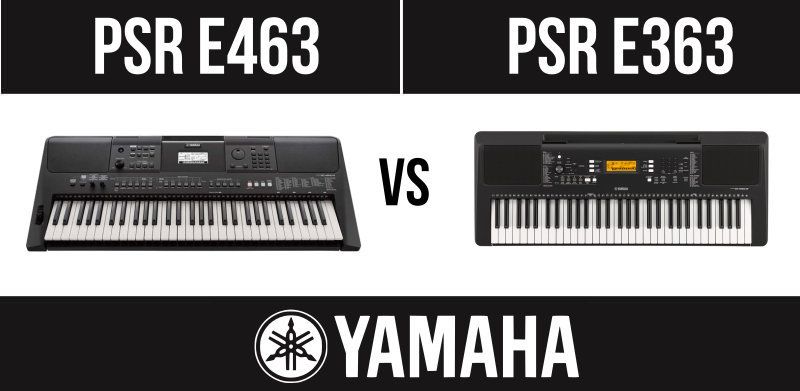
The PSR E363 is a device with lower performance and at a lower price than the PSR E463.
The first and most noticeable difference is in its sound library since the PSR E463 has 758 sounds versus the 574 sounds of the PSR E363.
There is also a big difference in the rhythms with the PSR E463, having the advantage with 235 rhythms versus the 165 rhythms of the PSR E363.
On the DSP they share the same number of Reverb, Chorus, EQs, and harmonies, but the PSR E463 has 10 more assignable effects that are not on the PSR E363.
It is also important to note that the PSR E363 does not have the functions of Groove Creator, Quick Sampling, nor the possibility to save audio in WAV format; functionalities present in the PSR E463. You can read our review of the Yamaha PSR E363 to learn more about this keyboard.
Yamaha PSR E463 vs Yamaha PSR S670
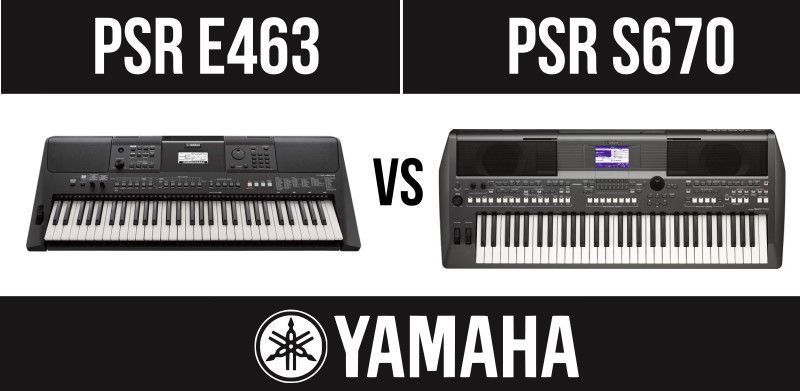
Yamaha’s PSR-S line is a line of workstations superior to the PSR-E line. The PSR S670 is equipment much superior to the PSR E463, as from its price (almost twice) one begins to perceive that it is an equipment with greater benefits, which truly has.
The Yamaha PSR S670 has fewer voices than the PSR E463, with 416 voices, versus the 758 of the PSR E463, but the voices of the PSR-S line are of higher sampling quality, with more realism, with real reverberations and more details captured in each instrument.
As for the number of effects of the PSR S670, it is much higher than the PSR E463 with 44 Reverb presets plus 3 User Reverbs in the PSR S670 versus only 12 Reverb presets of the PSR E463, 71 Chorus presets plus 3 user Chorus on the PSR S670 versus 5 types of Chorus on the PSR E463 and a powerful DSP engine with 283 assignable factory effects and 10 user DSP effects on the PSR S670 versus only 10 effects on the PSR E463. Navigation on the PSR S670 is also much easier, thanks to its more dedicated controls.
The speaker of the PSR S670 is much more powerful with 15 W while in the PSR E463 the power is 6W. This is great for taking it to live in restaurants, without having to load amplification. That is a very good point. You can read our review of the Yamaha PSR S670 to learn more about this keyboard.
Yamaha PSR E463 vs Yamaha PSR EW410
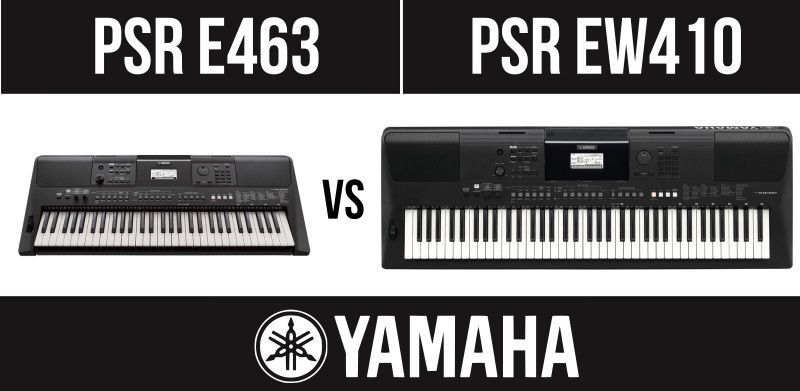
These two keyboards are quite similar, being their main difference, their size, the PSR E463 is a 5-octave keyboard and the PSR EW410 is a 7-octave keyboard. Both have the same amount of sounds (758 sounds), but the PSR EW410 has a Grand Piano of higher sampling quality.
Both have similar features as the Groove Creator, Quick Sampling, external audio input, the same amount of rhythms, and the same effects. Another difference is that the speakers of the PSR EW410 are more powerful, with 12 W versus 6 W of the PSR E463.
Where to buy Yamaha PSR S463?
Amazon
- Free Shipping and the possibility of shipping in one day with Amazon Premium.
- Full Guarantee but they are no experts in music equipment
- A leader in fast shipments.
- The price change a lot daily.
- The best option in USA and worldwide
Thomann
- Free Shipping for this synthesizer.
- Full warranty. If you have any problems, they take care of everything.
- Payment 100% reliable
- A leader in trouble-free shipping.
- Best reputation in Europe.
Conclusions
The Yamaha PSR E463 is one of the most powerful portable keyboards for beginners in its range. It is a powerful keyboard at an affordable price that can help musicians starting out in the piano world, both for studying and for their first live presentations.
For a similar price you have the following pianos and keyboards:
- YAMAHA YDP-S34 ARIUS
- YAMAHA YDP 163
- YAMAHA YDP 143
- YAMAHA PSR S770
- YAMAHA PSR S670
- YAMAHA PSR E453
- YAMAHA PSR E443
- YAMAHA P45
- YAMAHA P255
- YAMAHA P125
- YAMAHA P-121
- YAMAHA P115
- YAMAHA P105
- YAMAHA DGX 660
- YAMAHA ARIUS YDP 142
- YAMAHA PSR S775
- YAMAHA PSR E463
- YAMAHA P35
- THOMANN SP 5600
- THOMANN DP-33
- THOMANN DP-31
- ROLAND GO KEYS
- ROLAND FP-60
- ROLAND FP 80
- PIANO THOMANN SP 320
- KURZWEIL SPS4-8
- KURZWEIL SP6
- KURZWEIL SP4-8
- KURZWEIL FORTE SE
- KURZWEIL FORTE 8
- KURZWEIL ARTIS 7
- KORG PA-700 ORIENTAL
- KORG PA-700
- KORG PA600
- KORG PA-300
- KORG PA-1000
- KORG HAVIAN 30
- KORG GRANDSTAGE 88
- CASIO PX-870 PRIVIA
- CASIO PX-770 PRIVIA
- CASIO PX-5S PRIVIA PRO
- CASIO PX-560 PRIVIA
- CASIO PX-360 PRIVIA
- CASIO PX 160
- CASIO CT-X800
- CASIO CT-X700
- CASIO CT-X5000
- CASIO CT-X3000
- CASIO CDP 130
- THOMANN DP 26
- ROLAND FP 90
- ROLAND FP 30
- ROLAND FA 06
- ROLAND BK 5
- KORG SP 280
- KORG LP 380
- KORG B1
- KAWAI ES8
- KAWAI ES110
- KAWAI ES100
- KAWAI CN27
- KAWAI CN25
- CASIO CDP 230
- CASIO CDP S100
Did you like this article?
>>>>>>>>
Digital Piano Yamaha PSR E453. Full Review. Is it a good purchase?
In this article, you will find a quite popular electronic keyboard of the brand Yamaha. It is a very versatile musical keyboard with an extensive collection of very powerful additions.
You have to keep in mind that it’s not a piano as such. It has a sensitive keyboard and pedal with what it is worth to simulate the function of a piano but does not have a Hammer Action keyboard. So it’s not optimal to learn at the conservatory.
Note: The new model has been released. Check out our review of the Yamaha PSR E463 where we compared them.
The Yamaha PSR E453 is a musical keyboard aimed at someone who wants to get started in the piano experience. But its main function is as a keyboard with a lot of different sounds and a very good portability thanks to the fact that it only weighs 6 kg.
The approach of an electronic keyboard is different from that of a piano keyboard for studying. It is perfect for playing with many different sounds, both as a MIDI controller and as a composition tool.
Sound
I’m sure you’ll be interested in…
- Ranking with the best digital pianos in quality-price ratio
- The cheapest musical keyboards for beginners
- Other Yamaha Digital Piano Reviews
- Learn piano by yourself and for free
It has a polyphony of 48 sounds enough to play two hands comfortably. Polyphony is the number of musical notes that can sound at once. It’s not an incredible polyphony either, but it’s good. You can do a lot with it for the price it’s got. The more layers of sound you put in at the same time, the more notes are consumed.
It has a huge amount of different sounds and effects. Both piano and other instruments. It has 758 sounds+ 24 drum kits and many more sounds. How do you see the purpose of this keyboard is to give you a wide range of sounds rather than focus on imitating the sound of a grand piano. The idea is to give you a lot of sound possibilities for interpretation.
Of course, it has Reverb, Chorus, and DSP effects. And metronome too. Also the sound quality is acceptable and these sounds are not toy sounds.
It also has a Pitch Bend wheel that modifies the sound wave that is sounding and more things. Quite usable live.
Here’s a video where you can hear some of these sounds. Then read on to review and study more aspects of this electronic keyboard.
Sustain pedal and sensitivity velocity keyboard
It has a sensitive keyboard to be able to make dynamics but that yes, it does not simulate the Hammer Action of a piano keyboard. You can play the same note louder or louder, but it has no escape effect or anything similar to an acoustic piano.
It has a sustain pedal input which is the pedal that keeps the note ringing even if you don’t press the key. This is a very important interpretative resource. You have to buy it separately, though.
Connectivity and MIDI
Pretty good for the price. It has USB to HOST, which gives you the possibility to use your keyboard as a MIDI controller keyboard. This means that you can use the keyboard to write scores with programs like Sibelius or record MIDI tracks in music production software like CUBASE.
It has a headphone output to study in silence. This output can be taken out to a small amplifier to play in a small restaurant. But if you want to get this signal out for a bigger stage you’ll have to boost the signal with something to make it sound good.
You can arrange to play live but it is not the best sound to use the output of the headphones.
You can record what you touch and has a USB port to pass it to a flash drive. Quite useful.
Portability
Suitable, there are lighter keyboards but it weighs 6 kg. Which makes it quite portable. Very comfortable to rehearse and take to small restaurants.
It has 6W speakers each. Enough power to rehearse on acoustic or play in a small restaurant without extra amplification.
Supports battery power. Although it includes power supply and lectern.
Yamaha PSR E453 vs Yamaha PSR E463
The Yamaha PSR E463 is the new model of the ultra-popular Yamaha E453.
There are some changes and they are as follows:
- Possibility of sampling with its Quick Sampling engine to create your own sounds. You can create a phrase in an instrument that lasts a few bars and repeat it to play over it. You can also generate percussion. Very useful to use in loop mode.15 rhythms more than PSR E453 including more Latin rhythms.
- Possibility of recording audio in WAV format (80 minutes of audio)
- The PSR E463 features its Groove Creator function to create custom rhythms from patterns.
Right now the Yamaha PSR E463 has already replaced the 453 for the same price. We encourage you to see our review of the Yamaha PSR E463.
Yamaha PSR E453 vs Yamaha PSR E353
If you like keyboards with effects and the Yamaha PSR E453 is a bit expensive there is another option. The Yamaha PSR E353 is priced well below €200 and is an option for low budgets. Although the truth is that now the Yamaha PSR E463 is at a good price regularly hovering around 200 euros. Something that didn’t happen in 2017.
What if you have to understand that to play live is a much better option than the Yamaha PSR E453 because it has line output. So you can connect it to a PA mixer without having to amplify the signal with an injection box. With the PSR E353, you have to use the case output that will work but with a small amplifier.
Both keyboards have the pedal capability, 61-key sensitive keyboard, and MIDI.
That does bring a lot less sound and effect than you’d expect. Although it’s a little lighter at 4 kg. Although it gives a more delicate appearance. It’s only an option if your budget is too low. Of course, we do not recommend a lower range of Yamaha PSR E353.
If you want to know more don’t hesitate to read our review about the Yamaha PSR E353. Although the new version of the Yamaha PSR E353 has now been released, we, therefore, recommend that you take a look at our review of the Yamaha PSR E363. Also if you like keyboards oriented to many types of sound the PSR range, in general, is very interesting. Both the E series and the professional S series. Take a look in that case at our post about the PSR series.
Where to buy the Yamaha PSR E453?
There are many shops but this model can be bought perfectly online and saves a lot of money. The PSR 453 is out of stock and you can buy the E463 for the same price. If you live in America check your local Amazon website and if you live at Thomann check the Thomann website. Here the direct links to the product:
For a similar price you have the following pianos and keyboards:
- yamaha YDP-S34 Arius
- yamaha YDP 163
- yamaha YDP 143
- yamaha PSR S770
- yamaha PSR S670
- yamaha PSR E453
- yamaha PSR E443
- yamaha P45
- yamaha P255
- yamaha P125
- yamaha P-121
- yamaha P115
- yamaha P105
- yamaha DGX 660
- yamaha Arius YDP 142
- yamaha PSR S775
- yamaha PSR E463
- yamaha p35
- Thomann SP 5600
- Thomann DP-33
- Thomann DP-31
- roland Juno DS61
- roland JD XI
- roland Go Keys
- roland FP-60
- roland FP 80
- Piano Thomann SP 320
- Moog Sub Phatty
- Moog Mother 32
- Minimoog Model D
- Kurzweil SPS4-8
- Kurzweil SP6
- Kurzweil SP4-8
- Kurzweil Forte SE
- Kurzweil Forte 8
- Kurzweil Artis 7
- korg PA-700 Oriental
- korg PA-700
- korg PA600
- korg PA-300
- korg PA-1000
- korg Kross
- korg Kronos
- korg Havian 30
- korg Grandstage 88
- casio PX-870 Privia
- casio PX-770 Privia
- casio PX-5S Privia Pro
- casio PX-560 Privia
- casio PX-360 Privia
- casio PX 160
- casio CT-X800
- casio CT-X700
- casio CT-X5000
- casio CT-X3000
- casio Cdp 130
- Thomann DP 26
- roland FP 90
- roland FP 30
- roland FA 06
- roland BK 5
- korg SP 280
- korg Monologue
- korg Minilogue
- korg Microkorg
- korg LP 380
- korg B1
- kawai ES8
- kawai ES110
- kawai ES100
- kawai CN27
- kawai CN25
- casio Cdp 230
- Arturia Microbrute
- Casio CDP S100
Vote if you liked this article 🙂
Music Keyboard Yamaha PSR F51. Full Review. Is it Good?
Today we are analyzing a 61-key Yamaha keyboard in the PSR range. The Yamaha PSR E and F Series are a series of keyboards designed for beginners and people who want to experiment with a keyboard and a multitude of sounds without great pretensions. Then there’s the more professional PSR S series.The Yamaha PSR F51 is the evolution of the Yamaha PSR F50 and they are the same, simply a change of acronyms.
It is a very inexpensive keyboard with 120 different piano and other instrument sounds and 32-voice polyphony. Polyphony is the number of notes that can sound at once. If you are playing on top of accompaniment also consumes the polyphonic memory but with 32 you have plenty for an initial level. We’ll tell you where to buy it, but keep reading that the review continues.
Where to Buy Yamaha PSR F51? (if Yamaha PSR 263 has better price the link will redirect you to this item)
Amazon
- Free Shipping and the possibility of shipping in one day with Amazon Premium.
- Full Guarantee but they are no experts in music equipment
- A leader in fast shipments.
- The price change a lot daily.
- The best option in USA and worldwide
Apart from all that amount of sounds the Yamaha PSR F51 includes:
- Pantalla LCD que mejora la usabilidad y el cambiar de funciones.
- Efecto Reverb y Chorus (más brillo, como tocar en un iglesia)
- Metronome and headphone output
- Duet mode para tocar dos personas a la vez.
- Power supply included.
I’m sure you’ll be interested in…
- See this section for possible discounts and offers
- Ranking with the best digital pianos in quality-price ratio
- The cheapest musical keyboards for beginners
- Other Top Yamaha Digital Pianos
- Learn piano by yourself and for free
Advantages of the PSR F51
No doubt price below 100 € and portability as it only weighs 3.4 kg which makes you can take it to acoustic tests with other instruments that do not sound much like a guitar. In that case, it’s a good choice as a secondary keyboard. As mentioned above, it is battery operated and also comes with a power cord.
It has a headphone output so you can play silently and plug it into a small amplifier with minijack input.
It has two 2.5 W speakers but they are not very powerful either. We leave you a video so you can hear how it sounds and then we tell you its limitations:
Limitations of the Yamaha PSR F51
The Yamaha PSR F51 keyboard serves as a secondary keyboard for composing and practicing harmony. To make chords and see how they sound.
It is also suitable for having fun but you have to bear in mind that it is not suitable for learning. A piano needs at least to have sensitivity in the keys to regulate the volume, sustain pedal input to sustain the sound of the note in time (and this does not have it).
The Yamaha PSR F51 doesn’t even have a sensitivity (although you do have sensitivity and Hammer Action).
If your budget is about 100 € and you want a child to use it to learn this is not the option. But you have options with a sensitive keyboard and sustain pedal that also has MIDI to connect to the computer between 100 and 150 €.
Check out the Yamaha PSR E363 or the Casio CTK 3500 for a very similar price. Both keyboards feature sensitivity, sustain pedal input, and MIDI for connection to the computer.
MIDI is important because it lets you do things like record what you play in a program and then exports it to a score with a single click with any music production software.
On the other hand, if you want to study piano more seriously with a piano with Hammer Action (weight on the keys) at the end of the article we link our ranking with the best digital pianos of the moment in relation quality-price.
Yamaha PSR F50 vs Yamaha PSR F51
Nothing significant, it’s just a re-launch with aesthetic changes.
Where to buy it?
As we said before this keyboard you will find it at the best price in Amazon. If you are not happy you can return it without any problem and the logistics are the best. The keyboard always arrives without problems. Thomann and Woodbrass don’t sell it because they prefer models like the CTK 3500 and PSR E363.
If it’s worth it with this great keyboard although we leave you some very interesting post if you want more features and possibilities:
For a similar price you have the following pianos and keyboards:
- yamaha PSR-EW300
- yamaha PSR-E263
- yamaha PSR-A350
- yamaha PSR F51
- yamaha PSR F50
- yamaha PSR EW400
- yamaha PSR E363
- yamaha PSR E353
- yamaha PSR E253
- yamaha NP-32 Piaggero
- yamaha EZ 220
- yamaha PSR EW410
- Startone MKR 61
- Startone MK-300
- Startone MK-200
- korg Volca FM
- korg Tiny Piano
- casio SA78
- casio SA 77
- casio SA 76
- casio SA 47
- casio SA 46
- casio LK-280
- casio LK-265
- casio LK-135
- casio CTK-2500
- casio CTK-240
- casio CTK 7200
- casio CTK 4400
- casio CTK 3500
- casio CTK 2200
- casio CTK 1500
- yamaha NP12
- roland Go Piano
- casio CTK1300
- casio CTK 6200
- casio CTK 3200
Vote if you liked this article 🙂