
- Home
- Author's Archive:
Digital Piano Casio CTK 4400 Full Review. Is it a good choice?
Today we talk about this Casio keyboard and we try to share an important information gap because in many descriptions are not clear aspects as if it has sustain pedal and others.
The Casio CTK 4400 is a 61-key electronic keyboard with a sensitive but not a weighted keyboard. That supports sustain pedal (not included) and that has lots of sounds.
It is designed more to have many sounds available than to learn piano although you can use it to try if you like the piano the first year and then sell it or keep it as a keyboard with many different sounds.
I’m sure you’ll be interested in…
- Ranking with the best digital pianos in quality-price ratio
- The cheapest musical keyboards for beginners
- Learn piano by yourself and for free
Features
- 48-voice polyphony which is the number of notes that can sound at one time. It’s okay for its price.
- It has 600 different sounds and 180 accompaniment styles. Which is a great variety to use while playing.
- Sampling function that allows you to record small pieces of sound and associate them with keys.
- They can also be integrated as accompaniment.
- Recording functions from various sources and memory for up to 10 songs.
- Keyboard with 2 sensitivities, if you press it hard it sounds louder. To make dynamics but has weight on the keys.
- Metronome.
- It has a reverb and chorus effect.
- Possibility to record what you are playing.
- Includes power supply. But it can run on batteries.
- Not very powerful 2.5 W speakers.
- Music rest included.
- USB MIDI.
It admits as we have said sustain pedal, that serves to maintain the note in the time although you stop pressing the key. This is a very important interpretative resource for playing the piano.
Where to buy Casio CTK 4400?
Amazon
- Free Shipping and possibility of shipping in one day with Amazon Premium.
- Full Guarantee but they are no experts in music equipment
- Leader in fast shipments.
- Price that change a lot daily.
- The best option in USA and worldwide
The speakers are not very powerful so you would have to buy a small amplifier if you wanted to play in a larger venue. You can use the output of the headphones for that. Although it is not for playing in a big place with a powerful amplification, because you would need injection box.
MIDI connectivity
It has a USB to host MIDI connection, which is very useful for connecting it to the computer and using it as a MIDI controller. It will allow you to do things like write a score while playing with programs like Sibelius.
We leave you a video in introduction and then we give you our conclusion.
A perfect keyboard for beginners or musicians who want a keyboard with many different tones. Perfect for composing and taking small live and as a secondary keyboard at home to compose.
It has a weight of 4.3 kg which makes it very portable and a fairly solid and durable appearance. The keys don’t look like the plastic ones on the cheapest keyboards. That’s why it has a more intermediate price.
Casio CTK 4400 vs Yamaha PSR E353 vs Yamaha PSR E363
Note: The new version of the Yamaha PSR 353, the Yamaha PSR 363 and we update the comparison.
The Yamaha PSR E353 and its new version the Yamaha PSR E363 also have many sounds and both keyboards agree on the following:
- It has 61 keys.
- 48 notes of polyphony
- A huge amount of different sounds and accompaniments.
- It has USB Midi.
- Sustain pedal input
- Sensitive keyboard.
- They’re very light.
- Power adapter included.
The Yamaha PSR E363 wins in price, as it is usually around 150 €, but the Casio CTK 4400 is more robust and its keys have a better touch.
The Casio CTK 4400 has a sampling function that the Yamaha 353 and 363 don’t have and in the quality of the sound and the touch of the keyboard the price difference is a little noticeable. Although I personally would buy the Yamaha PSR 363 as they have improved the polyphony from the 32 I had the 353 to the 48 notes I now have the Yamaha PSR E363.
If you are going to spend between 200 and 300 euros maybe I would take a look at the Yamaha PSR 463. Of which we talked in our review of the Yamaha PSR 453 which is its previous version.
Where to buy it?
Always check your Amazon local website. Here is the directo link to the product:
For a similar price you have the following pianos and keyboards:
- YAMAHA PSR-EW300
- YAMAHA PSR-E263
- YAMAHA PSR-A350
- YAMAHA PSR F51
- YAMAHA PSR F50
- YAMAHA PSR EW400
- YAMAHA PSR E363
- YAMAHA PSR E353
- YAMAHA PSR E253
- YAMAHA NP-32 PIAGGERO
- YAMAHA EZ 220
- YAMAHA PSR EW410
- STARTONE MKR 61
- STARTONE MK-300
- STARTONE MK-200
- KORG TINY PIANO
- CASIO SA78
- CASIO SA 77
- CASIO SA 76
- CASIO SA 47
- CASIO SA 46
- CASIO LK-280
- CASIO LK-265
- CASIO LK-135
- CASIO CTK-2500
- CASIO CTK-240
- CASIO CTK 7200
- CASIO CTK 3500
- CASIO CTK 2200
- CASIO CTK 1500
- YAMAHA NP12
- ROLAND GO PIANO
- CASIO CTK1300
- CASIO CTK 6200
- CASIO CTK 3200
Vote if you liked this article 🙂
Digital Piano Casio PX 160 Full Review. Is it worth it?
Casio PX 160 in-depth analysis and opinion
The Casio PX 160 (Privia) is an 88-key digital piano that over time has made a niche for itself among people accustomed to CASIO keyboards.It is probably the most balanced option in your price range. All the others stand out in some aspects and limp in others. But the Casio PX 160 simply has an “OK” in everything. In comparison with the Roland FP 30 for example wins in loudspeakers but loses in line output…
Where to Buy Casio PX 160 Privia?
Amazon
- Free Shipping and possibility of shipping in one day with Amazon Premium.
- Full Guarantee but they are no experts in music equipment
- Leader in fast shipments.
- Price that change a lot daily.
- The best option in USA and worldwide.
Thomann
- Free Shipping.
- Full warranty. If you have any problems, they take care of everything.
- 100% reliable payment.
- Leader in trouble-free shipping.
- Usually Best Price.
- Best Reputation: They are the leading online store in Europe and have the best catalogue and information.
It is an entry-level piano keyboard (from keyboards that are already considered piano keyboards) and is designed to be very portable and comes with sufficient features to be used in any situation. It keeps a very low price and competes directly with the Yamaha P125 and the Roland FP 30.
If you want something cheaper but a Hammer Action piano with a sensitive keyboard you have to go to Casio CDP 130 or Yamaha P45. But for a few more euros you have this Casio that has better polyphony, supports triple pedalboard and has line output to connect to any amplification equipment without needing any extra.
We would like to take this opportunity to tell you that it makes no sense to compare the Casio PX 160 vs. the Yamaha P45 or the Casio CDP 130. It is better and therefore a little more expensive but not much more. The Casio CDP 130 competes directly with the Yamaha P45 although lately we have come to see it for up to 200 euros. A very powerful offer.
I’m sure you’ll be interested in…
- See this section for possible discounts and offers
- Ranking with the best digital pianos in quality-price ratio
- The cheapest musical keyboards for beginners
- Learn piano by yourself and for free
Sound of the Casio PX 160.
This piano keyboard from Casio has a polyphonic memory of 128 notes. The polyphony is the amount of notes that can sound at a time and this includes accompaniments.
You can do layering which is to make two sounds sound at the same time, this consumes twice as much polyphony. A very typical combination is a piano sound and a strings accompaniment at the same time.
As you probably already know, apart from polyphonic memory, another factor that determines the sound of a digital piano is the technology with which the piano sounds were recorded. It is called sampling and in this case uses the CASIO Multi-dimensional Morphing AiR technology.
It brings 18 high quality sounds. With various piano sounds recorded in different situations. Such as the Concert Grand or the Classic Grand. It also has organ sound that can be used in funk and jazz. Here you can hear the sounds Concert Piano, Modern piano and a baroque instrument such as the Clavichord.
It also brings acceptable reverb, chorus and brightness effects but without great variety.We can conclude that it has a polyphonic memory of 128 voices that is not bad at all and the sampling also guarantees a good sound in the price range that we move.
What is below 600 € and even many times below 500 €.If you want to hear more of the available sounds, listen to the following video for a more general review:
Sound Effects
Like most digital pianos in this range you can customize aspects of the sound and save your settings. You can modify the following aspects:
- Reverberation: Emulate for example if you are playing in a place like a church. It has 4 levels.
- Chorus: Up to 4 levels
- Brightness: Allows you to define a more mellow or metallic sound depending on the chosen level.
- You can also choose the temperament you like that refers to how pianos of certain times sounded.
- You can also emulate the sound produced by a piano when you stop stepping on the pedal. This is the damper noise. But come on, it is already being very fine.
Interface
The Casio PX 160 has a very intuitive and elegant interface. In this one, Casio has made a remarkable effort and to think that Casio are not able to make good quality keyboards. They make them and they are of the best, in this Roland and Kawai have better image but it is not at all true.

Velocity sensitivity y Hammer Action
As you know, the sensitivity of the key is very important. For the louder we press a key the louder the note will sound.
That is the sensitivity and then there is the Hammer Action that mimics the weight of a real piano key. In this case there are three sensibilities.In this case the Scaled Hammer Action II is used. So it has weighted keys. Not bad for an entry-level digital piano but there are other keyboards for the same price with more sensitivities.
Portability
In this point it stands out very much. It only weighs 11 Kg, when other piano keyboards in the same range usually weigh 12 Kg or 14. This is important if you move it regularly without a car.
Connectivity and speakers
It has L/R output, so it is good for playing as a stage piano and connecting to any amplification equipment without an audio power box.

In this sense it is also very complete. It has output for two headphones so that they can study teacher and student, in silence.It includes a sustain pedal SP3 (a little basic but like all of this range) and what is more important, it admits triple pedalboard that is important for the study of the classic in the conservatory from medium degree.
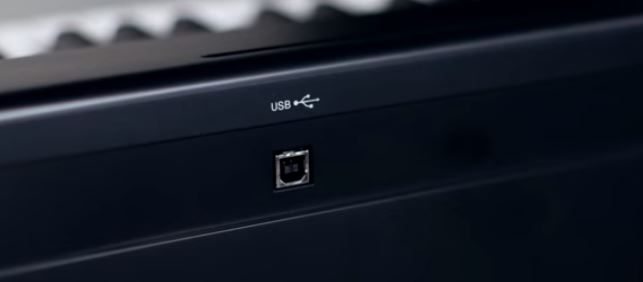
The sustain pedal is a basic interpretative resource to keep the note ringing even if the key of the corresponding note is released.It has USB MIDI (cheaper cable), so we can connect it to the computer and record MIDI tracks in any music editing program such as CUBASE, SIbelius, Ableton that we can then export to score.
Extras
It has a music sheet holder that fits in the piano and also comes with the mains adapter.It can record a track and has USB port to save the files.It also has the following typical functionalities in this type of keyboards:Layers that allow two tones to sound at the same time.
Split: In one half an electric bass sounds and in the other the piano sound you want.
Of course it takes very customizable metronome and allows to divide the piano in two to interpret the duo or the teacher.The Casio PX 160 has tough competitors in Yamaha and Roland. We will compare it to two models that are similarly priced:
Casio PX160 vs Yamaha P115 vs Yamaha P125
The Yamaha P125 and its previous model the Yamaha P115 are probably the hardest of the competitors of the Casio PX 160. It should be noted that the Yamaha P125 and the P115 only differ in that the new P125 brings 10 more piano sounds for the same price that was before the Yamaha P125.
The Casio PX 160 is usually cheaper than the Yamaha P125. Both are similar range piano keyboards with 88 keys and Hammer Action keyboard but the polyphony of the Yamaha 125 is 192 versus the maximum polyphony of 128 of the Casio PX 160.
The Yamaha P125 has a Hammer Action with the GHS system of 4 sensitivities versus the 3 sensitivities of the CASIO PX 160.Both support optional triple bottom bracket and come with sustain pedal.The P125 has a sound boost, a kind of turbo for live.
The Casio has more powerful 8W speakers compared to the 7W of the Yamaha P125.It is not easy to decide but for the small price difference the Yamaha P125 has a sound that we like better. Below you will see the prices on Amazon but we recommend that you take a look at our review on the Yamaha P125.
Casio PX 160 vs Roland FP 30
Roland FP 30 is Roland’s choice to compete with the Casio PX 160In this case the polyphony of both is the same, 128 voices.
So this would not be a reason to spend a little more.They are quite similar in the performances they bring but the Roland FP 30 has a Hammer Action system with 5 different sensitivities.
The touch is better with what if for a classical student better the Roland FP 30.The Casio PX 160 is the standard price, but you can change your mind if you appreciate that the Roland FP 30 has a built-in microphone.
This allows you to play and sing at the same time, so you can quickly record a demo to share with other musicians on a flash drive.The Roland wins on its super-powered 11W speakers over the Casio Px 160’s 8W. This means you can play in many places without needing an extra amplifier.Do not hesitate to see our analysis of Roland FP 30.
Where to buy the piano keyboard Casio PX 160?
As you have seen above we have advanced this answer in some explanatory tables. Today these piano keyboards can be found at the best prices by shopping online.
If you live at USA or America always check at your local Amazon website. If you live at Europe always check Thomann. Here the direct links of the product:
For a similar price you have the following pianos and keyboards:
- YAMAHA YDP-S34 ARIUS
- YAMAHA YDP 163
- YAMAHA YDP 143
- YAMAHA PSR S770
- YAMAHA PSR S670
- YAMAHA PSR E453
- YAMAHA PSR E443
- YAMAHA P45
- YAMAHA P255
- YAMAHA P125
- YAMAHA P-121
- YAMAHA P115
- YAMAHA P105
- YAMAHA DGX 660
- YAMAHA ARIUS YDP 142
- YAMAHA PSR S775
- YAMAHA PSR E463
- YAMAHA P35
- THOMANN SP 5600
- THOMANN DP-33
- THOMANN DP-31
- ROLAND GO KEYS
- ROLAND FP-60
- ROLAND FP 80
- PIANO THOMANN SP 320
- KURZWEIL SPS4-8
- KURZWEIL SP6
- KURZWEIL SP4-8
- KURZWEIL FORTE SE
- KURZWEIL FORTE 8
- KURZWEIL ARTIS 7
- KORG PA-700 ORIENTAL
- KORG PA-700
- KORG PA600
- KORG PA-300
- KORG PA-1000
- KORG HAVIAN 30
- KORG GRANDSTAGE 88
- CASIO PX-870 PRIVIA
- CASIO PX-770 PRIVIA
- CASIO PX-5S PRIVIA PRO
- CASIO PX-560 PRIVIA
- CASIO PX-360 PRIVIA
- CASIO CT-X800
- CASIO CT-X700
- CASIO CT-X5000
- CASIO CT-X3000
- CASIO CDP 130
- THOMANN DP 26
- ROLAND FP 90
- ROLAND FP 30
- ROLAND FA 06
- ROLAND BK 5
- KORG SP 280
- KORG LP 380
- KORG B1
- KAWAI ES8
- KAWAI ES110
- KAWAI ES100
- KAWAI CN27
- KAWAI CN25
- CASIO CDP 230
- CASIO CDP S100
Did you like this article?
>>>>>>>>>>
Digital Piano Kawai CN25 Full Review. Is it a good choice?
Today we bring you the analysis of a digital piano that is growing quite a lot in the market with the brand Kawai.
Note: The new version has been released with the Kawai CN 27. We’ll compare it to you in this article.
The Kawai CN25 is more of a digital piano than a piano keyboard. It is designed for the studio and to replace a wall-mounted piano. It weighs much less than an upright piano and is aesthetically very successful.
It is valid for the study of the piano at all levels as it is a complete digital piano. All this for a budget of between 1000 and 1200 euros. It’s not the cheapest digital piano but you’re also paying for a little aesthetics and touch. That’s already a personal decision. We move on to analyze the technical aspects to help you decide.
Sound
I’m sure you’ll be interested in…
- Ranking with the best digital pianos in quality-price ratio
- The cheapest musical keyboards for beginners
- Learn piano by yourself and for free
It has a polyphonic memory of 192 notes. That are the maximum of notes that can sound at the same time, this includes the notes that sound when we play on themes and when we accumulate notes by stepping on the pedal. It’s a powerful polyphony.
The system with which the sound of the piano has been sampled and recorded is Kawai’s Progressive Harmonic Imaging™ (PHI). A system of enough quality that surpasses for example the AWM.
It has 19 high quality piano sounds like the concert Grand or studio grand 2. Also the Modern E.Piano that we like. It has everything you need if you’re interested in the piano in particular, from organs to other more modern sounds.
Good sound and well sampled. Although there are much cheaper piano keyboard models with similar sound performance. For this price you are paying as we said the appearance, the quality of the wood and the real feel very important especially for classical piano…
Hammer Action Keys
Pretty good. It has a Responsive Hammer system with a very interesting emulation of the touch of an acoustic piano. The truth is that touch is its strongest feature
Connectivity, recording and MIDI
The Kawai CN 25 brings with it all the advantages of a digital piano. It has output for 2 headsets and brings MIDI or USB to host. MIDI allows you to record what you are playing on MIDI tracks with programs such as SIbelius or Cubase that can then be exported to a music sheet with a single click.
With the headphones you have the Duet mode in which you can split the piano in 2 so that teacher and student can play together in silence. It has triple pedalboard like a real piano (most of the cheapest digitals only usually bring the sustain pedal that is worth to keep the note in time). The triple footswitch makes sense to play certain already advanced pieces.
Below we leave a video of this digital piano which you can hear several of the sounds offered by this digital piano, even if it is in English is good for you to get an idea.
Portability
In this respect it must be borne in mind that the intention of Kawai CN25 is to resemble as much as possible a digital wall piano.
If you buy it you are supposed to be looking for a digital piano that adorns and is also a quality instrument to play and study with it without moving it from its place.
Round the 40 kg and that makes it much easier to move anyway compared to the 150 kg that can weigh a upright piano. Not to mention the price difference compared to an acoustic upright piano.
Does it fit all levels?
Thanks to the triple pedal, it is valid for all levels. It is valid for professionals as well as for students of any level if you cannot afford an upright piano. Although everyone would like to have a grand piano the reality is usually that people have to manage lower budgets.
This digital piano is a good option to study middle conservatory. And if you don’t have more budget it can be worth to the superior. The important thing at the end is the hours of study.
I really like the touch of this piano but if your budget is around 700 euros take a look at Yamaha Arius 143.
Kawai CN 25 vs Kawai CN 27
There are not many changes, it has done a face wash and have added MIDI Bluetooth 4.0 technology that is always an improvement and is at the same price as before. You can see our most complete review in the CN27 post.
If you live in America or Asia check Amazon. If you live at Europe check Thomann:
Kawai CN25 vs Yamaha P115
In this case we are comparing a piano keyboard with a digital piano and it has its logic because we want to guide you well.
If you just want to study and you can afford to buy the Kawai CN25 but if you want to move the piano and take it to performances think about a piano keyboard like the Yamaha P115.
The Yamaha P115 costs half, has a Yamaha Hammer Action GHS that’s not bad at all and also has a polyphonic memory of 192 notes. A cannon for its price and weighs 12 kg.
Both have MIDI output although the Kawai CN25 is more robust and with more “piano” appearance.
The Yamaha P115 only comes with sustain pedal but supports triple bottomboard.
Right now there is the new model of the Yamaha P115 which is the Yamaha P125. The only difference is that the new Yamaha has 10 more piano sounds. Which is a big improvement at the same price. Don’t miss our reviews on the Yamaha P125 if you’re interested in a portable digital piano.
Where to buy Yamaha CN 25 and Yamaha CN 27
Right now the Yamaha CN 25 is out of print in most online stores but we keep this post in case you find it second-hand.As I said If you live in America or Asia check Amazon. If you live at Europe check Thomann:
If you want portability and to play live occasionally we recommend you to see our ranking of the best digital piano.
For a similar price you have the following pianos and keyboards:
- YAMAHA YDP-S34 ARIUS
- YAMAHA YDP 163
- YAMAHA YDP 143
- YAMAHA PSR S770
- YAMAHA PSR S670
- YAMAHA PSR E453
- YAMAHA PSR E443
- YAMAHA P45
- YAMAHA P255
- YAMAHA P125
- YAMAHA P-121
- YAMAHA P115
- YAMAHA P105
- YAMAHA DGX 660
- YAMAHA ARIUS YDP 142
- YAMAHA PSR S775
- YAMAHA PSR E463
- YAMAHA P35
- THOMANN SP 5600
- THOMANN DP-33
- THOMANN DP-31
- ROLAND GO KEYS
- ROLAND FP-60
- ROLAND FP 80
- PIANO THOMANN SP 320
- KURZWEIL SPS4-8
- KURZWEIL SP6
- KURZWEIL SP4-8
- KURZWEIL FORTE SE
- KURZWEIL FORTE 8
- KURZWEIL ARTIS 7
- KORG PA-700 ORIENTAL
- KORG PA-700
- KORG PA600
- KORG PA-300
- KORG PA-1000
- KORG HAVIAN 30
- KORG GRANDSTAGE 88
- CASIO PX-870 PRIVIA
- CASIO PX-770 PRIVIA
- CASIO PX-5S PRIVIA PRO
- CASIO PX-560 PRIVIA
- CASIO PX-360 PRIVIA
- CASIO PX 160
- CASIO CT-X800
- CASIO CT-X700
- CASIO CT-X5000
- CASIO CT-X3000
- CASIO CDP 130
- THOMANN DP 26
- ROLAND FP 90
- ROLAND FP 30
- ROLAND FA 06
- ROLAND BK 5
- KORG SP 280
- KORG LP 380
- KORG B1
- KAWAI ES8
- KAWAI ES110
- KAWAI ES100
- KAWAI CN27
- CASIO CDP 230
- CASIO CDP S100
Vote if you liked this article 🙂