
- Home
- Author's Archive:
Digital Piano Yamaha DGX 660 Full Review – Is it a good choice?
Opinion and review of Yamaha DGX 660
Yahama DGX 660 is a lightweight digital piano that comes with a stand. It weighs about 28 Kg. with the Yamaha Stand and about 21 Kg. without at the stand. The Yamaha DGX is more of a digital piano than a piano keyboard because of its weight. It has 88 keys weighted with Yamaha’s GHS system of 4 sensitivities. It is a high-quality Hammer Action that mimics the feel of Yamaha grand pianos. It is a keyboard that stands out for a Hammer Action of good quality and many functions that make this digital piano a machine to increase your musical productivity. The Yamaha DGX 660 costs around €749/$800/£685.
Grand Piano Sound
The sound of the Yamaha DGX 660 has been recorded from a Yamaha Grand Piano with the Pure CF Sound Engine sound system that is superior to the AWM of other Yamaha models.
Where to Buy Yamaha DGX 660?
Amazon
- Free Shipping and the possibility of shipping in one day with Amazon Premium.
- Full Guarantee but they are no experts in music equipment
- A leader in fast shipments.
- The price change a lot daily.
- The best option in the USA and worldwide
Thomann
- Free Shipping
- Full warranty. If you have any problems, they take care of everything.
- 100% reliable payment.
- A leader in trouble-free shipping.
- Best Price.
- Best Reputation: They are the leading online store in Europe and have the best catalog and information.
He has a polyphonic memory of 192 voices. The polyphony is a very important factor that together with the type of sampling with which the sound was recorded defines how good the sound of a digital piano is. It has a very acceptable sound and perhaps it could be a little better for the price it has, which usually hovers around 800 euros. Below we will make comparisons with several similar keyboards. Take a look at this video, so you can hear what it sounds like.
I’m sure you’ll be interested in…
- Ranking with the best digital pianos in quality-price ratio
- The cheapest musical keyboards for beginners
- Other Yamaha Digital Piano Reviews
- Learn piano by yourself and for free
Hammer Action
Use Yamaha’s GHS system of 4 sensitivities. The velocity sensitivity of a piano is basic as an expressive resource to be able to regulate the volume and intensity with which note sounds depending on how hard the key is pressed. Yamaha’s Hammer Action is very successful and gives good results emulating a digital piano.
Highlights the Yamaha DGX 660
Both the Hammer Action and its sound is more than adequate, but the best fact about this keyboard is the usability it gives you to be very productive at playing. It has a USB port and you can record up to 7 tracks. It also has a microphone input, so you can quickly record a track and then pass it on to other musicians. Very productive and has a screen with a very comfortable interface. It has different piano sounds and very powerful reverb effects. In this particular, it beats other digital pianos of the same rank. It has USB MIDI for you to use as a MIDI controller as well. All pianos of these prices usually carry it.
The bad thing about Yamaha DGX 660
It has a footswitch sustain pedal, but for the price it has, it would be good if it had a triple pedal. It is not very portable as it is designed to study. Also, it’s heavy enough. It has a good polyphony but in sound, it is comparable to the Yamaha P115, which has the same polyphony for much less price, besides, it weighs much less. Below there are some comparisons with other keyboards that compete with this model.
Yamaha DGX 660 vs Roland FP 30
The Yamaha DGX 660 costs around €749/$800/£685 and the Roland FP30 costs around €625/£566. The Yamaha DGX 660 wins in polyphony with 192 voices against 128 in Roland FP 30. As for the quality of Hammer Action, the Yamaha DGX 660 has the 4 sensitivity GHS system which is configurable but the Roland FP 30 has a very advanced 5 sensitivity system, which we totally approve.
Both have MIDI, dual-mode, various reverb tones and the basics to be good digital pianos. Although if you want some portability, the Roland only weighs 14 Kg. The Yamaha DGX 660 can record more tracks than the Roland FP 30. Both support microphones and have a USB port for a USB flash drive.
Concluding, the Yamaha DGX 660 wins in sound and extras that make it more comfortable to work with whilst the Roland FP 30 wins in price (notable difference), portability, and Hammer Action system and velocity sensitivity. Do not hesitate to check out our review of the Roland FP 30 to find out more.
Yamaha DGX 660 vs Yamaha P125
The Yamaha DGX 660 costs around €749/$800/£685 and the Yamaha P125 costs around €566/£515. In this case, 2 digital pianos of the same brand compete, mainly in price and weight. In performance, the Yamaha DGX 660 wins, but you have to think about whether it is worth it for the price difference.
The difference can be up to 150 €. The Yamaha DGX 660 far outperforms the Yamaha P125 in types of sound and vocals and has a microphone input.
But both have the same Hammer Action GHS system, same Pure CF sound with 192-voice polyphony, USB MIDI, and all the basic and serious functions you need on a piano or digital piano keyboard. If the Yamaha DGX 660 would bring you the triple pedal for the price it has, we would tell you to buy it without hesitation, but both bring sustain pedal and the Yamaha P125 also supports the triple pedal. If you want portability, do not think about it.
The Yamaha P125 is the best option with a weight of 12 Kg. and 7W loudspeakers is good for you to rehearse in acoustics and even play live in small restaurants with good acoustics. If you want to study alone and more variety of sounds, the Yamaha DGX 660 is a good choice. Here’s our in-depth review of the Yamaha P125.
Where to Buy Yamaha DGX 660
Buying it online you can surely get the best price for this keyboard. To buy it in America and Asia the best option is Amazon, but in Europe the best option is Thomann:
Of course, we recommend that you visit our ranking with the best digital pianos of the moment. In which there is shared several of those that we have mentioned before, and on the other hand, visit the section where we inform of offers that can be found in different stores. Also, if you want to know more about digital pianos and piano keyboards in general, do not hesitate to take a look at our guide with everything you need to know about piano keyboards.
For a similar price you have the following pianos and keyboards:
- YAMAHA YDP-S34 ARIUS
- YAMAHA YDP 163
- YAMAHA YDP 143
- YAMAHA PSR S770
- YAMAHA PSR S670
- YAMAHA PSR E453
- YAMAHA PSR E443
- YAMAHA P45
- YAMAHA P255
- YAMAHA P125
- YAMAHA P-121
- YAMAHA P115
- YAMAHA P105
- YAMAHA DGX 660
- YAMAHA ARIUS YDP 142
- YAMAHA PSR S775
- YAMAHA PSR E463
- YAMAHA P35
- THOMANN SP 5600
- THOMANN DP-33
- THOMANN DP-31
- ROLAND JUNO DS61
- ROLAND JD XI
- ROLAND GO KEYS
- ROLAND FP-60
- ROLAND FP 80
- PIANO THOMANN SP 320
- MOOG SUB PHATTY
- MOOG MOTHER 32
- MINIMOOG MODEL D
- KURZWEIL SPS4-8
- KURZWEIL SP6
- KURZWEIL SP4-8
- KURZWEIL FORTE SE
- KURZWEIL FORTE 8
- KURZWEIL ARTIS 7
- KORG PA-700 ORIENTAL
- KORG PA-700
- KORG PA600
- KORG PA-300
- KORG PA-1000
- KORG KROSS
- KORG KRONOS
- KORG HAVIAN 30
- KORG GRANDSTAGE 88
- CASIO PX-870 PRIVIA
- CASIO PX-770 PRIVIA
- CASIO PX-5S PRIVIA PRO
- CASIO PX-560 PRIVIA
- CASIO PX-360 PRIVIA
- CASIO PX 160
- CASIO CT-X800
- CASIO CT-X700
- CASIO CT-X5000
- CASIO CT-X3000
- CASIO CDP 130
- THOMANN DP 26
- ROLAND FP 90
- ROLAND FP 30
- ROLAND FA 06
- ROLAND BK 5
- KORG SP 280
- KORG MONOLOGUE
- KORG MINILOGUE
- KORG MICROKORG
- KORG LP 380
- KORG B1
- KAWAI ES8
- KAWAI ES110
- KAWAI ES100
- KAWAI CN27
- KAWAI CN25
- CASIO CDP 230
- ARTURIA MICROBRUTE
- CASIO CDP S100
Vote if you liked this article 🙂
Digital Piano Yamaha PSR E353 Full Review. Is it worth it?
Yamaha Digital Piano PSR E353 Review Complete. Good Choice?
Today we bring you a very requested review. The Yamaha PSR E353 is the most searched electronic keyboard on the Internet under 200 €. So here we go with it:
Note: There is a version of the Yamaha PSR E353, which is already out of print. It also improves the polyphony from 32 to 48 notes for the same price. You can see our review of the Yamaha PSR E363.
It is a keyboard for beginners and musicians who want a cheap keyboard to compose and develop harmonic lines. A great keyboard to accompany in the home studio.
If you want to study piano at the conservatory level it is not the right keyboard. For although it has a touch-sensitive keyboard it does not have a Hammer Action system as such. So its general purpose is not to mimic the keyboard of an acoustic piano.
The Yamaha PSR E353 has 573 types of instruments that are good to have fun, but in the end for our compositions and live performances, we will only use a few because many of them are kind of a toy. But it’s piano and organ sound is acceptable to us. Even though his polyphonic memory is only 32 notes.
It is necessary to consider that its price is very reduced and for what it is worth it gives many benefits.
Keyboard Sensitivity
I’m sure you’ll be interested in…
- Ranking with the best digital pianos in quality-price ratio
- The cheapest musical keyboards for beginners
- Other Yamaha Digital Piano Reviews
- Learn piano by yourself and for free
The Yamaha PSR E353 has a 61-key keypad. More than enough to practice and compose. You can use it to practice the piano as long as it’s a secondary instrument. So it is impossible to develop the study that requires for example the conservatory in a keyboard of this range.
It has velocity sensitivity, so you can regulate the force with the sound of the note based on how strong you press the key. It is a detail that is appreciated because it does not allow us to give expressiveness to what we touch. Please note that this is not a GHS system with 4 levels of pulsation. But still, having a basic sensitivity in your range is a gift.
The keyboard has duet mode to divide the keyboard into two pianos so that two people can play at the same time. It is mainly useful for teaching but only for one-handed exercises. To play complete pieces you can be a little tight while sharing the piano in duo and playing it with two hands.
Connectivity to computer and pedal
This is the strength of the keyboard. Many keyboards in its range do not have a MIDI interface, which limits them a lot and turns them into toy instruments. For a keyboard to be a little serious it needs a MIDI connector (it is called USB to Host).
Thanks to the MIDI connection of the Yamaha PSR E353 we can play and generate a score at the same time that we play with programs like Sibelius. Not only that, but with any recording or production program such as Ableton, Garage Band, or Cubase, we can record MIDI tracks that can then be exported to score.
How you see the MIDI connection is very important. In addition, it admits pedal although it does not have it included. The sustain pedal is vital for playing the piano because it allows the sound of the note to be maintained over time even if the note key is released. Another wonderful connection which is included, despite how cheap it is and is not common.
The connectivity and the pedal are what really make it possible to consider an option to keep in mind if you have a budget lower than 180 €.
Portability and power
Here is a good feature. It only weighs 4 Kg. which makes that many people who have a superior keyboard buy this model to take it to rehearsal places or even live. Thanks to the fact that it has an acceptable piano sound along with other sounds that are not toy sounds. A lot of people take it everywhere just because it weighs so little.
The loudspeakers are not very strong, they are 2 speakers of 2,5 W. To rehearse in a house with friends in acoustics can be worth it. But to play in open spaces you will need a small amplifier.
This is a brawler keypad which runs on 6 AA batteries and comes with main power suppliers included.
Interesting extras
The keyboard itself has the ability to record what you are playing and then replay it live. In fact, you can record up to two tracks.
It has an input for headphones (not included) to be able to study in silence and also a metronome. It has an integrated learning mode, but the truth is that then these methods are not used much because they are a bit orthopedic.
If you want to learn piano in a self-taught way there are more serious and cheaper options than a private teacher like the interactive app Flowkey.
Advantages
It has the basics to be what can option would be and not being considered a “toy”, as it is keyboard sensitive, has acceptable piano sound and MIDI, and sustain pedal possibility. In fact, the weight of 4 Kg. makes it super portable.
Disadvantages
Like all these keyboards, has a lot of toy-like extras that only serve for that; playing (as what we do with a toy). Of all its sounds you will only use a few and its synthesizer option is quite basic.
Here is a video for you to see what the most popular 61-key electronic keyboard sounds like:
If you like Yamaha in general do not hesitate to buy it, because it brings the subscription to Flowkey, but you should have a look at our review on the Casio CTK 3200 in which you will see that for the same price the CASIO CTK 3200 wins, especially because it has a polyphonic memory of 48 voices against 32 of the Yamaha. And this is important for sound quality. Although many people prefer the Yamaha sound for the nuances of its timbre against Casio.
We hope you liked this analysis and that you have been able to decide. If you see that this keyboard is a bit limited and you prefer something more close to a piano with an acceptable Hammer Action, we advise you to take a look at our review of the Yamaha P-45.
Where to buy Yamaha PSR 353?
I keep on the date the links to the new Yamaha PSR E363. The best place to buy in America and Asia is Amazon. In Europe the best option is to have a look at Amazon. Here the direct links to this digital piano:

For a similar price you have the following pianos and keyboards:
- yamaha PSR-EW300
- yamaha PSR-E263
- yamaha PSR-A350
- yamaha PSR F51
- yamaha PSR F50
- yamaha PSR EW400
- yamaha PSR E363
- yamaha PSR E353
- yamaha PSR E253
- yamaha NP-32 Piaggero
- yamaha EZ 220
- yamaha PSR EW410
- Startone MKR 61
- Startone MK-300
- Startone MK-200
- korg Volca FM
- korg Tiny Piano
- casio SA78
- casio SA 77
- casio SA 76
- casio SA 47
- casio SA 46
- casio LK-280
- casio LK-265
- casio LK-135
- casio CTK-2500
- casio CTK-240
- casio CTK 7200
- casio CTK 4400
- casio CTK 3500
- casio CTK 2200
- casio CTK 1500
- yamaha NP12
- roland Go Piano
- casio CTK1300
- casio CTK 6200
- casio CTK 3200
Vote if you liked this article 🙂
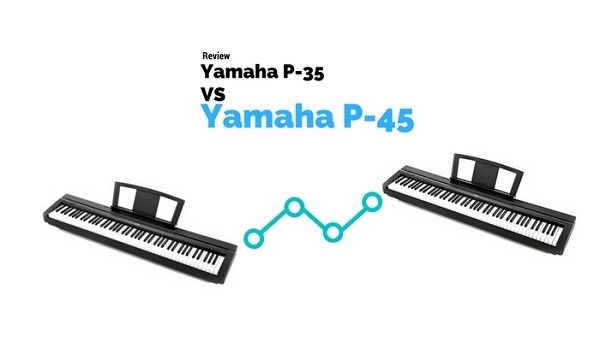
Digital Piano Yamaha P 35 vs Yamaha P 45
Welcome to the review of one of Yamaha’s most balanced piano keyboards, the Yamaha P-35. This article is an extension of our selection of the best Yamaha keyboards in value for money.
You may wonder why we named you the Yamaha P-45 if you’re looking for a P-35. Well, the reason is that the Yamaha and the P-35 and the P-45 are the same and cost the same (around €625/$620/£566). Yamaha has released the new version and discontinued the old one. And as it is evident the new one is the P-45 which in addition has some improvements.
Today if you buy a Yamaha P-35 you will be buying the latest stock or you can buy it second hand but if you buy it new we advise you to go to the new model.
The review that we are going to do next is valid for both and then we will comment on the improvements that the P-45 includes over the P-35 for the same price.
AWM Sampling (Advanced Wave Memory)
I’m sure you’ll be interested in…
- Ranking with the best digital pianos in quality-price ratio
- The cheapest musical keyboards for beginners
- Other Yamaha Digital Piano Reviews
- Learn piano by yourself and for free
Well, when we’re talking about a digital piano like the P-35 we have to keep in mind that the sound is actually recorded. Even the sound that sounds based on the force with which we press the keys are various recordings of a real piano.
These recordings are made with a special sampling system so that the sound is real and does not lose any harmonic called AWM.
If you want to get a bit involved with the technical evolution of this technology we leave you the official Yamaha link that will give you an idea even if the translation is not perfect.
It is true that if you go to more expensive models (about 150€ extra) like the Yamaha P-115 the sampling is done with the CF3S standard which is a little better. But come on, you’ve got to have a very tuned ear to tell the difference. We’re talking about a higher conservatory level ear.
Hammer Action System
They both use Yamaha’s GHS system. What is the one that usually goes in the range of counterweight systems up to €1000? It has 4 levels of Pulsed or Touches Sensitivity which are Hard/Medium/Soft/Fixed or Hard/Medium/Soft/Fixed.
Yamaha’s Hammer Action system is considered by many to be the best on the market above Casio and Roland. So that’s always a plus.
They have 88 touch keys very similar to real and the keystroke is very successful.
In case you don’t know, Hammer Action’s system is vital for something to be called a piano. The basis of the piano is that the key can be pressed with different intensities by adjusting the volume with the sound of a note. Basic characteristic for the expressiveness when touching a work. Hence its original name of Piano-Forte.
Portability and sound
Both weigh approximately 11.5 kg making them the perfect tool if you carry them in a bag with backpack handles. The power of the speakers is 6 W in both the P-45 and the P-35. They can be used for performances in small restaurants or acoustic rehearsals. But if you’re already going to bigger rooms, you’ll have to take your sound signal to a more powerful table or amplifier.
Is Ok the P-45 and P-35 for all levels?
The answer is yes because we would all like to be taken a grand piano to the live show we are going to play but the reality is usually different. Most sites do not have a piano and it is normal for the musician to have to carry a keyboard.
And then there’s the price which is super balanced because it costs around 420 € with a Hammer Action GHS system and more than acceptable sound. Many professionals use it regularly and for small or medium-size format. If you make good money it’s normal to go to keyboards with a more live punch like the P-115 (actually p 125).
To study if you don’t have a grand piano or upright piano available and your neighbor wants to kill you, put on your headphones and you can do the higher conservatory with it. Many will kill me for saying this but the truth is that many high school students do their studies with these digital pianos, as they do not have an acoustic one within reach and are perfectly matched. Above all in modern, in a classic, it matters more than it is an acoustic with the super brutal level of the conservatory superior but you can shoot with this one. What really matters is that you study hard.
And to connect it to the computer?
Both are MIDI controllers because they have a MIDI connector. Although this is where the Yamaha P-45 stands out because it has the new USB-MIDI connector in front of the P-35’s 5-pin connector. In addition, the P-45 always comes with three months of free Flowkey piano lessons. An interesting interactive app in English.
You can also compose music with programs like Cubase, or write scores with software like Sibelius while playing in real-time. Below are the related articles we will link you to articles where we talk to you about all these possibilities.
Apart from this, the P-45 is superior to the P-35 in that it has a polyphony of 64 as opposed to that of 32 of the P-35.
Both come with power supply and sustain or sustained pedal to keep the note even if you stop pressing the key, but with this, we are done because you know the aspects that really matter in a digital piano like the Yamaha P-35 or the P-45.
Yamaha P 45 and P 45B are the same. The B comes from black, it’s just the color.
The Yamaha P45 can now be purchased at the following stores. In America and Asia, I really encourage you to check Amazon. If you live in Europe check Thomann. Here the direct links to the product:
We are sure you have found this review useful. Do not hesitate to share it and visit other sections of the website such as our ranking with the best digital pianos of the moment and the in-depth review of the Yamaha P45.
For a similar price you have the following pianos and keyboards:
- YAMAHA YDP-S34 ARIUS
- YAMAHA YDP 163
- YAMAHA YDP 143
- YAMAHA PSR S770
- YAMAHA PSR S670
- YAMAHA PSR E453
- YAMAHA PSR E443
- YAMAHA P45
- YAMAHA P255
- YAMAHA P125
- YAMAHA P-121
- YAMAHA P115
- YAMAHA P105
- YAMAHA DGX 660
- YAMAHA ARIUS YDP 142
- YAMAHA PSR S775
- YAMAHA PSR E463
- YAMAHA P35
- THOMANN SP 5600
- THOMANN DP-33
- THOMANN DP-31
- ROLAND GO KEYS
- ROLAND FP-60
- ROLAND FP 80
- PIANO THOMANN SP 320
- KURZWEIL SPS4-8
- KURZWEIL SP6
- KURZWEIL SP4-8
- KURZWEIL FORTE SE
- KURZWEIL FORTE 8
- KURZWEIL ARTIS 7
- KORG PA-700 ORIENTAL
- KORG PA-700
- KORG PA600
- KORG PA-300
- KORG PA-1000
- KORG HAVIAN 30
- KORG GRANDSTAGE 88
- CASIO PX-870 PRIVIA
- CASIO PX-770 PRIVIA
- CASIO PX-5S PRIVIA PRO
- CASIO PX-560 PRIVIA
- CASIO PX-360 PRIVIA
- CASIO PX 160
- CASIO CT-X800
- CASIO CT-X700
- CASIO CT-X5000
- CASIO CT-X3000
- CASIO CDP 130
- THOMANN DP 26
- ROLAND FP 90
- ROLAND FP 30
- ROLAND FA 06
- ROLAND BK 5
- KORG SP 280
- KORG LP 380
- KORG B1
- KAWAI ES8
- KAWAI ES110
- KAWAI ES100
- KAWAI CN27
- KAWAI CN25
- CASIO CDP 230
- CASIO CDP S100
Vote if you liked this article 🙂